

No government survey measures “marketing automation” adoption by small businesses directly, so every number you see is a proxy. The best 2025 proxies: 24% of U.S. small businesses use technology to automate tasks and 34% use it for marketing and promotions (U.S. Chamber of Commerce, 3,870 firms under 250 employees, June 2025), and 25% of small EU enterprises used CRM software in 2025 against 65% of large ones (Eurostat). For AI-driven automation, 46% of U.S. employer firms with 1 to 499 employees used AI in late 2025, according to the Federal Reserve’s Small Business Credit Survey.
Below: the headline numbers with sample and date, adoption by company size, a “which number to cite” table, what small firms automate first, what automated email actually earns, the market size estimates by definition, and five widely repeated statistics traced back to where they started. Every figure is labeled government, academic, analyst or vendor, because the label decides how far you can push it.
Marketing automation statistics: small business adoption rates 2025
These are the numbers people search for, each with what was actually asked. Read the “measures” column before you quote anything: “uses AI”, “uses CRM” and “automates tasks” are three different behaviors.
| Statistic | Figure | Measures | Sample and date | Source type |
|---|---|---|---|---|
| U.S. small businesses using technology for “automating tasks” | 24% | Self-reported use of a tech platform for task automation | 3,870 firms under 250 employees, June 6 to 26, 2025 (U.S. Chamber) | Business association survey |
| U.S. small businesses using technology for marketing/promotions | 34% | Most common use of technology in the survey | Same survey | Business association survey |
| U.S. small businesses using generative AI | 58% (40% in 2024, 23% in 2023) | Self-identified generative AI use | Same survey | Business association survey |
| Small EU enterprises (10 to 49 staff) using CRM software | 25% (large: 65%) | CRM software use, 2025 | EU enterprise survey, released May 20, 2026 (Eurostat) | Government statistics |
| U.S. employer firms using AI | 46%, plus 15% planning to within 12 months | Business or employees use AI for work; 83% of users apply it to writing or marketing | 6,525 firms, 1 to 499 employees, Sept 3 to Nov 14, 2025 (Federal Reserve SBCS) | Government (Federal Reserve Banks), convenience sample |
| U.S. businesses using AI, all sizes | 7.6% (Sept 2024 to Aug 2025); 19.8% (May 2026, new question wording) | AI use in producing goods or services; from Nov 17, 2025, AI use “in any business function” | Census Business Trends and Outlook Survey, via SBA Advocacy and Census Bureau | Government statistics |
| Small businesses currently using AI | 55% (39% in 2024) | Any AI, “including software you have been using that now uses AI” | 540 owners, 1 to 100 employees, May 4 to 14, 2025 (Thryv) | Vendor survey (Thryv sells marketing automation) |
| SMBs using AI in marketing | 48% across 4 countries; 37% in the U.S. | AI used in marketing | 2,500 SMBs in AU, CA, UK, US, June 2025 (Constant Contact) | Vendor survey |
| SMB marketers using AI for marketing | 81% (47% daily) | AI use by function | 1,000 U.S. marketers and owners, May 21 to June 12, 2025 (ActiveCampaign) | Vendor survey (Talker Research) |
| Marketers rating their automation at least somewhat successful | 96% (B2B, 2025); 97% (all, 2024) | Self-rated success | Act-On and Ascend2, March 2025; Ascend2, 387 marketers, Feb 2024 | Vendor-sponsored survey |
Two patterns hold across all of them. First, vendor surveys of opt-in owners report adoption three to ten times higher than government surveys of the whole business population. Second, adoption rises steeply with headcount in every source that splits by size.
What U.S. small businesses use technology for
The U.S. Chamber’s 2025 survey, run by Teneo Research for the Chamber Technology Engagement Center, is the largest 2025 dataset that asks small firms what their technology actually does. Marketing is the top use, yet only about one firm in four says it automates tasks. Nearly all respondents (99%) use at least one technology platform, and 58% use four or more.
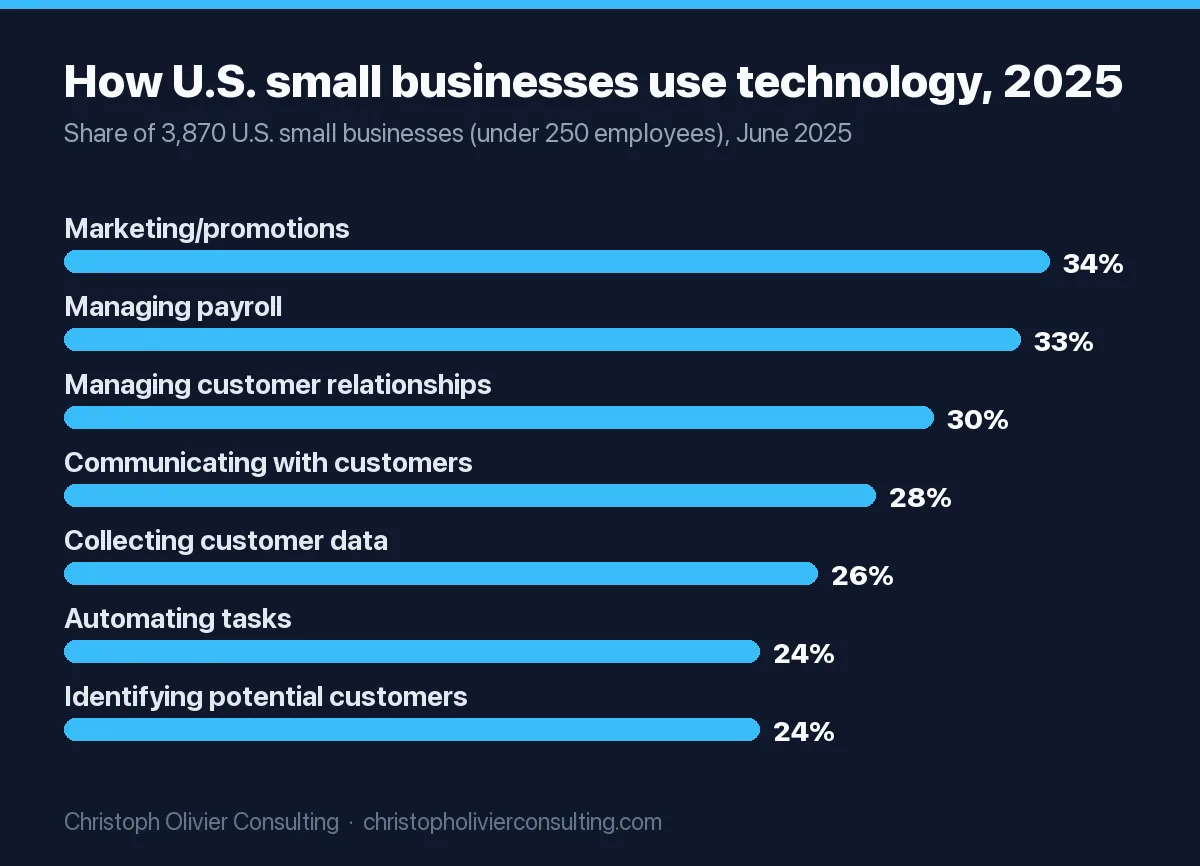
The gap between 34% using technology for marketing and 24% using it to automate tasks is the realistic headroom for marketing automation at the small end: many firms run marketing through software, but far fewer have set it to run without them. Managing customer relationships (30%) sits in between, which matches the Eurostat CRM number for small EU firms (25%).
Adoption by company size: the gap is real
Every dataset that splits by size shows the same slope. The smallest firms adopt least, and the jump usually comes once a firm has 10 or more staff.
| Source | Smaller firms | Larger firms | What was measured |
|---|---|---|---|
| Thryv, May 2025 | 1 to 4 employees: 37%; 5 to 9: 53% | 10 to 100 employees: 68% | Current AI use |
| Eurostat, 2025 | 10 to 49 staff: CRM 25%, ERP 41%, BI 11% | 250+ staff: CRM 65%, ERP 89%, BI 69% | Business software use |
| Eurostat, 2025 | 10 to 49 staff: 17% | 50 to 249: 30.36%; 250+: 55.03% | AI technology use (19.95% of all enterprises) |
| Census BTOS, May 2026 | Under 20% of firms with 4 or fewer employees | 100 to 249: 32%; 250+: 37% | AI use in any business function |
| Census BTOS via SBA, Sept 2024 to Aug 2025 | Under 5 employees: 8.2% | Over 250: 11.4% | AI use in producing goods or services (older wording) |
| The CMO Survey, Jan 2026 | Under $10M revenue: AI used in 21.85% of optimizing and automating work (n=27) | All firms: 24.17% (n=191) | Share of time AI or machine learning optimizes and automates marketing |
Two cautions. Eurostat excludes firms with fewer than 10 staff, so its “small” is bigger than most U.S. small businesses. And the CMO Survey’s small-firm cells hold fewer than 35 respondents each, so treat them as directional. The Census Bureau said AI use rose among firms with 20 or more employees between December 2025 and May 2026 but did not change significantly among firms with fewer than 20.
Which number to cite
Pick the statistic that matches the claim you are making, then name the source and the date in the same sentence.
| If your sentence says | Cite | Do not cite |
|---|---|---|
| “X% of U.S. small businesses automate” | 24% automate tasks, U.S. Chamber 2025 (closest direct measure) | Any vendor “marketing automation adoption” figure without a sample |
| “Small firms lag large firms on CRM and automation” | Eurostat 2025: CRM 25% small vs 65% large | Market research size estimates, which say nothing about adoption |
| “Most small businesses now use AI” | Federal Reserve SBCS: 46% of employer firms, fall 2025 | ActiveCampaign’s 81%, which counts marketers who already work in marketing software |
| “X% of all U.S. businesses use AI” | Census BTOS: 19.8% (May 2026, new wording) or 7.6% (2024 to 2025, old wording), never mixed | Vendor surveys of opt-in owners |
| “Automated emails earn far more per send” | Omnisend 2025 data: $2.87 vs $0.18 per send; Klaviyo: flows 41% of revenue from 5.3% of sends | “2% of volume, 37% of sales” without saying it is 2024 data |
| “Firms waste much of their martech” | Gartner: 49% stack utilization, 2025 (33% in 2023, 405 marketing leaders) | Undated “most companies use under half their tools” claims |
| “Marketing automation drives sales productivity” | Nucleus Research’s own 2017 benchmark (20% productivity gain), labeled as dated | “14.5% sales productivity”, a 2012 figure (see the trace table below) |
For broader small business AI and channel numbers, including LocaliQ’s and Constant Contact’s 2026 surveys, see our small business marketing statistics, which line up seven AI adoption figures from 7.6% to 87% and explain why they differ.
What gets automated first: channels and tactics
Email is still where automation starts. In Ascend2’s February 2024 survey of 387 marketers (44% at companies with fewer than 50 employees), email led for the third straight year, though its share slipped from 63% to 58%.
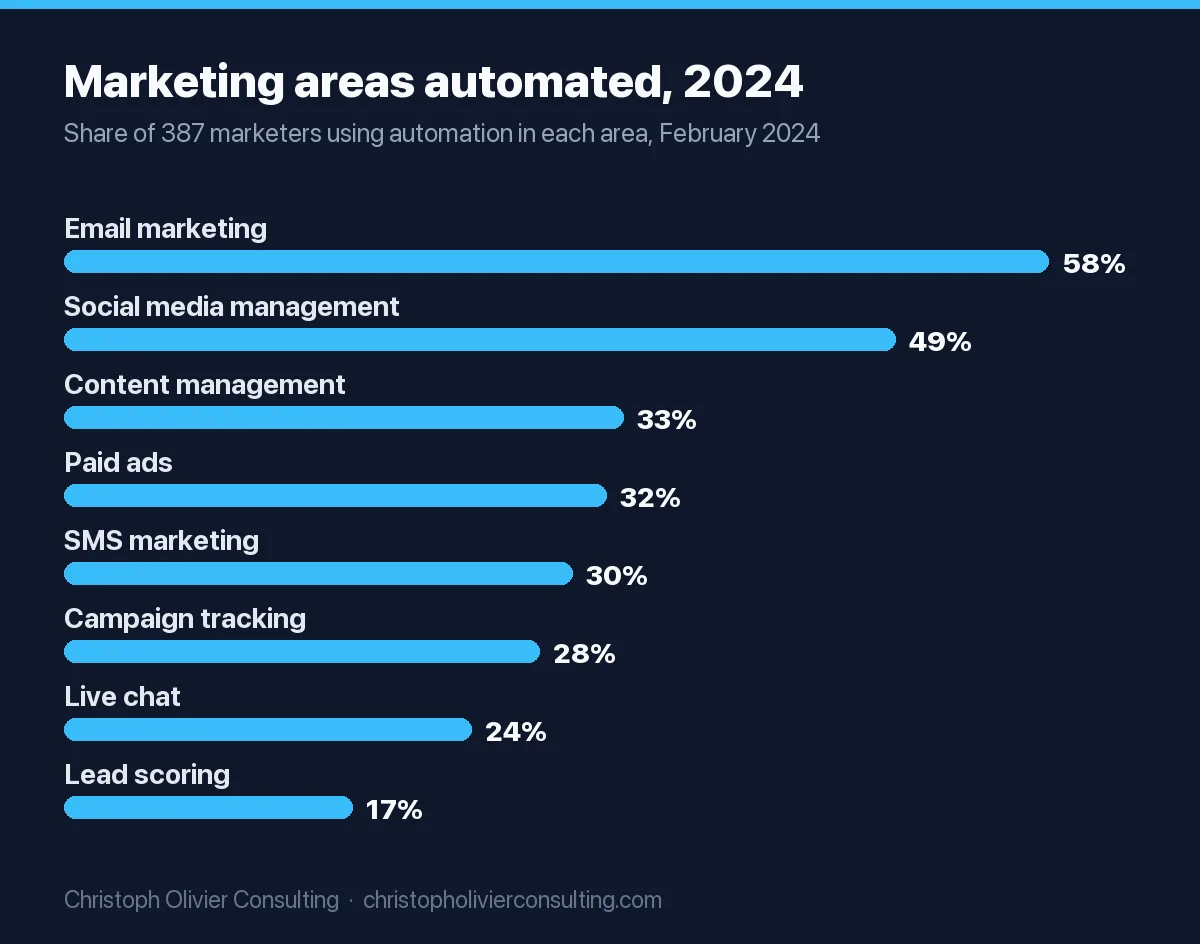
| Area automated | 2023 | 2024 |
|---|---|---|
| Email marketing | 63% | 58% |
| Social media management | 50% | 49% |
| Content management | 35% | 33% |
| Paid ads | 40% | 32% |
| SMS marketing | 28% | 30% |
| Campaign tracking | 26% | 28% |
| Landing pages | 29% | 27% |
| Live chat | 21% | 24% |
| SEO efforts | 18% | 22% |
| Account-based marketing | 24% | 20% |
| Lead scoring | 14% | 17% |
Source: Ascend2, The State of Marketing Automation 2024, published March 2024. Panel survey, multiple answers allowed.
The 2025 data points the same way. Email marketing (57%) was the most used feature in Act-On and Ascend2’s State of B2B Marketing Automation 2025, and 75% of those B2B marketers planned to raise automation budgets in 2025. Among small businesses using AI, Thryv’s 2025 survey lists “marketing automations” at 47%, behind data analysis tools (62%) and AI content generators (55%); the chart’s question wording is muddled, so treat that as indicative. In the larger-company CMO Survey 2026, 48.9% of firms using AI in marketing use AI-powered automation tools (n=188).
Lead scoring is the outlier: only 17% automated it in 2024, the lowest of any tactic Ascend2 tracked. For small B2B and professional service firms that is usually the right order. Score leads after you have enough volume to see a pattern, not before.
Automated email results: flows versus campaigns
The cleanest evidence that automation pays comes from email platforms, because they can compare triggered messages with bulk sends inside the same accounts. Both large datasets are ecommerce-heavy and vendor-published, so they describe online stores better than service firms.
| Metric | Automated (flows) | Campaigns | Source |
|---|---|---|---|
| Share of sends | 5.3% | 94.7% | Klaviyo benchmarks, 183,000+ customers |
| Share of email revenue | Nearly 41% | About 59% | Klaviyo |
| Average click rate | 5.58% (top 10%: 10.48%) | 1.69% (top 10%: 3.38%) | Klaviyo |
| Share of sends, 2025 data | 2% | 98% | Omnisend 2026 report, 150,000 brands, 27 billion emails |
| Share of email revenue, 2025 data | 30% | 70% | Omnisend |
| Revenue per send, 2025 data | $2.87 | $0.18 | Omnisend |
| Abandoned cart flow, revenue per recipient | $6.77 average, $13.70 top 10% | n/a | Klaviyo 2026 benchmarks, 110,000+ customers |
| Welcome series, revenue per recipient | $5.75 average, $13.27 top 10% | n/a | Klaviyo |
Omnisend also reports that welcome and abandoned cart messages together drove 76% of automation-generated orders in 2025, and back-in-stock emails converted at 6.46%, the highest of any automation type. Neither Klaviyo nor Omnisend states whether these averages are weighted by account or by message, so compare your own numbers to them loosely.
Worked example (illustrative, using Klaviyo averages). A small store that sends its abandoned cart flow to 400 shoppers a month and its welcome series to 300 new subscribers would expect, at average revenue per recipient:
- Abandoned cart: 400 × $6.77 = $2,708 a month.
- Welcome series: 300 × $5.75 = $1,725 a month.
- Total: $4,433 a month, or about $53,000 a year, from two flows that run without new work once built.
- At top-10% performance ($13.70 and $13.27): 400 × $13.70 + 300 × $13.27 = $5,480 + $3,981 = $9,461 a month.
The spread between average and top 10% is the real case for tuning flows rather than adding campaigns. The full flow map with triggers and timings is in our guide to ecommerce email marketing flows.
The utilization gap: paying for automation you do not use
Adoption is not usage. A Gartner survey of 405 marketing leaders (May and June 2023) found utilization of the martech stack’s capability fell to 33% on average in 2023, from 42% in 2022 and 58% in 2020. Gartner’s 2025 Marketing Technology Survey put utilization at 49%, so cite 2025 for the current figure and 2023 for the low point.
The small business data tells the same story from a different angle:
- Only 9% of marketers said their customer journey was fully automated; 32% mostly and 59% partially (Ascend2, Feb 2024).
- Collecting quality data (52%) and creating an overall strategy (47%) were the top challenges in 2024. In 2025, 51% of B2B marketers named strategy as the most significant challenge (Act-On and Ascend2).
- Of small employer firms using AI, about half are still experimenting, 44% have partially integrated it and 7% have fully integrated it into business processes (Federal Reserve SBCS, fall 2025).
- 42% of SMBs across four countries have less than one hour a day for marketing (Constant Contact, June 2025).
In my view the hour-a-day number explains most of the gap: a small team buys automation to save time, then never has the time to build past the first flow. Building three working flows beats licensing thirty features, which is the order our marketing automation workflows to build first follow.
AI is turning into the automation layer
The newest automation data is really AI data, because vendors now ship AI inside the same workflow tools.
- 16% today, 36% by 2028. CMOs expect AI-driven automation of marketing work to more than double, from 16% in 2026 to 36% by 2028 (Gartner, 402 CMOs, Aug to Oct 2025).
- 24.17% now, 55.91% in three years. That is the mean share of time U.S. companies use AI or machine learning to optimize and automate marketing, per The CMO Survey (308 marketing leaders, January 7 to 29, 2026). Firms under $10 million in revenue expect to go from 21.85% to 48.33%.
- 75% use AI, 13% use agents. Salesforce’s tenth State of Marketing (4,450 marketers) found high performers twice as likely to use AI agents as underperformers, with a 20% average bump in ROI reported for agentic AI. Vendor survey.
- 13 hours a week. ActiveCampaign’s survey puts AI time savings for SMB marketers at 13 hours weekly, self-reported. Thryv’s respondents most often estimated 11 to 20 hours saved per month, a far smaller number for the same kind of question.
The larger-company AI benchmarks, including McKinsey and Gartner budget data, are collected in our AI in marketing statistics.
Marketing automation market size: three estimates, three definitions
The two main forecasts for 2030 differ by a factor of five ($15.6 billion vs $81.01 billion) because the firms count different things. Cite the publisher and its definition every time.
| Publisher | Base | Forecast | CAGR | What it counts |
|---|---|---|---|---|
| Grand View Research | $6.7 billion (2024); $8.4 billion estimate for 2026 | $15.6 billion (2030) | 15.3% (2025 to 2030) | Marketing automation software; North America 43.6% of 2024 revenue; SMEs expected to grow fastest |
| MarketsandMarkets | $47.02 billion (2025) | $81.01 billion (2030) | 11.5% | Broader offering scope: campaign management, analytics and reporting, lead generation, content management |
The supply side keeps growing too. ChiefMartec’s 2026 martech map counts 15,505 marketing technology products, up just 0.79% from 15,384, while the marketing automation category grew 5.9%. For how martech spending fits into budgets, see our martech statistics.
Popular marketing automation stats traced to their source
Roundup pages repeat a small set of numbers. Here is where four of them come from.
| Claim as usually repeated | Where it actually comes from | Verdict |
|---|---|---|
| “Marketing automation drives a 14.5% increase in sales productivity and a 12.2% reduction in marketing overhead” | Credited to “Nucleus Research, Apr 2012” in an Act-On fact sheet (slides marked 2014). Salesforce repeats it with no date; one 2026 roundup now credits it to “Salesforce / Forrester”. Nucleus’s own 2019 page cites a 20% productivity gain from its 2017 report instead. | 14 years old, attribution drifting. Do not present as current. |
| “Automated emails are 2% of volume but 37% of sales” | Omnisend, 2024 data from its 2025 report | Real, but superseded: 2025 data shows 30% of revenue from 2% of sends. |
| “Omnichannel automation gets a 287% higher purchase rate” | Omnisend’s 2020 report, campaigns using 3+ channels, apparently 2019 data | Dated vendor figure. The full lineage is in our omnichannel marketing statistics. |
| “Small businesses see a 25% increase in marketing ROI with automation” | Listed as #44 on a 2024 roundup with no citation | No traceable source. Do not use. |
Benchmark your own automation against these numbers
Statistics are only useful if you can compare yourself to them. Pull these six numbers from your own platform and mark each one. The benchmarks come from the sources above; the “behind” thresholds are my rules of thumb, not published standards.
| Check | How to measure it | Published benchmark | Behind if |
|---|---|---|---|
| Automated share of email revenue | Flow revenue ÷ total email revenue, last 90 days | 30% (Omnisend, 2025 data) to nearly 41% (Klaviyo) | Under 20% |
| Flow click rate | Average click rate across live flows | 5.58% average (Klaviyo) | Under 3% |
| Abandoned cart revenue per recipient (stores) | Flow revenue ÷ recipients | $6.77 average, $13.70 top 10% (Klaviyo) | Under $3 |
| Features used vs features paid for | List plan features, tick the ones running live | 49% utilization (Gartner, 2025) | Under half of what you pay for |
| Customer journey automation | Stages with a live trigger ÷ total stages (inquiry, welcome, nurture, proposal, onboarding, review request, win-back) | 9% fully, 32% mostly automated (Ascend2, 2024) | Fewer than 3 of 7 stages |
| Share of marketing work done by AI | Estimate hours AI handles ÷ total marketing hours | 16% (Gartner, 2026); 21.85% for firms under $10M (CMO Survey) | Under 10% |
If you fail three or more, the fix is rarely a new tool. It is usually a missing welcome or follow-up flow on the platform you already pay for. If you are choosing a platform, our comparison of marketing automation platforms lists current prices at 5,000 contacts. If you want a second set of eyes on your scorecard, you can book a consultation.
Frequently asked questions
What is the marketing automation adoption rate for small businesses in 2025?
No government survey measures it directly. The closest 2025 figure is the U.S. Chamber of Commerce survey of 3,870 firms under 250 employees: 24% use technology to automate tasks and 34% use it for marketing and promotions. In the EU, Eurostat found 25% of small enterprises used CRM software in 2025, against 65% of large enterprises.
How many small businesses use AI for marketing automation?
It depends on the survey. The Federal Reserve found 46% of U.S. employer firms used AI in fall 2025, and 83% of those users applied it to writing or marketing. Vendor surveys run higher: Thryv reported 55% AI use in May 2025, with 47% of respondents listing marketing automations among the AI they use. ActiveCampaign reported 81% among SMB marketers.
Do larger companies adopt marketing automation more than small businesses?
Yes, in every dataset that splits by size. Eurostat's 2025 data shows CRM use at 25% for enterprises with 10 to 49 staff and 65% for those with 250 or more. Thryv found AI use of 37% at firms with 1 to 4 employees and 68% at firms with 10 to 100. Census data shows the same slope.
What do small businesses automate first?
Email. In Ascend2's February 2024 survey of 387 marketers, 44% of them at firms under 50 employees, 58% automated email marketing, 49% social media management and 33% content management. Lead scoring was the least automated tactic at 17%. Act-On and Ascend2's 2025 B2B study again found email the most used feature, at 57%.
How much revenue do automated emails generate compared with campaigns?
In Omnisend's 2025 data from 150,000 brands, automated emails were 2% of sends but 30% of email revenue, earning $2.87 per send against $0.18 for scheduled campaigns. Klaviyo reports flows produce nearly 41% of email revenue from 5.3% of sends, with abandoned cart flows averaging $6.77 revenue per recipient. Both datasets are ecommerce heavy.
Is the 14.5% sales productivity statistic for marketing automation current?
No. The claim that marketing automation drives a 14.5% increase in sales productivity and a 12.2% reduction in marketing overhead is credited to Nucleus Research, April 2012, in an Act-On fact sheet. Nucleus's own later research cites a 20% productivity gain from its 2017 report. Label either figure as dated if you use it.
How big is the marketing automation market?
Estimates depend on scope. Grand View Research put marketing automation software at $6.7 billion in 2024, forecasting $15.6 billion by 2030 at a 15.3% CAGR, with SMEs expected to grow fastest. MarketsandMarkets uses a broader scope and sizes the market at $47.02 billion in 2025, rising to $81.01 billion by 2030 at 11.5%.