
The best landing page builder is the one that matches your traffic volume, your testing needs, and your budget, not the tool with the longest feature list. Most teams overpay for enterprise optimization suites when a mid-tier builder converts just as well.
Last reviewed: September 2026
This guide ranks named builders neutrally by use case, shows how their entry pricing compares, and walks through the setup and testing basics that decide whether a page earns leads. For the strategy that sits above the tool, see our lead generation landing pages hub.
What the best landing page builder actually needs to do
A landing page builder earns its keep on five jobs: a drag-and-drop editor, a template library, fast-loading published pages, native A/B testing, and clean integrations with your CRM and ad platforms. Anything past those five is a fit question, not a quality question.
Two variables quietly decide value. The first is where A/B testing lives, because several tools gate split testing behind a higher tier than their advertised entry price. The second is the visitor cap, since some plans meter monthly traffic while others do not.
Page speed belongs on the same shortlist. A slower variant can distort a split test, so a builder that ships lightweight published pages protects both conversions and the honesty of your results. Pair the tool choice with strong organic reach through SEO for lead generation.
Best landing page builder by use case and budget
Match the tool to the job. Solo founders and simple offers reward the cheapest responsive builders. Paid-ad teams reward native A/B testing and visitor-routing features. Agencies reward client workspaces and large template libraries. The table below describes each named tool neutrally by primary use case, one standout feature, and its lowest paid entry price.
| Tool | Best use case | Key feature | Entry price |
|---|---|---|---|
| Carrd | Solo founders, single-page sites | Fast responsive one-page builds | About $19 per year (Pro) |
| HubSpot | Teams already using its CRM | Pages tied to native contact records | Free tier; Starter about $20 per month |
| Zoho LandingPage | Small teams wanting testing early | A/B testing and heatmaps on lower tiers | About $18 per month (annual) |
| Landingi | Budget-conscious marketers | Large template library (400+) | About $24 per month (annual) |
| Webflow | Design-led custom pages | Pixel-level visual control | About $25 per month (Site plan) |
| Leadpages | Lead capture with unlimited traffic | No visitor cap on any plan | About $49 per month (Standard) |
| ClickFunnels | Full sales funnels, not single pages | Multi-step funnel and checkout flow | About $97 per month (Startup) |
| Unbounce | Paid-ad teams optimizing variants | Visitor routing to the top variant | About $99 per month (Build); testing on $149 |
| Instapage | Enterprise ad teams at scale | Ad-to-page personalization | About $99 per month; $79 annual |
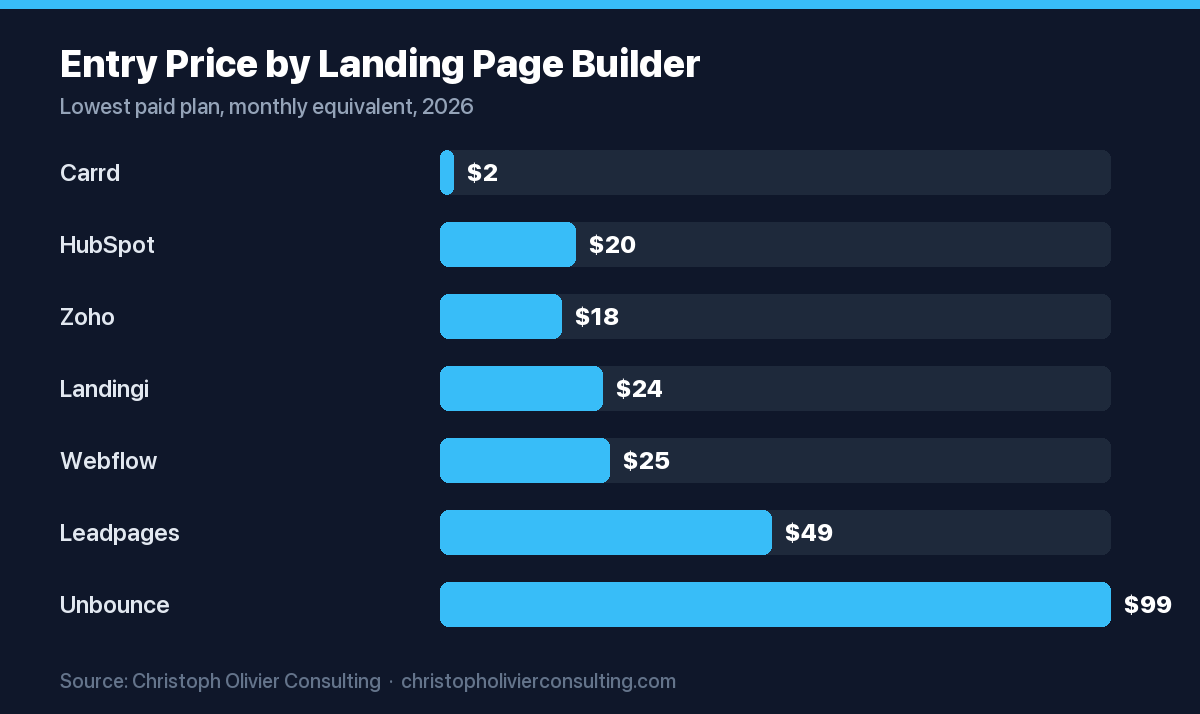
Entry prices reflect the lowest paid plan and vary by billing term; several tools reserve A/B testing for a higher tier, so confirm the plan that includes it before you commit. The chart under this section plots those entry prices side by side.
How landing page builder pricing really works
Advertised entry prices hide two costs: the tier where A/B testing turns on, and the visitor cap. Unbounce and Instapage meter monthly traffic by plan, while Leadpages and Carrd sell unlimited traffic. A cheap plan that throttles your ad spend is not cheap.
Annual billing usually cuts the monthly rate by roughly 20 to 30 percent versus month-to-month. Landingi, for example, runs near $24 per month on annual billing against about $29 billed monthly, and Instapage lists about $79 annual against $99 monthly.
Testing tiers matter most for paid traffic. Unbounce places A/B testing on its $149 Experiment plan rather than its $99 Build plan, so a team that needs split testing should price the tier that includes it, not the headline entry price.
How to set up your first landing page
A first landing page follows a repeatable sequence. Start with the offer and the single action you want, then build the page around that one action and measure it. The steps below work in any of the named builders above.
- Define one goal and one call to action, such as a demo booking or a guide download.
- Pick a template close to your layout so you edit rather than design from scratch.
- Write the headline and subhead around the visitor’s problem, then trim every line that does not support the action.
- Connect your form to your CRM or email tool and confirm a test submission arrives.
- Add a tracking pixel and analytics so you can measure conversion rate, not just visits.
- Publish on a custom domain and check the page loads in under three seconds on mobile.
- Launch an A/B test on the headline or the button once you have enough traffic to read a result.
Feed those pages with content that pulls qualified visitors; our content marketing guidance covers the top-of-funnel side.
Which landing page builder should you pick
Pick by constraint, not by brand. If budget rules, start with Carrd or Landingi. If you run paid ads and test constantly, price Unbounce or Instapage at the tier that includes A/B testing. If your traffic is unpredictable, favor an unlimited-traffic plan like Leadpages.
Teams already inside an ecosystem often win by staying there. HubSpot users get pages tied to their contact records, and design-led teams get control from Webflow. The best landing page builder for you is the one whose pricing tier, traffic cap, and testing features fit the campaign you are about to run.
If you would rather hand the build and testing to a specialist, review our services.
Frequently asked questions
What is the best landing page builder for beginners?
For beginners, Carrd and Landingi are the easiest starting points. Carrd builds a clean responsive single page for about $19 per year, while Landingi offers a large template library from roughly $24 per month on annual billing. Both use drag-and-drop editing, so you can publish a working page in an afternoon without code or a designer.
Which landing page builder has the best A/B testing?
Unbounce and Instapage are built around split testing, though the feature sits on higher tiers. Unbounce places A/B testing on its $149 Experiment plan, and Instapage gates it above its entry plan. Zoho LandingPage includes testing on lower tiers from about $18 per month, which suits smaller teams that want to test early without a large budget.
Do I need a paid landing page builder?
Not always. HubSpot includes landing pages in its free CRM tier, and Carrd’s paid plans start near $19 per year. A paid plan pays off once you need A/B testing, higher traffic limits, custom domains, or CRM integrations. If you are validating one offer, a free or low-cost tool is usually enough to start measuring conversions.
How much does a landing page builder cost in 2026?
Entry prices run from about $2 per month equivalent for Carrd up to about $99 per month for Unbounce and Instapage. Most mid-tier tools land between $18 and $49 per month. Annual billing typically cuts 20 to 30 percent off the monthly rate, and the tier that enables A/B testing often costs more than the advertised entry price.
What features matter most in a landing page builder?
Five features decide value: a drag-and-drop editor, a strong template library, fast-loading published pages, native A/B testing, and integrations with your CRM and ad platforms. Two hidden variables matter too: the plan tier where A/B testing turns on, and whether the plan caps your monthly visitors. Confirm both before you pick a tool.
Is a landing page builder better than building pages on my website?
For campaigns, usually yes. A dedicated builder gives you conversion-focused templates, faster iteration, and native testing that a general website often lacks. If your goal is one measurable action per page, a builder removes distractions and shortens setup. For content and brand pages, your main site remains the better home.
More marketing guides for rank on ai: get cited by ai search
- The 12 Brand Archetypes: A Practical Reference for Choosing Yours
- Call to Action Examples That Convert (With Before and After Rewrites)
- CMO Salary in 2026: Base, Bonus, and Total Comp by Company Size
- Color Psychology in Marketing: What Colors Signal and How to Use Them
- What Is a Customer Success Manager? Role, Metrics, and Salary
- How to Write an Elevator Pitch (Structure, Template, and Examples)
- Rank on AI: Get Cited by AI Search