
An elevator pitch is a 30 to 60 second spoken summary of who you help, the problem you remove, and the result you deliver, ending with one clear ask. This guide gives you the five-part structure, a fill-in template, word-count targets by length, and before-and-after examples for networking, investor, and sales settings.
Last reviewed: September 2026
What is an elevator pitch?
An elevator pitch is a short spoken introduction that explains what you do and why it matters, in about the time of a brief elevator ride. A working pitch answers three questions fast: who you help, what problem you solve, and what result the listener gets. It then closes with one specific request, such as a meeting or a follow-up.
Think of it as the spoken version of your value proposition: same core promise, shaped for a live conversation. The goal is not to close a deal in one breath. The goal is to earn the next five minutes.
The elevator pitch structure
A strong pitch follows five parts in order: hook, problem, solution, proof, and ask. Each part is one or two sentences. Keep the focus on the listener’s problem, not your feature list. The order matters because it earns attention before it asks for anything, and it makes the pitch easy to remember and repeat.
- Hook: Open with who you help and the change you create, in one line. This replaces the job-title opener that most people forget within seconds.
- Problem: Name the specific pain your listener recognizes. A pitch without a problem sounds like a feature list.
- Solution: Say what you do in plain words, framed as the fix for that problem. Skip the jargon.
- Proof: Add one concrete point that makes it believable, such as a result, a number, or a recognizable client type.
- Ask: Close with one clear next step, said as a full sentence. This is the part most people drop.
How long should an elevator pitch be?
Aim for 30 to 60 seconds. At a normal speaking pace of about 150 words per minute, that is roughly 75 to 150 words. Use a 10 second version for quick introductions, a 30 to 45 second version for networking, and a 90 second version for investor conversations. Nerves speed most people up 15 to 20 percent, so rehearse slightly slower than feels natural.
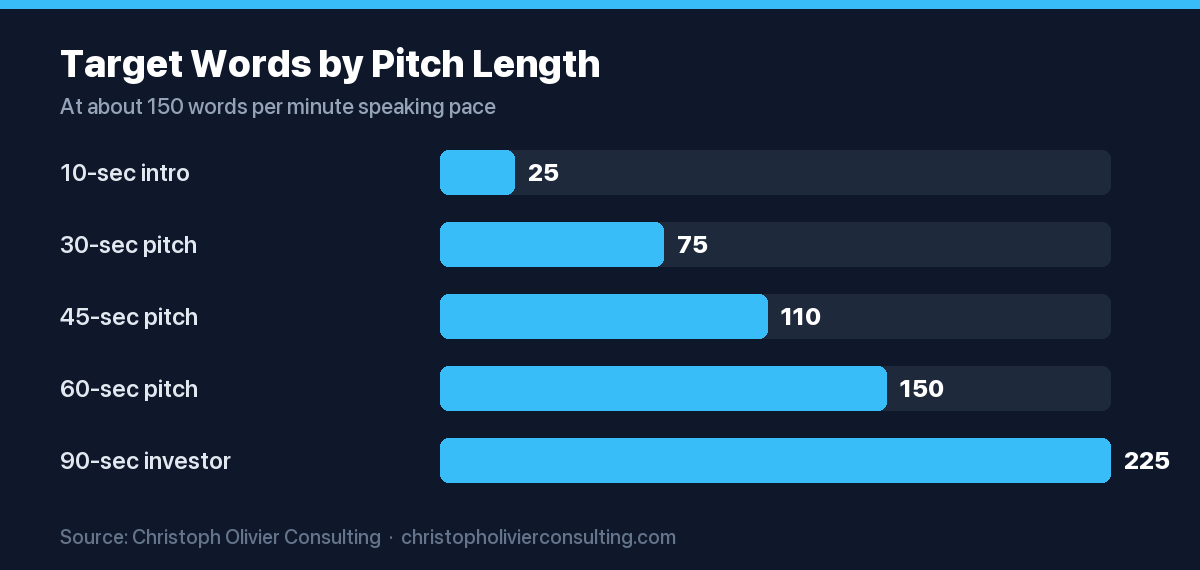
| Version | Time | Approx words | Best for |
|---|---|---|---|
| Quick intro | 10 sec | ~25 words | Hallways, fast introductions |
| Short pitch | 30 sec | ~75 words | Networking events |
| Standard pitch | 45 sec | ~110 words | Conversations, interviews |
| Full pitch | 60 sec | ~150 words | Warm intros, panels |
| Investor pitch | 90 sec | ~225 words | Investor meetings |
Keep two or three versions ready. You rarely control how much time you get, so practice the 10 second and the 30 second versions until they are automatic.
Fill-in elevator pitch template
Use this template and replace each bracket with one specific detail. Say it out loud, then cut any word that does not help the listener understand who you help or what changes for them. Read the finished version against a clock and trim until it fits your target length from the table above.
Template: “I help [who you help] [reach a specific outcome] by [what you do]. Unlike [the usual alternative], [what makes you different]. For example, [one proof point]. [Your ask, as a full sentence].”
Each slot has a job. “Who you help” keeps the pitch listener-first. “A specific outcome” gives them a reason to care. “What makes you different” is the part they will repeat to someone else, which is why it doubles as your spoken value proposition. The proof point makes the claim believable, and the ask turns interest into a next step.
Elevator pitch examples by context
The same core message shifts by setting. A networking pitch stays conversational, an investor pitch leads with the problem size and traction, and a sales pitch names the buyer’s pain first. The before-and-after table below shows a weak version and a stronger rewrite for each context. The numbers in the rewrites are illustrative, meant to show the shape of a strong claim.
| Context | Before (weak) | After (stronger) |
|---|---|---|
| Networking | “I’m a marketing consultant with years of experience helping companies with all kinds of marketing.” | “I help early-stage B2B founders turn a fuzzy message into one that books more sales calls. One client doubled demo requests in eight weeks. Are you working on your messaging right now?” |
| Investor | “We’re building an amazing AI platform that will change small-business marketing forever.” | “Small B2B teams waste a large share of ad spend on the wrong message. Our tool tests messaging in a week instead of a quarter. We’re at 120 paying teams. Can I send you the deck?” |
| Sales | “Our software has tons of features and integrations and a dashboard your team will love.” | “Most sales teams lose deals because follow-up slips through the cracks. We flag every stalled deal so reps act before it goes cold. Want a 15 minute walkthrough this week?” |
| Job interview | “I’m looking for a new role because my current job isn’t a great fit anymore.” | “I’m a demand-gen marketer who grew qualified leads 60 percent in a year at a SaaS startup. I want a growth role where I own the funnel end to end. Is that the scope here?” |
Notice the pattern in every rewrite: it starts with the listener, names a result, and ends with a question. That structure ties directly to your wider sales and marketing strategy, because a pitch is only as sharp as the positioning behind it.
How to end an elevator pitch
End with one specific ask, said as a full sentence, not a trailing “let me know.” Over a call or email, request an action that survives the conversation, such as booking a 15 minute call or sending materials to a named address. A vague close wastes the attention you just earned. A question that ties to the listener’s goal often works better than a demand.
Good closes include: “Can I send you a one-page summary?”, “Are you free for 15 minutes next week?”, and “Who on your team owns this?” Each one gives the listener a low-effort yes.
Common elevator pitch mistakes
The most common failures are talking too long, listing features instead of outcomes, using jargon, and forgetting the ask. Speaking too fast hides your best points. A generic pitch that ignores the listener feels canned. Fix these by cutting to three points, naming a result the listener cares about, and rehearsing the close until it lands cleanly.
- No problem: jumping to what you do before naming the pain the listener feels.
- Feature dumping: reciting tools and integrations instead of the outcome they produce.
- Jargon: words only your industry understands, which push the listener out.
- No ask: ending on a full stop instead of a next step.
- One-size pitch: the same script for every room, with no version for time or audience.
Once the pitch works in person, reuse the same language in your written channels so the message stays consistent across content marketing and outreach. If you want help sharpening the positioning behind the pitch, see the full list of consulting services.
Frequently asked questions
How long should an elevator pitch be?
Aim for 30 to 60 seconds, which is roughly 75 to 150 words at a normal 150 words-per-minute pace. Keep a 10 second version for fast introductions and a 90 second version for investor meetings. Because nerves speed most people up, rehearse slightly slower than feels natural and stop cleanly once you hit the ask.
What are the five parts of an elevator pitch?
A complete pitch has five parts in order: a hook that says who you help, the problem your listener recognizes, your solution in plain words, one proof point that makes it believable, and a clear ask for the next step. Each part is one or two sentences, and the order earns attention before it requests anything.
How do you start an elevator pitch?
Start with who you help and the change you create, not your job title. A line like “I help early-stage founders turn a fuzzy message into more sales calls” is memorable, while “I’m a consultant” is forgotten in seconds. Leading with the listener’s outcome earns their attention and sets up the problem you are about to name.
How many words is a 30-second elevator pitch?
A 30 second pitch is about 75 words at an average speaking rate of 150 words per minute, or 2.5 words per second. Many coaches suggest landing between 75 and 100 words so the pitch fits comfortably even if nerves speed you up. Time yourself against a clock and trim until it fits.
How do you end an elevator pitch?
End with one specific ask stated as a full sentence, such as booking a 15 minute call or sending a one-page summary to a named email. Avoid vague closes like “let me know.” A question tied to the listener’s goal, such as “Are you working on this right now?”, often opens a longer conversation better than a demand.
What is the difference between an elevator pitch and a value proposition?
A value proposition is the written promise of the value you deliver and why it beats the alternatives. An elevator pitch is the spoken, conversational version of that promise, shaped for a live setting and closed with an ask. The pitch carries the same core message but adds a hook and a next step for the person in front of you.
More marketing guides for rank on ai: get cited by ai search
- Unique Selling Proposition (USP): Definition, Formula, and Examples
- What Is a CMO? Role, Responsibilities, and Pay
- AIDA Model: Attention, Interest, Desire, Action Explained
- Best Landing Page Builder in 2026: How to Choose
- The 12 Brand Archetypes: A Practical Reference for Choosing Yours
- Call to Action Examples That Convert (With Before and After Rewrites)
- Rank on AI: Get Cited by AI Search