
A customer success manager (CSM) is the person who owns the relationship with existing customers after the sale, working to keep them retained, active, and growing their spend over time. The role sits between sales, product, and support, and it is measured on revenue outcomes such as renewals and expansion rather than ticket volume. This guide covers what a CSM does day to day, how the job differs from an account manager or support rep, the metrics a CSM owns, when to hire one, and current US pay.
Last reviewed: September 2026
What does a customer success manager do?
A customer success manager guides customers to the outcomes they bought the product for, then protects and grows that account. Day to day the work spans onboarding, adoption tracking, renewal preparation, and spotting upsell or cross-sell openings. The through-line is proactive: a CSM reaches out before a problem shows up in the numbers rather than waiting for a complaint.
A typical CSM workflow across an account looks like this:
- Run onboarding so the customer reaches first value quickly and understands the core workflows.
- Set success goals with the customer and agree on what a good outcome looks like in 90 days.
- Monitor product usage and a health score to catch drop-off early.
- Hold regular check-ins and business reviews that tie usage back to the customer’s goals.
- Prepare renewals ahead of the date and flag risk to sales or leadership.
- Surface expansion opportunities (more seats, new modules) when the account is healthy.
Strong CSMs pair communication and empathy with the analytical habit of reading account data. For how this connects to the wider go-to-market motion, see our sales and marketing strategy guide.
CSM vs account manager vs customer support
These three roles all touch the customer after the sale, but they optimize for different things. A customer success manager owns outcomes and retention, an account manager owns the commercial relationship and quota, and support owns resolving reported issues. Many teams blur the lines, so the table below shows the common split.
| Dimension | Customer success manager | Account manager | Customer support |
|---|---|---|---|
| Primary goal | Retention and adoption | Revenue and renewals quota | Resolve reported issues |
| Posture | Proactive | Commercial | Reactive |
| Owns the number | Net revenue retention, churn | Bookings, expansion quota | Response and resolution time |
| Trigger to engage | Usage signals and milestones | Contract and pricing events | Customer raises a ticket |
| Typical reports to | VP Customer Success or Revenue | Sales leadership | Support or service leadership |
In smaller companies one person may cover all three. As the team grows, splitting them lets each role focus, which is part of building a repeatable customer acquisition strategy that does not leak revenue after the sale.
The metrics a customer success manager owns
A customer success manager is judged on retention and expansion, not activity. The core metrics are net revenue retention (NRR), gross revenue retention (GRR), logo churn, and a customer health score that combines usage, support history, and sentiment. NRR above 100% means existing customers grow faster than others leave.
Published 2026 B2B SaaS benchmarks give useful anchors for what good looks like:
| Metric | Concerning | Good | Best in class |
|---|---|---|---|
| Net revenue retention | Below 100% | 100% to 120% | Above 130% |
| Median NRR by segment | SMB near 97% | Mid-market near 108% | Enterprise near 118% |
| Health score coverage | Ad hoc | Scored monthly | Predictive and automated |
Segment matters: median NRR runs near 97% for SMB accounts (under $25K ACV), near 108% for mid-market, and near 118% for enterprise, per 2026 SaaS benchmark reports. A CSM who lifts NRR by even a few points changes the trajectory of the whole business.
How much does a customer success manager make?
Customer success manager pay in the US scales sharply with experience and scope. In 2026, entry-level CSMs average roughly $62,000, the typical CSM sits near $83,000, senior CSMs reach around $110,000, and leadership roles run higher, with senior managers near $159,000 and directors near $178,000. Total compensation adds a bonus tied to retention and expansion targets, often 10% to 25% of base.
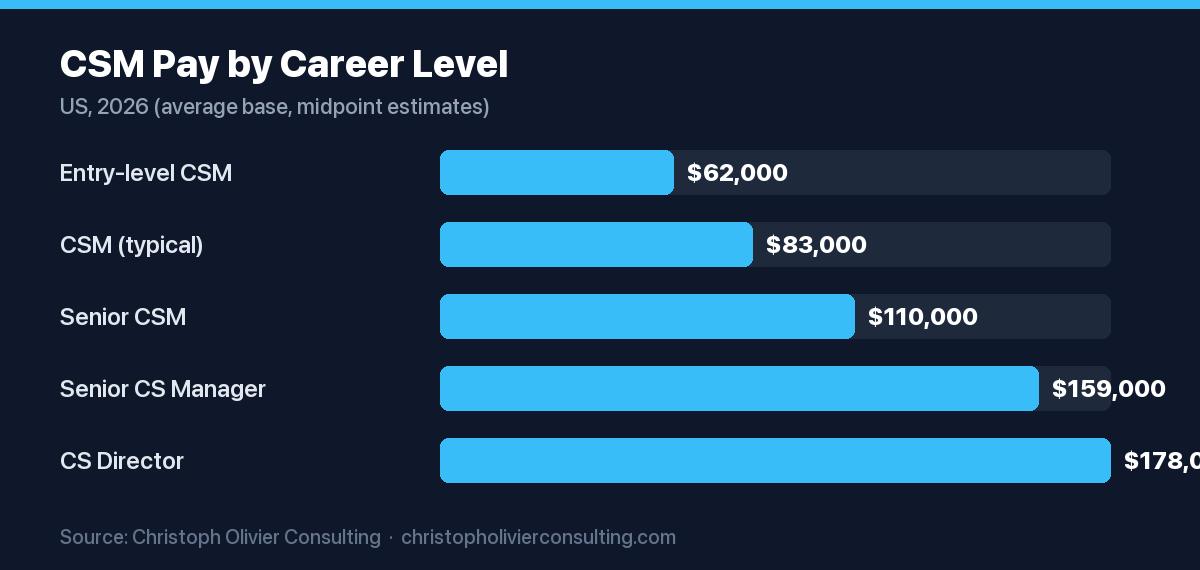
Software, networking, and telecom sectors tend to pay above the average, and location, ACV managed, and equity all move the number. The chart below shows average US base pay by career level using midpoint estimates from 2026 salary sources.
If you are deciding between building this function in-house or getting help shaping the retention motion first, our consulting services can map the plan before you hire.
When should you hire a customer success manager?
Most companies hire their first customer success manager when the customer base gets too large for founders or account managers to service by hand and when renewals start to matter to the forecast. A common trigger is recurring revenue reaching a point where a few percentage points of churn is a real dollar figure.
Signs it is time to hire a CSM:
- Churn is rising or renewals are slipping and no one owns the fix.
- Onboarding is inconsistent and new customers stall before first value.
- Sales is spending time on existing accounts instead of new pipeline.
- You have expansion revenue on the table but no one to work it.
- You cannot answer which accounts are at risk this quarter.
Getting onboarding content and enablement right before the hire makes the CSM productive faster, which ties into your content marketing and education assets.
How customer success ties to retention and expansion revenue
Customer success is a growth function, not a cost center, because retained and expanding accounts compound. A 15 percentage point gap in NRR between top and bottom performers can correspond to a large gap in company valuation, since expansion revenue carries low acquisition cost. That is why mature teams treat the CSM as a revenue role.
The practical model is simple: keep more of what you win, grow the accounts you keep, and reinvest the efficiency into acquisition. Aligning that loop is what our sales and marketing strategy work focuses on.
Frequently asked questions
What is a customer success manager in simple terms?
A customer success manager is the person who owns the customer relationship after the sale and works to keep that customer retained, active, and growing their spend. They run onboarding, track product adoption, prepare renewals, and spot upsell opportunities. Unlike support, they act proactively, reaching out based on usage signals before a problem appears in the numbers.
What is the difference between a CSM and an account manager?
A customer success manager is measured mainly on retention, adoption, and outcomes, while an account manager carries a commercial quota focused on renewals and expansion bookings. CSMs engage on usage milestones and risk signals; account managers engage around contracts and pricing. In smaller teams one person often does both, then the roles split as the company grows.
What metrics does a customer success manager own?
The core metrics are net revenue retention (NRR), gross revenue retention (GRR), logo churn, and a customer health score built from usage, support history, and sentiment. NRR above 100% means existing customers expand faster than others churn. 2026 SaaS benchmarks put good NRR at 100% to 120% and best in class above 130%.
How much does a customer success manager make in 2026?
In the US in 2026, entry-level CSMs average roughly $62,000, a typical CSM sits near $83,000, and senior CSMs reach around $110,000. Leadership pays more, with senior managers near $159,000 and directors near $178,000. Bonuses tied to retention and expansion add roughly 10% to 25% of base, and software and telecom sectors pay above average.
When should a company hire its first customer success manager?
Hire when the customer base grows past what founders or account managers can service by hand and when renewals start to move the forecast. Common triggers include rising churn with no clear owner, inconsistent onboarding, sales getting pulled onto existing accounts, and untapped expansion revenue. If you cannot say which accounts are at risk this quarter, it is time.
Is customer success a sales or support role?
Customer success is closer to a revenue role than a support role. Support resolves reported issues reactively, while a customer success manager works proactively to drive adoption, retention, and expansion, and is judged on metrics like NRR and churn rather than ticket resolution time. Mature teams position customer success as a growth function that compounds recurring revenue.
More marketing guides for rank on ai: get cited by ai search
- How to Write an Elevator Pitch (Structure, Template, and Examples)
- Unique Selling Proposition (USP): Definition, Formula, and Examples
- What Is a CMO? Role, Responsibilities, and Pay
- AIDA Model: Attention, Interest, Desire, Action Explained
- Best Landing Page Builder in 2026: How to Choose
- The 12 Brand Archetypes: A Practical Reference for Choosing Yours
- Rank on AI: Get Cited by AI Search