
Customer success software is a category of B2B tools that watch how customers use your product after the sale, score account health, and flag churn or expansion before a renewal date forces the conversation. This guide covers what these platforms do, who needs one, the main categories, and honest entry pricing so you can shortlist without sitting through five demos first.
Last reviewed: September 2026
What Customer Success Software Does
Customer success software centralizes every account’s usage data, support history, and commercial signals, then turns that into a health score and a set of automated plays. It is proactive by design: support tools react to tickets, while a customer success platform watches for declining usage or stalled onboarding and prompts a human before the customer files a complaint.
Health scores and churn signals
A health score is a predictive metric that combines product usage, engagement, support volume, and payment behavior into one color-coded status per account. Green, yellow, and red tell a team who is safe, who is at risk, and who is already slipping. The score is the trigger that decides which accounts get a human touch and which run on automation.
Onboarding and adoption
The software tracks onboarding milestones and feature adoption so a new customer reaches first value on schedule. When an account stalls, the platform fires an alert or a playbook step instead of waiting for a quarterly review. Slow onboarding is one of the earliest and most reliable churn predictors these tools surface.
Renewals and expansion
Every account carries a renewal date and a forecast, so leaders see committed revenue and at-risk revenue in one view. The same usage signals that predict churn also flag expansion readiness: accounts with consistent, growing engagement become the upsell queue. This turns renewals from a scramble into a scheduled, data-backed motion.
Who Needs Customer Success Software
You need dedicated customer success software when a spreadsheet can no longer track account health across your book of business, usually somewhere past 30 to 50 recurring accounts or your first two or three customer success hires. Below that, a CRM with disciplined tagging often covers it. The tool is what a customer success manager uses to work at scale, not a replacement for the role. If you are still defining that role, our customer success manager guide covers responsibilities and hiring.
The trigger is usually revenue retention, not headcount. Once net revenue retention is a board metric and a single missed renewal moves the number, the cost of guessing exceeds the cost of software. Software-led retention also depends on a clear value proposition the customer can actually measure, because a health score is only as honest as the outcome it tracks.
Customer Success Software Categories
Four categories get labeled “customer success software,” and they solve different problems. Dedicated platforms are the true all-in-one option; the others cover pieces you may already own. Match the category to your gap before you compare vendors, because paying enterprise platform prices for a product-analytics problem is the most common overspend here.
| Category | What it does | Example tools | Best for |
|---|---|---|---|
| Dedicated CS platform | Health scores, playbooks, renewals, and account 360 in one system | Gainsight, ChurnZero, Vitally, Planhat, Totango, Custify | Teams that own the full post-sale lifecycle |
| CRM with CS module | Adds lifecycle and health views on top of contacts and deals | HubSpot Service Hub | Small teams already standardized on one CRM |
| Product analytics | Turns product telemetry into adoption and feature-usage metrics | Userpilot and similar product-led tools | Product-led growth motions feeding CS signals |
| Supporting tools | Onboarding content, surveys, sentiment, and support tickets | Support and feedback point tools | Filling one gap, not running the whole motion |
What Customer Success Software Costs to Start
Entry pricing for a dedicated platform ranges from roughly $199 to $850 per month for the lowest paid tier, with product-led and CRM-attached tools clustering at the low end. Most vendors publish a starting price but negotiate the real number on seats, managed accounts, or revenue under management, so treat these as the floor, not the invoice.
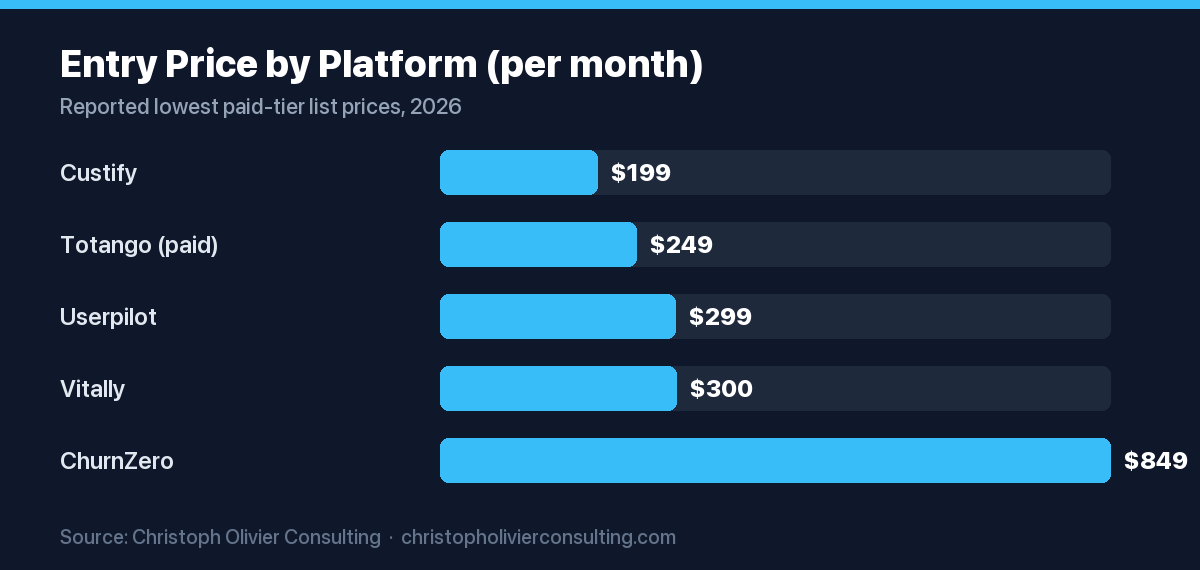
| Platform | Reported starting price | Pricing model |
|---|---|---|
| Custify | from ~$199/mo | Tiered, SaaS-focused |
| Totango | free tier, paid from ~$249/mo | Free up to 100 customers, then quote |
| Userpilot | from ~$299/mo | Priced per monthly active user |
| Vitally | from ~$300/mo | Tiered, scales with accounts |
| ChurnZero | from ~$849/mo | Quote-based above entry |
| Gainsight | quote only | Enterprise, annual contract |
Total Annual Cost by Platform
Starting prices hide the real spread, because most contracts scale with account volume and add-on modules. Reported median annual contract values run from about $16,800 for a lean SaaS tool up to $66,000 for a mid-market deployment, with enterprise platforms reaching well past $200,000 at the top of their range. Budget from the median for your segment, not the published floor.
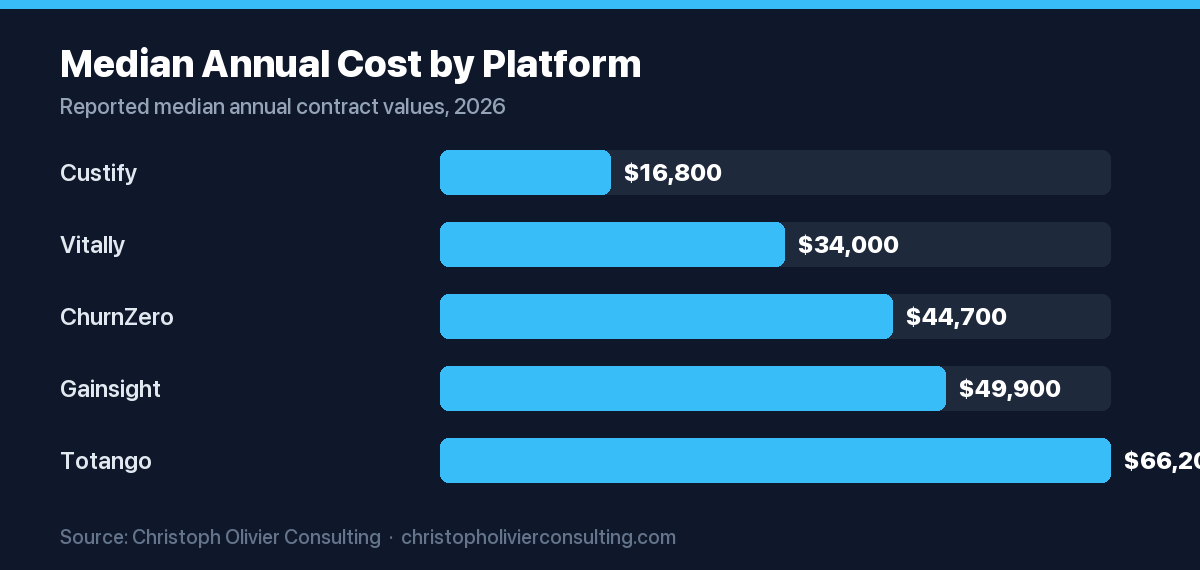
| Platform | Reported median annual cost | Segment |
|---|---|---|
| Custify | ~$16,800 | Early stage / SaaS |
| Vitally | ~$34,000 | Mid-market |
| ChurnZero | ~$44,700 | Mid-market |
| Gainsight | ~$49,900 | Enterprise |
| Totango | ~$66,200 | Mid-market / enterprise |
These are reported medians, not quotes; enterprise deals commonly range from around $13,000 to more than $200,000 depending on volume and modules, and Totango adds a setup fee on new contracts.
How to Choose Customer Success Software
Choosing well is a sequencing problem: name the gap, then buy the category, then compare vendors. Skipping the first two steps is how teams end up paying for a platform they use at ten percent. Work the order below.
- Define the outcome you are protecting, usually net revenue retention or gross churn, and the number you need to move.
- Identify your real gap: health visibility, onboarding, renewals forecasting, or product-usage signals.
- Match the gap to a category before shortlisting vendors, so you do not overpay for unused modules.
- Check integrations first: the tool must pull from your CRM, billing, and product analytics or the health score is guesswork.
- Price on your account volume and seat count, not the published starting tier, and ask about setup fees.
- Run a paid pilot on your worst-scoring accounts and measure whether interventions actually change renewals.
The software is a force multiplier for a strategy you already have, not the strategy itself. If you want help connecting retention tooling to a broader growth and positioning plan, see our consulting services, and if AI search is part of your acquisition mix, our guide to ranking on AI pairs with it.
Frequently asked questions
What is customer success software?
Customer success software is a B2B platform that centralizes each account’s product usage, support history, and commercial data, then scores account health and automates onboarding, renewal, and churn-prevention plays. It is proactive rather than reactive: instead of waiting for a support ticket, it flags declining usage or stalled onboarding so a customer success manager can step in before a renewal is at risk.
How much does customer success software cost?
Entry tiers for dedicated platforms run from roughly $199 to $850 per month, but reported median annual contracts land between about $16,800 for a lean SaaS tool and $66,000 for a mid-market deployment. Enterprise platforms are quote-only and can exceed $200,000 a year. Most pricing scales with seats, managed accounts, or revenue under management, so budget from the median for your segment rather than the published starting price.
Do small businesses need customer success software?
Most small teams do not need a dedicated platform until a spreadsheet stops tracking account health, usually past 30 to 50 recurring accounts or the first few customer success hires. Below that, a CRM with disciplined tagging or a CRM customer success module often covers the job. The trigger is usually net revenue retention becoming a metric leadership watches, not headcount alone.
What is the difference between customer success software and a CRM?
A CRM tracks the relationship and the deal: contacts, pipeline, and closed revenue. Customer success software takes over after the sale, pulling product usage and support signals a CRM does not capture to predict churn and expansion. Many teams run both, with the CRM feeding account data into the customer success platform so the health score reflects the full picture.
What are the main categories of customer success software?
There are four: dedicated all-in-one platforms like Gainsight, ChurnZero, Vitally, and Custify; CRMs with a customer success module such as HubSpot Service Hub; product analytics tools that convert telemetry into adoption metrics; and supporting point tools for onboarding, surveys, and support. Match the category to your actual gap before comparing vendors so you do not overpay for modules you will not use.
What features should customer success software include?
The core set is health scoring, a unified account 360 view, automated playbooks, renewal forecasting, and churn and expansion alerts. It should integrate with your CRM, billing, and product analytics, because a health score built on partial data misleads more than it helps. Reporting that shows forecasted renewals and at-risk revenue in one view is what makes the tool useful to leadership, not just the CS team.
More marketing guides for rank on ai: get cited by ai search
- What Is Fractional Marketing? Model, Cost, and When to Use It
- 31 Free Marketing Tools Worth Using in 2026
- How to Brand Yourself: A Step-by-Step Playbook for 2026
- How to Generate More Leads: 12 Tactics That Actually Work
- How to Make a Sales Call: Structure, Questions, and Openers
- Internet Advertising: Channels, Pricing Models, and How to Choose
- Rank on AI: Get Cited by AI Search