
Internet advertising is any paid promotion delivered through online channels, from a search result to a social feed to a video pre-roll. This page explains the channels, the pricing models behind them, and a practical way to choose, without the “best tool” listicle framing you see elsewhere.
Last reviewed: September 2026
What is internet advertising?
Internet advertising is a paid method of reaching people through digital channels, where an advertiser pays a platform to show a message to a targeted audience. It differs from earned attention (organic search, unpaid social) because placement is bought through an auction or a direct deal, and it can be measured click by click.
The defining trait is targeting plus measurement. Platforms let you segment by intent, interest, location, device, and past behavior, then report exactly what each dollar returned. That feedback loop is why online budgets keep shifting away from channels that cannot prove a result.
The main internet advertising channels
There are five channel families that carry most online budgets: search, social, display, video (including connected TV), and retail media. Each maps to a different moment in the buyer journey, so the right mix depends on whether you need demand capture (people already searching) or demand creation (people you interrupt).
| Channel | Example platforms | Buyer intent | Best for |
|---|---|---|---|
| Search | Google Ads, Microsoft Ads | High (active intent) | Capturing existing demand |
| Social | Meta, TikTok, LinkedIn | Low to medium | Creating demand, retargeting |
| Display | Google Display Network, DSPs | Low (passive) | Awareness, remarketing reach |
| Video / CTV | YouTube, connected TV apps | Low to medium | Brand storytelling at scale |
| Retail media | Amazon Ads, retailer networks | High (purchase context) | Product sales near the buy button |
Search and retail media sit closest to a purchase, which is why they tend to convert at higher rates and cost more per click. Display and video sit earlier, so they are priced to buy attention, not conversions. Getting the sequence right matters more than any single platform choice, which is a core part of any sales and marketing strategy.
How internet advertising pricing models work
Internet advertising is sold on three core pricing models: cost per mille (CPM, per 1,000 impressions), cost per click (CPC, per click), and cost per action (CPA, per conversion). Each shifts risk between you and the platform, and each fits a different campaign goal along the funnel.
| Model | You pay per | Who carries the risk | Best goal |
|---|---|---|---|
| CPM | 1,000 impressions | Advertiser | Awareness, reach |
| CPC | Click | Shared | Traffic, engagement |
| CPA | Action or acquisition | Platform (mostly) | Leads, sales |
Two related models appear often: cost per lead (CPL) and cost per view (CPV) for video. Most large platforms now run auctions where you set a goal (for example, maximize conversions) and the system bids on your behalf, so the “model” you pick is increasingly a target rather than a fixed rate. Many advertisers blend models, using CPM for awareness and CPA-style bidding for retargeting.
What internet advertising costs by channel
Cost per click varies widely by channel because intent and competition differ. In 2026 benchmark data, high-intent search and business-to-business social sit at the top of the range, while display and video carry the lowest cost per click because a click there is worth less. Use these as directional midpoints, not guarantees.
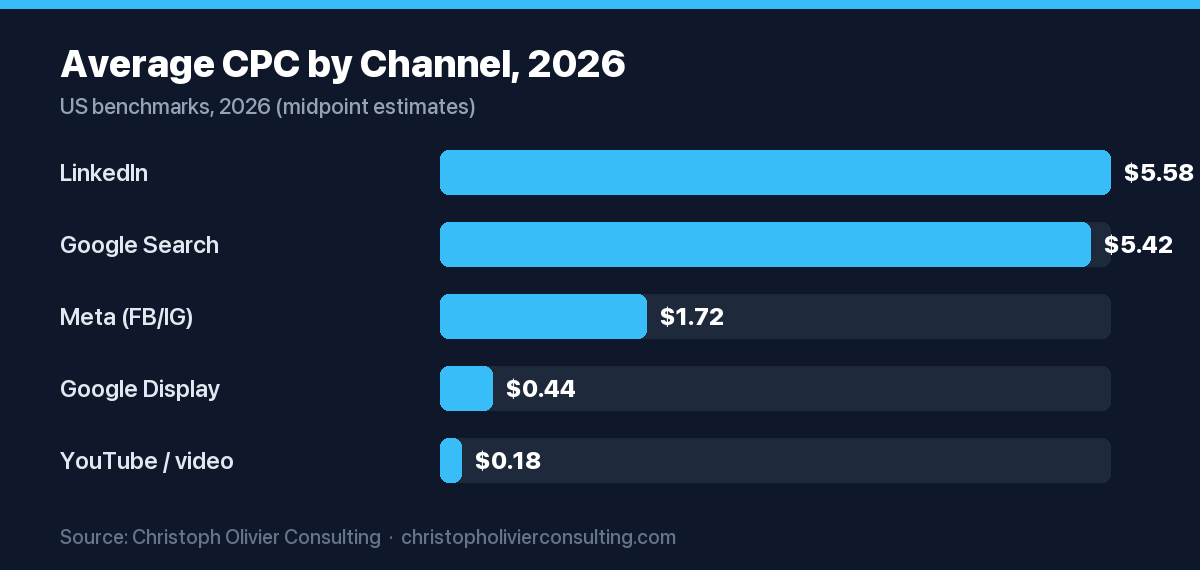
| Channel | Average CPC (2026, midpoint) |
|---|---|
| $5.58 | |
| Google Search | $5.42 |
| Meta (Facebook / Instagram) | $1.72 |
| Google Display | $0.44 |
| YouTube / video | $0.18 |
A low CPC is not automatically cheaper. A $0.18 video click that rarely converts can cost more per sale than a $5.42 search click from someone ready to buy. Always compare channels on cost per outcome, not cost per click, which is why the pricing model you choose should follow the goal, not the sticker price.
How to choose the right channel and pricing model
Choosing well is a sequence, not a single decision. Start from the goal, match it to buyer intent, then let that pick both the channel and the pricing model. The steps below give a repeatable order that works for most budgets.
- Define the outcome in numbers: a target cost per lead or sale, not just “more traffic.”
- Decide whether you are capturing demand (search, retail media) or creating it (social, video, display).
- Match the pricing model to the goal: CPM for reach, CPC for traffic, CPA-style bidding for conversions.
- Pick one primary channel to prove the economics before adding a second.
- Set a test budget large enough to exit the learning phase, usually 30 to 50 conversions.
- Measure cost per outcome, then reallocate toward the channel with the best return.
For consultancies and considered purchases, search and LinkedIn often earn the first budget because intent is highest, even though the cost per click is steep. If you also want to appear inside AI answer engines, treat that as its own workstream and see how to rank on AI. When you want the plan built and run for you, that is the core of our services.
US internet advertising spend in 2026
US digital advertising keeps growing and shifting between channels in 2026. Search remains the single largest category at roughly 39.8% of digital ad spending, while social sits near 27.7% of total US ad spending and retail media and connected TV are the fastest-growing segments. Those shifts should shape where you test first.
The direction is clear: budgets are fragmenting away from a single dominant channel toward a portfolio. Retail media is forecast near $62 to $70 billion and connected TV near $38 billion in the US for 2026, both growing double digits. For the full breakdown by channel and year, see our US digital ad spend statistics for 2026.
Frequently asked questions
What is internet advertising?
Internet advertising is any paid promotion delivered through online channels such as search engines, social platforms, websites, video, and retailer networks. An advertiser pays a platform, usually through an auction, to show a targeted message to a chosen audience. Its defining feature is precise targeting combined with click-by-click measurement, which lets advertisers tie spend to specific results and adjust in near real time.
What are the main types of internet advertising?
The five main channel families are search ads (Google, Microsoft), social ads (Meta, TikTok, LinkedIn), display ads on websites, video and connected TV ads (YouTube, streaming apps), and retail media on platforms like Amazon. Search and retail media sit closest to a purchase and convert best, while display and video sit earlier in the journey and are priced to buy attention and reach rather than immediate conversions.
What is the difference between CPC, CPM, and CPA?
CPM charges per 1,000 impressions and suits awareness. CPC charges per click and suits traffic and engagement, so you pay only when someone interacts. CPA charges per action, such as a lead or sale, and shifts most of the risk to the platform, so it suits conversion goals. Many advertisers combine them, using CPM for reach and CPA-style bidding for retargeting and performance campaigns.
Which internet advertising channel is cheapest?
By cost per click, video and display are cheapest, often near $0.18 to $0.44 in 2026 benchmarks, while search and LinkedIn run around $5.42 to $5.58. A low cost per click is not automatically cheaper overall, because a cheap click that rarely converts can cost more per sale than an expensive high-intent click. Compare channels on cost per outcome, not cost per click.
How much does internet advertising cost to start?
Most platforms have no minimum, but a useful test budget is one that reaches the learning threshold, roughly 30 to 50 conversions on your target action. In practice that often means a few thousand dollars over several weeks on one channel. Start with a single primary channel, prove the economics against a defined cost-per-outcome target, then expand to a second channel once the first is profitable.
How do I choose the right internet advertising channel?
Start from a numeric goal, then decide whether you are capturing existing demand (search, retail media) or creating new demand (social, video, display). Match the pricing model to the goal, pick one primary channel to prove the economics, run a test budget large enough to exit the learning phase, then reallocate toward the best cost per outcome. Intent, not the lowest click price, should drive the first choice.
More marketing guides for rank on ai: get cited by ai search
- What Is a Marketing Consultancy? Services, Fees, and How to Choose
- The 7 Sales Process Steps (and How to Run Each One)
- Customer Engagement Platform: What It Is and How to Choose
- Customer Success Software: Categories, Features, and Pricing
- What Is Fractional Marketing? Model, Cost, and When to Use It
- 31 Free Marketing Tools Worth Using in 2026
- Rank on AI: Get Cited by AI Search