
A customer engagement platform (CEP) is software that unifies customer data and orchestrates personalized messaging across channels like email, SMS, push, in-app, and web from a single interface. It runs the campaigns, journeys, and triggered messages that a CRM or a CDP on their own cannot coordinate in real time.
Last reviewed: September 2026
Most guides for this term are written by the vendors selling the product, so they tend to blur a CEP with a CRM or a customer data platform. This piece keeps the three separate, gives you an honest read on starting price, and hands you a vendor-neutral way to shortlist one.
What is a customer engagement platform?
A customer engagement platform is a system that centralizes customer data and executes messaging across many channels at once. It combines segmentation, journey orchestration, and analytics so a marketer can build a message once and deliver it consistently across email, mobile push, SMS, WhatsApp, in-app, and web. The goal is coordinated, timely communication rather than disconnected one-off sends.
Think of it as the execution layer of the customer relationship. A CRM records who someone is and what has happened. A CEP decides what message that person should get next, on which channel, and when.
Core capabilities of a customer engagement platform
A capable CEP does four jobs well: omnichannel messaging, journey automation, segmentation, and analytics. Weaker tools claim all four but excel at only one or two, so the buying question is which capability your team relies on most. Match the platform’s strongest area to your primary channel.
- Omnichannel messaging. Send and coordinate email, SMS, push, in-app, and web messages from one place so a customer gets a consistent experience across devices.
- Journey orchestration. Build multi-step, triggered flows (welcome, onboarding, cart recovery, win-back) that react to real-time behavior instead of fixed calendar dates.
- Segmentation and personalization. Group audiences by behavior, lifecycle stage, and attributes, then tailor content and timing to each segment.
- Analytics and experimentation. Measure opens, clicks, conversions, and retention, and run A/B or holdout tests to prove incremental lift.
CEP vs CRM vs CDP: what actually differs
A CRM manages records and relationships, a CDP unifies data into one profile, and a CEP acts on that data by running cross-channel messaging. They are complementary, not interchangeable. A common stack uses a CDP or CRM as the source of truth and a CEP as the layer that sends the messages and orchestrates the journeys.
| Dimension | CRM | CDP | CEP |
|---|---|---|---|
| Primary job | Manage customer and account records | Unify data into a single profile | Orchestrate cross-channel messaging |
| Core users | Sales and service teams | Data and marketing ops | Lifecycle and growth marketers |
| Data role | Captures direct interactions | Ingests and resolves many sources | Consumes profiles to trigger sends |
| Main output | Pipeline and account history | Clean, connected customer records | Campaigns, journeys, and messages |
| Real-time messaging | Limited | Not its job | Yes, its core function |
If you are unifying messy data, you need a CDP. If you are tracking deals and support tickets, you need a CRM. If you need to send the right message to the right person on the right channel at scale, that is the CEP.
How much does a customer engagement platform cost?
Entry pricing ranges widely, from around $20 per month for a small-list tool to roughly $999 per month for enterprise-oriented platforms, with most vendors pricing on monthly tracked or active users. Several vendors publish no list price and quote custom contracts, so treat any single number as a starting point and expect the real figure to scale with audience size and message volume.
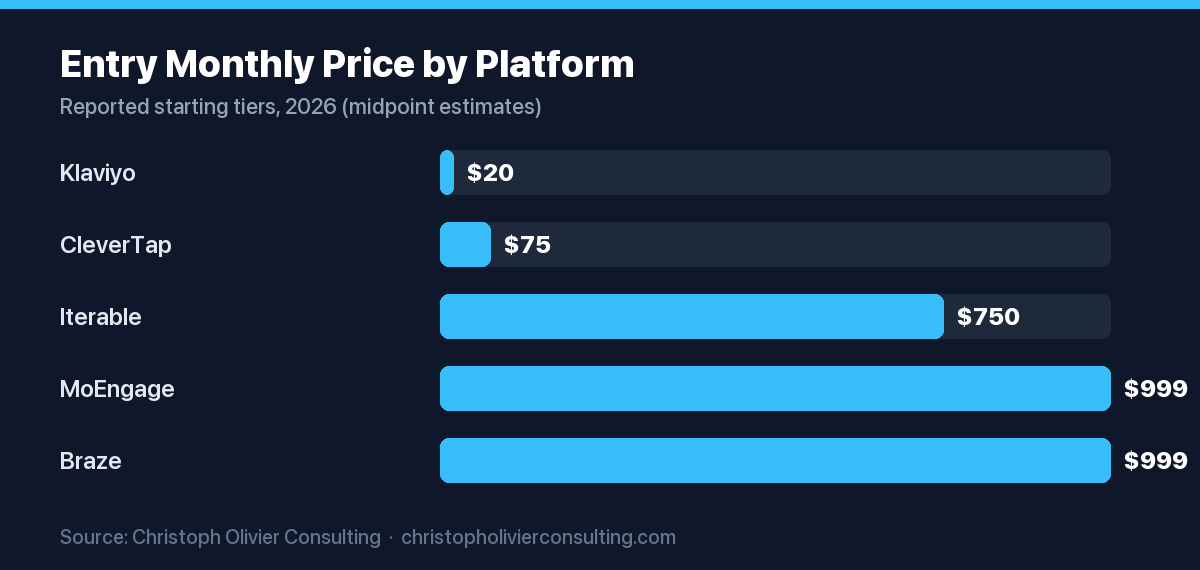
Reported starting tiers as of 2026 show the spread clearly. Klaviyo starts near $20 per month, CleverTap near $75 per month for up to 5,000 monthly active users, Iterable entry contracts around $500 to $1,000 per month, and MoEngage and Braze both near $999 per month at their entry level. Twilio quotes custom pricing rather than a fixed tier, so it is not charted below.
The chart below compares these published or reported starting monthly prices. Use it to sanity-check quotes, not as a final budget, because usage-based tiers can push enterprise costs into the tens of thousands per year.
How to choose a customer engagement platform
Choosing well is a fit exercise, not a feature race. Start from your goal (retention, acquisition, or lifecycle), then test the tools that are strongest in your primary channel against real workflows. Run demos with your own data and talk to customers in your industry before you sign.
- Audit your stack. Map what you already have for data, channels, and automation, and name the specific gaps a CEP must fill.
- Define the primary goal. Decide whether retention, acquisition, or lifecycle optimization matters most this year, since that dictates which capability to weight.
- List must-have channels. Confirm the platform is genuinely strong (not just present) in the one or two channels your customers actually use.
- Check data integration. Verify it connects to your CDP, CRM, and warehouse so profiles stay current for triggered messaging.
- Test the workflow builder. Build a real journey in a trial and judge how quickly a marketer can ship without engineering help.
- Model total cost. Ask for pricing at your projected 3-year audience size, not just today’s, so a usage-based tier does not surprise you later.
- Confirm analytics and testing. Make sure you can prove incremental lift with holdouts or A/B tests, not just report vanity opens.
Where a CEP fits in your growth strategy
A customer engagement platform is a tool, not a strategy. It pays off only when it sits inside a clear plan for who you are messaging, why, and what a good outcome looks like. Buy the platform after you have defined the journey, not before.
If you are building that plan, our work on sales and marketing strategy covers how engagement fits the wider funnel, while our view of the customer success manager role explains who owns retention once the messaging is live. For teams focused on being found and cited by AI answer engines, see how to rank on AI. When you want help selecting and standing up the right stack, review our fractional CMO services.
Frequently asked questions
What is a customer engagement platform?
A customer engagement platform is software that unifies customer data and delivers personalized messages across channels such as email, SMS, push, in-app, and web from one interface. It handles segmentation, journey automation, and analytics so marketers can coordinate timely, consistent communication at scale instead of sending disconnected one-off campaigns from separate tools.
How is a CEP different from a CRM?
A CRM manages customer and account records and internal workflows, mostly for sales and service teams. A CEP acts on that data by orchestrating cross-channel messaging and journeys in real time. The CRM tracks who someone is and what has happened; the CEP decides what message they should receive next and on which channel.
Is a customer engagement platform the same as a CDP?
No. A customer data platform unifies data from many sources into a single, resolved profile, while a customer engagement platform uses those profiles to trigger and deliver messages. They are complementary. A common setup treats the CDP as the data foundation and the CEP as the execution layer that sends campaigns and runs journeys.
What channels does a CEP support?
Most customer engagement platforms coordinate email, SMS, mobile push, in-app messages, web push, and often WhatsApp and social. Coverage varies by vendor, and many are strong in only one or two channels despite claiming full omnichannel support. Confirm the platform is genuinely capable in the specific channels your customers actually use before you commit.
How much does a customer engagement platform cost?
Entry pricing ranges from about $20 per month for small-list tools to roughly $999 per month for enterprise-oriented platforms, usually priced on monthly tracked or active users. Some vendors quote custom contracts with no list price, and usage-based tiers can push enterprise spend into the tens of thousands per year. Always request pricing at your projected audience size.
How do I choose the right customer engagement platform?
Start by auditing your current stack and naming the gaps, then define whether retention, acquisition, or lifecycle is your priority. Shortlist tools that are strongest in your main channel, test their workflow builders with your own data, verify integrations with your CDP and CRM, and model total cost at your three-year audience size before signing.
Do I still need a CRM if I have a CEP?
Usually yes. A CEP is built to orchestrate messaging, not to manage sales pipeline, account history, or support tickets. If your teams rely on those record-keeping and relationship workflows, keep the CRM and connect it to the CEP. The two serve different jobs and work best together rather than as replacements for each other.
More marketing guides for rank on ai: get cited by ai search
- Customer Success Software: Categories, Features, and Pricing
- What Is Fractional Marketing? Model, Cost, and When to Use It
- 31 Free Marketing Tools Worth Using in 2026
- How to Brand Yourself: A Step-by-Step Playbook for 2026
- How to Generate More Leads: 12 Tactics That Actually Work
- How to Make a Sales Call: Structure, Questions, and Openers
- Rank on AI: Get Cited by AI Search