
Last reviewed: September 2026
A CMO salary in 2026 runs from about $140,000 in base pay at an early startup to $550,000 or more at a large public company, and total compensation with bonus and equity can pass $1M at the top. The single number that matters is company size and stage, which moves pay more than any other factor. This guide breaks the ranges down by company size, shows the bonus and equity mix, and compares a full-time hire with a fractional CMO.
CMO salary in 2026 at a glance
The typical US CMO base salary sits between roughly $190,000 and $375,000 depending on the source and how each survey defines the role. Built In reports an average base near $225,908, PayScale near $189,969, and Salary.com near $374,000. The spread reflects company size, not disagreement. A CMO salary at a seed-stage startup and one at a Fortune 500 are two different jobs with two different pay scales.
CMO base salary by company size and stage
CMO base salary scales with company revenue and stage. Under $5M ARR the base runs $140,000 to $180,000, often paired with equity to offset lower cash. Growth-stage firms pay $180,000 to $240,000, mid-market companies $300,000 to $420,000, and large public companies $300,000 to $550,000 in base alone.
| Company size / stage | Base salary range (2026) | Typical equity grant |
|---|---|---|
| Startup, under $5M ARR | $140,000 to $180,000 | 1% to 3% |
| Growth-stage, $5M to $20M ARR | $180,000 to $240,000 | 0.5% to 2% |
| Mid-market, $75M to $250M revenue | $300,000 to $420,000 | Equity plus RSUs |
| Large public, $250M+ revenue | $300,000 to $550,000 | $100,000 to $500,000 in RSUs |
Software companies tend to pay 15% to 25% above the median for an equivalent size, driven by high growth expectations and a strong equity culture.
CMO total compensation by company size
Total compensation adds bonus and equity on top of base, and the gap between stages widens sharply. A startup CMO earns roughly $200,000 all in, a growth-stage CMO around $270,000, a mid-market CMO near $500,000, and a large public-company CMO $700,000 to $1M or more once base, bonus, and long-term incentives are counted.
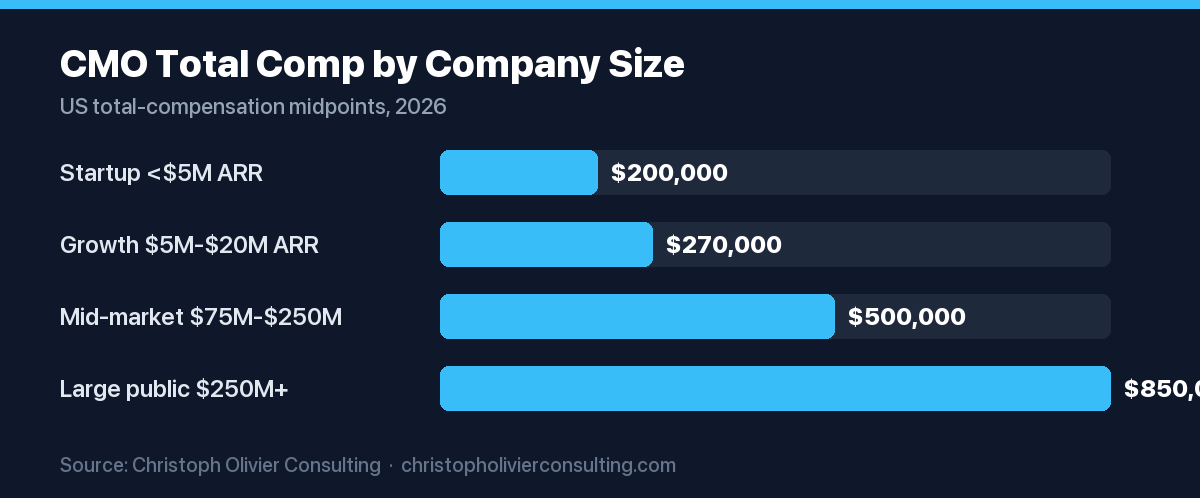
| Company size / stage | Total compensation midpoint (2026) |
|---|---|
| Startup, under $5M ARR | ~$200,000 |
| Growth-stage, $5M to $20M ARR | ~$270,000 |
| Mid-market, $75M to $250M revenue | ~$500,000 |
| Large public, $250M+ revenue | ~$850,000 |
These are midpoint estimates. Actual equity value swings widely with company performance, so two CMOs on paper-identical packages can realize very different outcomes.
What a CMO bonus and equity package looks like
Most CMO packages combine three parts: base cash, an annual bonus, and equity. Target bonus runs 20% to 35% of base at growth-stage firms and 30% to 50% or higher at large public companies. A common mid-market split is about 60% base, 20% bonus, and 20% equity. Bonus payout usually ties to revenue, pipeline, and CAC targets.
Bonus metrics typically weight three areas:
- Company revenue targets, roughly 40% to 50% of the bonus.
- Marketing KPIs such as pipeline generated or customer acquisition cost, roughly 30% to 40%.
- Net revenue retention or new-product adoption, roughly 10% to 20%.
Equity ranges from 2% to 4% at companies valued under $10M down to 0.5% to 1% above $50M in valuation.
What drives a CMO salary up or down
Beyond company size, a handful of factors move a CMO offer. Sector matters, with software and fintech paying above services and manufacturing. Scope matters, since a CMO owning demand generation, brand, and product marketing commands more than one owning a single function. Location, growth stage, and whether the role carries revenue accountability round out the list.
| Driver | Effect on pay |
|---|---|
| Industry (software vs services) | Software pays 15% to 25% above median |
| Revenue accountability | Raises base and bonus target |
| Scope of function owned | Broader remit lifts total comp |
| Company stage | Later stage shifts pay from equity to cash |
A clear sales and marketing strategy and defined KPIs help a company set the right pay band for the outcomes it needs.
Full-time CMO cost vs fractional CMO cost
A full-time CMO costs $300,000 to $500,000 a year all in once benefits, payroll taxes, and bonus sit on top of base, with a midpoint near $375,000. A fractional CMO runs $5,000 to $25,000 a month, averaging about $12,000 a month or $144,000 a year. That usually saves a company 40% to 70% versus a full-time hire at the same experience level.
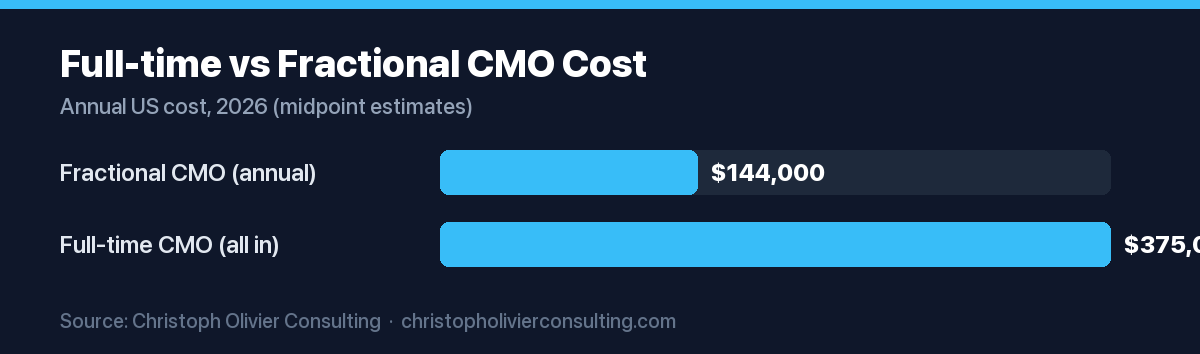
| Model | Annual cost (2026) | Best fit |
|---|---|---|
| Full-time CMO (all in) | $300,000 to $500,000 | $20M+ revenue, in-house team to lead |
| Fractional CMO (retainer) | $60,000 to $300,000 | Early to growth-stage needing senior direction |
See the full monthly breakdown in the fractional CMO cost guide for 2026, or review how the engagement works across our services.
How to benchmark a CMO offer
Benchmark a CMO offer against company size first, then adjust for sector, scope, and stage. Compare cash and equity separately, since a large equity grant at a pre-revenue startup is not the same as cash at a public company. Use this order to sanity-check any number.
- Set the base band from company revenue and stage using the table above.
- Add the target bonus at 20% to 50% of base, matched to stage.
- Value equity conservatively and treat it as at-risk, not guaranteed cash.
- Adjust up 15% to 25% for software or high-growth sectors.
- Compare the all-in cost against a fractional model before committing.
Frequently asked questions
What is the average CMO salary in 2026?
The average US CMO base salary in 2026 sits between roughly $190,000 and $375,000 depending on the survey. Built In reports about $225,908, PayScale about $189,969, and Salary.com about $374,000. The wide spread reflects company size and how each source defines the role rather than real disagreement about the market.
How much does a CMO make at a startup?
A startup CMO, typically pre-Series B or under $5M ARR, earns $140,000 to $180,000 in base salary in 2026, often with 1% to 3% equity to offset the lower cash. Total compensation lands near $200,000 once a modest bonus is added, though realized equity value depends entirely on the company’s outcome.
What is a CMO total compensation at a large company?
At a large public company with $250M or more in revenue, CMO total compensation ranges from $700,000 to over $1M. That figure combines a $300,000 to $550,000 base, an annual bonus of 30% to 50% of base, and $100,000 to $500,000 in annual RSU grants. Realized value moves with stock performance.
How much bonus does a CMO get?
CMO target bonus runs 20% to 35% of base salary at growth-stage companies and 30% to 50% or higher at large public firms. Payout usually ties to company revenue targets, marketing KPIs such as pipeline or customer acquisition cost, and sometimes net revenue retention or new-product adoption goals.
Is a fractional CMO cheaper than a full-time CMO?
Yes. A fractional CMO costs $5,000 to $25,000 a month, averaging about $144,000 a year, while a full-time CMO costs $300,000 to $500,000 all in with benefits and bonus. That saves most companies 40% to 70% at the same experience level, which is why early and growth-stage firms often start fractional.
How much equity should a CMO get?
Equity depends on company valuation. Startups under $10M in valuation typically grant a CMO 2% to 4%, while companies above $50M offer 0.5% to 1%. Earlier-stage grants are larger because they carry more risk. Always value equity conservatively and treat it as at-risk rather than guaranteed cash when comparing offers.
More marketing guides for rank on ai: get cited by ai search
- Color Psychology in Marketing: What Colors Signal and How to Use Them
- What Is a Customer Success Manager? Role, Metrics, and Salary
- How to Write an Elevator Pitch (Structure, Template, and Examples)
- Unique Selling Proposition (USP): Definition, Formula, and Examples
- What Is a CMO? Role, Responsibilities, and Pay
- AIDA Model: Attention, Interest, Desire, Action Explained
- Rank on AI: Get Cited by AI Search