
Last reviewed: October 2026
A full service marketing agency is a single firm that plans, creates, runs and measures your marketing across most channels (strategy, brand, website, SEO, paid media, social, content, email and reporting) under one contract. You get one team and one point of accountability instead of several vendors. The tradeoff is that breadth can come at the expense of depth in any one channel, and retainers for real multi-channel scope usually cost more than a single-channel specialist.
This guide covers what the model actually includes, what it costs according to published pricing data, how it compares with specialist agencies, a fractional CMO plus specialists, and an in-house team, and how to evaluate a proposal before you sign. It is written for owners and partners of professional-service firms and 7-figure service businesses who are deciding how to staff marketing for the next two to three years.
What is a full service marketing agency?
A full service marketing agency is an outside firm that owns both the thinking and the doing of your marketing. It sets strategy and positioning, produces the creative, runs the channels, and reports on results. The defining feature is integration: one team coordinates every channel, so messaging, budget and measurement stay connected instead of split across vendors.
The label is not regulated, so it means different things to different firms. In SE Ranking’s 2025 pricing survey of 260 agencies, nearly 93% said they sell SEO alongside other services such as PPC, social media, web design and website maintenance. In other words, most agencies offer more than one service. That does not make them all full service in a meaningful sense.
A practical test: a genuinely full service agency can show you a single plan where positioning, website, content, search, paid media and reporting are tied to the same business goal, staffed by people on its own payroll or a named, stable partner bench. If the “full service” offer is really one strong channel plus outsourced extras, you are buying a specialist with a reseller arrangement.
Full service marketing agency vs full service digital marketing agency
A full service digital marketing agency covers online channels only: website, SEO, paid search and social, content, email, marketing automation and analytics. A traditional full service agency may also handle TV, radio, print, out-of-home, events, promotional marketing and PR. For most professional-service firms, the digital version covers nearly all of the work that drives leads.
What services does a full service marketing agency include?
Most full service agencies group their work into four layers: strategy, creative, channel execution and measurement. The exact menu varies, but a credible offer covers all four layers with in-house staff, and is specific about which services are subcontracted, which are billed separately, and which (such as ad spend) are never included in the fee.
Strategy
- Market, customer and competitor research
- Positioning, messaging and offer design
- Annual marketing plan, channel mix and budget allocation
- Go-to-market planning for new services or locations
Creative and content
- Brand identity, design systems and sales collateral
- Website design and development
- Articles, guides, case studies, video and social content
Channel execution
- SEO (technical, on-page, content, local)
- Paid search and paid social campaign management
- Email marketing and marketing automation
- Social media management, PR and, for traditional agencies, media buying and promotional marketing
Measurement
- Analytics and conversion tracking setup
- CRM integration and lead source reporting
- Monthly or quarterly performance reviews tied to pipeline and revenue
What is usually not included: the ad spend itself, paid software licenses, stock media, printing, and large one-off builds such as a new website, which are often quoted as a separate project. Clutch’s pricing guide makes the same point, noting that agency fees do not include advertising costs, which must be budgeted separately.
How much does a full service marketing agency cost in 2026?
There is no reliable published average for full service retainers specifically, because scope varies so widely. The best available benchmarks are channel and hourly data. Use them to sanity-check quotes: a true multi-channel retainer should cost meaningfully more than a single-channel one, and ad spend sits on top of the fee.
Here is what the published data shows:
| Benchmark | Figure | Source and scope |
|---|---|---|
| Hourly rate, US, Canada and Australia agencies | $100 to $149 per hour | Clutch, based on its directory of 106,043 digital marketing companies, updated September 2026 |
| Most common hourly band, all listed agencies worldwide | $25 to $49 per hour | Clutch, same dataset (pulled down by offshore firms) |
| Typical project size reviewed on Clutch | $10,000 to $49,999 | Clutch, same dataset |
| Average SEO agency retainer (single channel) | $3,209 per month | Ahrefs survey of 439 SEO providers, August 2024 |
| Average hourly rate, SEO agencies | $98.90 per hour | Ahrefs, same survey |
| Agencies charging under $1,000 per month for SEO | 64% | SE Ranking survey of 260 agencies, December 2024 |
How to read this: if a single-channel SEO retainer averages around $3,200 per month in the Ahrefs data, then a retainer that genuinely covers strategy, content, SEO, paid media management, email and reporting for a US firm will usually land well above that. When a “full service” quote comes in near single-channel pricing, check how many hours per month are actually allocated to each channel. Thin coverage across many channels is a common outcome of underpriced full service retainers.
Pricing models you will see
- Monthly retainer: a fixed fee for an agreed scope. The Ahrefs survey found 78.2% of SEO providers charge retainers.
- Project fee: common for websites, rebrands and campaign launches.
- Hourly: useful for advisory work and overflow, harder to budget.
- Percentage of media spend: common for paid media management. Ask how it scales as your budget grows.
- Performance-linked: a base fee plus a bonus tied to agreed metrics. Make sure the metric is one the agency can actually influence.
For a fuller breakdown by channel and budget level, see our guide to how much digital marketing costs.
Pros and cons of hiring a full service agency
The main advantage of a full service agency is coordination: one team, one plan, one report, and fewer handoffs between vendors. The main disadvantages are depth and dependency. Generalist teams can be thinner in specialist channels, and consolidating everything with one firm makes switching harder if the relationship stalls.
Pros
- One accountable partner. No finger-pointing between the SEO firm, the ad agency and the web developer.
- Consistent messaging. The same team writes the website, the ads and the emails.
- Faster execution. Strategy and production sit in the same building, so plans turn into assets quickly.
- Access to a bench. You get designers, writers, analysts and media buyers without hiring each one.
- Simpler management. One contract, one invoice, one meeting cadence.
Cons
- Uneven depth. Few agencies are excellent at every channel. Most have one or two strengths.
- Strategy and execution are sold by the same firm. The agency recommending the channel mix also bills for running it, which can bias recommendations toward services it sells.
- Junior staffing. Senior people often pitch and juniors often deliver.
- Switching cost. If the agency holds your accounts, data and creative files, leaving is slow and risky.
- Budget pressure. Gartner’s 2025 CMO Spend Survey found 39% of CMOs planned to cut agency allocations, and agencies’ share of marketing spend had fallen to 20.7%. Retainers are among the first lines finance teams question.
Full service agency vs specialist agencies vs fractional CMO vs in-house
There are four common ways to staff marketing: one full service agency, several specialist agencies, a fractional CMO directing specialists, or an in-house team. They differ mainly in who owns strategy, how deep each channel goes, and how much management time you have to supply. Many firms end up with a hybrid.
| Factor | Full service agency | Specialist agencies | Fractional CMO + specialists | In-house team |
|---|---|---|---|---|
| Who owns strategy | The agency | You, or nobody | The fractional CMO, on your side of the table | Your marketing leader |
| Channel depth | Varies by channel | High in each channel | High, specialists chosen per channel | Limited by headcount |
| Coordination effort for you | Low | High | Low to medium | Medium |
| Independence of advice | Lower (sells what it recommends) | Each vendor sees only its channel | Higher (does not profit from execution fees) | High, but limited outside view |
| Switching cost | High | Low per vendor | Low to medium | High (hiring and severance) |
| Best fit | Need breadth and speed, light internal capacity | Clear strategy, one or two channels matter most | Need senior strategy without a full-time executive | Steady, high volume marketing work |
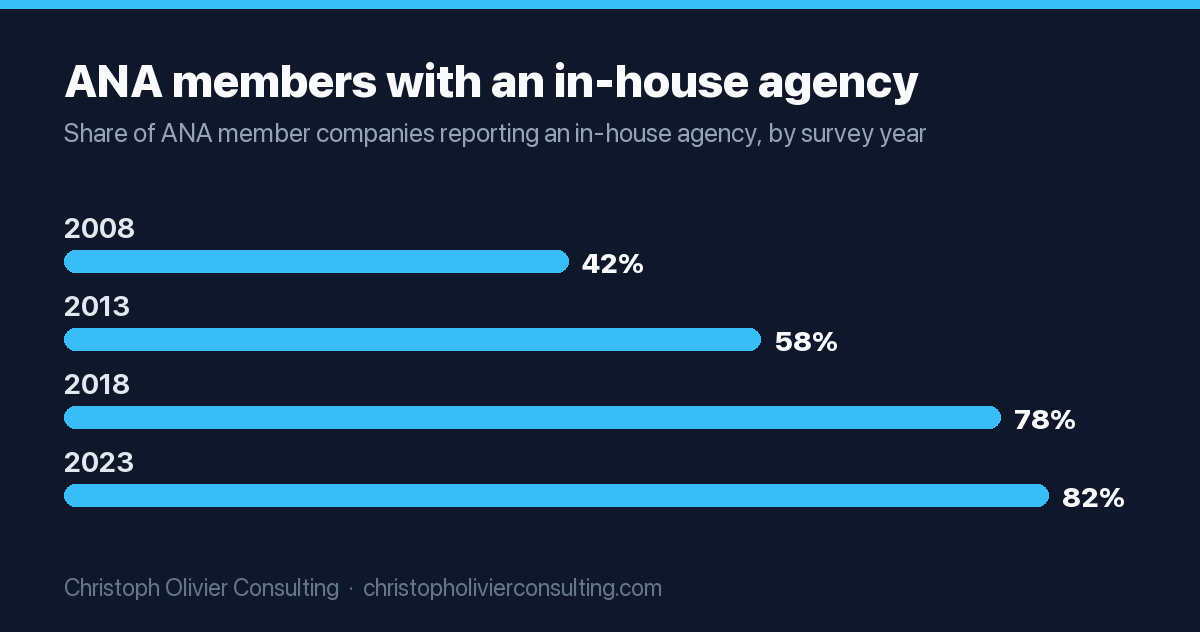
In-house is the direction many large advertisers have moved. The ANA’s 2023 study found 82% of its members now have an in-house agency, up from 42% in 2008. The same study found 92% of those members still work with outside agencies too, with an average of 61% of work done in-house. Even large brands rarely choose one model exclusively.
Cost is the other factor. The US Bureau of Labor Statistics puts the median annual wage for marketing managers at $166,790 as of May 2025, before benefits, tools and the team that person would manage. For a 7-figure service business, one senior hire can absorb most of the marketing budget before any work is produced. That is why smaller firms often split the leadership role from the execution role. If you want to compare those options in more depth, our guides on fractional marketing and on hiring a marketing consultancy cover the cost structures and tradeoffs.
Which model fits your company size and stage?
The right model depends less on revenue than on two questions: do you already have a clear strategy, and do you have someone internally who can direct vendors? If both answers are yes, specialists are often efficient. If neither is true, you need strategy first, from either a full service agency or an independent senior leader.
| Your situation | Model that usually fits | Why |
|---|---|---|
| Early stage, under $1M revenue, founder-led sales | Specialist freelancer or one specialist agency | Budget is too small to fund multi-channel execution well. Focus on the one channel closest to revenue. |
| $1M to $10M, no marketing leader, several channels needed | Full service agency, or fractional CMO + 1 to 3 specialists | You need strategy and execution. The choice is whether you want strategy owned inside or outside the vendor. |
| $1M to $10M, owner wants independent oversight of spend | Fractional CMO + specialists | Separates the person setting the plan from the firms billing for execution. |
| $10M+, in-house marketing manager in place | In-house lead + specialist agencies, or in-house lead + full service agency for production | Internal leader directs, outside partners supply depth and capacity. |
| Larger firm with steady, high content volume | In-house team + agencies for overflow and specialist skills | Mirrors the hybrid pattern the ANA data shows among large advertisers. |
These are rules of thumb, not thresholds. A $3M law firm in a competitive metro may need more marketing firepower than a $15M firm that wins most work by referral. Gartner’s 2026 CMO Spend Survey found 56% of CMOs said they lacked the budget to deliver their 2026 strategy, so do not assume more money is the fix. Choosing the right model for the budget you have matters more.
How to evaluate a full service marketing agency: 12 questions to ask
Evaluate a full service marketing agency on four things: who will actually do the work, how strategy connects to each channel, how results are measured, and what you own if you leave. Ask the questions below in the pitch meeting and require written answers in the proposal so you can compare agencies on the same terms.
- Who exactly will work on my account, and what percentage of their time is allocated to it? Ask for names and roles, not titles on a slide.
- Which services do you deliver with your own staff, and which are subcontracted or white-labeled?
- What is your strongest channel, and where do you rely on partners? An honest answer is a good sign.
- How many hours per month does the retainer buy, broken down by channel?
- What will the first 90 days deliver? Look for an audit, a written plan and at least one shipped asset.
- Which metrics will you report, and how do they connect to leads, pipeline and revenue in my CRM?
- Who owns the ad accounts, analytics properties, domain, website and creative files? The answer should be you.
- How do you bill media, and do you receive any rebates, commissions or markups from platforms or vendors?
- What are the minimum term and termination notice? Shorter initial terms reduce your risk.
- Can I speak with two current clients of similar size, including one that has been with you for more than two years?
- How do you handle a channel that is not working? Ask for the process, not reassurance.
- What do you need from us each month in time, approvals and access? Under-resourced clients are a common reason agency relationships fail.
If your firm sells to other businesses, the B2B-specific criteria in our guide to choosing a business-to-business marketing agency apply on top of these.
Red flags in agency proposals and contracts
The most serious red flags concern ownership, transparency and vague scope: an agency that wants to own your accounts or data, will not disclose how it is paid on media, or cannot say what the retainer buys in hours or deliverables. Any of these can make results hard to judge and leaving expensive.
- The agency holds admin rights to your ad accounts. Google Ads has distinct access levels, and only Admin users can manage who has access. Google itself warns that an account with a single administrator can lose access if that user becomes unavailable. Your company should hold Admin. The agency should hold Standard.
- No disclosure of media rebates or markups. This is not hypothetical. A 2016 ANA study by K2 Intelligence found non-transparent practices, including cash rebates that were often not disclosed or passed through to advertisers, were pervasive in US media buying. Ask for written disclosure and audit rights in the contract.
- Scope described only as “ongoing optimization” with no deliverables, hours or reporting dates.
- Long lock-ins with no performance review point or exit clause.
- Guaranteed rankings, lead volumes or returns. No agency controls Google’s algorithm or your close rate.
- Reports that stop at clicks and impressions with no link to leads or revenue.
- A pitch team you never see again after the contract is signed.
Worked example: scoring two full service agency proposals
A weighted scorecard keeps the decision about substance rather than presentation. Weight the criteria that matter most for your firm, score each proposal from 1 to 5, and multiply. The example below is a hypothetical template, not real agencies or results. Adjust the weights to your situation before you use it.
| Criterion | Weight | Agency A score (1 to 5) | Agency A weighted | Agency B score (1 to 5) | Agency B weighted |
|---|---|---|---|---|---|
| Named senior team and time allocation | 20% | 4 | 0.80 | 2 | 0.40 |
| Strategy quality and fit to our buyers | 20% | 3 | 0.60 | 4 | 0.80 |
| Depth in our two most important channels | 20% | 4 | 0.80 | 3 | 0.60 |
| Measurement tied to CRM and revenue | 15% | 4 | 0.60 | 2 | 0.30 |
| Ownership, transparency and contract terms | 15% | 5 | 0.75 | 3 | 0.45 |
| Relevant references in our industry | 10% | 3 | 0.30 | 4 | 0.40 |
| Total | 100% | 3.85 | 2.95 |
In this example, Agency B wrote the more persuasive strategy deck, but Agency A wins on the factors that tend to decide whether a retainer pays off: who does the work, how results are measured, and what you own. Price comes after this scoring. Compare the fee only between agencies that clear a minimum total, such as 3.5 out of 5.
A quick budget check belongs here too. Gartner found marketing budgets averaged 7.8% of company revenue in 2026. The respondents were mostly companies with more than $1 billion in revenue, so treat that as a reference point, not a target for a smaller firm. Add the agency fee, ad spend, software and any website project, and check the total against what your firm can sustain for at least 12 months. Marketing that is cut after four months rarely shows its full effect.
How to make a full service agency relationship work in the first 90 days
Most agency relationships are decided in the first 90 days. Set ownership and access on day one, agree a written plan with measurable goals, ship something visible early, and hold a formal review at day 90. That sequence gives you an early, evidence-based read on whether to continue, adjust scope, or exit.
- Week 1: access and ownership. Create or confirm company-owned ad, analytics, CRM and website accounts. Grant the agency the access it needs, not ownership.
- Weeks 1 to 3: discovery and audit. The agency reviews your positioning, website, tracking, past campaigns and sales process.
- Weeks 3 to 5: written plan. Goals, channel priorities, budget split, deliverables by month and the metrics you will review.
- Weeks 4 to 8: first assets ship. Fix tracking, launch one campaign or publish the first content pieces. Momentum matters.
- Monthly: review against the plan. Compare what was promised with what shipped, then look at leads and pipeline, not only traffic.
- Day 90: formal review. Decide to continue, rescope, or exit, using the scorecard criteria above.
One more point from my own approach: whatever model you choose, someone on your side of the table should own the strategy and judge the agency’s work. In a full service relationship that person can be you, an internal marketing lead, or an independent adviser. Fractional CMO arrangements are one way to fill that role; our page on fractional CMO services explains what that scope covers.
If you are weighing a full service agency against other options and want a second opinion on proposals or structure, you can book a consultation and we will walk through it together.
Frequently asked questions
What is a full service marketing agency?
A full service marketing agency is one outside firm that handles strategy, creative, channel execution and measurement for your marketing. That usually covers positioning, website, SEO, paid media, social, content, email and reporting under a single contract. The main benefit is coordination: one team keeps messaging, budget and results connected instead of splitting them across several vendors.
What is the difference between a full service agency and a full service digital marketing agency?
A full service digital marketing agency covers online channels only, such as website, SEO, paid search and social, content, email, automation and analytics. A traditional full service agency may also run TV, radio, print, out-of-home, events, promotional marketing and PR. For most professional-service firms, the digital version covers the channels that generate leads.
How much does a full service marketing agency cost?
There is no reliable published average for full service retainers because scope varies widely. Clutch data puts US, Canadian and Australian agency rates at $100 to $149 per hour, and Ahrefs found single-channel SEO agency retainers averaged $3,209 per month. A genuine multi-channel retainer usually costs more than one channel, and ad spend is billed on top of the fee.
Is a full service agency better than hiring specialists?
It depends on who owns strategy. A full service agency reduces coordination work and suits firms without a marketing leader. Specialist agencies often go deeper in each channel but need someone to direct them. Many firms combine an internal lead or a fractional CMO with one to three specialists, which separates the person setting strategy from the firms billing for execution.
What should I ask before hiring a full service marketing agency?
Ask who will actually work on your account and for how many hours, which services are subcontracted, how reporting connects to leads and revenue, who owns the ad accounts and creative files, how media is billed, whether the agency receives rebates, and what the minimum term and exit terms are. Require written answers so proposals can be compared on equal terms.
Who should own the ad accounts when working with an agency?
Your company should own the ad accounts, analytics properties, domain and website, and hold Admin access. The agency should usually receive Standard access in Google Ads, which allows campaign management without control over users. Google warns that an account with a single administrator can lose access if that person becomes unavailable, so keep at least two admins on your side.
More Fractional CMO guides
- What Is Fractional Marketing? Model, Cost, and When to Use It
- Fractional CMO Services: The Full Scope of What Gets Delivered
- Fractional CFO vs CMO: When You Need Each
- CMO Salary in 2026: Base, Bonus, and Total Comp by Company Size
- What Is a CMO? Role, Responsibilities, and Pay
- When to Hire a Fractional CMO
- All Fractional CMO guides →