
Last reviewed: October 2026
The digital marketing future trends that matter most for 2026 and 2027 are AI answers replacing clicks, AI agents starting to shop and book on people’s behalf, ad money shifting to social, video and commerce media, creators becoming a bought media channel, and buyers doing more research alone before they ever talk to you. Budgets are flat, so the winners will be the firms that move money away from fading tactics, not the ones that add new tactics on top.
This guide is written for owners and marketing leads at professional-service firms and 7-figure service businesses. Every trend below comes with the primary evidence behind it, what it means for a firm your size, and one thing to do about it this year. Where the data is thin or contested, I say so.
Digital marketing future trends: the short list for 2026 and 2027
Nine trends have hard evidence behind them right now: AI search and zero-click results, chatbots as a research channel, agentic AI, budget moving to social and video, streaming TV, commerce media, the creator economy, privacy-driven first-party data, and self-directed B2B buying. Most other “trends” on generic lists are either old news or not yet measurable.
The scorecard below rates each trend by the strength of its evidence and its likely impact on a service business with a small or mid-sized marketing team. Use it to decide where to spend attention first.
| Trend | Key evidence | Impact on a service firm | Action this year |
|---|---|---|---|
| AI search and zero-click results | Clicks on a traditional result fell from 15% to 8% of visits when an AI summary appeared (Pew) | High | Rebuild key pages so AI can quote them; track leads, not just sessions |
| Chatbots as a research channel | 49% of US adults use AI chatbots (Pew, 2026) | High | Check how ChatGPT and Gemini describe your firm today |
| Agentic AI (agents that act) | Google’s Universal Commerce Protocol for agentic checkout is live with retailers | Medium now, high by 2027 | Make services, prices and booking machine-readable |
| Social and video take the growth | Social ad revenue up 32.6%, digital video up 25.4% in 2025 (IAB/PwC) | Medium to high | Turn expertise into short video you own |
| Streaming TV and YouTube | Streaming hit 48.6% of US TV time in May 2026 (Nielsen) | Medium | Test YouTube before any CTV buy |
| Commerce and retail media | $63.4B in 2025, up 18% (IAB/PwC) | Low for most service firms | Watch; act only if you sell through retailers or marketplaces |
| Creator economy | US creator ad spend $37B in 2025, projected $44B in 2026 (IAB) | Medium | Partner with niche experts your buyers already follow |
| First-party data and privacy | Chrome kept third-party cookies; 19 states had comprehensive privacy laws by July 2025 (IAPP) | Medium | Grow your email list and clean up consent |
| Self-directed B2B buying | 61% of B2B buyers prefer a rep-free experience (Gartner) | High for B2B firms | Publish pricing logic, process and proof before the first call |
AI search and zero-click results are shrinking organic clicks
AI answers now sit above the blue links for a large share of informational searches, and people click through less when they appear. The trend is not that search is dying. It is that the click is no longer the default outcome, so being quoted inside the answer matters as much as ranking below it.
The cleanest independent data comes from the Pew Research Center’s analysis of 68,879 Google searches by 900 US adults in March 2025. When an AI summary appeared, users clicked a traditional result in 8% of visits, against 15% when there was no summary. Only 1% of visits included a click on a source cited inside the summary, and users ended their browsing session 26% of the time versus 16% without a summary.
Ranking first no longer protects you either. Ahrefs’ February 2026 update, which compared Search Console data for 300,000 keywords from December 2023 and December 2025, found that an AI Overview correlated with a 58% lower average clickthrough rate for the top-ranking page. Position two saw a 50.8% drop and position ten a 19.4% drop.
But search volume is not collapsing
In February 2024, Gartner predicted that traditional search engine volume would drop 25% by 2026. Google tells a different story. On its Q2 2026 earnings call, Alphabet said AI Mode had passed one billion monthly active users, that it is driving an incremental increase in Search queries overall, and that Google sends “billions of clicks to websites every week” through AI features. Both can be true at once: more searches, fewer clicks per search. For you, the only number that settles it is your own Search Console data.
The practical response is answer engine optimization: short direct answers under clear headings, original data, named authors and pages that are easy to quote. The 12-month AEO roadmap lays out that work in order, and the AI search statistics for 2026 cover how each engine picks its sources.
Chatbots are becoming a research channel your buyers use
About half of US adults now use AI chatbots, and buyers use them to research purchases. That makes ChatGPT, Gemini and Copilot a discovery channel you cannot buy ads in yet, but can influence through what the web says about you. Your reputation in these tools is built from your site, reviews and third-party mentions.
Pew’s 2026 survey of 5,119 US adults, fielded February 17 to 23, found 49% use AI chatbots, up from 33% in 2024. ChatGPT leads at 44% of adults, followed by Gemini at 24%, Copilot at 17% and Meta AI at 14%.
The shopping signal is sharper. Adobe Analytics measured a 693.4% year-over-year increase in traffic from generative AI tools to US retail sites over the 2025 holiday season, while noting the base of users is still modest. In B2B, the 6sense 2025 Buyer Experience Report, built on nearly 4,000 buyer responses, found 94% of buyers use large language models during their buying process.
- Ask ChatGPT, Gemini and Perplexity who the best firms for your service are in your market, and note who gets named.
- Correct anything wrong about your firm at the source: your site, Google Business Profile, directories and bios.
- Earn mentions on the sites these tools cite for your category, such as trade publications and industry associations.
Agentic AI: from answering questions to taking actions
Agentic AI means software that completes tasks, such as comparing options, filling a cart or booking a reservation, instead of only answering a question. In 2026 the infrastructure for this went live inside Google. For most service firms the impact is early, but the preparation is cheap and mostly overlaps with good SEO.
On the same Q2 2026 call, Google described its open-source Universal Commerce Protocol as “the new standard for agentic commerce,” with Target and Steve Madden live, plus a Universal Cart that lets shoppers buy items from different retailers in one checkout. It also cited agentic dining reservations on OpenTable and said the Gemini app has 950 million monthly active users.
Inside marketing teams, adoption is ahead of capability. The Gartner 2026 CMO Spend Survey found CMOs put 15.3% of marketing budgets into AI initiatives, yet only 30% report mature AI readiness, even though 70% call AI leadership a critical goal. The AI in marketing statistics page tracks more of that adoption data.
What to do now: list your services, service areas, hours, starting prices or price ranges and booking options in plain text and structured data. An agent cannot recommend or book what it cannot read.
Where ad budgets are moving: social, video and commerce media
US digital ad revenue reached $294.6 billion in 2025, up 13.9%, and the growth was concentrated in social, digital video and commerce media. Search still grew, but slower than the market. Budgets follow attention, and attention is moving to feeds, screens and the places people buy.
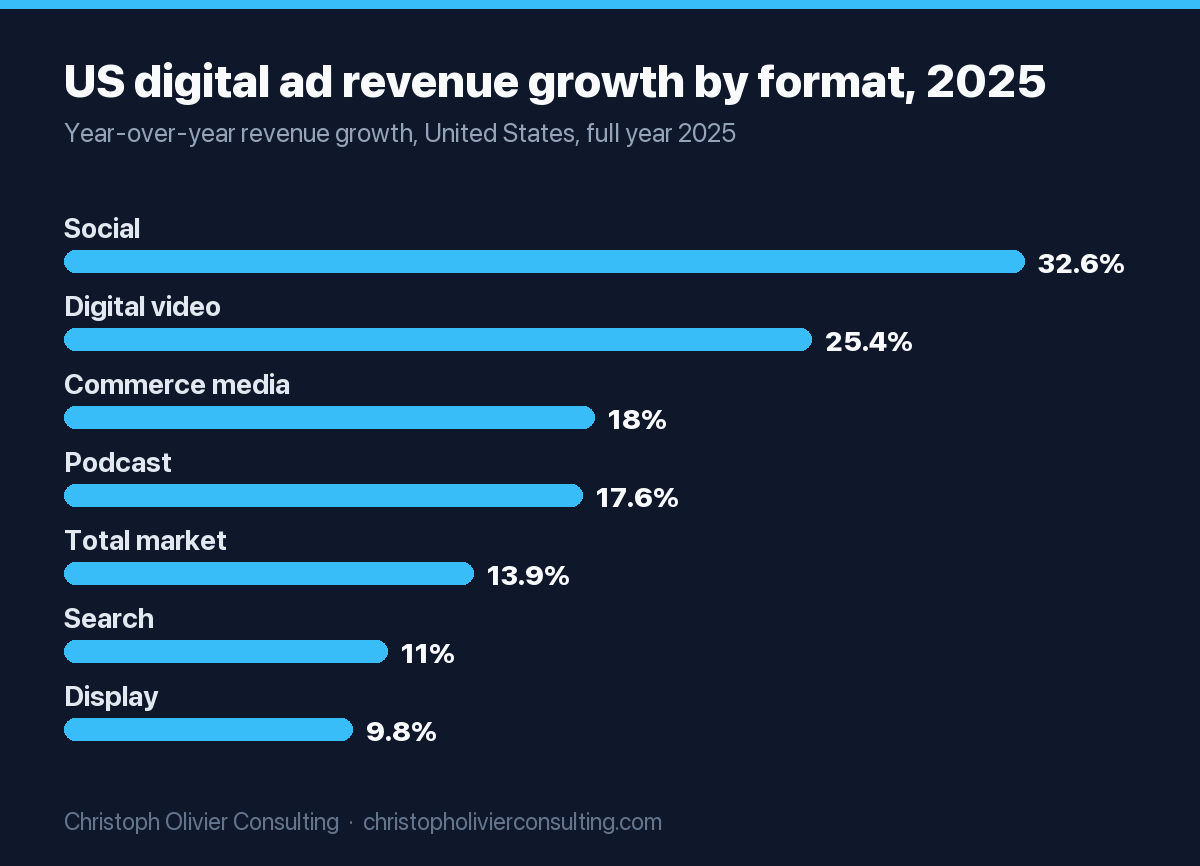
The IAB/PwC Internet Advertising Revenue Report for full year 2025, released April 16, 2026, shows social at $117.7 billion (up 32.6%), search at $114.2 billion (up 11%), display at $81.6 billion (up 9.8%), digital video at $78 billion (up 25.4%) and commerce media at $63.4 billion (up 18%). The US digital ad spend statistics for 2026 break these channels down further.
Commerce and retail media
Commerce media means ads sold by retailers and marketplaces on their own sites and apps, using their purchase data. It matters a great deal if you sell products through those retailers. For a law firm, accounting practice or home-service company it is mostly a signal of where consumer brands are shifting money, not a channel to buy. The retail media statistics page has the detail if you do sell through retail.
Streaming TV and YouTube
Streaming is now close to half of all US TV viewing. Nielsen’s May 2026 Gauge put streaming at 48.6% of total TV time, against 20.4% for cable and 19.2% for broadcast, with YouTube alone at 13.8%. Google also said on its Q2 call that viewers can now complete purchases directly on connected TVs through Buy with Google Pay. For a regional service business, YouTube is usually the cheaper first test of the TV screen, because you can target narrowly and reuse the same videos on your site.
The creator economy is now a bought media channel
Creator marketing has moved from side experiment to budget line. Advertisers now buy creators the way they buy search or social, and the spend is growing several times faster than media overall. For service firms, the useful version is small: niche experts with a trusted audience of your exact buyers.
The IAB 2025 Creator Economy Ad Spend and Strategy Report projected US creator ad spend at $37 billion in 2025, up 26% and nearly four times faster than the media industry overall, with $44 billion expected in 2026. Spend more than doubled from $13.9 billion in 2021 to $29.5 billion in 2024, and 48% of creator ad buyers now call creators a “must buy.”
A practical version for a professional-service firm: sponsor a newsletter or podcast run by an operator in your clients’ industry, or co-create a webinar with a respected peer. The creator economy statistics page covers rates and formats.
First-party data and privacy: the cookies stayed, the rules did not
The long-predicted death of the third-party cookie did not happen in Chrome, but that does not make tracking easier. State privacy laws keep spreading, browsers and platforms keep limiting signals, and AI answers hide more of the journey. Your own data, especially email and CRM records, is the asset that holds its value.
On April 22, 2025, Google announced it would keep its current approach to third-party cookie choice in Chrome and would not roll out a new standalone cookie prompt. The same page notes that some Privacy Sandbox technologies are being phased out. Meanwhile the IAPP counted 19 states with comprehensive consumer privacy laws as of July 2025.
- Make your email list a priority metric, with a real reason to subscribe.
- Ask every new lead how they heard about you. Self-reported attribution catches AI and word of mouth that analytics miss.
- Audit consent banners and forms against the state laws where your clients live. This is a legal question, so check it with counsel.
B2B buying: committees research alone, then pick from a shortlist
B2B buyers increasingly want to research and decide without a salesperson, and they make most of the decision before first contact. If your firm sells to businesses, your website and public proof now do the job your first sales meeting used to do. A buyer who cannot find answers simply moves to the next firm.
A Gartner survey of 632 B2B buyers found 61% prefer an overall rep-free buying experience, 73% actively avoid suppliers who send irrelevant outreach, and 69% report inconsistencies between a supplier’s website and what its sellers say.
The 6sense 2025 report adds timing: buyers first contact sellers about 61% of the way through their journey, earlier than 69% in 2024, and 95% of the time the winning vendor was already on the day-one shortlist. Average cycle length fell from 11.3 to 10.1 months. The lesson is blunt. If you are not on the shortlist before the buyer reaches out, you rarely win.
Flat budgets make every trend a trade-off
Marketing budgets are not growing to fund all of these trends. That means each new bet has to be paid for by cutting something weaker. The firms that do well in 2026 and 2027 will be the ones that reallocate with discipline, not the ones that chase every new channel.
Gartner’s 2026 CMO Spend Survey of 401 marketing leaders found budgets at 7.8% of company revenue, barely up from 7.7% in 2025, and 56% of CMOs say they lack the budget to deliver their 2026 strategy. One caveat: most respondents work at companies with more than $1 billion in revenue, so treat the percentages as direction, not a benchmark for a 7-figure firm.
How to act on digital marketing trends 2026: a 90-day plan
Start with the trends that already affect your pipeline, which for most service firms means AI search, chatbot visibility and self-directed buying. Measure your baseline, fix the pages that buyers and AI tools read first, then fund one new channel test by cutting your weakest spend.
- Weeks 1 to 2: baseline. Pull 16 months of Search Console clicks and impressions for your top 20 pages. Run 10 buyer-style prompts in ChatGPT, Gemini and Perplexity and record which firms get named.
- Weeks 3 to 4: add a “how did you hear about us” field to every form and intake call, with AI assistant as an option.
- Weeks 5 to 8: rebuild your five most important service pages. Lead with a direct answer, then process, price ranges or pricing logic, proof and FAQs. Add structured data for services and reviews.
- Weeks 5 to 8, in parallel: publish one original asset, such as a client survey, a pricing study or a dataset from your own work, that others can cite.
- Weeks 9 to 12: run one channel test. Pick short video on YouTube or LinkedIn, or one creator or newsletter sponsorship. Fund it by cutting the lowest-performing line in your current budget.
- Week 12: review. Compare leads by source, not traffic, and keep, cut or scale the test.
Worked example: an illustrative 15-person accounting firm
Picture a 15-person accounting firm that spends a fixed annual amount on paid search, a directory listing and a print sponsorship. This is a hypothetical to show the logic, not a client result. In its baseline, the firm sees impressions steady but clicks down on its “small business tax” pages, and ChatGPT names two competitors but not the firm. Its intake question shows the print sponsorship produced no leads it can identify.
Following the plan, the firm cuts the print sponsorship, rewrites its five service pages with fee ranges and a clear onboarding process, publishes a short survey of its own clients’ biggest tax questions, and uses the freed budget for a quarter of sponsored issues in a local business newsletter. At week 12 it judges the change on qualified consultations by source. The point is the method: one cut, one fix, one test, measured in leads.
Digital marketing trends 2027 and the future of digital marketing
Looking into 2027, the safest bet is that today’s trends compound: more AI answers, more agent-driven actions, more spend in social, video and creators, and buyers deciding earlier. The basics that win buyers’ trust do not change. Clear positioning, visible proof and a fast response still decide most service-business sales.
Signals worth watching over the next 12 to 18 months:
- Ads inside AI answers. Google said it is testing formats in AI Mode, including sponsored links inside list responses. Watch whether these reach local and professional services.
- Agent bookings for services. If agentic checkout spreads from retail to appointments, your booking system becomes a marketing asset.
- Creator spend against the $44 billion projection, as a test of whether the channel keeps outgrowing media overall.
- Your own click-through rates. Industry studies show direction, but your Search Console data shows your exposure.
Treat with caution: predictions that put a precise number on a future year, including the 2024 forecast of a 25% drop in search volume that Google’s own reported query growth does not support. In my experience, the firms that waste the most money are the ones reacting to forecasts instead of their own lead data.
If you want a second set of eyes on which of these trends deserves your budget next quarter, you can book a consultation and we will work through your numbers together.
Frequently asked questions
What are the biggest digital marketing trends for 2026?
The trends with the strongest evidence are AI answers reducing clicks from search, chatbots becoming a research channel, AI agents that take actions, ad spend shifting to social, digital video and commerce media, creators becoming a bought channel, tighter privacy rules, and B2B buyers doing most of their research before contacting a supplier.
What is the future of digital marketing?
The future of digital marketing points toward fewer clicks and more answers. AI tools will summarize, compare and increasingly act for buyers, so being quoted and recommended matters as much as ranking. Spend will keep moving to video, social and creators, while owned assets such as email lists, original data and strong service pages hold their value.
Is SEO still worth it with AI Overviews?
In most cases, yes, but the goal changes. Studies from Pew and Ahrefs show fewer clicks when AI summaries appear, yet AI tools build their answers from web pages. Pages with direct answers, original data and clear expertise can be cited in those answers. Measure success in leads and citations, not only in traffic.
What digital marketing trends should a small service business focus on first?
Start with what already affects your pipeline: how AI search and chatbots describe your firm, the quality of your top service pages, and whether buyers can find pricing logic, process and proof without calling you. Then fund one new channel test, such as short video or a newsletter sponsorship, by cutting your weakest current spend.
What are the digital marketing trends for 2027?
Expect the 2026 trends to compound: more AI answers and agent-driven actions, possible ads inside AI answers for more categories, continued growth in creator and video spend, and buyers shortlisting firms earlier. Treat precise long-range forecasts with caution and track your own click-through rates and lead sources to see how much each trend affects you.
Did Google get rid of third-party cookies?
No. In April 2025 Google said it would keep its current approach to third-party cookie choice in Chrome and would not launch a new standalone prompt. That does not make tracking easier, because state privacy laws, platform limits and AI answers still hide much of the buyer journey. First-party data such as email and CRM records remains the safer asset.
More Growth Consulting guides
- Hair Restoration Marketing: A 2026 Cost Per Consult Playbook
- Barbershop Marketing: The 2026 Playbook to Fill Every Chair
- Press Release Distribution in 2026
- Locksmith Marketing: A 2026 Playbook for Booked Jobs and Beating Lead-Gen Spam
- How to Design a Customer Loyalty Program That Protects Margin
- CPA Marketing in 2026: What Works
- All Growth Consulting guides →