
Last reviewed: October 2026
A content strategist is the person who decides what content a business should create, why, for whom, and how it will be produced, published, measured and maintained. They own the plan and the standards, not every piece of writing. In the US, published salary ranges for the role run from about $72,500 to $113,500 according to Robert Half’s 2026 salary data.
This guide covers what a content strategist actually does, the deliverables you should expect, how the role differs from a content marketer, copywriter and SEO specialist, what it pays, and when a business needs one. It ends with a hiring process and a 90-day plan you can hand to a new hire on day one.
What is a content strategist?
A content strategist plans, structures and governs a business’s content so it serves both the audience and the business goals. The role answers four questions: who the content is for, what it should say, where and how it gets delivered, and who keeps it accurate over time. Writing is often part of the job, but the core output is decisions.
The most widely cited definition comes from Brain Traffic, the agency that helped popularize the discipline: content strategy guides “the creation, delivery, and governance of useful, usable content” (Brain Traffic). Each of those three words maps to real work. Creation means choosing topics and formats. Delivery means getting content to the right channel in the right structure. Governance means rules, owners and maintenance, which is the part most businesses skip.
The title is messy. You will see content strategist, content marketing strategist, marketing content strategist, content lead and head of content used for overlapping jobs. Read the responsibilities, not the title. A useful test: if the person is judged mainly on output volume, the job is production. If they are judged on whether the content program moves a business metric, it is strategy.
What does a content strategist do?
A content strategist researches the audience and existing content, sets the content plan and priorities, defines standards like voice and style, builds the workflow that gets content produced and published, and measures what works. Day to day, that means audits, briefs, calendars, stakeholder interviews and performance reviews rather than writing every article themselves.
The work falls into four areas. Brain Traffic groups them as guiding content activities, creating useful content, delivering it effectively and establishing governance, and notes that no single strategist masters all of them (Brain Traffic).
Research and audit
- Interview sales, service and leadership to learn what buyers ask and what the business needs to sell.
- Audit existing content: what exists, what ranks, what converts, what is outdated or duplicated.
- Map audience segments and the questions each one asks at each buying stage.
- Review keyword and search demand data to size topics.
Planning and prioritization
- Set content goals tied to business goals, such as qualified leads, consultations booked or sales cycle length.
- Build the topic architecture: pillar pages, supporting articles and how they link.
- Turn priorities into a dated content roadmap and a working calendar.
Standards and governance
- Write the voice and style guide, brief templates and review checklists.
- Define who drafts, who reviews, who approves and who updates each content type.
- Set a refresh schedule so old pages are updated, merged or retired.
Measurement
- Choose metrics for each content type, not one vanity number for everything.
- Report what moved, what did not, and what changes next quarter.
Job postings reflect the same shape. Indeed’s template describes the biggest responsibility as “creating and enforcing a plan for producing content,” along with keeping content consistent across platforms and updating older content to current standards (Indeed).
Deliverables you should expect
If you hire a content strategist, you should be able to point to documents, not just activity. The standard set is a content audit, audience and question map, content strategy document with goals and priorities, topic architecture, editorial calendar, brief template, style guide, workflow and approval map, and a recurring performance report.
Content strategist skills and tools
The core content strategist skills are research, editorial judgment, information architecture, SEO, analytics, project management and stakeholder management. Writing and editing ability matters because strategists review and brief writers, but the rarer skill is connecting audience questions to business goals and getting several departments to agree on one plan.
Robert Half’s 2026 guide lists strategic thinking, data analysis, project management, SEO and SEM knowledge, UX principles and AI tool proficiency among the key skills (Robert Half). Brain Traffic makes the point more bluntly: a content strategist “cannot live in a silo” (Brain Traffic).
Tools vary by company, but most strategists work across these categories:
- Search and keyword research: Google Search Console plus a keyword research platform.
- Analytics: Google Analytics or a similar web analytics tool, and CRM reporting for lead quality.
- Planning: a project tool or spreadsheet for the calendar, briefs and status.
- Publishing: the CMS, such as WordPress, and its SEO plugin.
- AI assistants: for research summaries, outlines and first drafts, with human review for accuracy and voice.
Tools are the easy part. In my experience, the gap in most firms is not software. It is that nobody has the authority to say no to a content request that does not fit the plan.
Content strategist vs content marketer vs copywriter vs SEO specialist
A content strategist decides what to create and why. A content marketer executes and distributes that content to drive results. A copywriter writes persuasive copy for specific assets. An SEO specialist makes content findable in search. In small teams one person often covers two or three of these, which is why the titles blur.
Indeed draws the line this way: strategists focus on planning, research, content types, topics and platforms, while content marketers take those objectives and run campaigns, schedules and publishing (Indeed). The table below expands that into the four roles you are most likely to be choosing between.
| Role | Core question | Typical outputs | Judged on | Hire when |
|---|---|---|---|---|
| Content strategist | What should we create, for whom, and why? | Audit, strategy document, topic architecture, calendar, style guide, governance rules | Whether the content program moves business goals | Content exists but is unfocused, or you are starting a serious program |
| Content marketer | How do we produce and distribute this so it performs? | Articles, emails, social posts, campaigns, distribution plans | Traffic, engagement, leads from content | The plan exists and you need consistent execution |
| Copywriter | What words make this asset persuade? | Landing pages, ads, email copy, service pages | Conversion of specific assets | You know what to say and need it said well |
| SEO specialist | How do we get found in search? | Keyword research, technical fixes, on-page optimization, link plans | Rankings, organic traffic, indexing health | Content is good but search visibility is weak |
The roles overlap at the edges. A strong content strategist understands SEO well enough to plan around search demand, which is why an SEO content plan is often one of their first deliverables. They do not need to be your technical SEO.
Content strategist salary in 2026
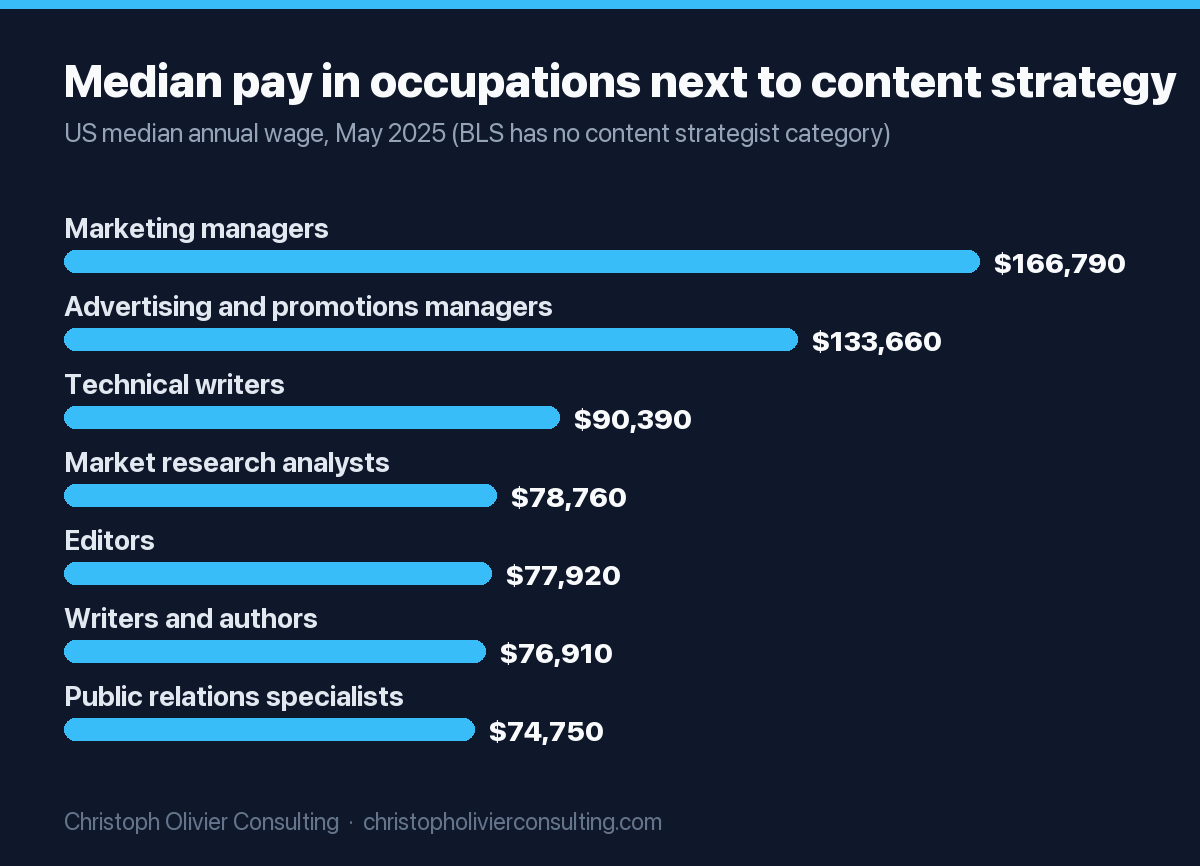
US content strategist salary estimates in 2026 cluster between about $72,500 and $113,500. Robert Half puts the midpoint starting salary at $92,750, and Indeed’s job-posting data shows an average base of $83,806. The US Bureau of Labor Statistics does not track content strategist as its own occupation, so use related categories with care.
Different sources measure different things, so compare like with like:
| Source | What it measures | Figure |
|---|---|---|
| Robert Half 2026 Salary Guide | Starting salary range for content strategists | $72,500 to $113,500; midpoint $92,750 |
| Robert Half 2026 Salary Guide | Projected 2026 salary increase for the role | 3.3% |
| Indeed | Average base salary from 348 job postings (updated October 2, 2026) | $83,806 |
| BLS | Median annual wage, writers and authors (May 2025) | $76,910 |
| BLS | Median annual wage, marketing managers (May 2025) | $166,790 |
The BLS figures bracket the role. A strategist who mostly writes and edits will be paid closer to writer and editor medians. A head of content who owns budget, a team and pipeline targets is doing work closer to a marketing manager. Location, industry and whether the job includes people management move the number more than the title does.
When does a business need a content strategist?
A business needs a content strategist when content is being produced without clear priorities, when results cannot be tied to revenue, or when several people publish with no shared standards. If you publish rarely and have one clear offer, a simple plan may be enough. The role pays off when volume, channels or stakeholders multiply.
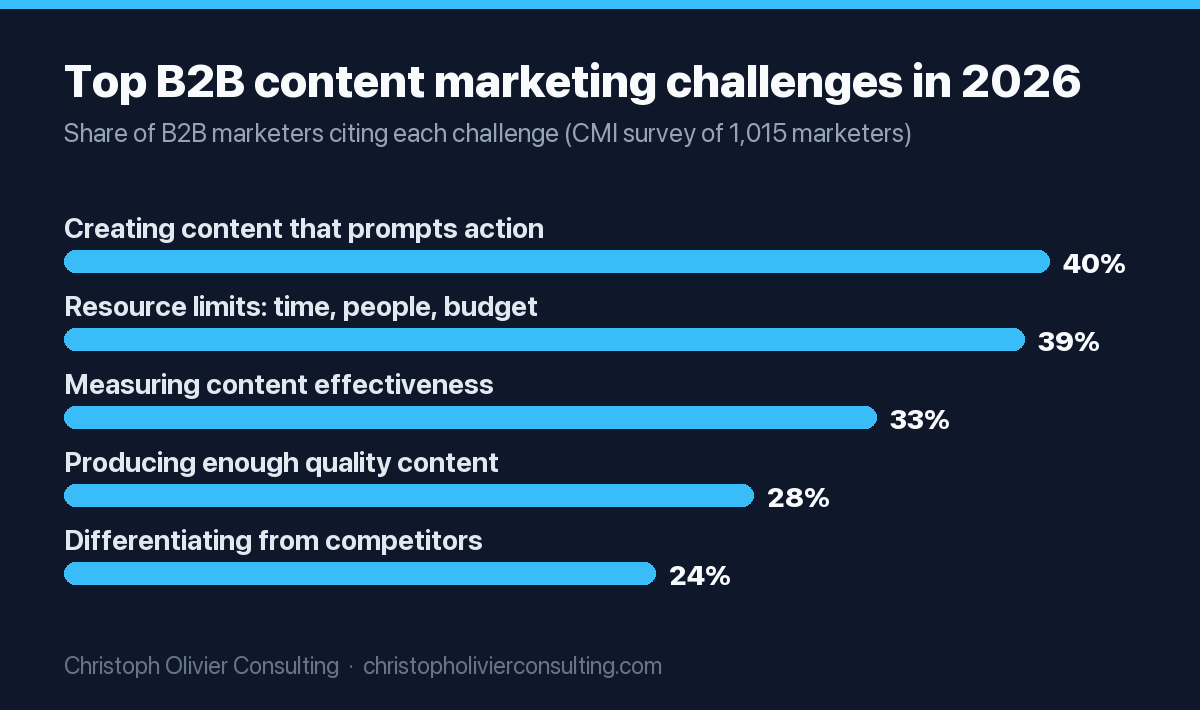
The common pain points show up in the research. In the Content Marketing Institute’s 2026 B2B study of 1,015 marketers, 97% said they have a content strategy, yet the top challenges were creating content that prompts action (40%), resource constraints (39%) and measuring effectiveness (33%) (Content Marketing Institute). Having a strategy on paper and having one that works are different things. Among respondents, 74% pointed to strategy refinement as the biggest driver of improved results.
Watch for these signs:
- Partners or leaders each request content, and nobody decides what ships first.
- You have dozens of blog posts but cannot name which ones produce leads.
- Several pages compete for the same search term.
- Writers or agencies ask “what should we write next?” every month.
- Service pages, articles and emails describe your offer differently.
In-house, freelance, fractional or agency?
You do not always need a full-time hire. Match the model to how much ongoing direction you need:
| Model | Best for | Watch out for |
|---|---|---|
| Full-time in-house strategist | Larger teams publishing across many channels with internal writers | Needs enough scope and authority to justify a salary |
| Freelance strategist | A one-time audit, strategy document or style guide | Plans can stall without someone to run them afterward |
| Fractional strategist or consultant | Firms that need senior direction a few days a month while writers or agencies execute | Requires an internal owner for day-to-day decisions |
| Agency | Businesses that want strategy and production bundled | Strategy can drift toward what the agency produces most easily |
For many professional-service firms, a fractional or consulting model is the practical middle. The guide to hiring a content marketing consultant covers how to scope that kind of engagement.
How to hire a content strategist
To hire a content strategist, define the business problem first, then test candidates on real work: review their past strategy documents, ask how they made prioritization decisions, and run a short paid test project on your own content. Writing samples alone will not tell you whether someone can build and defend a plan.
- Write down the problem. For example: “We publish weekly but cannot connect content to consultations.” This shapes the job more than any title.
- Decide the scope. Strategy only, or strategy plus writing, editing and team management? Say so in the posting.
- Screen for evidence of decisions. Ask for a strategy document, audit or editorial guide they created, with confidential details removed.
- Interview on reasoning. Use the questions below.
- Run a paid test project. Keep it to a few hours of work on your real content.
- Check references on influence. Ask former managers how the candidate handled stakeholders who disagreed with the plan.
Interview questions that reveal strategy skill
- Walk me through a content audit you ran. What did you cut, and why?
- How did you decide which topics to prioritize when everything seemed important?
- Tell me about a time a senior stakeholder wanted content that did not fit the plan. What happened?
- Which metrics would you use for a service page versus a research article versus a newsletter?
- How do you use AI tools in your process, and where do you not trust them?
- What would you need from us in the first 30 days?
A test project that works
Give finalists access to your site and a short summary of your services and buyers. Ask for three things: the five pages they would fix or consolidate first, the next ten topics they would publish with a one-line reason for each, and one completed content brief. Pay for the time. Judge the reasoning more than the polish.
A sample 90-day plan for a new content strategist
A strong 90-day plan for a content strategist spends the first month listening and auditing, the second month building the strategy and standards, and the third month shipping and measuring. By day 90 the business should have a documented plan, a working calendar, clear owners and the first results to review.
Use this template as a starting point and adjust it to your team size:
| Phase | Focus | Key activities | Output by end of phase |
|---|---|---|---|
| Days 1 to 30 | Listen and audit | Stakeholder interviews; sales and service call review; full content inventory; Search Console and analytics review | Audit with keep, update, merge and retire decisions; audience question map |
| Days 31 to 60 | Plan and standardize | Set goals and metrics; build topic architecture; write style guide and brief template; agree on workflow and approvals | Signed-off strategy document, roadmap and calendar |
| Days 61 to 90 | Ship and measure | Fix the highest-value existing pages; publish first new pieces; launch reporting; hold a first quarterly review | First performance report and next-quarter priorities |
Two notes on this plan. First, fixing existing pages usually comes before new publishing, because updated pages with history often respond faster than new URLs. Second, the calendar only works if people keep it, so build a content calendar your team will actually keep rather than an ambitious one that dies in month two.
How AI is changing the content strategist role
AI has made content cheaper to produce, which makes deciding what to produce more valuable. In 2026, content strategists spend more time on review, accuracy and differentiation, and on making content easy for AI search tools to interpret. The fundamentals have not changed: Google says no special optimization is needed for its AI features.
Robert Half now lists evaluating AI-generated content for accuracy and brand alignment as part of the job, and points to generative engine optimization, “which focuses on how AI tools interpret and surface information,” as a trend strategists need to follow (Robert Half). Google’s own guidance keeps the bar simple: “There are no additional requirements to appear in AI Overviews or AI Mode, nor other special optimizations necessary” (Google Search Central).
What that means in practice for a strategist:
- Answer first. Put a direct, quotable answer near the top of each section so both readers and AI systems can lift it.
- Show who and how. Google’s people-first guidance asks creators to consider who made the content, how it was made and why (Google Search Central). Clear authorship and real expertise matter more when generic content is everywhere.
- Govern AI use. Write down where AI is allowed in your workflow, who checks facts, and what never gets published without human review.
- Avoid search-first topics. Google warns against entering a topic “without any real expertise, but instead mainly because you thought you’d get search traffic” (Google Search Central).
Budgets are shifting too. In CMI’s 2026 research, 45% of B2B marketers pointed to AI-powered marketing tools for added investment, compared with 9% for human resources such as salaries, training and development (Content Marketing Institute). My view: that makes the judgment layer a strategist provides harder to find, not less needed.
Common mistakes when building a content strategy role
The most common mistakes are hiring a writer and calling them a strategist, giving the strategist no authority over priorities, measuring only traffic, and skipping maintenance. Each one turns a strategy role into a production role, and the business ends up with more content but no clearer results.
- No decision rights. If any partner can override the calendar, the strategy is a suggestion.
- Volume targets only. A posts-per-month quota rewards output, not outcomes.
- No maintenance budget. Old pages go stale and start competing with new ones.
- Strategy without distribution. Content that nobody sees cannot work, however good the plan.
- Skipping the basics. Everyone involved should share an understanding of what content marketing is and how it creates demand before arguing about tactics.
If you are weighing whether your firm needs a content strategist, a fractional lead or just a sharper plan, you can book a consultation and talk it through.
Frequently asked questions
What does a content strategist do?
A content strategist researches the audience and existing content, decides what the business should publish and why, sets standards such as voice, style and approval workflow, plans the calendar, and measures results. They own the plan and the rules for maintaining content over time. Writing is often part of the job, but the main output is prioritized decisions and the documents that record them.
How much does a content strategist make?
Robert Half's 2026 salary data puts US content strategist starting salaries between $72,500 and $113,500, with a midpoint of $92,750. Indeed reports an average base of $83,806 from 348 job postings, updated October 2, 2026. Pay depends heavily on location, industry, and whether the role includes managing people or a budget.
What is the difference between a content strategist and a content marketer?
A content strategist plans: they research the audience, choose topics, formats and channels, and set standards. A content marketer executes: they create and distribute content, run campaigns and manage publishing schedules. In small teams one person often does both, so check the responsibilities in a job description rather than relying on the title.
Does a content strategist need to know SEO?
In most cases, yes. A content strategist should understand search demand, keyword research and how pages compete with each other, because search is a major channel for most content programs. They do not usually need deep technical SEO skills. Crawling, indexing and site speed fixes typically sit with an SEO specialist or developer.
When should a small business hire a content strategist?
Consider one when content is published without clear priorities, when you cannot connect content to leads or revenue, or when several people create content without shared standards. If you publish rarely and sell one clear offer, a simple plan may be enough. A freelance or fractional strategist can be a lower-commitment first step than a full-time hire.
What should a content strategist do in the first 90 days?
A practical plan spends days 1 to 30 interviewing stakeholders and auditing existing content, days 31 to 60 setting goals, topic architecture, a style guide and workflow, and days 61 to 90 fixing the highest-value pages, publishing new content and delivering a first performance report with next-quarter priorities.
More Content Marketing guides
- What Is Content Marketing? Modern Playbook
- How to Build a Content Calendar You Actually Keep
- How to Hire a Content Marketing Consultant
- Content Marketing for Architects: A Project-Led System That Wins Better Work
- Video Marketing in 2026: Production + Distribution
- Email Open Rates 2026: Benchmarks & Strategy
- All Content Marketing guides →