
Last reviewed: October 2026
An event marketing plan is a written schedule that ties one event goal to a defined audience, a promise, a set of channels and a week-by-week timeline, starting about 12 weeks out and ending 30 days after the event. It also sets the KPIs, the reminder sequence and the follow-up that turns attendees into pipeline.
Most guides list a dozen generic steps and stop. This one gives you the timeline as a table, the no-show math you need to set registration targets, a fill-in template and a worked example for a 40-seat client seminar. It covers in-person events, virtual events and the small seminars professional-service firms run every quarter.
What an event marketing plan includes
An event marketing plan includes eight parts: a single business goal, KPIs with targets, a target audience, a one-sentence promise, a channel mix, a dated timeline with owners, a reminder sequence and a post-event follow-up plan. If any part is missing, you usually find out the week before the event, when it is too late to fix.
The plan answers three questions for everyone involved: who should be in the room, why would they come, and what happens to them afterward. Venue, catering and AV belong in a separate logistics plan. This one is about demand.
The business case for doing this properly is real. In Bizzabo’s survey of more than 1,500 organizers and attendees, 78% of organizers said in-person events are the most impactful marketing channel for engaging audiences, and 53% expected their in-person event budgets to rise in 2025 (Bizzabo, 2025 State of Events). For more verified numbers, see our roundup of event and trade show marketing statistics.
How to market an event: the 8-step process
To market an event, set one goal, define the audience, write the promise, build a registration page, promote it across three to five channels on a dated schedule, run confirmations and reminders, use the event itself to create next steps, and follow up within 24 hours. The order matters, because each step depends on the one before.
- Set the goal and KPIs. Decide what a successful event produces, in numbers, before you pick a date.
- Define the audience. Name the role, company type and situation of the ideal attendee, and where you can reach them.
- Write the promise. One sentence that says what attendees will be able to do or decide afterward.
- Build the registration page. Short form, clear outcome, date and time in the visitor’s terms.
- Promote on a schedule. Email first, then partners, social, paid and PR, in waves that build toward the date.
- Protect attendance. Confirmation, calendar invite, reminders and a personal touch for high-value registrants.
- Run the day for next steps. Capture check-ins, run one clear offer and book meetings in the room.
- Follow up and attribute. Send recaps, book calls and tag every opportunity to the event in your CRM.
Event marketing goals and KPIs
Pick one primary goal for each event and three to five KPIs that measure it. A client-appreciation dinner and a lead-generation seminar need different numbers. If you try to make one event do everything, you end up measuring registrations, which are easy to count and rarely the point.
Bizzabo’s 2025 survey found that 24% of organizers named sales pipeline growth as the top priority for B2B conferences, summits and conventions (Bizzabo, 2025). For a professional-service firm, the goal is usually narrower: consultations booked or existing clients expanded.
| Event goal | Primary KPI | Supporting KPIs | How to set the target |
|---|---|---|---|
| New client acquisition | Consultations booked within 14 days | Attendance rate, cost per attendee, pipeline value | Work backward from the number of new clients you need and your consult-to-client rate |
| Expand existing clients | Follow-up meetings with attending clients | Share of invited clients who attend, new services discussed | Start from the client list you invite, not from a registration number |
| Referral partner growth | Partner introductions made | Partners attending, co-promoted registrations | Count the partners you want in the room by name |
| Brand and authority | Qualified attendees from target accounts | Press or podcast mentions, content created from the event | Set a target account list and measure coverage |
| Retention and loyalty | Renewal or retention rate of attendees vs non-attendees | Satisfaction score, referrals given | Compare against the same client tier that did not attend |
Write the targets down before promotion starts. A target set after the event is a story, not a KPI.
Define your audience and positioning
Your audience definition should name who the event is for, who it is not for, and the specific problem the event solves for them right now. Positioning is the one-sentence promise that makes that person decide to give up an evening or an hour. Both should exist before any copy is written.
A useful test: could a colleague forward your invitation to the right person with no explanation? “Business owners interested in tax” fails. “Owners of profitable S corporations deciding before December 31 whether to buy equipment” passes.
Write the promise
Use this structure: “In [length], you will [outcome], so you can [decision or result].” Keep the speaker’s credentials in a supporting line, not the headline. People register for the outcome, and they check the speaker to decide whether to believe it.
In-person, virtual or hybrid
Choose the format from the goal. In-person events tend to suit relationship goals: closing, client expansion and referral partners. Virtual events suit reach and education, and they create a recording you can keep promoting. If you run virtual sessions often, our webinar marketing strategy guide covers the promotion and conversion side in detail.
Event marketing strategy: choosing your channels
The best event marketing strategy uses the channels where your audience already pays attention to you, in this order: your own email list, personal invitations, partners who share your audience, social, then paid and PR. Owned channels convert best and cost least. Paid and PR fill the gaps once you know your list cannot supply enough registrations.
| Channel | Best for | When to start | Watch out for |
|---|---|---|---|
| Email to your list | Most registrations for most firms | 6 to 8 weeks out, then weekly | Sending the same message every time; vary angle, proof and urgency |
| Personal invitations | Top clients, key prospects, small rooms | 6 weeks out, follow up at 2 weeks | Delegating it so far that it no longer feels personal |
| Partners and co-hosts | New audiences that already trust the partner | 8 to 10 weeks out to agree terms | Unclear lead-sharing rules; agree them in writing first |
| LinkedIn and other social | Reach among peers of existing contacts | 6 weeks out, peak in final 2 weeks | Posting only the flyer; share the speaker’s point of view instead |
| Paid social and search | Local or niche audiences you cannot reach otherwise | 4 to 6 weeks out | Cheap registrations from people outside your target |
| PR and local media | Authority, community events, newsworthy data | 6 to 8 weeks out for calendars | Expecting press to drive registrations on its own |
Co-marketing with partners
For professional-service firms, partners are often the highest-quality channel. A CPA and an estate attorney share clients who need both. Give partners ready-made copy, a tracked link and a clear answer on how their contacts’ details will be used.
Compliance check
If you work in a regulated profession, run invitations and ads past your compliance process before launch. Law firms answer to bar advertising rules, and investment advisers have their own marketing rules. Avoid promising outcomes in event copy, and get consent before sending text-message reminders.
The event marketing timeline: 12 weeks out to 30 days after
A standard event marketing timeline starts 12 weeks out with goals and partners, launches promotion around 8 weeks out, builds to the heaviest push in the final 2 weeks, and runs follow-up for 30 days afterward. Shorten it for small client events and webinars, but keep the order of the phases the same.
| When | Marketing tasks | Owner | Done when |
|---|---|---|---|
| 12 weeks out | Set goal and KPIs, confirm audience and promise, choose format, approach co-hosts and speakers, set budget | Marketing lead | One-page brief signed off |
| 10 weeks out | Build registration page, CRM campaign and tracking links per channel; draft email and social copy; confirm partner terms | Marketing ops | Test registration flows into the CRM |
| 8 weeks out | Launch: announcement email, page live, personal invites to top accounts, partner kits sent, event listed on calendars | Marketing lead, partners | First registrations recorded by channel |
| 6 weeks out | Second email with a new angle, speaker content on social, paid campaigns live if needed | Marketing | Registrations at roughly a third of target |
| 4 weeks out | Review registrations against target; add channels or invitations if behind; publish a short preview piece | Marketing lead | Gap to target known and plan to close it |
| 2 weeks out | Heaviest promotion: urgency emails, partner reminders, personal follow-ups to non-responders | Whole team | Registration target met, including no-show buffer |
| 1 week out | Reminder sequence starts, logistics email, attendee list sorted into priority tiers, follow-up emails drafted | Marketing, sales | Every priority registrant has an assigned host |
| Day before and day of | Final reminder, morning-of reminder, check-in, live social, in-room offer | Event team | Check-ins and meetings booked logged |
| Within 24 hours after | Thank-you email with recording or slides, separate no-show email, survey | Marketing | All attendees and no-shows contacted |
| Within 7 days after | Personal follow-up to priority attendees, book consultations, partner debrief | Sales, partners | Meetings booked logged in CRM |
| 30 days after | Report KPIs against targets, pipeline attribution, repurpose content, lessons for next event | Marketing lead | One-page results report shared |
For a webinar, compress this to 4 to 6 weeks. For a conference with travel, extend the front end so people can get approval and book flights.
Registration page best practices
A good registration page states the outcome in the headline, shows date, time and location above the fold, asks only for what you will use, and confirms instantly with a calendar invite. Every extra decision on the page costs registrations, and every unused form field costs trust.
- Headline: the promise, not the event name.
- Who it is for: two or three bullets that let the right person recognize themselves.
- What they will get: three specific takeaways, plus any handout or checklist.
- Logistics: date, time zone for virtual events, address and parking for in-person ones, and length.
- Speaker: photo and one-line credentials.
- Form: name, email, company and one qualifying question at most.
- Confirmation: a thank-you page with an add-to-calendar button and one useful next step.
Do not add form friction hoping to screen out people who will not show. PheedLoop’s analysis of more than 860 events found no-show rates for paid events stayed flat at 16% to 19% regardless of registration completion rates, and its conclusion was blunt: “Do not add friction to registration flows as an attendance strategy” (PheedLoop Event Data Lab Report #06, 2026). The things that move attendance are price, commitment and reminders, covered next.
How to boost attendance: reminders and the no-show math
Expect a share of registrants not to show and plan for it. Across more than 1,070 live events, PheedLoop found a median no-show rate of about 20%, rising to about 28% for free events and about 37% for small free events of 10 to 49 people. Set your registration target with that buffer built in.
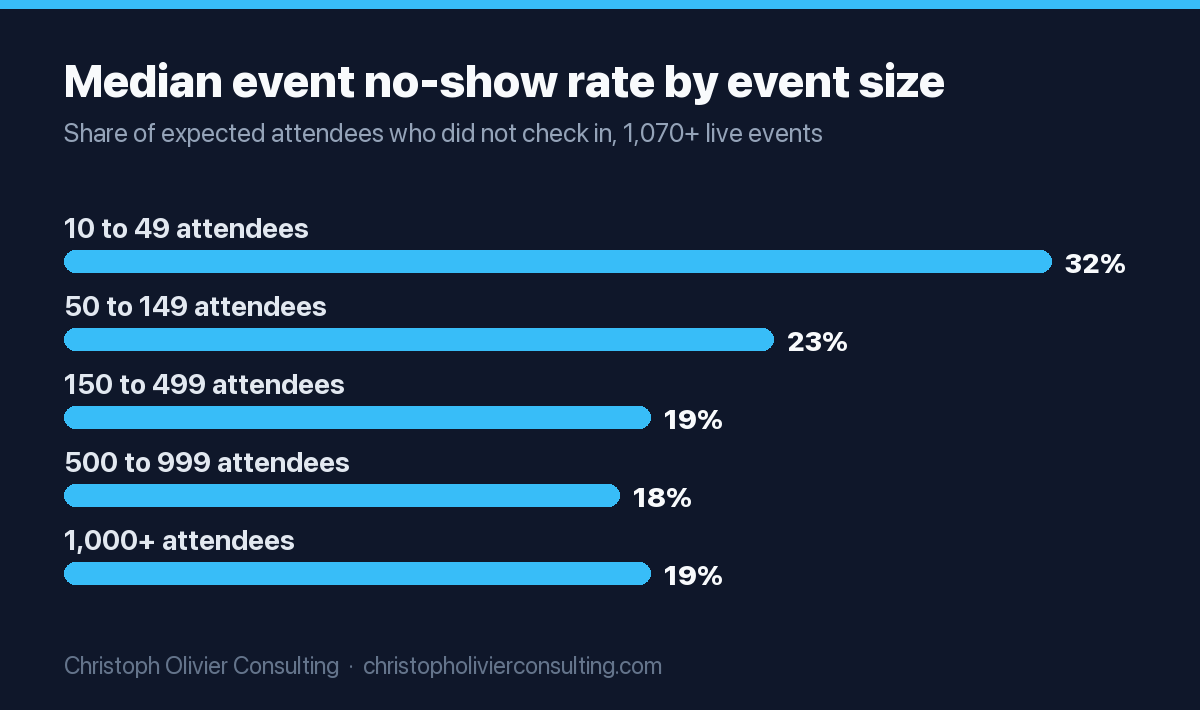
The same report, which calculated no-shows as one minus check-ins divided by expected attendees, found paid events had a median no-show rate of about 17%, and smaller events had higher rates than larger ones (PheedLoop Event Data Lab Report #05, April 2026). That matters for professional-service firms, because most client seminars are small and free, which is the highest-risk combination in the data.
Set the registration target
Use this formula: registration target = seats you want filled ÷ (1 minus expected no-show rate). For 40 filled seats at a 37% expected no-show rate, that is 40 ÷ 0.63, or about 64 registrations. If your own past events show a different rate, use yours instead of the benchmark.
Reminder sequence that protects attendance
- Immediately: confirmation email with calendar invite and the promise restated.
- 7 days out: a “what to expect” email with one piece of preparation, such as a question to bring.
- 1 day out: logistics reminder with parking, link or agenda.
- Morning of, or 1 hour before for virtual: short reminder with the join link or address.
- Priority registrants: a personal email or call from the host in the final week.
Small commitments help too: ask registrants to submit a question in advance. For free events, consider a modest charge or refundable deposit where your profession’s rules allow it, since paid events in the PheedLoop data had lower no-show rates.
Day-of event marketing tactics
On the day, your marketing job is to capture who came, give attendees one clear next step and create material for follow-up. Everything else is logistics. Decide in advance what the next step is, who offers it, and how it gets recorded, so nobody improvises it in the room.
- Check-in data: record attendance in the same system as registrations so follow-up can split attendees from no-shows.
- One offer: a consultation, assessment or review with a clear reason to book now. Our guide on how to structure a webinar offer applies to in-person seminars too.
- Book in the room: bring a scheduling link on a printed card or slide, and staff who can book on the spot.
- Content capture: note the questions asked; they are your next articles.
Financial advisors have refined this into a repeatable format, covered in our guide to dinner seminar marketing for financial advisors.
Post-event follow-up and pipeline attribution
Follow up with attendees within 24 hours and with no-shows separately, then attribute every resulting meeting and opportunity to the event in your CRM. Without attribution, you cannot compare one event against another, or events against other channels, and next year’s budget will be set by opinion.
Follow-up by segment
- Attendees who booked: confirmation and a short preparation note before the meeting.
- Engaged attendees who did not book: personal note from the speaker, slides and the offer again.
- Other attendees: recap email with recording and a three-to-five email nurture sequence. Our email drip campaign examples include sequences you can adapt.
- No-shows: “sorry we missed you” email with the recording or key takeaways and an invitation to the next event.
Attribution that holds up
- Create one CRM campaign per event and attach every registrant, with status: registered, attended, no-show.
- Use a tracked registration link per channel and partner so you know where attendees came from.
- Tag any meeting booked within a set window, such as 60 days, as event-sourced or event-influenced.
- Report pipeline and closed revenue at 30, 90 and 180 days, since professional-service sales cycles are often longer than a month.
- Divide total event cost by attendees and by meetings booked to compare against your other channels.
Event marketing plan template
Use this event marketing plan template as a one-page brief. Copy it into a document, fill in each line before promotion starts, and share it with everyone involved, including partners. If you cannot fill in a line, that is the decision to make next, not a detail to skip.
| Section | Fill in |
|---|---|
| Event name, date, format | [Name], [date and time zone], [in-person / virtual / hybrid], [venue or platform] |
| Primary goal | [One outcome, for example: 8 consultations booked within 14 days] |
| KPI targets | Registrations [ ], attendance rate [ ]%, meetings booked [ ], pipeline [$ ], cost per attendee [$ ] |
| Audience | [Role, company type, situation]. Not for: [who to exclude] |
| Promise | In [length], you will [outcome], so you can [decision or result]. |
| Speakers and co-hosts | [Names, credentials, what each partner promotes and receives] |
| Channels and targets | Email [ ] registrations, invitations [ ], partners [ ], social [ ], paid [ ], PR [ ] |
| Budget | Venue/platform [$ ], promotion [$ ], materials [$ ], food [$ ], total [$ ] |
| Timeline | Launch [date], 4-week checkpoint [date], final push [date], follow-up complete [date] |
| Attendance plan | Expected no-show rate [ ]%, registration target [ ], reminder dates [ ] |
| Day-of offer | [What attendees are invited to do next, who offers it, how it is booked] |
| Follow-up | Attendees [what, when], no-shows [what, when], owner [name] |
| Attribution | CRM campaign [name], tracking links [yes/no], report dates [30/90/180 days] |
Worked example: a 40-seat tax planning seminar
Here is how the template fills in for a hypothetical accounting firm running a free, in-person year-end tax planning breakfast for business owners. The numbers are illustrative planning inputs, not results.
- Goal: 8 planning consultations booked within 14 days.
- Audience: owners of profitable service businesses with 5 to 50 employees in the firm’s metro area. Not for existing tax clients, who get a separate client briefing.
- Promise: “In 75 minutes, you will see the five year-end moves worth checking for your business, so you can decide what to do before December 31.”
- Registration target: 40 seats ÷ (1 minus 0.37) is about 64 registrations, using the small free event median from the PheedLoop data.
- Channels: email to the firm’s prospect list, personal invitations from partners, a co-host (a business bank) promoting to its clients, and LinkedIn posts from the presenting partner.
- Timeline: launch 8 weeks out, checkpoint at 4 weeks, personal follow-up to non-responders at 2 weeks, reminder sequence in the final week.
- Day-of offer: a 30-minute year-end review, booked on cards at each table.
With 40 attendees, the 8-consultation goal implies a 20% attendee-to-consultation rate. If the firm has run similar events before, it should replace that assumption with its own history.
An event marketing plan works best inside a wider plan for how your firm wins clients. If you want a second set of eyes on your next event or on the marketing plan around it, you can book a consultation and we can walk through it together.
Frequently asked questions
What is an event marketing plan?
An event marketing plan is a written schedule that connects one event goal to a defined audience, a clear promise, a channel mix and a dated timeline. It sets KPI targets, a reminder sequence that protects attendance and the follow-up that turns attendees into meetings and pipeline. It is separate from the logistics plan, which covers venue, catering and AV.
How far in advance should you start marketing an event?
For most in-person business events, start planning about 12 weeks out and launch promotion around 8 weeks out, with the heaviest push in the final 2 weeks. Webinars can work on a 4 to 6 week timeline. Conferences that require travel need a longer front end so attendees can get approval and book flights.
How many people should I register to fill my event?
Divide the seats you want filled by one minus your expected no-show rate. PheedLoop's 2026 analysis of more than 1,070 events found a median no-show rate of about 20%, about 28% for free events and about 37% for small free events. To fill 40 seats at a 37% rate, aim for about 64 registrations.
What should an event marketing plan template include?
A useful template covers the event name, date and format, one primary goal, KPI targets, the audience and who it is not for, a one-sentence promise, speakers and co-hosts, channel targets, budget, timeline checkpoints, the no-show buffer and reminder dates, the day-of offer, follow-up by segment and how results will be attributed in your CRM.
What are the best channels to promote an event?
Start with the channels you own: your email list and personal invitations to top clients and prospects. Add partners who share your audience, then social posts from the speaker. Use paid social or search and PR when your own list cannot supply enough registrations. Track each channel with its own registration link.
How do you measure event marketing ROI?
Create one CRM campaign per event, attach every registrant with a registered, attended or no-show status, and tag meetings booked within a set window as event-sourced. Report pipeline and closed revenue at 30, 90 and 180 days, and compare cost per attendee and cost per meeting against your other channels.
How do you reduce no-shows at a free event?
Send a confirmation with a calendar invite, a reminder a week out, a reminder the day before and one on the morning of the event. Personally contact your most important registrants. Ask for a small commitment, such as a question to bring. Where appropriate, a modest fee or refundable deposit can help, since paid events show lower no-show rates.
More Growth Consulting guides
- Customer Lifetime Value: How to Calculate and Raise CLV
- Med Spa Marketing: How to Attract and Keep Clients in 2026
- What Is Inbound Marketing? Modern Playbook
- What a Full-Service Website Actually Includes (2026 Buyer’s Guide)
- Franchise Marketing: How to Balance National Brand and Local Demand
- Marketing Strategy Framework for Service Businesses
- All Growth Consulting guides →