
Last reviewed: October 2026
To structure a webinar offer, decide what single next step you are selling, then present it in a fixed order: the outcome, what is included, who it is for, the price with an honest anchor, a risk reducer, a real deadline and one clear action. For consultants, agencies and professional-service firms, that next step is usually a scoped strategy session, a paid diagnostic or an entry engagement, not a course.
This guide covers the offer itself, not webinar logistics. You get a decision table, pricing and bonus rules, the FTC lines on urgency and testimonials, a slide-by-slide pitch outline, a follow-up sequence and a fill-in template. If you need the wider plan first, start with your webinar marketing strategy and come back here when you are ready to build the pitch.
What is a webinar offer, and why do most webinars skip it?
A webinar offer is the specific, priced next step you invite attendees to take at the end of the session, with a deadline and a single action. It is different from the webinar’s promise, which gets people to register. Many B2B webinars never make a real offer: they teach, take questions and end, leaving the buying decision to chance.
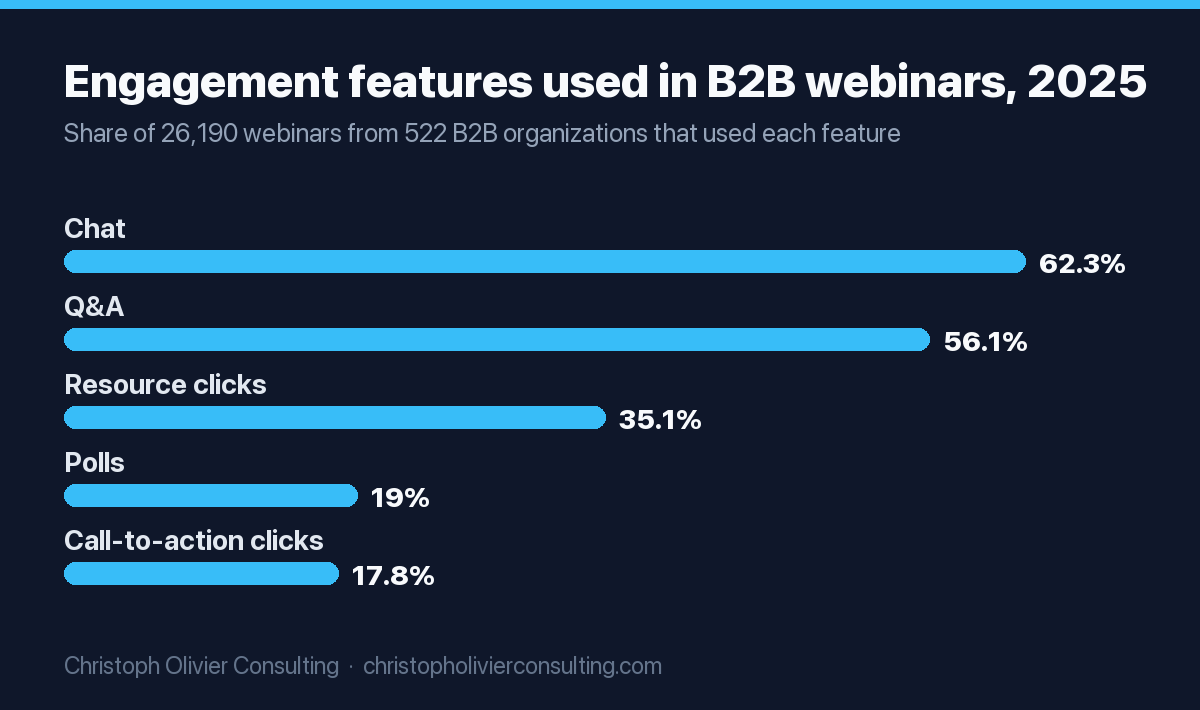
The data points the same way. In the Goldcast 2026 B2B Webinar Benchmark Report, which analyzed 26,190 webinars hosted by 522 B2B organizations in 2025, call-to-action clicks were used in only 17.8% of webinars. Chat (62.3%) and Q&A (56.1%) were far more common. Feature usage is not the same as making an offer, but it matches what you see in practice: teams invest in the content and under-invest in the ask.
The registration promise qualifies people at the door; the offer converts the qualified ones at the end. If you have built the registration side using our playbook for a webinar that books sales calls, this page is the second half.
What should you sell at the end of a webinar?
Sell the smallest next step that a qualified attendee can say yes to within a week, and that leads naturally to your core engagement. For most service firms that means a free strategy session, a paid diagnostic, a group program or a done-for-you package. Match the offer to your price point and to how ready the audience is to buy.
| Offer type | Best fit | What the attendee commits | Main strength | Watch out for |
|---|---|---|---|---|
| Free strategy session | High-ticket, custom services with a considered buying process | 30 to 45 minutes and an intake form | Lowest friction; lets you qualify one to one | No-shows and poor fits unless you qualify with an application |
| Paid diagnostic or audit | Firms whose expertise shows in an assessment (accounting, legal, marketing, IT) | A fixed fee for a fixed scope | Filters for buyers; the fee can be credited toward a larger engagement | Scope creep; define the deliverable in writing |
| Group program or cohort | Coaches, trainers and firms that have productized a method | Program fee plus time each week | Can close on the webinar itself; scales delivery | Delivery capacity, refund terms, start-date logistics |
| Done-for-you package | Agencies with a productized service | Project fee or retainer | Highest value per sale | Rarely closes on the webinar alone; usually needs a call |
A useful rule: the higher the price and the more custom the work, the more the webinar should sell a conversation, not the engagement itself. Few people sign a five-figure retainer from a slide, but many will book a call or pay a modest fee to find out whether it makes sense.
Free strategy session or paid diagnostic?
A free session works when your calendar has room and a short application (revenue, role, timeline) screens people out. A paid diagnostic works when your calendar is the constraint. The fee screens out browsers, the deliverable shows your thinking, and a fee credit removes the feeling of paying twice. My own bias for professional-service firms is the paid diagnostic, because it turns a sales call into a piece of delivered work.
What are the parts of a webinar offer?
A complete webinar offer has seven parts: a named offer, the outcome it produces, what is included, who it is and is not for, the price and payment terms, a risk reducer, and a real reason to act now. If any part is missing, attendees fill the gap with doubt, and doubt usually turns into “later”.
- A name. “The Cash Flow Diagnostic” is easier to remember, discuss with a partner and search for in an inbox than “a call with us”.
- The outcome. One sentence describing what changes for the client. This is your value proposition compressed; if it is fuzzy, work through a value proposition exercise before you write any slides.
- What is included. Deliverables, sessions, timelines and access. Be concrete: “a 13-week forecast and a 45-minute readout” beats “full financial clarity”.
- Who it is for, and who it is not for. Naming the poor fit makes the good fit feel seen and saves you from bad-fit sales calls.
- Price and terms. The actual number, payment options and any credit toward future work.
- A risk reducer. A refund policy, a fee credit or a pause option. Write terms you will honor every time.
- A reason to act now, and one action. A real deadline or capacity limit, plus a single link or button. Two calls to action split attention.
How should you price and anchor a webinar offer?
Anchor the price against something real: your standard fee for the same work, the cost of the problem, or the cost of the alternative path. Then state the actual price plainly, with payment terms. Avoid inflated “total value” figures you have never charged, because fictitious reference prices are a recognized deceptive pricing practice under FTC guidance.
The FTC’s Guides Against Deceptive Pricing (16 CFR 233.1) say a former price is a legitimate basis for comparison only when it is the actual, bona fide price at which the item was offered to the public on a regular basis for a reasonably substantial period. A stack slide that says “total value $27,000, yours for $2,000” invites exactly the question those guides raise: has anyone ever paid $27,000 for this? If not, drop the made-up number and anchor on something you can defend.
Anchors that hold up:
- Your real standalone rate. If you sell the diagnostic on its own at a set fee, the webinar price or bonus can be compared against that.
- The cost of the problem. Work it out live from the attendee’s own numbers, show your assumptions, and present a range rather than a single dramatic figure.
- The alternative path. What it typically costs in time or money to solve the problem another way, described honestly and without naming competitors.
Keep the structure simple: one offer with at most two options, such as pay in full or in installments, is easier to decide on live than three tiers. If you credit a diagnostic fee toward a larger engagement, say how long the credit lasts. This is general guidance, not legal advice; if your pricing claims are aggressive, have counsel review them.
Which bonuses actually help a webinar offer?
Good bonuses remove a specific objection or speed up the first result, and they are things you would genuinely deliver. Weak bonuses pad the stack with recycled PDFs and invented dollar values. Two or three relevant bonuses beat ten, and a bonus tied to a real deadline gives you honest urgency without inventing scarcity.
Map each bonus to the objection it answers:
- “It costs too much.” A payment plan, or crediting the fee toward the next engagement.
- “I don’t have time.” A done-with-you setup session so the client does not start alone.
- “I’m not sure it fits my situation.” A short pre-start fit review, with a clear exit if it does not fit.
- “I need to ask my partners.” A one-page summary written for the other decision makers, or a short briefing call with them. In partner-led firms this bonus often matters more than any discount.
- “I’ll decide later.” A bonus that is only available to people who decide by a stated date, and that you actually withdraw afterwards.
How do you add urgency without fake scarcity?
Use only deadlines and limits that are true and that you enforce: a cohort start date, a fixed number of slots your team can actually staff, a bonus that genuinely expires, or a price change on a stated date. Never use a countdown timer that resets or an “ends tonight” claim for an offer that does not end.
The FTC staff report Bringing Dark Patterns to Light (September 2022) lists both of the common webinar tricks as dark patterns. A “Baseless Countdown Timer” is described as a fake countdown clock that goes away or resets when it times out. A “False Limited Time Message” is an offer described as good only for a limited time, but without a deadline or with a meaningless deadline that resets when reached.
Real reasons to act now for a service firm:
- Capacity. “We run eight diagnostics a month because two analysts deliver them.” True, specific and checkable.
- Calendar. A cohort that starts on a date, or a fee that changes at the start of a quarter.
- Bonus expiry. The partner briefing call is included for decisions made by a named date.
Automated and evergreen webinars need extra care. If each registrant gets a personal deadline, it must actually close for that person. A replay page that says “available for 48 hours” while the same offer stays open indefinitely is the false limited-time message the FTC describes.
How do you use proof and testimonials in the pitch safely?
Use real clients, with permission, describing results that are representative or clearly qualified. Under the FTC Endorsement Guides, a consumer testimonial about a key result is likely to be read as typical of what buyers generally achieve. If it is an outlier, you need substantiation or a clear disclosure of what people can generally expect.
The rule sits in 16 CFR 255.2. Separately, the FTC’s Consumer Reviews and Testimonials Rule, in effect since October 21, 2024, prohibits fake testimonials, including those that misrepresent that the person had experience with the service or misrepresent what that experience was, and it authorizes courts to impose civil penalties for knowing violations. Licensed professions such as law, accounting and financial advice can carry extra rules on testimonials and past results, so check with your regulator or bar before you put client outcomes on a slide.
Proof that does not depend on outcome claims often works just as well in a webinar:
- Process proof. Show the actual framework, checklist or template you use with clients.
- Live demonstration. Walk through an anonymized or permission-granted example during the teaching section.
How should the last 15 to 20 minutes of the webinar be structured?
Give the final 15 to 20 minutes a fixed sequence: bridge from the teaching, name the offer, show what is included and who it fits, reveal the price, reduce the risk, state the deadline, make one ask, then take questions with the offer still on screen. Script and rehearse it, because this is the part most presenters improvise.
Timing context: Goldcast’s 2025 data put the average B2B webinar at 56.8 minutes, and 50.5% of events ran exactly 60 minutes. In a one-hour slot, that leaves roughly 35 to 40 minutes of teaching before the offer, which is enough to deliver one complete idea well.
| Slide | Approx. minute (60-min webinar) | What you say | Job of the slide |
|---|---|---|---|
| 1. Recap | 40 | The three things they learned, in one line each | Close the teaching loop |
| 2. Two paths | 41 | “You can do this yourself with what you learned today, or get help to do it faster. Both are valid.” | Permission to pitch without pressure |
| 3. Offer name and outcome | 42 | The named offer and the one-sentence outcome | Make it concrete and memorable |
| 4. What is included | 43 to 45 | Deliverables, sessions, timeline | Remove ambiguity |
| 5. Who it is for and not for | 45 | Fit criteria and honest exclusions | Self-qualification |
| 6. Proof | 46 to 47 | Process proof or a compliant client example | Credibility |
| 7. Price and anchor | 48 | Real anchor, then the price and terms | Clarity, no surprises |
| 8. Bonuses and risk reducer | 49 | Each bonus and the objection it answers; refund or credit terms | Lower perceived risk |
| 9. Deadline | 50 | The real date or capacity limit, and why it exists | Honest urgency |
| 10. The ask | 51 | One link, what happens after they click, what to do now | Action |
| 11. Q&A with offer pinned | 52 to 60 | Answer questions; return to the link after objection answers | Handle objections live |
The transition from teaching to offer
The handoff is where most pitches lose the room. Two habits help. First, announce the structure at the start: “I’ll teach for about 40 minutes, take ten minutes to show how we help, then answer questions.” Nobody feels ambushed. Second, make doing it yourself a real option. When the do-it-yourself path is credible, the offer reads as a faster route, not a trap.
During Q&A, answer the four predictable objections even if nobody asks: price, time, fit and “I need to think about it”. Keep the link on screen and say what happens after someone clicks.
What follow-up sequence should come after a webinar offer?
Follow up by behavior, not just attendance. Buyers, people who clicked but did not buy, people who stayed through the pitch, people who left early and no-shows each need different messages. Run the sequence until the real deadline, then stop pitching that offer and move everyone into your regular nurture.
Most registrants never see the live pitch. In Goldcast’s data, live attendance was 40% of registrants, 89.1% of webinars were offered on demand, and the on-demand completion rate (91%) was higher than the live completion rate (74%). The replay and the emails have to carry the offer on their own. Our roundup of webinar statistics has more benchmarks if you are setting targets.
- Within an hour: replay link, the offer summary, the deadline and the single action. Send to everyone who registered.
- Day 1: an objection email that answers the top questions from Q&A in writing.
- Day 2: proof email with process detail or a compliant client example.
- Day 3: a short personal note from the presenter to high-intent contacts: those who clicked the offer, stayed through the pitch or asked a question.
- The day before the deadline: a reminder of what closes and when.
- Deadline day: a final notice, sent in the morning, not at 11:58 pm.
- After the deadline: confirm it has closed, then move non-buyers into regular nurture with no further pressure on this offer.
Build these branches as funnel automations in your CRM, so tags from the webinar platform (attended, clicked, watched replay) trigger the right path without manual list work. If you run webinars as a repeatable channel rather than one-off events, the same sequence becomes part of a webinar funnel you can measure month to month.
Fill-in webinar offer template
Write your offer with this template before you build a single slide. If you cannot fill a line with something specific and true, the offer is not ready. Each line maps to one slide in the pitch section above, so the finished template doubles as your pitch outline and your follow-up email copy.
- Offer name: ____________________
- Outcome (one sentence): After this, you will have ____________ so that you can ____________.
- What is included: (1) ________ (2) ________ (3) ________, delivered over ____ weeks.
- Who it is for: ____________________
- Who it is not for: ____________________
- Honest anchor: our standard rate / the cost of the problem / the alternative path is ____________.
- Price and terms: $______, payable ______; credited toward ______ if you proceed within ____ days.
- Risk reducer: ____________________ (terms you will honor every time)
- Bonus 1 (objection it answers): ____________________
- Bonus 2 (objection it answers): ____________________
- Real deadline or limit, and why it exists: ____________________
- One action: Go to ______ and ______. Next, you will ______.
Worked example (illustrative)
Here is the template filled in for a hypothetical fractional CFO firm that runs a webinar for owners of multi-location dental groups. The firm, numbers and terms are invented for illustration.
- Offer name: The Cash Flow Diagnostic.
- Outcome: After this, you will have a 13-week cash forecast and a ranked list of margin leaks, so that you can decide on your next location with real numbers.
- What is included: a data request checklist, a 90-minute working session, a written report and a 45-minute readout with you and your partners, delivered over three weeks.
- Who it is for: groups with three or more locations and a bookkeeper already in place.
- Who it is not for: single-location practices, or anyone without twelve months of clean books.
- Honest anchor: the diagnostic is sold on its own at the same fee all year; the webinar adds a bonus, not a fake discount.
- Price and terms: $2,500, credited in full toward a retained engagement started within 30 days.
- Risk reducer: if you decide after the working session that the diagnostic is not useful, the firm refunds the fee.
- Bonus: a partner briefing call for groups that book by the stated date (answers “I need to ask my partners”).
- Real limit: eight diagnostics per month, because two analysts deliver them.
- One action: go to the booking page, complete the five-question intake, and pick a working-session date.
Notice what is missing: no invented “total value”, no resetting timer, no savings promise. It still has a name, a price, a reason to act and one next step.
A strong webinar offer is mostly decided before the webinar: what you sell, at what price, for whom and by when. If you would like a second set of eyes on your offer before your next session, you can book a consultation and we can work through it together.
Frequently asked questions
What is the best offer to make at the end of a webinar for consultants?
For most consultants and professional-service firms, the best webinar offer is a small, scoped next step: a free strategy session with a qualifying application, or a paid diagnostic whose fee is credited toward a larger engagement. High-ticket custom work rarely closes from a slide, so sell the conversation or the diagnostic rather than the full retainer.
How long should the pitch section of a webinar be?
Plan 15 to 20 minutes for the offer and Q&A combined, with roughly 10 minutes for the pitch itself. In a 60-minute slot that leaves about 35 to 40 minutes of teaching. Goldcast's 2025 data put the average B2B webinar at 56.8 minutes, with half of events running exactly an hour.
Should I reveal the price on the webinar?
If attendees can buy or pay a deposit directly from the webinar, yes: state the actual price and payment terms plainly after a real anchor. If the offer is a free strategy session for custom work, you can give a typical fee range instead. Hiding the price entirely tends to push the decision to later.
Is it legal to use a countdown timer on a webinar offer?
A countdown timer is fine when the deadline is real and enforced. The FTC's 2022 dark patterns staff report lists baseless countdown timers that reset and false limited-time messages as dark patterns. If you use per-registrant deadlines on an evergreen webinar, the offer must actually close for that person. This is general information, not legal advice.
How many bonuses should a webinar offer include?
Two or three is usually enough. Each bonus should answer a specific objection, such as price, time, fit or getting partner buy-in, and should be something you would genuinely deliver. Avoid padding the offer with low-value extras and invented dollar values, which can make a premium service look less credible.
What should I do if nobody buys during the live webinar?
Treat the live session as the start of the sale, not the whole sale. Most registrants never attend live, so the replay and a behavior-based email sequence carry much of the offer. Send a personal note to people who clicked or stayed through the pitch, answer objections in writing, and close the offer on the stated deadline.