
Last reviewed: October 2026
The clearest affiliate marketing examples are Amazon Associates (category commissions from 0% to 10%), the Shopify Affiliate Program (up to $150 per qualified referral), HubSpot (30% recurring for up to a year) and publishers like Wirecutter that earn a commission when readers buy what they recommend. Each one pays a partner only after a tracked click turns into a sale, sign-up or paying customer.
This page breaks down 12 real programs and publishers, with commission terms taken from each program’s own page and checked in October 2026. You will see which payout model each uses, why it works for that business, what the FTC requires when you publish affiliate links, and how a service firm can turn the same mechanics into its own partner program.
What are affiliate marketing examples?
Affiliate marketing examples are real arrangements where a business pays an outside partner for a measurable result, usually a sale, a trial or a qualified sign-up, that the partner drove through a tracked link or code. The partner can be a blogger, a creator, a review site, a software tool or another business.
Every example on this page has the same four moving parts:
- The merchant (Amazon, Shopify, HubSpot) sets the commission and the rules.
- The affiliate (a publisher, creator, consultant or agency) sends qualified buyers.
- The tracking layer (a cookie window, a referral code, or a network such as Impact or PartnerStack) records who referred whom.
- The customer buys, and the merchant pays the affiliate after the sale clears.
What changes from program to program is the payout model, the attribution window and who may join. If you want the market-size and performance numbers behind the channel, see our roundup of affiliate marketing statistics.
12 affiliate program examples compared (2026 terms)
The 12 affiliate program examples below cover retail, hosting, SaaS, publishers and a B2B partner program. Commissions range from a flat $65 per hosting sale to 50% of a customer’s first-year subscription. Cookie windows run from 30 to 180 days. All terms come from the program pages linked in each section, checked October 2026.
| Program | Category | Payout model | Headline commission | Attribution window | Network |
|---|---|---|---|---|---|
| Amazon Associates | Retail | Revenue share (CPS) | 0% to 10% by product category | Not stated on rates page | In-house |
| Shopify Affiliate Program | E-commerce SaaS | Flat bounty (CPA) | Up to $150 per qualified referral | 30 days (trials tracked up to 400 days) | In-house |
| Bluehost | Web hosting | Flat bounty (CPA) | $65 per qualified sale | 30 days | Impact |
| Semrush | SEO SaaS | Flat bounty, tiered by volume | $200 to $350 per SEO Toolkit sale; $10 per trial | 120 days, last click | Impact |
| HubSpot Affiliate Program | CRM SaaS | Recurring revenue share | 30% recurring for up to 1 year | 180 days | Impact |
| Kit (formerly ConvertKit) | Email SaaS | Recurring revenue share | 50% for 12 months, then 10% to 20% for top tiers | Not stated | PartnerStack |
| ActiveCampaign | Email/CRM SaaS | Recurring revenue share | 20% rising to 30% for up to 12 months | Not stated | PartnerStack |
| Webflow | Website SaaS | Recurring revenue share | 50% for up to 12 months, plus renewal bonus tiers | 90 days, first touch | PartnerStack |
| Notion | Productivity SaaS | Hybrid (bounty plus share) | Up to $50 per activated sign-up plus 20% of year-one revenue | 180 days, last click | PartnerStack |
| HubSpot Solutions Partner Program | B2B services partner | Multi-year revenue share plus services revenue | 20% for 3 years on deals partners bring | Deal registration | In-house |
| Wirecutter (New York Times) | Publisher | Earns commissions from retailers | Varies by retailer | Retailer’s terms | Multiple, including Awin |
| RTINGS.com | Publisher | Affiliate commissions plus paid memberships | Varies by retailer | Retailer’s terms | Multiple |
Treat the table as a snapshot. Programs change terms or close to new applicants, so confirm on the live program page before you plan around any number.
Retail and e-commerce affiliate marketing examples
Retail and e-commerce programs pay either a percentage of the order (Amazon) or a flat fee per new paying merchant (Shopify, Bluehost). Percentage models suit huge catalogs with thin margins. Flat bounties suit products where one new customer is worth a lot over time, so the merchant can afford to pay a fixed, predictable amount up front.
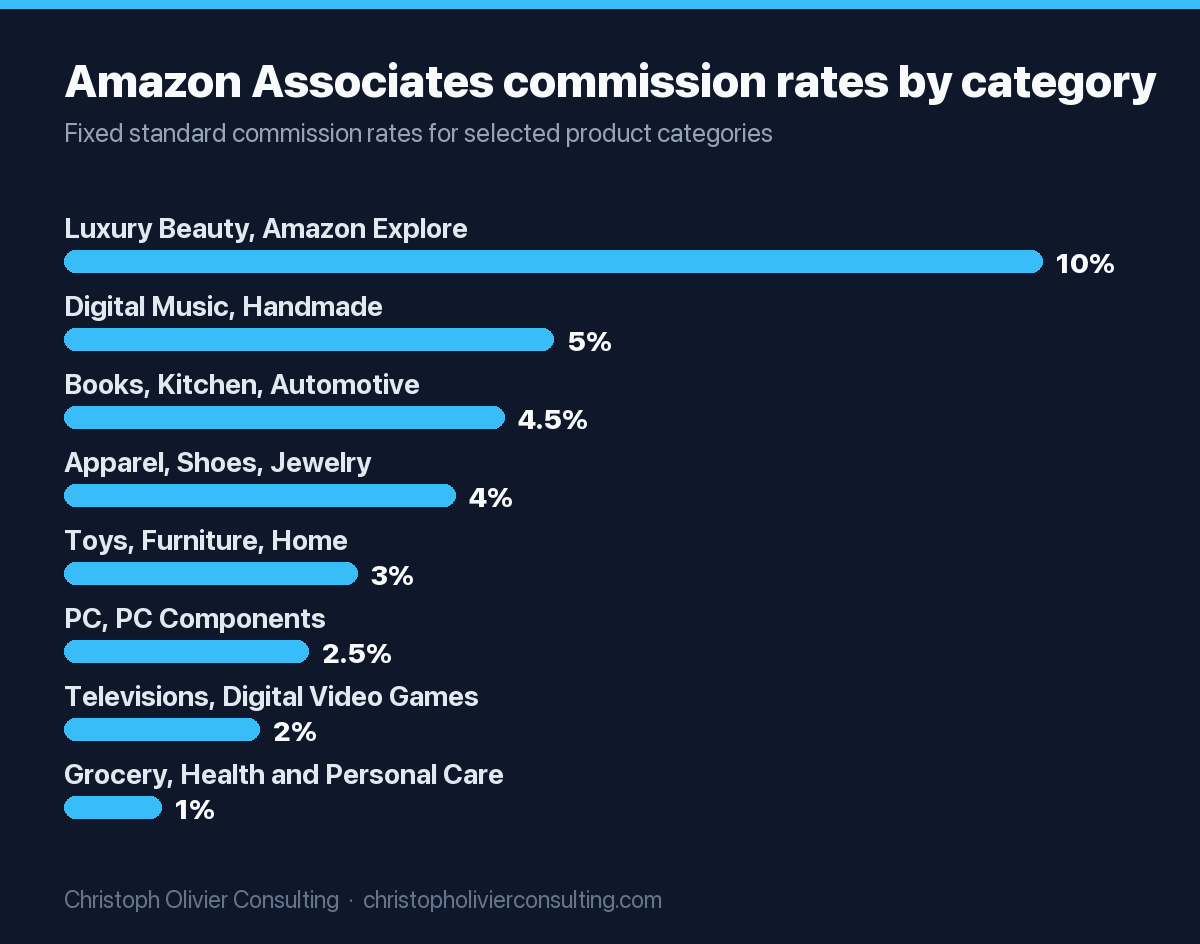
Amazon Associates
Amazon Associates is the reference point most people mean by affiliate marketing. Its standard commission income rates are fixed by category: 10% for Luxury Beauty and Amazon Explore, 4.5% for physical books, kitchen and automotive, 4% for apparel, shoes, jewelry and “all other categories,” 3% for toys, furniture and home, 2% for televisions and 1% for grocery and health and personal care. Gift cards, wireless plans and several other categories pay 0%.
Why it works: the conversion rate on Amazon is the selling point, not the rate card. Affiliates earn on whatever the visitor buys, but low per-order rates mean Amazon suits high-traffic review content more than niche B2B sites. Amazon also requires a fixed disclosure line in its Associates Operating Agreement: “As an Amazon Associate I earn from qualifying purchases.”
Shopify Affiliate Program
The Shopify Affiliate Program pays “up to $150 USD per qualified referral,” with the amount varying by the referral’s location and “no commission caps.” Tracking lasts 30 days from the click, but if the referral starts a free trial, Shopify tracks the store for up to 400 days to see whether it becomes a paying store.
Why it works: Shopify recruits by audience type (creators, course makers, publishers, migration experts, app partners), and the long trial window matches how merchants buy: test, stall, launch later.
Bluehost
Bluehost pays “$65 for each qualified sale,” uses a 30-day cookie and runs on Impact. It states that commissions are processed 45 to 70 days after a sale.
Why it works: hosting is a classic “how to start a website” recommendation, and a flat bounty is easy for tutorial writers to understand. The payout delay protects the merchant against refunds.
SaaS affiliate program examples with recurring commissions
SaaS companies usually pay a share of subscription revenue for a set period, commonly 12 months, instead of a one-time fee. That aligns the affiliate with retention: a partner who sends customers who stay earns more than one who sends sign-ups that churn. Semrush is the exception, paying flat bounties that rise with volume.
HubSpot Affiliate Program
The HubSpot Affiliate Program offers “30% recurring commission for up to one year and a 180-day cookie window,” runs on Impact, and has three tiers based on monthly sign-ups: Starter (0 to 29), Sprocket (30 to 99, with an optional cost-per-sign-up model) and Elite (100+, custom commission). The 180-day window fits a long B2B buying cycle.
Semrush
The Semrush affiliate program pays per product and per loyalty tier: an SEO Toolkit sale earns $200 at the Basic tier up to $350 at Platinum, a Semrush One sale earns $300 to $450, and most trials earn $10. It uses a 120-day cookie with last-click attribution, and tiers are based on quarterly sales volume (0 to 4 sales for Basic, 50+ for Platinum).
Kit (formerly ConvertKit)
Kit’s affiliate program pays “50% commission for 12 months” on referred paying customers. After the first year, affiliates who refer at least 10 paying customers a year can keep earning an extra 10% (Bronze), 15% (Silver) or 20% (Gold) recurring. Referrals driven by paid ads such as pay-per-click do not count toward tier qualification.
ActiveCampaign
ActiveCampaign describes a commission “starting at 20% commission and climbing up to 30% based on new business and retention,” paid on the subscription price for up to 12 months, through PartnerStack. Tying the rate to retention is the detail worth copying.
Webflow
The Webflow Affiliate Program pays a 50% revenue share on a new customer’s first subscription for up to 12 months, with first-touch attribution and a 90-day cookie. Pro and Premium affiliates earn an extra 10% or 15% for up to 12 more months if the customer renews. Webflow also excludes freelancers and agencies from the affiliate program and states that one-to-one client referrals are not eligible; those go to its separate partner program.
Notion
Notion’s program is a hybrid: “up to $50 per activated sign up plus 20% of year one revenue.” Workspaces that upgrade within 180 days of the click qualify, attribution is last click, and Notion may claw back the reward if the customer downgrades or is refunded within the first two months. When checked in October 2026, the page said the program was not accepting new affiliates, a reminder that even well-known programs open and close.
Successful affiliate marketing examples on the publisher side
The most successful affiliate marketing examples on the publisher side are review sites that earn trust first and commissions second. Wirecutter and RTINGS both make money when readers buy through their links, and both publish how that money is kept away from the recommendation itself. That separation is the asset.
Wirecutter
According to an Awin profile of Wirecutter, the site was founded in 2011 by Brian Lam and acquired by The New York Times in 2016 for more than $30 million, and affiliate revenue has been “a cornerstone source of revenue for Wirecutter since its inception.” The same profile says the commerce team “operates completely independently from editorial, with the journalists unaware of any commercial agreements in place.” The lesson: readers pay you in trust before any retailer pays you in commission.
RTINGS.com
RTINGS states plainly that “when you purchase through links on our site, we may earn an affiliate commission,” and it also sells memberships. Its how-we-make-money page shows a running count of products it has bought and tested (close to 5,000 when checked). Buying its own test units gives its links a credibility a generic “best of” list cannot match.
As affiliate marketing website examples, both show the same pattern: a narrow promise, a visible testing method and a disclosure on every page.
B2B and service-business partner program examples
For B2B and service businesses, the strongest examples look less like coupon links and more like partner programs: a smaller group of trusted firms that refer or co-sell, paid a revenue share over years, with deal registration instead of cookies. HubSpot’s Solutions Partner Program is the clearest public example of that model.
The HubSpot Solutions Partner Program targets “service firms, consultancies, and agencies.” Partners earn a “20% commission for 3 years for deals they bring to HubSpot” plus 20% for one year on certain upmarket deals co-sold with HubSpot’s sales team. The page cites typical client engagements of $10k to $500k a year. The membership package starts at $400 a month.
Put that next to HubSpot’s own affiliate program (30% for up to one year) and you see the split most B2B companies make:
- Affiliates are content-driven, high volume and paid for a short window.
- Partners are relationship-driven, lower volume and paid longer because they also implement, retain and expand the account.
Webflow draws the same line by sending agencies to its partner program instead of its affiliate program. If you run a professional-service firm, the partner side is usually the more useful model to copy, because your buyers rarely click a link and buy a $5,000 engagement. For the broader playbook, see our guides to partnership marketing and channel sales strategy.
One caveat for regulated professions: law, accounting and financial advice often have their own rules on paying for referrals. Check your state bar, board of accountancy or regulator before you offer anyone a fee for sending you clients.
What successful affiliate programs have in common
Successful affiliate programs match the payout to what a customer is worth, set the tracking window to the real buying cycle, recruit partners who already have the right audience, and protect themselves with clear rules on refunds, paid search and attribution. The examples above vary in size, but these four choices repeat across almost all of them.
| Your situation | Payout model that usually fits | Example on this page | Watch out for |
|---|---|---|---|
| Large catalog, thin margins, impulse purchases | Percentage of order | Amazon Associates | Low per-order earnings make it hard to attract niche experts |
| High lifetime value, predictable onboarding | Flat bounty per paying customer | Shopify, Bluehost, Semrush | Paying for customers who refund; use a holding period |
| Subscription with churn risk | Recurring share for 12 months | HubSpot, Kit, ActiveCampaign, Webflow | Cash cost spreads out; model 12 months of payouts |
| Free plan with paid upgrade | Hybrid: small bounty plus revenue share | Notion | Sign-ups that never upgrade; define “activated” carefully |
| High-ticket B2B or professional services | Multi-year revenue share or referral fee via registered deals | HubSpot Solutions Partner Program | Professional referral-fee rules; partner conflicts |
Volume tiers (Semrush, HubSpot, Kit, Webflow) reward the few partners who drive most results, while clawbacks (Notion) and payout delays (Bluehost) stop you paying for customers who leave fast.
FTC disclosure rules for affiliate links
US law requires affiliates to disclose clearly and conspicuously that they earn money from a link whenever that connection could affect how readers weigh the recommendation. The rule sits in the FTC’s Endorsement Guides at 16 CFR 255.5, and the FTC’s guidance says the disclosure should sit close to the link, not on a separate page.
The regulation reads: “When there exists a connection between the endorser and the seller of the advertised product that might materially affect the weight or credibility of the endorsement, and that connection is not reasonably expected by the audience, such connection must be disclosed clearly and conspicuously” (16 CFR 255.5). One of the official examples in that section describes a coffee-maker review blog that earns a share of sales through affiliate links and concludes the reviews “should clearly and conspicuously disclose the compensation.”
The FTC’s Endorsement Guides FAQ, which reflects the guides as revised in 2023, adds practical rules:
- Put the disclosure near the recommendation. The closer, the better.
- A disclosure only on an “About us” or separate disclosures page is not enough, because readers of a single post may never see it.
- The phrase “affiliate link” on its own may not be understood. Wording such as “paid link” next to the link is given as adequate.
If you run the program, you carry risk too. Write disclosure requirements into your affiliate terms, show partners approved wording and spot-check their pages. The same principle applies to creators you pay, which we cover in our influencer marketing strategy guide.
How to launch your own affiliate or referral program
To launch an affiliate or referral program, work out what a new customer is worth, set a payout and tracking window that fit your sales cycle, pick tracking software or a network, write terms that cover refunds and disclosure, then recruit a short list of partners whose audience already matches your buyer. Start small and adjust from real data.
- Calculate what a customer is worth. Use gross margin over a realistic lifetime, not revenue. That sets your ceiling.
- Choose the payout model. Use the decision table above. Flat bounties are easiest to explain; recurring shares align partners with retention; referral fees on registered deals fit high-ticket services.
- Set the attribution window. Match it to how long buyers take to decide. HubSpot uses 180 days, Semrush 120, Webflow 90, Shopify 30.
- Pick the tracking layer. High-volume programs tend to run on networks such as Impact or PartnerStack. A handful of referral partners can work with unique codes, intake-form questions and a CRM field.
- Write the terms. Cover qualification, payout timing, refund clawbacks, self-referrals, paid search on your brand, and the FTC disclosure you require.
- Recruit deliberately. Approach 10 to 20 partners who already serve your buyer before opening a public application. Shopify and Webflow both screen applicants by audience type.
- Equip partners. Give them a one-page explainer, approved claims and a named contact.
- Review quarterly. Track referred revenue, refund rate and cost per acquired customer by partner. Raise rates for partners who send customers who stay.
Formalizing the informal referrers you already have is often the fastest first step, and our referral marketing guide covers that side in detail.
Worked example: setting a referral fee for a service firm
A service firm can set a referral fee by starting from gross profit per client, deciding what share of that profit it would accept as acquisition cost, then expressing the fee in a form partners understand. The numbers below are illustrative assumptions, not benchmarks, so swap in your own figures.
Assume a firm sells a $3,000 a month retainer, keeps clients for an average of 18 months and runs at a 40% gross margin.
- Lifetime revenue per client: $3,000 x 18 = $54,000.
- Lifetime gross profit: $54,000 x 40% = $21,600.
- If the firm is willing to spend up to 25% of gross profit to win a client, the ceiling is $5,400.
That ceiling can be offered three ways: a flat $5,000 when the client signs and pays the first invoice (simple, like Bluehost or Shopify), 10% of fees for the first 12 months, which is $3,600 (like HubSpot’s or Kit’s recurring model), or a smaller upfront fee plus a share of year one (like Notion’s hybrid). The recurring version costs less and rewards partners for sending clients who stay. Either way, add a clawback if the client leaves inside 90 days, and check professional-conduct rules first if you are in a regulated field.
How to choose the right example to copy
Copy the example whose buyer looks most like yours, not the one with the biggest brand. If your customer buys online in one session, study Amazon and Shopify. If they subscribe and could churn, study HubSpot, Kit and Webflow. If they sign a five-figure engagement, study HubSpot’s Solutions Partner Program.
In my experience, service firms get the most from a small, well-run partner program before they ever need an affiliate network: a few complementary firms, a clear fee, a registration step and a quarterly review. If you want help deciding which model fits your firm and what you can afford to pay, you can book a consultation and we will work through the numbers together.
Frequently asked questions
What is an example of affiliate marketing?
Amazon Associates is the best-known example. A blogger or creator links to a product on Amazon, a reader clicks and buys, and Amazon pays the affiliate a commission set by product category, from 0% on gift cards to 10% on Luxury Beauty. The affiliate only earns when the tracked click turns into a qualifying purchase.
What are the most common affiliate commission models?
The three common models are a percentage of each order (Amazon), a flat bounty per new paying customer (Shopify, Bluehost, Semrush) and a recurring share of subscription revenue for a set period, often 12 months (HubSpot, Kit, Webflow). Some programs, like Notion, combine a small sign-up bounty with a share of first-year revenue.
Which affiliate programs pay recurring commissions?
Several SaaS programs pay recurring commissions. As of October 2026, HubSpot pays 30% recurring for up to a year, Kit pays 50% for 12 months with ongoing commissions for higher tiers, ActiveCampaign pays 20% rising to 30% for up to 12 months, and Webflow pays 50% for up to 12 months with renewal bonuses for top affiliates.
Do I have to disclose affiliate links?
Yes, in the US. The FTC's Endorsement Guides (16 CFR 255.5) require a clear and conspicuous disclosure when a material connection, such as a commission, could affect how readers weigh a recommendation. The FTC says the disclosure should sit close to the link, and a separate disclosures page alone is not enough.
Can a service business run an affiliate program?
Yes, but most service firms do better with a partner or referral program than a public affiliate program. Buyers of high-ticket services rarely click a link and purchase. A small group of complementary firms, a clear referral fee tied to registered deals, and a quarterly review usually fit better. Regulated professions should check referral-fee rules first.
How much commission should I offer affiliates?
Start from gross profit per customer over a realistic lifetime, decide what share you will accept as acquisition cost, and set the payout below that ceiling. Then match the format to your buyer: a flat fee for simple purchases, a recurring share for subscriptions, or a referral fee on registered deals for high-ticket services.
More Referrals & Partnerships guides
- Referral Marketing: How It Works and How to Build a Program
- How Fund Managers and Capital Raisers Get Cited by AI Search Without Violating Solicitation Rules
- How Fund Managers and GPs Build a Personal Brand That Attracts LPs
- Marketing for Capital Raisers
- Investor Update Email Templates for Fund Managers
- Referral Partner Outreach Templates for Accountants & Tax Firms
- All Referrals & Partnerships guides →