
Last reviewed: October 2026

A home care marketing agency is worth hiring when it can fill two pipelines at once: client inquiries from families and referral sources, and caregiver applicants to staff those cases. Expect to pay a monthly retainer plus ad spend, judge the agency on cost per start of care rather than clicks, and confirm it understands HIPAA, anti-kickback rules and Google’s health ad limits before you sign.
This guide compares your options fairly, shows the price data we could actually verify, and gives you a hiring checklist, red flags, the metrics to demand and a 90-day plan. It covers non-medical home care and Medicare-certified home health, and calls out where the rules differ.
Want a specialist to build this for your business? See how CO Consulting’s marketing services work, starting with a diagnostic and audit.
What does a home care marketing agency actually do?
A home care marketing agency plans and runs the channels that bring you new clients and new caregivers: Google Business Profile, local SEO, paid search, website conversion, review generation, referral-partner materials and recruitment ads. A good one ties every channel back to intake, so you can see which inquiries became assessments and which assessments became paying clients.
The work splits into three audiences, and a strong agency plans for all three:
- Families and older adults. Usually an adult child searching on a phone, often in a hurry after a fall or hospital stay. They want trust signals, clear service descriptions, pricing guidance and a fast callback.
- Professional referral sources. Hospital discharge planners, case managers, physician offices, senior living communities and elder law attorneys. They want reliability: can you staff the case this week?
- Caregivers and clinicians. Your supply side. Without them, every client lead you buy is a lead you may have to turn away.
What an agency should not do is promise a fixed number of new clients, buy "exclusive leads" it cannot trace, or run tracking that sends health information to ad platforms. If you want the broader context of how regulated healthcare brands market, our healthcare marketing guide covers the principles that apply across care types.
Home care marketing in 2026: the numbers that shape your plan
Home care marketing in 2026 is shaped by two facts: demand for care is growing, and the cost of winning a client is rising. Industry benchmarks show double-digit client growth for home care, a record customer acquisition cost, and staffing shortages that still force many agencies to decline cases they have already won.
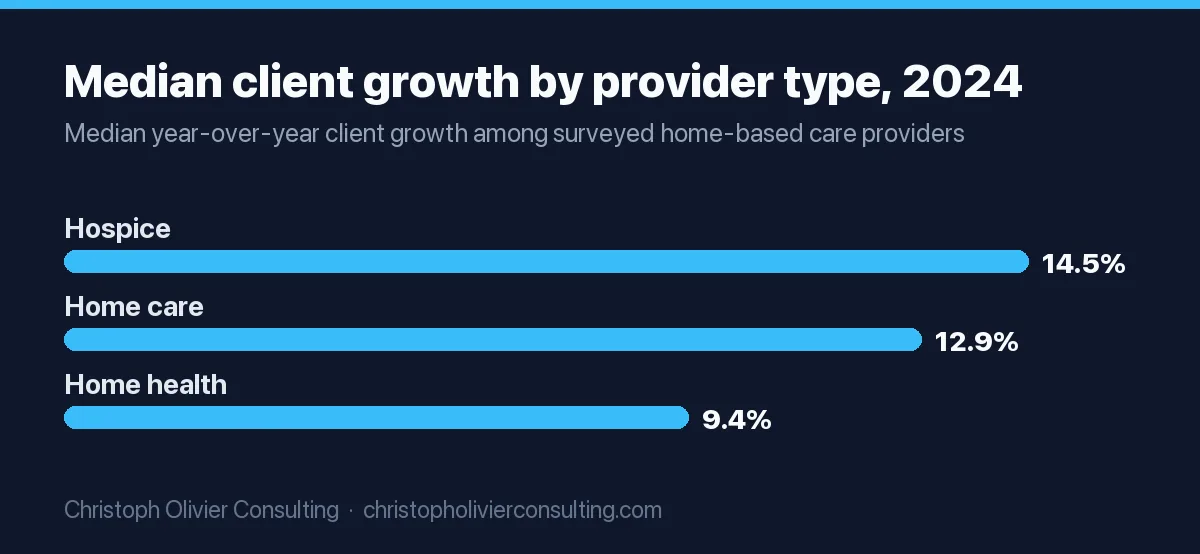
The most useful recent benchmark is the Activated Insights (formerly Home Care Pulse) report covered by Home Health Care News in July 2025, based on a survey of nearly 1,000 home-based care providers. Key findings for 2024:
- Median home care customer growth was 12.9%, the highest in six years. Hospice grew 14.5% and home health 9.4%.
- Customer acquisition cost reached $845 per client, a six-year high.
- Only 9.6% of home-based care applicants were hired.
- 39% of providers reported turning down cases because of insufficient staffing.
- Median home care provider revenue reached $2.3 million.
The same coverage quotes Activated Insights’ Todd Austin saying agencies that track every inquiry "have brought in nearly $1 million more in revenue" than those that do not. Treat that as a correlation, not a promise, but it points to the single biggest lever most agencies ignore: intake discipline.
On the labor side, the US Bureau of Labor Statistics counts 4,677,100 home health and personal care aide jobs in 2025, projects 18% employment growth from 2025 to 2035, and expects about 760,500 openings each year. Median pay is $17.21 per hour. Every competitor in your market is recruiting from the same pool.
Your options: specialist agency, generalist, fractional or in-house
You have five realistic ways to staff home care marketing: a home care specialist agency, a general local marketing agency, a fractional CMO or consultant, an in-house marketer plus a community liaison, or a low-cost productized plan. The right choice depends on your census goals, number of locations and how much management time you have.
| Option | Best fit | Strengths | Watch-outs |
|---|---|---|---|
| Home care specialist agency | Single or multi-location agencies that want done-for-you execution | Knows intake, referral sources, caregiver recruiting and care terminology | Templated sites and content shared across many clients in the same niche; check territory exclusivity |
| General local marketing agency | Agencies with strong intake that mainly need SEO or ads execution | Often sharper channel skills; may cost less | May not know HIPAA, anti-kickback or Google health ad limits; may optimize for form fills, not starts of care |
| Fractional CMO or consultant | Owners with $1M+ revenue who need strategy, vendor oversight and measurement | Senior judgment, audits your funnel, manages vendors on your behalf | Still needs execution hands, either a vendor or staff |
| In-house marketer plus community liaison | Larger or multi-territory agencies | Deep local relationships with discharge planners and senior living | Salary cost and single-person risk; needs a measurement system |
| Productized low-cost plan | New agencies with a small budget | Predictable price; covers site and Google Business Profile basics | Limited strategy; little help with recruitment or referral development |
In my experience, the most common mistake is hiring a lead-generation vendor when the real constraint is staffing or intake follow-up. Diagnose before you buy.
How much does a home care marketing agency cost?
Home care marketing agencies rarely publish prices, so expect custom quotes. The public data points we could verify range from productized plans near $250 to $600 per month up to custom retainers, and most SEO providers in Ahrefs’ survey charge $2,000 per month or less. Ad spend is billed separately on top of any fee.
Here is what we could verify from published sources. These are market data points, not quotes, and your price will depend on locations, channels and whether recruitment is in scope.
| Data point | Figure | Source and context |
|---|---|---|
| Productized home care plan (site plus SEO content plus Google Business Profile management) | $597 per month | Published plan from one home care marketing vendor; a lighter site plus lead capture plan is $249 per month |
| Most common SEO retainer, all industries | $501 to $1,000 per month (20.4% of providers) | Ahrefs survey of 439 SEO providers |
| Share of SEO providers charging $2,000 per month or less | 68.8% | Same Ahrefs survey; 31.2% charge more than $2,000 |
| Average SEO hourly rate | $111 per hour | Same Ahrefs survey |
| Home care customer acquisition cost benchmark | $845 per client (2024) | Activated Insights via Home Health Care News; covers all acquisition costs, not just agency fees |
Two practical notes. First, a full-service scope (SEO, paid search, recruitment ads, referral materials, reporting) costs more than any single-channel line above, so compare quotes on identical scope. Second, the $845 acquisition benchmark is the more useful anchor: if your total marketing cost per new client is well above that, something in the funnel needs fixing before you add budget.
Home care advertising and the channels that move census
The channels that most reliably move census for home care are professional referral sources, your Google Business Profile and reviews, local SEO pages for each service and town, and tightly targeted paid search. Social media helps with trust and recruiting but rarely drives client starts on its own. Prioritize by where families search when they need help this week.
Referral sources: discharge planners, physicians and senior living
Referral marketing is relationship work: regular visits, fast responses and proof you can staff cases. Bring a one-page service sheet, your coverage map, your typical start-of-care turnaround and a direct intake number. For Medicare home health, know the discharge rules: under 42 CFR 482.43, hospitals must give patients a list of available home health agencies, inform them of their freedom to choose, and "must not specify or otherwise limit the qualified providers." Your job is to be the agency patients and planners recognize on that list, not to bypass it.
Google Business Profile and reviews
Most home care agencies are service-area businesses. Google’s Business Profile guidelines say a service-area business should have one profile for its central office with a designated service area, that you should not create more than one profile per location, and that a virtual office is not allowed unless it is staffed during business hours. Multi-location agencies with separate staff and service areas get one profile per location. Build a steady review habit, respond to every review, and never confirm in a reply that the reviewer is a client.
Local SEO pages that answer real questions
Build one strong page per service (companion care, personal care, dementia care, respite, 24-hour care) and pages for the towns you actually staff. Answer cost, insurance and long-term care policy questions plainly. Our local SEO playbook for service businesses walks through the page structure and citation basics.
Paid search and Google’s health ad limits
Search ads for high-intent terms like "home care near me" can work well, but plan around Google’s rules. Google’s personalized advertising policy lists health as a sensitive interest category, and for ads promoting in sensitive categories, data segments (formerly remarketing) and Customer Match are marked "Not supported." Predefined Google audiences, location targeting and keyword targeting remain available. If your plan depends on retargeting site visitors, expect it to be limited. Our paid advertising guide covers bid strategy and conversion tracking in more depth.
Home health care marketing ideas you can run this quarter
- A "same-week start" promise to referral partners, but only if your staffing data supports it.
- A printed and web "questions to ask a home care agency" guide for families.
- Educational talks at senior centers and libraries on hospital-to-home transitions.
- A caregiver spotlight series (with written consent) that doubles as recruitment content.
- A monthly check-in email to referral partners with your current open capacity by area.
Caregiver recruitment marketing: often the real bottleneck
For many home care agencies, caregiver supply limits growth more than client demand does. When applicants are scarce and turnover is high, every client lead you pay for risks becoming a declined case. A home care marketing agency that ignores recruitment can raise your inquiry volume while your census stays flat.
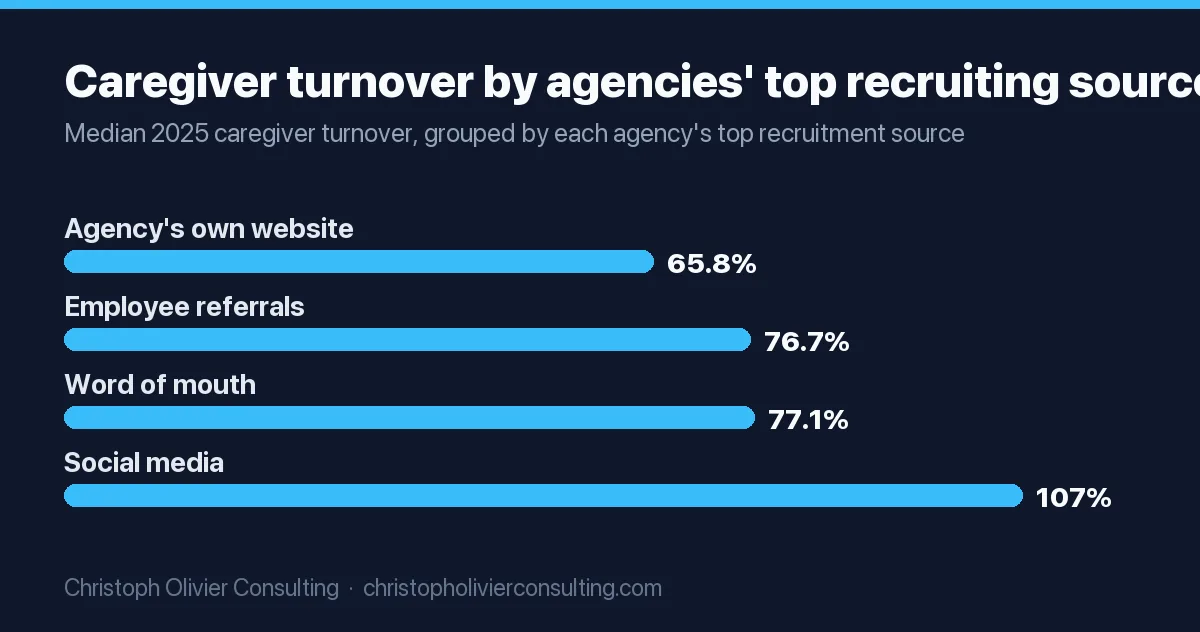
The data supports this. According to Home Health Care News coverage of the 2024 Activated Insights report, Indeed was the top recruiting source for 39.3% of home care providers, followed by employee referral programs at 14.6%, and Indeed-sourced hires had 88% turnover. A newer HHAeXchange summary of the 2026 Activated Insights report puts 2025 caregiver turnover at 75.5% and shows large gaps by recruiting source.
Practical moves that can lower your cost per retained caregiver:
- Build a careers page on your own site with pay range, schedule options and a short mobile application.
- Run a structured employee referral bonus, paid after a set number of shifts or days.
- Post on job boards for reach, but measure retention by source, not just applicant volume.
- Text applicants within hours, not days; slow follow-up loses candidates to the next agency.
- Report 90-day retention by source monthly and shift budget toward the sources that keep people.
If hiring is your real constraint, start with our guide to recruitment marketing before you add client lead spend.
Compliance basics: HIPAA, anti-kickback and gifts
Home care marketing touches health information and, for Medicare or Medicaid work, federal fraud and abuse law. The core rules: get authorization before using protected health information for marketing, never pay or reward anyone for referrals of federally funded care, and keep gifts to beneficiaries within OIG’s nominal value limits. Confirm details with healthcare counsel.
- HIPAA marketing rule. If your agency is a HIPAA covered entity (many are, for example when billing Medicaid or other health plans electronically), 45 CFR 164.508(a)(3) requires a patient’s authorization for marketing uses or disclosures of protected health information, with exceptions for face-to-face communications and promotional gifts of nominal value. Client testimonials, photos and case stories need written authorization.
- Tracking and ad platforms. Do not send names, conditions or intake details to ad platforms through pixels or Customer Match. Ask any agency how its tracking avoids that, and whether it will sign a business associate agreement where one is needed.
- Anti-Kickback Statute. Under 42 U.S.C. 1320a-7b(b), knowingly and willfully offering or paying anything of value to induce referrals of items or services paid by a federal health care program is a felony, punishable by a fine of up to $100,000, up to 10 years in prison, or both. Be careful with gift cards, meals and "thank you" perks for discharge planners and referral partners.
- Gifts to beneficiaries. The OIG’s December 2016 policy statement interprets nominal value as no more than $15 per item or $75 in aggregate per patient per year, and the items may not be cash or cash equivalents.
Private-pay non-medical agencies may fall outside some federal rules, but state law, licensing boards and consumer protection rules still apply. This is general information, not legal advice.
Metrics: from cost per inquiry to start of care
Judge a home care marketing agency on four numbers: cost per inquiry, inquiry-to-assessment rate, assessment-to-start-of-care rate, and cost per start of care. Clicks, impressions and follower counts are diagnostics, not results. Add caregiver cost per hire and 90-day retention by source if recruitment is in scope.
| Metric | How to calculate | What it tells you |
|---|---|---|
| Cost per inquiry | Total marketing cost divided by qualified inquiries | Channel efficiency |
| Inquiry-to-assessment rate | Assessments booked divided by qualified inquiries | Intake speed and script quality |
| Assessment-to-start-of-care rate | New clients started divided by assessments | Fit, pricing clarity and staffing availability |
| Cost per start of care | Total marketing cost divided by new clients started | The number to compare with the $845 industry acquisition benchmark |
| Declined cases | Inquiries turned away for lack of staff | Whether recruitment, not marketing, is the constraint |
Worked example (hypothetical numbers)
Say you spend $6,000 in a month on agency fees and ads and log 60 qualified inquiries. That is $100 per inquiry. If 30 become assessments and 12 become clients, your cost per start of care is $500. If 8 more inquiries were declined for lack of caregivers, the fastest gain may come from recruiting, not more ads. These figures are illustrative only; use your own intake log.
How to hire a home care marketing agency: checklist and red flags
Hire a home care marketing agency the way you would hire a director of care: check relevant experience, ask how it measures results against intake, confirm compliance knowledge, and read the contract for ownership and exit terms. A short, structured interview with the same questions for every agency makes comparison fair.
Questions to ask every agency
- Which home care or home health agencies have you worked with, and can I speak with two of them?
- How will you report on starts of care, not just leads? Will you work from our intake log?
- How does your tracking avoid sending health information to ad platforms? Will you sign a business associate agreement if needed?
- What is your plan for caregiver recruitment, or is it out of scope?
- Do you work with other home care agencies in my territory?
- Who owns the website, ad accounts, Google Business Profile and content if we part ways?
- What is the notice period, and is there a setup fee?
Red flags
- Guaranteed numbers of new clients or a guaranteed ranking position.
- Ad accounts or your Google Business Profile owned by the agency, not you.
- Referral "perks" for discharge planners that look like payment for referrals.
- Reports full of impressions and clicks with no tie to intake.
- Patient stories or photos published without written authorization.
Copy-and-use agency scorecard
- [ ] Relevant home care or home health references checked
- [ ] Reports on cost per start of care from our intake data
- [ ] HIPAA-aware tracking plan in writing
- [ ] Recruitment marketing included or deliberately excluded
- [ ] We own all accounts, domains and content
- [ ] Month-to-month or short notice period after an initial term
- [ ] Scope and deliverables listed by month
A 90-day home care marketing plan
A sensible first 90 days runs audit first, then fixes, then scale. Month one finds where inquiries and caregivers leak. Month two fixes intake, Google Business Profile and core pages. Month three adds paid search and referral outreach where the data shows room. Expect early signals in 90 days, not a finished growth engine.
| Weeks | Client growth | Caregiver recruitment | Measurement |
|---|---|---|---|
| 1 to 4: Audit | Review Google Business Profile, site, reviews, referral source list and intake call handling | Review job posts, application flow, time to first contact and turnover by source | Set up an intake log with source, assessment and start-of-care fields |
| 5 to 8: Fix | Fix profile categories and service area, rebuild service pages, start a review request routine, tighten intake scripts | Launch a careers page, referral bonus and same-day applicant texting | Baseline cost per inquiry and cost per start of care |
| 9 to 12: Scale | Launch or restructure search ads on high-intent terms; schedule referral partner visits | Shift job board spend toward sources with better 90-day retention | Monthly review; reallocate budget by cost per start of care |
The pattern matters more than the exact weeks: measure first, fix the funnel second, and spend more only where the numbers justify it. If you are also comparing agencies for other care lines, the same approach applies to mental health practice marketing.
If you would rather not run the search alone, I help owners match with the right agency or build the plan in-house. My background includes content systems that have earned more than 200 million organic views and millions of dollars in ad spend managed, and every engagement starts with an audit and a 90-day plan, with no guaranteed outcomes. You can book a consultation when the timing is right.
Work with CO Consulting
Want this done for your business?
- A diagnostic call and an audit of your current marketing and numbers
- A prioritized 90-day plan built for your market
- Execution across SEO and AI search, paid ads, content, funnels and automation
- Weekly check-ins and monthly reporting, led by a fractional CMO
Frequently asked questions
What does a home care marketing agency do?
It runs the channels that bring a home care business new clients and caregivers: Google Business Profile, local SEO, paid search, reviews, referral-partner materials and recruitment ads. A good agency ties every channel to your intake log so you can see which inquiries became assessments and which became paying clients, rather than reporting only clicks and impressions.
How much does a home care marketing agency cost?
Few agencies publish prices. Published productized home care plans start around $249 to $597 per month, and most SEO providers in an Ahrefs survey charge $2,000 per month or less. Full-service scopes that include paid search, recruitment and reporting cost more, and ad spend is billed separately. Compare quotes on identical scope.
What is a good customer acquisition cost for home care?
Activated Insights reported a median customer acquisition cost of $845 per client for home care in 2024, a six-year high, according to Home Health Care News. Use it as a rough anchor. Track your own cost per start of care, which divides total marketing cost by new clients started, and compare it month to month.
Can home care agencies use remarketing on Google Ads?
Often only in a limited way. Google lists health as a sensitive interest category in its personalized advertising policy, and for ads in sensitive categories it marks data segments (formerly remarketing) and Customer Match as not supported. Keyword targeting, location targeting and predefined Google audiences remain available, so plan campaigns around search intent instead.
Is it legal to give gifts to hospital discharge planners for referrals?
Be very careful. For services paid by Medicare, Medicaid or other federal programs, the Anti-Kickback Statute makes it a felony to knowingly and willfully offer anything of value to induce referrals. Gift cards, meals and perks tied to referrals can create risk. Ask healthcare counsel before any referral-partner gift or event program.
Should my home care marketing focus on clients or caregivers first?
If you are declining cases for lack of staff, start with caregivers. Activated Insights data reported by Home Health Care News showed 39% of providers turned down cases due to insufficient staffing in 2024. Buying more client leads without caregivers to serve them raises costs without raising census.
How long does home care marketing take to work?
Fixes to intake, your Google Business Profile and paid search can show early signals within the first 90 days. SEO and referral relationships usually take longer to compound. Results vary by market, competition and staffing, so judge progress on cost per start of care and trend lines rather than expecting a fixed timeline.
More Growth Consulting guides
- Healthcare Marketing: How Practices Attract and Keep Patients
- Recruitment Marketing: A Fractional CMO’s Field Guide
- Handyman Marketing: The Channel Plan That Books More Jobs
- What Is Growth Marketing?
- Hotel Marketing: How to Win Direct Bookings and Beat the OTA Commission Math
- What Is B2B Marketing? Modern Definition
- All Growth Consulting guides →