
Last reviewed: October 2026
Mental health marketing is how a therapy practice gets found, trusted and booked by the clients it is best trained to help, without breaking the ethics and privacy rules that apply to clinicians. In practice it comes down to five channels: directory profiles, a Google Business Profile, specialty pages on your website, referral relationships with physicians, and clear insurance or private pay messaging. All five sit on a compliance spine of APA or ACA advertising standards and HIPAA.
This guide is written for solo therapists, group practice owners and the people who run marketing for them. It covers what works, what the professional codes and federal regulators actually say, and a 90-day plan you can run without an agency. It does not cover substance use treatment marketing, which has its own rules.
Want a specialist to build this for your business? See how CO Consulting’s marketing services work, starting with a diagnostic and audit.
What mental health marketing is (and what it is not)
Mental health marketing is the set of activities that connects a licensed clinician or practice with people actively looking for help: search visibility, directory listings, referral networks and clear messaging about fit, fees and access. It is not lead volume for its own sake. The goal is a full caseload of well-matched clients, not more inquiries you cannot serve.
Therapy differs from other service marketing in three ways: the buyer is often in distress, so clarity beats cleverness; your ethics code limits tactics like soliciting testimonials; and your website may touch protected health information, which limits tracking.
Most general healthcare marketing advice applies, with less room for aggressive conversion tactics and more need for trust signals a client can verify.
How clients actually find a therapist in 2026
Most people do not start with Google. In a 2025 survey of more than 2,000 U.S. adults in or planning therapy, primary care providers were the top starting point at 39%, followed by friends and family at 32%, insurer resources at 31% and search engines at 28%. Directories and social channels follow close behind.
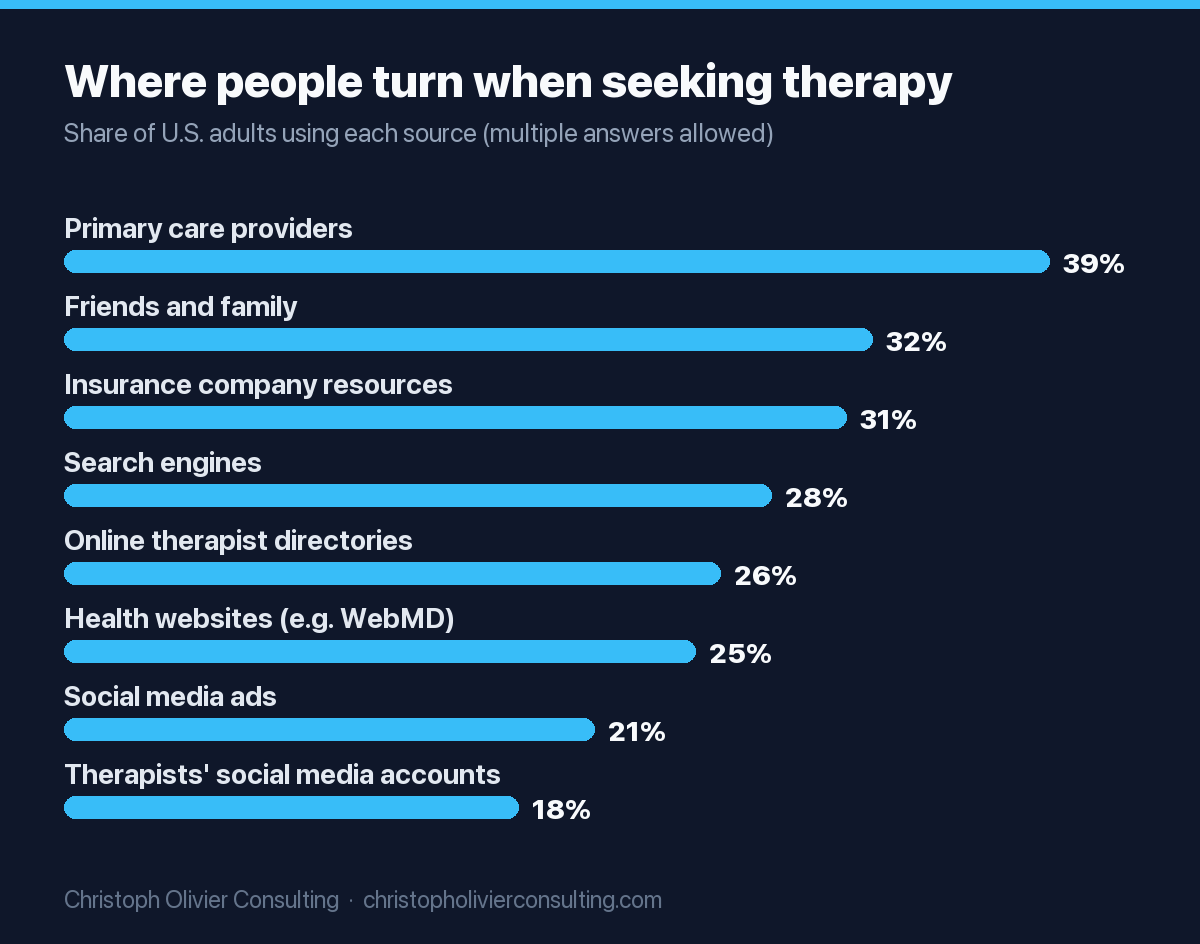
Those figures come from Thriveworks’ 2025 therapy-seeking research, and respondents could choose more than one source. Treat them as directional. The same survey found that 26% visit online therapist directories like Psychology Today, 21% are reached by social media ads and 18% are influenced by therapists’ own social accounts.
A practice that only invests in SEO ignores the three largest entry points. The same survey found that 95% of consumers say knowing their out-of-pocket cost is important or very important, and 39% only book when they know the expected copay or cost in advance. Fee clarity is a marketing asset, not just an admin detail.
| Channel | Who it reaches | Cost | Time to first results | Main compliance watch-out |
|---|---|---|---|---|
| Physician and clinician referrals | People already in the health system | Time only | 4 to 12 weeks | Share client information only with valid releases |
| Psychology Today and niche directories | Active searchers comparing therapists | Psychology Today lists $29.95 per month | Days to weeks | Accurate credentials and specialties (APA 5.01, ACA C.3.a) |
| Google Business Profile | Local “therapist near me” searches | Free | Weeks | Never reveal client details when replying to reviews |
| Specialty pages and content (SEO) | People researching a specific concern | Time or writer fees | 3 to 9 months | Tracking pixels on condition pages and booking forms |
| Insurance panels and insurer directories | Members using their benefits | Credentialing time | Months | Keep panel listings current |
| Paid search ads | High-intent searchers | Pay per click | Days | No customer match or remarketing lists for health ads |
Marketing for therapists starts with a niche
A defined niche makes every channel work harder. “Anxiety therapy for college students” or “couples counseling after infidelity” gives a directory profile, a Google listing and a specialty page something specific to match. Generalist messaging competes with every therapist in your city; a specialty competes with a handful.
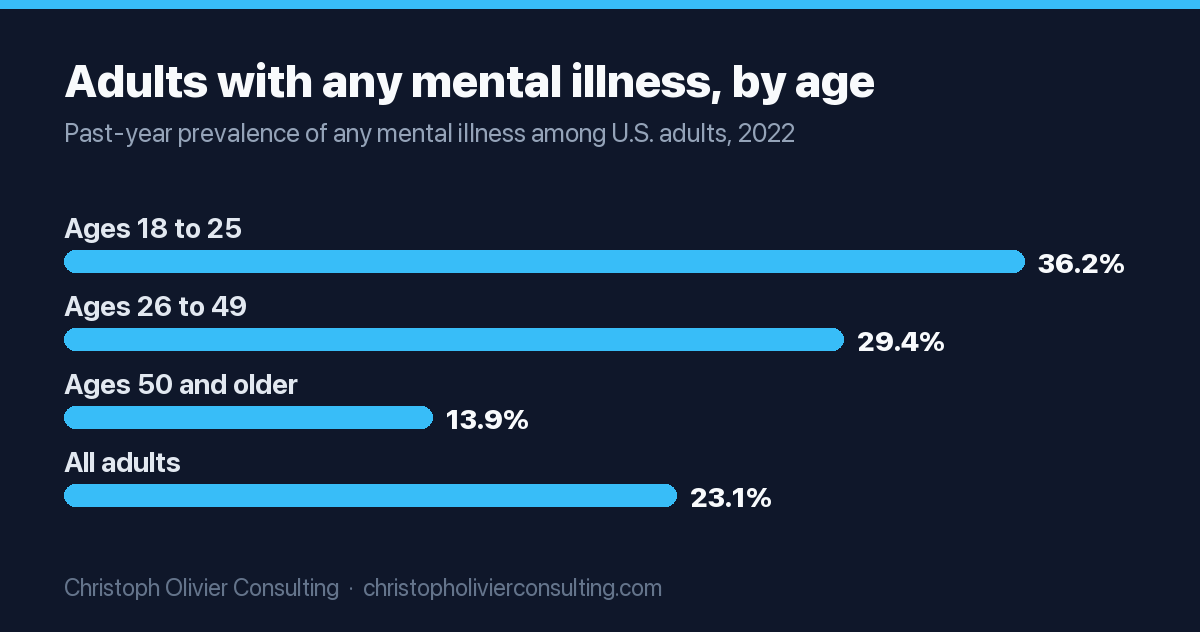
Demand is not evenly spread. According to NIMH, using SAMHSA’s 2022 National Survey on Drug Use and Health, 23.1% of U.S. adults (59.3 million people) had any mental illness in the past year. Prevalence was highest among adults aged 18 to 25 at 36.2%, compared with 29.4% for ages 26 to 49 and 13.9% for ages 50 and older. Only 50.6% of adults with any mental illness received treatment.
That last number matters. Your marketing often competes with inertia, cost worries and stigma, not with another therapist, so messaging that lowers the barrier to a first call usually beats a list of modalities.
How to choose a niche you can defend
- Training: pick what you have supervised experience or certification in (APA 5.01(b) and ACA C.4.a bar overstating competence).
- Caseload fit: choose the clients you do your best work with and want more of.
- Local gap: search your city plus the specialty and count the credible pages already there.
- Payer fit: some niches (executives, couples) lean private pay; others (children, older adults) lean on insurance or Medicare.
Directory listings: Psychology Today and niche directories
Directory profiles are usually the fastest way for a new or growing practice to get inquiries, because the people browsing them are already shopping for a therapist. Psychology Today, the best-known general directory, lists membership at a fixed $29.95 per month. Niche directories for specific identities, modalities or populations can add smaller but better-matched traffic.
The fee is stated on Psychology Today’s membership signup page. On any directory, the profile does the selling, and most fail by opening with credentials instead of the client’s experience.
What a strong directory profile includes
- An opening line written to the client in their words (“You lie awake replaying conversations”).
- One or two named specialties, not fifteen checkboxes.
- What the first session looks like and how to book it.
- Fees, insurance accepted and whether you offer superbills, stated plainly.
- A current, professional photo and a short video if the platform supports it.
- Credentials stated exactly as licensed. ACA’s code says counselors “clearly state their highest earned degree” and do not imply doctoral-level competence they lack.
Google Business Profile and local SEO for therapists
A Google Business Profile puts your practice in the map results that appear for “therapist near me” and similar searches. It is free. Google treats therapists as individual practitioners, so a solo clinician, a group practice and each clinician within a group can follow different listing rules. Getting this structure right prevents suspensions and duplicate listings.
Google’s representation guidelines define an individual practitioner as “a public-facing professional, typically with their own customer base.” When several practitioners share a location, the organization gets one profile for the location and each practitioner’s profile uses only their own name. A solo practitioner with a brand uses a combined format such as “[brand]: [practitioner name].” Business names cannot include keywords added for search visibility, so “Calm Path Counseling” is fine and “Calm Path Counseling Anxiety Therapist Denver” is not.
Verification trips up many telehealth and shared-office practices. Google’s own walkthrough is below.
Reviews: the HIPAA trap
Reviews help local rankings, but replying to them is where therapists get into trouble. The HHS Office for Civil Rights settled with Manasa Health Center, a New Jersey practice providing adult and child psychiatric services, after it disclosed a patient’s protected health information in a reply to a negative online review. The practice paid $30,000 and agreed to a corrective action plan. A California dental practice, New Vision Dental, paid $23,000 over the same pattern.
The safe reply never confirms that the reviewer is or was a client. A generic response such as “We take all feedback seriously. Please call our office manager if you would like to discuss your experience” protects you and still shows prospective clients that you respond. For a deeper walkthrough of map rankings, see the local SEO playbook for service businesses.
SEO and content for therapy practice marketing
Search engine optimization for a therapy practice means one strong page per specialty, written for the person searching, plus a few articles that answer the questions those people ask before they book. It is slower than directories, often three to nine months, but the traffic compounds and you own it rather than renting it.
Most therapist sites have one “Services” page listing eight concerns. Split it into one page per main specialty, each with its own title, local context and booking path, then add articles that answer adjacent questions and link back. The content marketing framework I use with service firms applies here with one change: every piece must stay within your competence and avoid anything that reads as individual clinical advice.
Ethics rules that shape your content
APA Standard 5.04 on media presentations says that when psychologists give public advice online, they take precautions that statements are based on their professional knowledge and appropriate literature, are consistent with the Ethics Code, and “do not indicate that a professional relationship has been established with the recipient.” ACA’s C.6.c sets a similar standard for counselors. In content terms: cite sources, write in general terms, and add a short note that the article is not a substitute for treatment.
Specialty page template
| Section | What to write | Why it matters |
|---|---|---|
| Title and H1 | “[Specialty] therapy in [City]” or “[Specialty] counseling for [population]” | Matches how people search |
| Opening paragraph | Describe the experience in the client’s words, then say what therapy for it looks like | Builds recognition in seconds |
| Approach | Modalities you are trained in, explained in plain language | Honest competence claims (APA 5.01, ACA C.4.a) |
| Who you see | Ages, formats (in person, telehealth), states licensed | Filters out poor fits |
| Fees and insurance | Session fee, panels, superbills, good faith estimate note | Cost clarity drives booking |
| First step | One booking method and what happens next | Reduces drop-off |
| Short FAQ | Three to five real intake questions | Answers objections and feeds AI search |
Referral relationships with physicians and other clinicians
Physician referrals are the single largest starting point for people seeking therapy, so a referral program is often the highest-return marketing a practice can run. It means identifying primary care practices, pediatricians, OB-GYNs and psychiatrists near you, making it easy for them to refer, and closing the loop on referrals with proper consent.
Physicians need three facts: what you treat, whether you have openings, and how to refer. A one-page sheet with specialties, insurance, current wait time and a direct line beats a glossy brochure.
- List 20 to 30 referral sources within your service area, starting with primary care practices.
- Send a short introduction letter and referral sheet, then ask for a 10-minute call or lunch-hour visit.
- Offer something useful: a screening resource list or a brief in-service talk on your specialty.
- When a referral arrives, thank the referrer and, with the client’s signed release, confirm the client was seen.
- Update referrers quarterly on openings so they keep you top of mind.
ACA C.3.d bars using your employer or institutional affiliation to recruit private practice clients. APA Standard 5.06 bars uninvited in-person solicitation of potential clients who are vulnerable to undue influence. Market to referring clinicians, never directly to their patients. Referral programs work the same way in physical therapy marketing.
Insurance vs private pay positioning
Whether you take insurance changes your marketing more than any tactic. In-network practices compete on access and availability, so their marketing should emphasize openings, panels and speed to first appointment. Private pay practices compete on specialization and fit, so their marketing must justify the fee with clear expertise and explain superbills and out-of-network benefits.
| Element | In-network practice | Private pay practice |
|---|---|---|
| Core promise | Covered care, available soon | Specialized care, worth the investment |
| Top channels | Insurer directories, physician referrals, Google Business Profile | Specialty pages, niche directories, professional referrals |
| Key page content | Panels accepted, copay guidance, openings | Session fee, superbill process, out-of-network help |
| Required disclosure | Accurate panel listing | Good faith estimate for uninsured or self-pay clients |
| Main risk | Full caseload at low reimbursement | Inquiries that stall on price |
Two federal rules affect this choice. Under the No Surprises Act, CMS explains that if a client is not using health insurance, the provider usually must give a good faith estimate of expected charges when the client requests one or schedules at least three business days in advance. Note this on your fees page. Second, per CMS, since January 1, 2024 marriage and family therapists and mental health counselors can bill Medicare independently, paid at 75% of the clinical psychologist rate. For counselors and MFTs with an older-adult niche, that opens a new audience.
The compliance spine: APA, ACA, HIPAA and ad platforms
Every tactic above must pass four tests: your professional ethics code, HIPAA, the FTC’s health privacy enforcement, and the ad platform’s own health policy. Most marketing problems in therapy practices come from tactics copied from other industries, such as solicited testimonials, retargeting pixels and review replies, that these rules specifically restrict.
| Rule | What it says | What it means for your marketing |
|---|---|---|
| APA Ethics Code 5.01 | No false, deceptive or fraudulent statements about training, credentials, services, results or fees; directory listings count as public statements | No outcome promises, no inflated credentials, accurate fees |
| APA 5.02 | Psychologists who engage others to create promotional statements retain responsibility; paid ads must be identified as such | You own what your agency or VA publishes |
| APA 5.05 | No soliciting testimonials from current therapy clients or others vulnerable to undue influence | Do not ask current clients for reviews or testimonials |
| ACA Code of Ethics C.3.b | Counselors do not solicit testimonials from current clients, former clients, or others who may be vulnerable to undue influence | Stricter than APA: former clients are covered too |
| HIPAA tracking guidance | Tracking tech that collects PHI requires a BAA and a Privacy Rule permission or authorization; cookie banners are not HIPAA authorization | Audit pixels on booking forms, portals and intake pages |
| Google Ads health policy | Counseling for depression or anxiety is a sensitive health category; customer match, lookalikes and your data segments are not allowed | No remarketing lists for therapy ads; use keywords, location and predefined audiences |
Testimonials and reviews
ACA’s C.3.b also requires counselors who use testimonials to “discuss with clients the implications of and obtain permission for the use of any testimonial.” The practical rule: do not ask clients for reviews. Let them arrive on their own, build trust with credentials, process and content, and check your state board’s rules, which can be stricter.
Tracking pixels and HIPAA
The HHS Office for Civil Rights bulletin on online tracking technologies defines a tracking technology as “a script or code on a website or mobile app used to gather information about users.” It says pages behind a login, such as client portals and telehealth platforms, generally have access to PHI, and that information typed into a booking form or symptom tool can be PHI too. Website banners asking users to accept cookies “do not constitute a valid HIPAA authorization,” and a vendor promising to strip PHI after receiving it is not enough.
There is one important limit. On June 20, 2024, a federal court in American Hospital Association v. Becerra vacated the part of the guidance saying HIPAA is triggered when tracking connects an IP address with a visit to an unauthenticated public page about specific health conditions or providers. That narrows the rule for public pages, but it does not change the analysis for booking forms, intake flows or portals. The FTC has also acted outside HIPAA: in March 2023 it ordered BetterHelp to pay $7.8 million over sharing consumers’ email addresses, IP addresses and health questionnaire information with advertising platforms.
The conservative setup: no ad pixels on booking, intake or portal pages, a scheduling tool with a signed BAA, and conversion tracking on non-identifying events rather than form contents.
Paid ads
Google’s health sensitive category policy lists “counseling for depression/anxiety” as an example. Ads in that category cannot use customer match, lookalike segments or your own data segments, though predefined Google audiences, demographics and location targeting remain available. Tight keyword campaigns on specialty plus city terms, landing on the matching specialty page, usually work best. General psychotherapy sits outside Google’s separate certification rules for drug and alcohol recovery services.
A 90-day mental health marketing plan for private practice
A realistic 90-day plan for a private or group practice covers compliance first, then the fast channels (directories, Google Business Profile, referrals), then the compounding ones (specialty pages and content). Most solo therapists can run it in about three to four hours a week. Results vary by market, but this order puts the quickest wins first.
| Weeks | Focus | Deliverables | What to measure |
|---|---|---|---|
| 1 to 2 | Compliance and foundations | Pixel audit, BAA with scheduling tool, review reply script, fees page with good faith estimate note | Pixels removed from intake and booking pages |
| 3 to 4 | Directories and Google Business Profile | Rewritten directory profile, verified GBP with correct practitioner structure, categories, photos | Profile views, calls, directory inquiries |
| 5 to 6 | Referral outreach | Referral sheet, list of 20 to 30 sources, first 10 introductions | Conversations held, referrals received |
| 7 to 9 | Specialty pages | Two to three specialty pages using the template above | Indexing, impressions in Search Console |
| 10 to 12 | Content and follow-through | Three to four supporting articles, second round of referral contact, intake process review | Inquiry to first session rate, source of each new client |
Track inquiry to first session above all. If inquiries rise but bookings do not, the issue is usually response time, fee clarity or intake friction.
Compliance checklist before you launch any campaign
Run this checklist before publishing a profile, page or ad. It turns the rules above into yes or no questions so a practice owner, office manager or agency can review marketing in a few minutes. If any answer is no, fix it before launch rather than after a complaint.
- Every credential, license and degree is stated exactly as earned and current (APA 5.01, ACA C.4).
- No copy promises outcomes, cure rates or timelines.
- No testimonials were solicited from current clients, or from former clients if you follow the ACA code.
- Review replies never confirm someone is or was a client.
- No advertising pixels fire on booking, intake, portal or symptom-checker pages.
- Every vendor that may receive PHI has a signed BAA.
- Paid ads use keyword and location targeting only, with no customer match or remarketing lists.
- Paid content is clearly identified as advertising (APA 5.02).
- The fees page explains insurance, superbills and good faith estimates.
- Educational content includes a short note that it is not a substitute for treatment.
- Agency and freelancer work is reviewed by a licensed clinician before publishing.
Most therapy practices do not need more marketing. They need the right five channels done consistently and kept within the rules. If you want a second set of eyes on your plan, you can book a consultation and we can walk through where your next clients are most likely to come from.
Work with CO Consulting
Want this done for your business?
- A diagnostic call and an audit of your current marketing and numbers
- A prioritized 90-day plan built for your market
- Execution across SEO and AI search, paid ads, content, funnels and automation
- Weekly check-ins and monthly reporting, led by a fractional CMO
Frequently asked questions
What is mental health marketing?
Mental health marketing is how a therapist or practice gets found and chosen by well-matched clients through directory profiles, a Google Business Profile, specialty web pages, physician referrals and clear fee messaging. It differs from other service marketing because APA and ACA ethics codes limit tactics like soliciting testimonials, and HIPAA restricts tracking on booking and intake pages.
How do most people find a therapist?
In Thriveworks' 2025 survey of more than 2,000 U.S. adults, primary care providers were the top starting point at 39%, followed by friends and family at 32%, insurer resources at 31% and search engines at 28%. About 26% used directories like Psychology Today. Respondents could choose several sources, so a practice usually needs referrals, directories and search working together.
Can therapists ask clients for reviews or testimonials?
Generally no. APA Ethics Code Standard 5.05 says psychologists do not solicit testimonials from current therapy clients or others vulnerable to undue influence. The ACA Code of Ethics C.3.b extends this to former clients. Many practices therefore let reviews arrive unprompted and never confirm a reviewer was a client when replying. Check your state licensing board rules as well.
Is the Meta or Google pixel HIPAA compliant on a therapy website?
Not on pages that collect protected health information. HHS OCR guidance says tracking technology that receives PHI needs a business associate agreement and a valid Privacy Rule permission, and cookie banners are not HIPAA authorization. A 2024 court ruling narrowed the rule for public informational pages, but booking forms, intake flows and client portals remain sensitive.
Can therapists run Google Ads?
Yes. General therapy services can advertise, but Google classifies counseling for depression or anxiety as a sensitive health category. That means no customer match, lookalike or your-data remarketing segments. Practices typically run tight keyword campaigns on specialty plus city terms, with predefined Google audiences or location targeting, and send clicks to a matching specialty page.
Should a private practice take insurance or stay private pay?
It depends on your niche, location and finances. In-network practices market availability and covered care through insurer directories and physician referrals. Private pay practices market specialization and must explain fees, superbills and good faith estimates. Since January 1, 2024, MFTs and mental health counselors can also bill Medicare, which opens older-adult niches.
How long does therapy practice marketing take to work?
Directory profiles and a verified Google Business Profile can produce inquiries within days or weeks. Physician referral relationships often take one to three months. Specialty pages and content usually need three to nine months to rank. A 90-day plan that handles compliance first, then fast channels, then content, tends to show the earliest measurable results.
More Growth Consulting guides
- Healthcare Marketing: How Practices Attract and Keep Patients
- Physical Therapy Marketing: A Cost-Per-Patient Playbook for Clinics
- The 4 Ps of Marketing: Product, Price, Place, Promotion
- Nonprofit Marketing: A Small-Budget Playbook That Wins Donors
- Moving Company Marketing: A Cost-Per-Booked-Move Playbook
- Press Release Distribution in 2026
- All Growth Consulting guides →