
Handyman marketing works best as a short stack of local channels, not a scatter of one-off tactics. The operators who stay booked lead with a strong Google Business Profile, earn steady reviews, run Local Services Ads for overflow, and turn first jobs into repeat customers. This guide shows what each channel costs per booked job and the order to build them in.
Last reviewed: September 2026
What Handyman Marketing Costs Per Booked Job
The number that decides everything is cost per booked job, not cost per lead. For most handyman businesses in 2026, referrals and Google Business Profile settle near $35 per booked job, local SEO lands around $90 once it matures, Local Services Ads run about $120, and shared aggregator leads climb toward $300. Cheaper channels take longer to build; paid channels book faster but cost more.
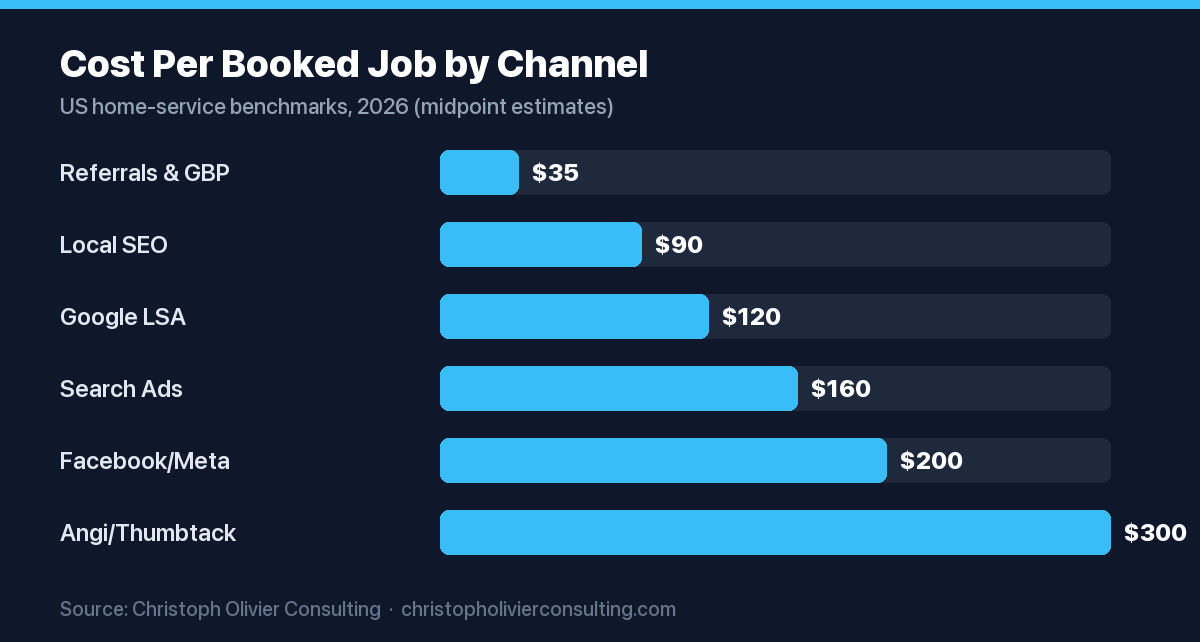
| Channel | Typical cost per booked job | Close rate | Best use |
|---|---|---|---|
| Referrals and Google Business Profile | $20 to $50 | 50% to 70% | Your first and cheapest channel |
| Local SEO | $30 to $150 | 30% to 50% | Compounding pipeline over 6 to 12 months |
| Google Local Services Ads | $100 to $160 | 30% to 48% | Fast, verified, pay-per-lead volume |
| Google Search Ads | $140 to $190 | 25% to 40% | Coverage beyond the LSA slots |
| Facebook and Meta Ads | $150 to $250 | 10% to 25% | Awareness and remarketing, not urgent demand |
| Angi and Thumbtack | $250 to $500 | 10% to 20% | Backfill only; leads are shared |
Read the chart as a priority order. Build the low-cost owned channels first, then buy paid leads to fill gaps while the free channels compound.
Start With Google Business Profile and Local SEO
A complete, active Google Business Profile is the single highest-return asset for a handyman, because most homeowners search “handyman near me” and pick from the map pack. Verify the profile, list every service, add fresh job photos weekly, and reply to every review. Then support it with a fast, service-specific website so you rank in the regular results too.
Local SEO takes a few months to pay off, but the cost per booked job keeps falling as the pipeline grows. A practical build is a homepage plus one page per core service and one page per town you cover. For the strategy behind ranking a service business, see our guide to SEO for professional services, and pair it with these small business lead generation tactics to convert the traffic.
Local Services Ads and Paid Search
Local Services Ads sit at the very top of Google, carry the Google Guaranteed badge, and charge per verified lead rather than per click. Handyman lead prices commonly run $25 to $41 each in 2026, which works out to roughly $100 to $160 per booked job after your booking rate. They are the fastest way to add volume while your organic channels build.
Standard Google Search Ads cover the queries LSAs miss and usually cost 20% to 40% more per booked job. Run them second, with tight local targeting and call tracking, so you can compare cost per booked job against your LSA and SEO numbers on the same scorecard.
Reviews: The Trust Signal That Wins the Click
Reviews are the deciding factor for handyman buyers, who are inviting a stranger into their home. Volume, recency, and rating together move you up the map pack and lift your booking rate across every channel. Ask each satisfied customer for a review within 24 hours of finishing the job, when goodwill is highest, and always reply in your brand voice.
- Send a one-tap review link by text the same day the job closes.
- Ask in person and mention it costs the customer under a minute.
- Reply to every review, positive or negative, within 48 hours.
- Rotate the request across Google, Facebook, and Nextdoor so no single profile looks staged.
Referrals and Repeat Customers Build Lifetime Value
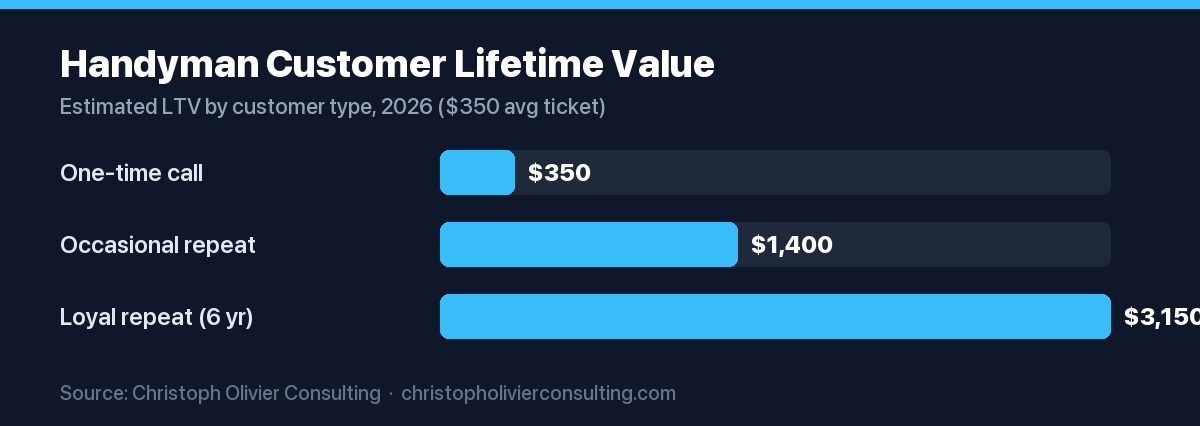
Repeat customers and referrals are the cheapest jobs you will ever book and the reason strong handyman businesses stay profitable. Retaining a customer costs far less than winning a new one, and disciplined operators earn 50% to 65% of revenue from repeat work. A single loyal customer who calls roughly 1.5 times a year for six years at a $350 average ticket is worth about $3,150 before a single referral.
Capture every customer in a simple database, send a seasonal maintenance reminder, and offer a small credit for referrals. Those two habits raise lifetime value and lower your blended cost per booked job faster than any ad spend. Fold them into a broader small business lead generation system so nothing leaks.
Social Media and Neighborhood Targeting
Social platforms are best for proof and neighborhood reach, not urgent demand. Before-and-after photos on Facebook, Instagram, and Nextdoor build recognition in the exact zip codes you serve, and local Facebook groups routinely surface “who do you recommend” threads you can answer. Treat this as trust-building that supports search, not a primary lead source.
Post two or three real jobs a week, tag the town, and point every profile back to your booking page. Our social media lead generation guide covers how to turn that attention into booked calls without a large ad budget.
A 90-Day Handyman Marketing Plan
You do not need every channel at once. Sequence them so each new one is funded by results from the last. This plan assumes a solo or small handyman crew starting close to zero.
- Days 1 to 15: Claim and fully complete your Google Business Profile, add 20 job photos, and set up one-tap review requests.
- Days 16 to 30: Launch a five-page service website and turn on Local Services Ads with a modest weekly cap.
- Days 31 to 60: Publish one service or town page per week, collect reviews after every job, and start a simple customer database.
- Days 61 to 90: Add Search Ads for gaps, begin seasonal maintenance reminders, and launch a referral credit.
- Ongoing: Track cost per booked job by channel monthly and shift budget toward the lowest-cost sources.
Where a Fractional CMO Fits
Most handyman owners can run this plan themselves; the harder part is deciding what to cut and where to spend as you scale past a full schedule. That is the call a fractional marketing leader makes for you, using the same cost-per-booked-job scorecard above. See how the fractional CMO services work, and review the SEO for professional services approach that anchors the whole system.
Frequently asked questions
How much should a handyman spend on marketing?
A common range is 5% to 10% of revenue, weighted toward owned channels early on. In practice, start by fully building your free Google Business Profile and reviews, then add a modest Local Services Ads budget of a few hundred dollars a month. Scale spend only on channels where your tracked cost per booked job stays profitable against your average ticket.
What is the best marketing for a handyman business?
For most handymen the best channel is a fully optimized Google Business Profile backed by steady reviews, because that is where near-me searchers pick. It carries the lowest cost per booked job and feeds every other channel. Local Services Ads are the best paid add-on once the free foundation is in place, since you pay only for verified leads.
Do Local Services Ads work for handymen?
Yes. Local Services Ads place you above regular search results with a Google Guaranteed badge and charge per verified lead, not per click. Handyman lead prices commonly run $25 to $41 in 2026, which lands near $100 to $160 per booked job after your booking rate. They are the fastest way to add volume while organic channels build, and you can dispute low-quality leads.
How do handymen get more customers?
Book more jobs by stacking a few local channels in order: complete your Google Business Profile, earn reviews after every job, rank service and town pages in local search, then run Local Services Ads for overflow. Capture past customers in a database and send seasonal reminders. Referrals and repeat work become your cheapest jobs once that system runs.
Is SEO worth it for a handyman?
Usually yes, once you can wait a few months for results. Local SEO amortized over a year often lands at $30 to $150 per booked job, well below shared aggregator leads, and it keeps compounding as pages age. Build a homepage plus one page per core service and one page per town you cover, then support it with fresh Google Business Profile activity.
How many reviews does a handyman need?
There is no fixed number, but rating, volume, and recency together decide your map-pack position and booking rate. Aim to stay ahead of the top competitors in your town and to add fresh reviews every week rather than in bursts. A steady flow of recent five-star reviews with owner replies outperforms a large but stale count.
More marketing guides for rank on ai: get cited by ai search
- How Much Does Digital Marketing Cost?
- How Much Does SEO Cost in 2026?
- Junk Removal Marketing: A Channel-by-Channel Booking System
- Landscaping Marketing in 2026: Cost Per Booked Job by Channel
- Martial Arts School Marketing: A Playbook to Fill Mats and Keep Students
- Pressure Washing Marketing: The Channels That Book Jobs in 2026
- Rank on AI: Get Cited by AI Search