
Junk removal marketing works best as a layered system, not one channel you turn on and hope. The haulers who stay booked pair local SEO and a strong Google Business Profile with Google Local Services Ads, high-intent paid search, a steady review engine, and referral partnerships with realtors and property managers. This guide gives the estimated cost per booked job for each channel and the order to switch them on.
Last reviewed: September 2026
How junk removal marketing actually works
Junk removal marketing is the set of channels that put your truck in front of people who already need a pickup, then book them before a competitor does. Because most demand is same-day or next-day and searched on a phone, the winning mix favors intent-based channels (search and maps) over interruption channels, then compounds with reviews and referrals that lower your cost per job over time.
Two numbers decide everything: your average ticket and your close rate. With average tickets running $250 to $600 and a healthy lead-to-job booking rate of 50% to 65%, most operators can sustain a cost per booked job between $45 and $120 and still protect margin. Track cost per booked job by channel, not just cost per lead, or you will overspend on cheap leads that never turn into paid work.
Cost per booked job by channel
Cost per booked job is the honest scoreboard: total channel spend divided by the jobs that channel actually produced. A cheap lead that books at 15% can cost more per job than an expensive lead that books at 50%. The table below shows 2026 midpoint benchmarks so you can compare channels on the metric that pays your bills.
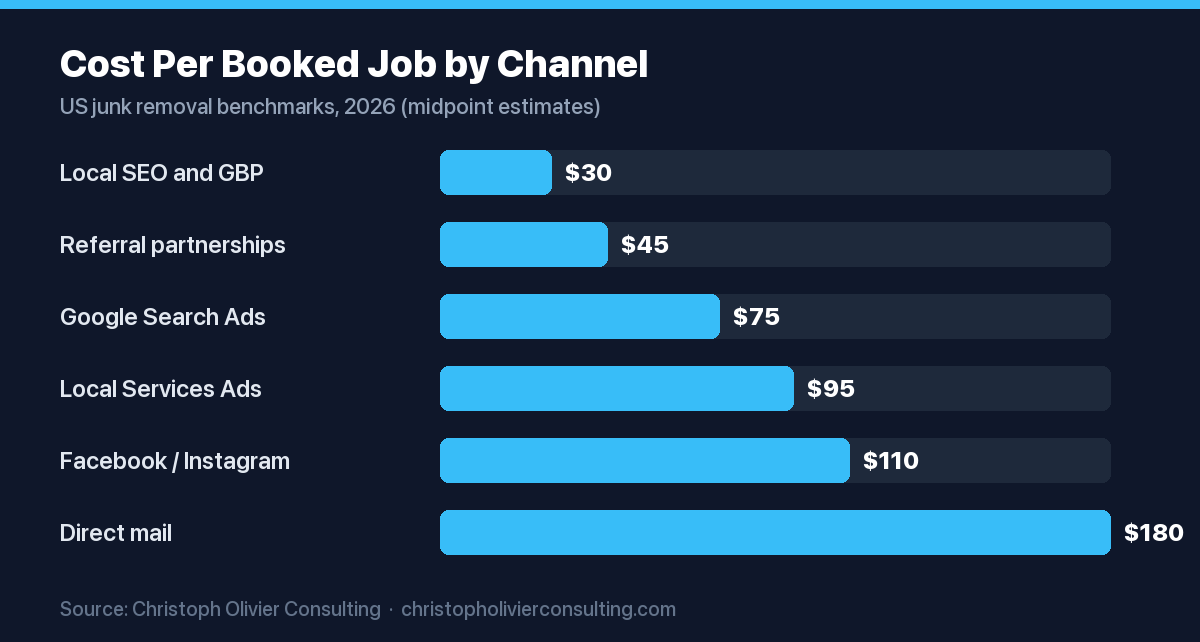
| Channel | Avg cost per lead (2026) | Lead-to-job booking rate | Est. cost per booked job | Time to first leads |
|---|---|---|---|---|
| Local SEO and GBP (organic) | $0 to $15 | 40% to 55% | ~$30 | 4 to 9 months |
| Referral partnerships | $25 to $50 flat | 70% to 90% | ~$45 | 2 to 6 weeks |
| Google Search Ads | $15 to $45 | 45% to 60% | ~$75 | Days |
| Google Local Services Ads | $30 to $83 | 35% to 50% | ~$95 | Days |
| Facebook and Instagram | $8 to $25 | 15% to 25% | ~$110 | Days |
| Direct mail | $50 to $54 | 10% to 18% | ~$180 | 2 to 4 weeks |
Read the table as a sequencing map. Paid channels buy you jobs this week; local SEO and referrals buy you the cheapest jobs next quarter. Most profitable haulers put 60% to 70% of budget on ads early, then flip that ratio as their local SEO for professional and home services matures.
What each channel costs per lead
Before booking rate enters the math, raw cost per lead ranges widely by channel. Facebook is the cheapest per lead but the coldest, so it needs the most follow-up. Local Services Ads cost more per lead but arrive as phone calls from people ready to book. The figure below shows 2026 midpoint cost per lead so you can see where the follow-up work has to happen.
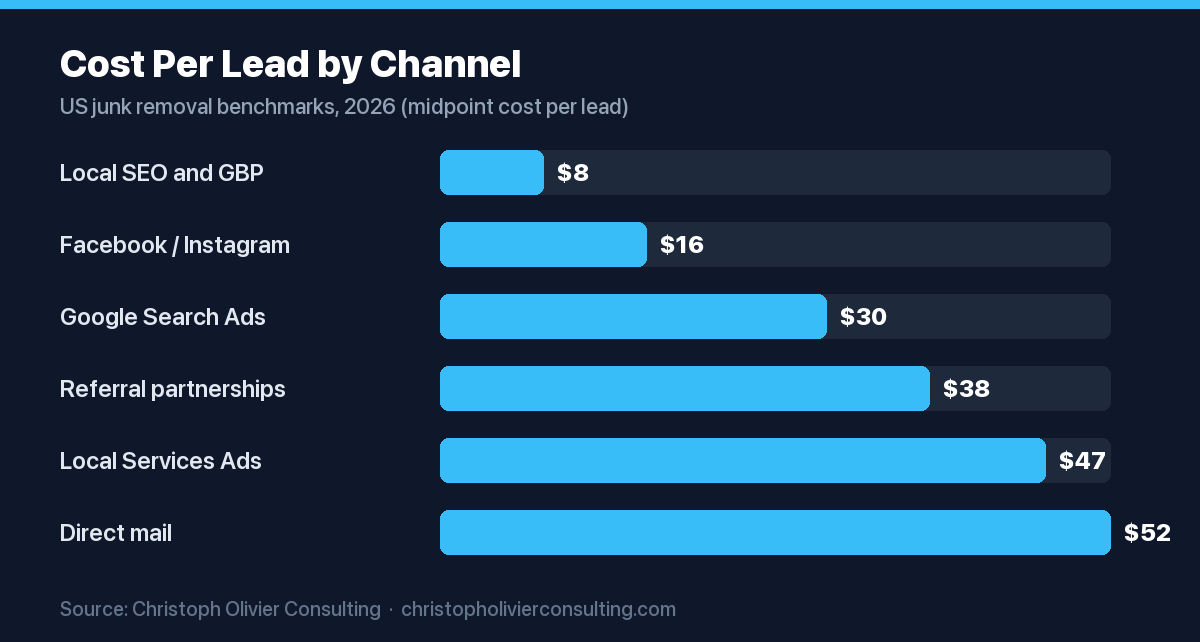
Use this alongside the cost-per-booked-job table above. A $16 Facebook lead looks great until a 20% booking rate turns it into a $110 job, while a $47 Local Services Ads call books far more often. Judge a channel by the job it produces, not the click it buys.
The five channels that keep a junk removal schedule full
Five channels do the heavy lifting for junk removal marketing: local SEO with a strong Google Business Profile, Google Local Services Ads, high-intent paid search, reviews, and referral partnerships. Each one plays a different role across the timeline, and the best operators run all five at once rather than betting on a single source.
Local SEO and your Google Business Profile
The map pack and your Google Business Profile drive most inbound calls, so local signals matter more than national link building. Fully complete your profile, add every service category from appliance pickups to estate cleanouts, post weekly photos of real jobs, and keep a steady flow of fresh reviews. Build one city page and one service page for each core offer so you rank for both the town and the job.
Expect 4 to 9 months to rank for competitive terms, which is why paid ads bridge the gap while organic matures. Local SEO is the lowest cost per booked job over time, so it is worth starting on day one even though it pays back last. It also feeds your broader small business lead generation engine.
Google Local Services Ads
Local Services Ads sit above the map pack and charge you per lead, not per click, so you pay only for a call or message rather than a curious DIYer. Junk removal saw an average charged lead near $47 in mid 2026, with a typical range of $30 to $83, and these leads book at 35% to 50% because they arrive as live phone calls. Earn the Google Guaranteed badge to lift trust and contact rate.
Answer every call inside 60 seconds, because the first responder usually wins the job. Dispute junk leads promptly to keep your effective cost per booked job down.
High-intent paid search
Standard Google Search Ads capture people typing exact phrases like same day junk removal or hot tub removal near me. A qualified lead usually runs $15 to $45, and service-segmented campaigns with upfront pricing keep cost per lead under $30. Segment by job type because furniture, appliance, and estate cleanout searches have different ticket sizes and competition.
Run search ads alongside Local Services Ads rather than instead of them. Operators running both report 40% to 60% lower cost per booked job, because you stop paying for clicks from bargain hunters and competitors.
Reviews as a marketing channel
Reviews are a channel, not a vanity metric, because star rating and review count decide who gets the click in the map pack. A profile with hundreds of recent 4.9-star reviews can carry roughly a quarter of total lead flow on its own. Ask for a review at the truck, the moment the job is done and the customer is happy.
Send one text with a direct review link within an hour of finishing, then a single reminder the next day. Reply to every review, good or bad, in your own voice so future customers see how you handle problems.
Referrals and partnerships with realtors and property managers
Referral partnerships produce the highest booking rate of any channel because the customer arrives pre-trusted. Realtors need properties cleared for listing, property managers need unit turnovers cleaned out at $400 to $900 each on a 24-hour timeline, and senior-living communities send downsizing families your way. One active agent or property-manager relationship can generate 2 to 5 cleanout jobs a month.
Make referring easy: offer a flat $25 to $50 per referred job or 10% to 15% of the ticket, pay within 48 hours, and give partners a dedicated booking line so their clients skip your general queue. Pair this outreach with social media lead generation so your name stays visible between referrals. If you want this built for you, see our consulting services.
Same-day demand economics and why speed wins the job
Junk removal is a speed business: most searches want a pickup today or tomorrow, and the first company to answer usually books it. That is why cost per booked job on Local Services Ads and search beats cheaper channels in practice, because the lead is live and ready. A missed call is a lost job that you still paid to generate.
Protect the economics with fast response and clear pricing. Answer calls in under a minute, quote a range on the phone, and offer same-day or next-day slots. Speed lifts your booking rate, which is the single biggest lever on cost per booked job across every channel in the table above.
How to build your junk removal marketing plan
Sequence beats intensity. Start with the fast channels to fill the truck this week, then invest the profit into the channels that lower your cost per job over the next two quarters. Here is the order that works for most local haulers.
- Claim and fully complete your Google Business Profile, add all service categories, and load 10 real job photos.
- Turn on Google Local Services Ads and earn the Google Guaranteed badge for immediate, pay-per-lead calls.
- Launch service-segmented Google Search Ads with upfront pricing to widen high-intent coverage.
- Build a review engine: one text with a review link within an hour of every completed job.
- Publish city and service pages so local SEO can compound over 4 to 9 months.
- Open 3 to 5 referral relationships with realtors, property managers, and senior communities, with a written kickback and a dedicated line.
- Track cost per booked job by channel monthly and shift budget toward the lowest-cost sources as organic and referrals mature.
Budget guide: plan on 8% to 12% of revenue during a growth phase. A hauler doing $400,000 a year typically runs $800 to $2,500 a month in ad spend plus agency or in-house management on top.
Junk removal marketing mistakes to avoid
The costliest mistakes are not bad channels, they are unmeasured ones. Judging Facebook by its low cost per lead, ignoring booking rate, and letting calls go to voicemail all quietly raise your cost per booked job. Fix the measurement and the follow-up before you add more spend.
Avoid these four traps: buying shared pay-per-lead lists that book at 12% to 20%, skipping upfront pricing so tire-kickers eat your ad budget, treating reviews as optional, and stopping local SEO because it pays back slowly. Each one trades a low headline cost for a high real cost per job.
Frequently asked questions
How much should a junk removal business spend on marketing?
Plan on 8% to 12% of revenue during active growth. A company doing $400,000 a year usually runs $800 to $2,500 a month in direct ad spend plus management. Early on, weight 60% to 70% toward paid channels for immediate jobs, then shift budget to local SEO and referrals as those lower-cost sources mature and carry more of the load.
What is the cheapest way to get junk removal leads?
Over time, local SEO with a strong Google Business Profile and referral partnerships produce the lowest cost per booked job, often near $30 to $45. They pay back slower than ads, taking weeks to months, but referrals book at 70% to 90% and organic search costs little per lead once you rank. Start them on day one while paid ads fill the truck now.
Are Google Local Services Ads worth it for junk removal?
For most haulers, yes. Local Services Ads charge per lead, not per click, averaged about $47 per charged lead in mid 2026, and arrive as live phone calls that book at 35% to 50%. They sit above the map pack and carry the Google Guaranteed badge. Answer within a minute and dispute junk leads to keep your effective cost per booked job low.
How do junk removal referral partnerships work?
You partner with realtors, property managers, and senior-living communities who regularly need spaces cleared. Offer a flat $25 to $50 per referred job or 10% to 15% of the ticket, pay within 48 hours, and give partners a dedicated booking line. One active relationship can send 2 to 5 cleanout jobs a month, and those leads book at the highest rate of any channel.
How long does junk removal SEO take to work?
Expect 4 to 9 months to rank for competitive local terms, depending on your market and how complete your Google Business Profile and city and service pages are. That lag is why paid ads bridge the gap early. Once you rank, organic delivers the lowest cost per booked job, so the wait pays back through cheaper jobs for years afterward.
What is a good cost per booked job for junk removal?
In most markets a healthy cost per booked job sits between $45 and $120, depending on your average ticket and local competition. With tickets of $250 to $600 and a 50% to 65% booking rate, that range protects margin. Track it by channel, not just cost per lead, because a cheap lead that rarely books can cost more per job than a pricier one.
More marketing guides for rank on ai: get cited by ai search
- Landscaping Marketing in 2026: Cost Per Booked Job by Channel
- Martial Arts School Marketing: A Playbook to Fill Mats and Keep Students
- Pressure Washing Marketing: The Channels That Book Jobs in 2026
- Tree Service Marketing: Cost and ROI by Channel (2026)
- Barbershop Marketing: The 2026 Playbook to Fill Every Chair
- Google Ads Budget for Small Business: How Much to Spend and How to Split It
- Rank on AI: Get Cited by AI Search