
Last reviewed: October 2026

Car dealer SEO is the work of getting a dealership’s inventory pages, service department and Google Business Profiles to show up when local shoppers search for a vehicle, a repair or a dealer near them. In 2026 it comes down to five things: correctly structured Business Profiles, crawlable vehicle detail pages, original content in place of OEM boilerplate, compliant reviews, and lead tracking that ties rankings to calls and sold units.
This guide is for dealer principals, general managers and marketing directors who are deciding what to fix in-house and what to buy. It draws on NADA’s latest advertising data, Google’s documentation and the FTC review rule, and ends with price ranges, a hiring checklist and red flags.
Would you rather hand SEO to a specialist? CO Consulting’s SEO services start with a month-one audit that decides the plan, and AI search optimization is included.
What car dealer SEO covers in 2026
Car dealer SEO covers four surfaces: your Google Business Profiles (sales, service, parts and brand listings), your inventory pages (search results pages and vehicle detail pages), your service and model content, and your reviews. Each one ranks for different searches, so a plan that only touches the homepage misses most of the demand.
Automotive SEO differs from most local SEO in three ways. First, your inventory changes daily, so thousands of URLs appear and disappear every month. Second, most dealer websites run on a platform vendor’s template, which limits what you can change and repeats the same OEM copy across hundreds of stores. Third, Google has dealer-specific Business Profile rules.
Two changes since 2025 matter for any plan you approve today:
- Vehicle listing rich results are gone. Google added vehicle listing structured data documentation in October 2023, then removed it on September 9, 2025, noting in its documentation changelog that these types “are no longer shown in Google Search results.” Google had flagged the change in a June 2025 Search Central post.
- The Business Profile inventory widget changed. SearchLab Digital reports that Google deprecated the Vehicles for Sale widget and the Q&A feature on dealership profiles. Confirm in your own profile before you pay anyone to “optimize” either one.
Where dealership marketing dollars go: the NADA numbers
Franchised dealers spent a record $9.96 billion on advertising in 2025, an average of $586,246 per store and $739 per new vehicle sold. Search is the biggest line: NADA estimates search engine marketing at 21.1% of spend and SEO website optimization at 19.5%, ahead of third-party listing sites at 20.0%.
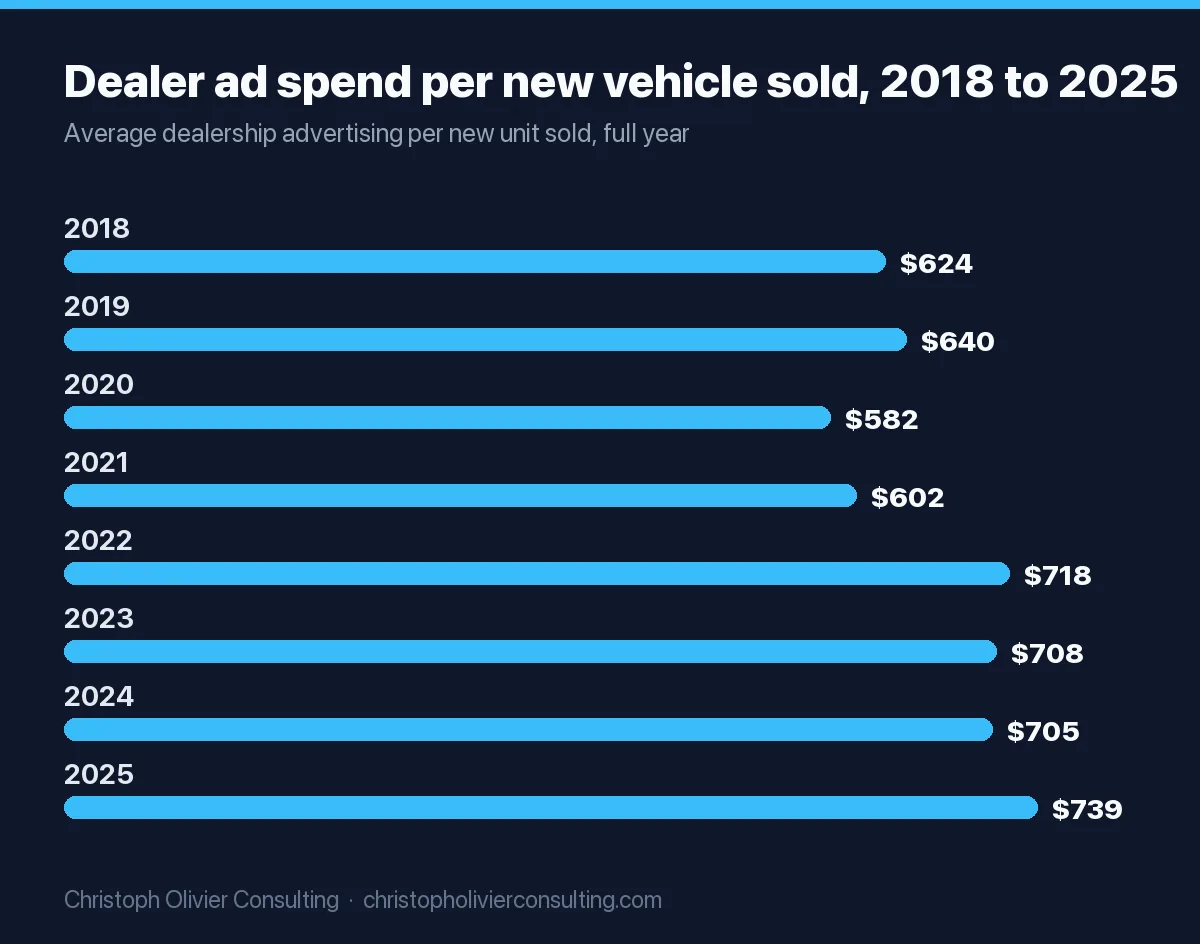
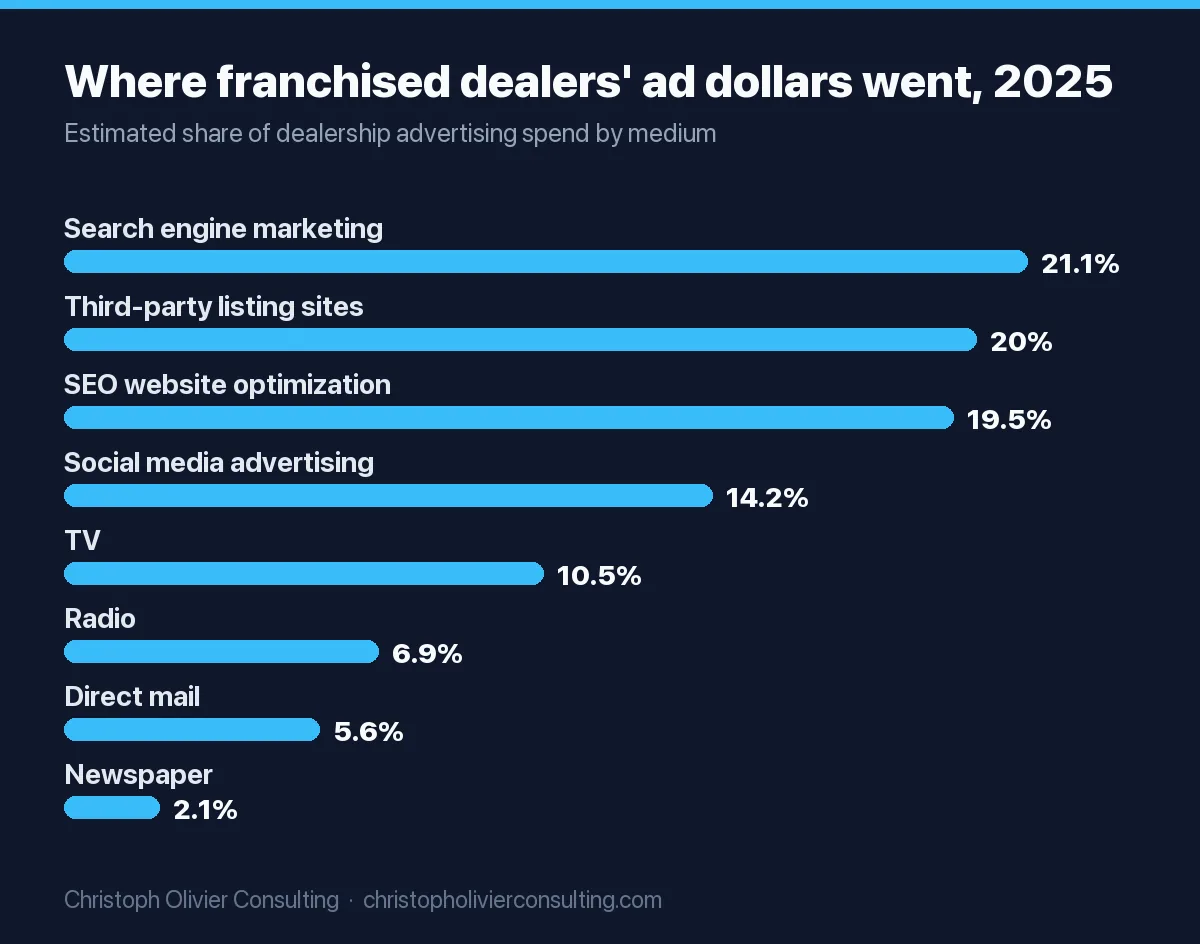
Those figures come from the NADA Data 2025 Annual Financial Profile, which covers the nation’s 16,990 franchised light-vehicle dealers. NADA’s per-dealership breakdown puts SEO website optimization at $114,318 a year, or roughly $9,500 a month. Treat that as a category average, not a price for SEO alone: the line may include website platform and related costs, and it is an average across stores of every size.
The cost per unit keeps rising. NADA’s 2026 midyear report puts advertising at $791 per new vehicle sold for January to June 2026, up from $722 in the same period of 2025. Organic traffic that does not bill per click gets more valuable as that number climbs, if you can prove it sells cars. For a channel-by-channel view of cost per sold unit, see our breakdown of car dealership marketing costs.
Google Business Profile for car dealerships: sales, service, parts and brands
Google lets every car dealership run a main profile plus separate department profiles for sales, service and parts. New-car franchise dealers can also create one profile per new-car brand sold. Used-car dealers cannot create brand profiles. Each department needs its own name, category and, usually, its own entrance and hours.
The rules come from Google’s Business Profile help page for car dealerships and its general guidelines for representing your business. Google says “publicly-facing departments that operate as distinct entities should have their own page,” that department names must differ from the main business, and that departments “typically” have a separate customer entrance and distinct categories.
| Listing | Who can have it | Suggested category (Google) | Naming pattern | Watch out for |
|---|---|---|---|---|
| Main dealership / sales | All dealers | Car dealer (or brand dealer category) | Real-world name on your sign | Adding “Sales” or a city name is keyword stuffing |
| Service department | All dealers with a distinct service operation | Car service | Dealership name + department | Needs a different primary category from sales |
| Parts department | Dealers with a customer-facing parts counter | Auto parts business | Dealership name + department | SearchLab reports Google rejects parts profiles without a dedicated counter |
| Brand profiles | New-car franchise dealers only | The brand’s dealer category | One per new-car brand sold | Used-car dealers cannot create these |
Hours also have a dealer-specific rule. Google tells car dealerships to use car sales hours, and if new and pre-owned sales hours differ, to use the new sales hours. Put service hours on the service profile, where shoppers who need an oil change will see them.
One trade-off to know: splitting departments splits reviews. A service profile with its own reviews can win “oil change near me” searches that a sales profile never would, but each listing will hold fewer reviews than one combined profile. In most cases the routing benefit is worth it. For the general playbook on profiles, citations and local pack signals, our local SEO playbook for service businesses covers the fundamentals that apply to every rooftop.
VDP and SRP indexing: making inventory crawlable
Your vehicle detail pages (VDPs) and search results pages (SRPs) are where model-level searches land. Google should crawl every live VDP and a small set of clean SRPs, not millions of filter combinations. The goal is fast discovery of new units, clean removal of sold ones and no crawl budget wasted on duplicate filtered views.
Control filtered search results pages
Dealer SRPs behave like ecommerce faceted navigation: make, model, trim, color, price and mileage filters multiply into near-infinite URLs. Google’s faceted navigation guidance says “oftentimes there’s no good reason to allow crawling of filtered items” and recommends blocking filter parameters you do not need in Search. It also says to return a 404 “when a filter combination doesn’t return results” and to keep filter order consistent.
The practical pattern for most stores:
- Keep a small set of indexable SRPs that match real searches, such as “used Toyota RAV4” or “new F-150 for sale,” each with unique intro copy.
- Block or canonicalize the long tail of color, price and sort combinations.
- Return a 404 for empty filter results instead of a “no vehicles found” page with a 200 status.
Handle sold vehicles on purpose
A sold unit’s VDP should not serve a “call for availability” stub forever. Agree one rule with your platform vendor: redirect sold VDPs to the closest matching SRP, or return a 404 or 410. Either is defensible. Thousands of dead live pages are not.
Vehicle structured data in 2026
Because Google retired vehicle listing rich results in 2025, markup no longer earns a special inventory display in standard search. Schema.org’s Vehicle and Car types are still a clean way to describe price, mileage, VIN and condition for other search engines and AI systems,. Keep it accurate, but do not pay a vendor a premium for “inventory rich results” that no longer appear.
OEM templates and duplicate content
Most dealer sites reuse the same OEM model descriptions, specials copy and platform templates as every other store selling that brand. Google will pick one version as canonical and filter the rest. To rank, your important pages need content only your store can publish: local details, real inventory context, staff expertise and service specifics.
Google’s guide to consolidating duplicate URLs explains the tools for duplicates inside your own site. Redirects and rel="canonical" are “a strong signal,” sitemap inclusion is “a weak signal,” and Google says “don’t use the robots.txt file for canonicalization purposes.” Canonical tags fix your internal duplicates. They do not make OEM copy unique across 300 sister sites.
Where to spend writing effort first:
- Top model pages. Rewrite the 5 to 10 model pages that drive the most new-car volume with local buying context, trims you actually stock and links to live inventory.
- Service pages. Replace generic “we service all makes” copy with specific services, pricing ranges you publish, loaner policy and appointment steps.
- Location pages. Give your store page real directions, parking, departments and staff, not a city-name swap.
- VDP descriptions. Add a short, human note to high-value used units: reconditioning done, ownership history highlights, why it is priced where it is.
Reviews that hold up under the FTC rule and Google policy
Reviews drive both local pack rankings and showroom trust, and the rules tightened in 2024. The FTC’s final rule bans fake and AI-generated reviews, paying for positive or negative reviews, undisclosed insider reviews and review suppression, and it lets the FTC seek civil penalties against knowing violators. Google’s own policy bars incentives and selective solicitation.
The FTC announced the rule in August 2024 after a 5 to 0 Commission vote. Reviews from officers, managers or employees must disclose the material connection. Separately, Google’s fake engagement policy prohibits reviews “paid for, directly or in kind,” content posted “due to an incentive offered by a business,” and businesses that “selectively solicit positive reviews.” It also names “merchants requesting that staff solicit a certain number of reviews” as a violation.
That last line matters for dealers. If your pay plan sets salesperson review quotas, or staff ask customers for five stars to protect a bonus, that sits squarely inside Google’s prohibited list. A compliant program asks every customer, sales and service alike, through the same text or email at delivery or pickup, with no reward and no filter for happy customers. Respond to every review, especially negative ones, without legal threats.
A related note on advertising claims: the FTC’s CARS Rule, which would have set dealer pricing and add-on disclosure requirements, was vacated by the Fifth Circuit on January 27, 2025 on procedural grounds. Dealers should still expect FTC scrutiny of misleading pricing on VDPs and specials pages, so keep advertised prices honest.
Service department SEO: the fixed-ops opportunity
Service department SEO targets repeat, high-intent local searches such as “oil change,” “brake repair” or “[brand] service near me.” NADA reports that franchised dealerships wrote more than 276 million repair orders in 2025 with service and parts sales above $164 billion, so organic visibility for service often pays back faster than another sales page.
The same NADA report puts the average dealership at $9.69 million in service and parts sales and 16,252 repair orders a year, with $494 in service and parts sales per customer repair order.
What a service SEO build usually includes:
- A dedicated service Business Profile with “Car service” or a closer category, service hours and the service phone line.
- One page per major service (oil change, brakes, tires, batteries, alignment, EV service if you offer it) with what is included, typical time and how to book.
- Online scheduling linked from both the website and the Business Profile.
- Service review requests sent at vehicle pickup, using the same compliant process as sales.
Local landing pages and content for automotive SEO
Automotive SEO content works when it answers questions a buyer or owner in your market actually asks, on pages tied to inventory or service. Local landing pages should exist only for towns you genuinely serve, each with real reasons to choose you, drive time and relevant inventory. Thin city-swap pages rarely rank and can drag down site quality.
Content types that tend to earn traffic for dealers:
- Comparison pages for models you sell against close rivals, with trims and pricing you stock.
- Ownership guides such as maintenance schedules, warranty coverage explainers and EV charging basics for your area.
- Video walkarounds of real units and service explainers, embedded on the relevant VDP or service page.
Measuring dealer SEO: calls, leads and VDP views
Measure dealer SEO by the leads and sold units it produces, not by rankings alone. Track organic phone calls, form leads, chat leads, service appointments, VDP views per visit and Business Profile actions, then match leads to your CRM so you can report organic cost per sold unit next to paid channels.
| Metric | Where it comes from | Why it matters | Common trap |
|---|---|---|---|
| Organic phone calls | Call tracking with dynamic number insertion | Captures shoppers who never fill out a form | Tracking numbers that break Business Profile NAP consistency |
| Organic form and chat leads | GA4 key events plus CRM source field | Ties SEO to sold units | Platform forms that do not pass source data to the CRM |
| VDP views from organic | GA4 page reports filtered by organic | Shows shoppers reaching real inventory | Counting SRP filter pages as VDP views |
| Business Profile actions | Business Profile performance report | Calls, directions and website clicks per department | Reporting all departments as one number |
| Service appointments booked | Scheduler integration and GA4 | Fixed-ops revenue attribution | Scheduler on a third-party domain with no tracking |
| Indexed VDPs vs live inventory | Search Console page indexing report | Shows crawl and indexing health | Thousands of indexed sold units or filter URLs |
Car dealership SEO pricing and your options
Car dealership SEO pricing varies widely by scope. For general SEO services, Ahrefs’ survey of 439 providers found the most common monthly retainer band was $501 to $1,000, with agencies averaging about $3,209 a month and consultancies about $3,250. Dealer SEO often sits at or above that range because of inventory scale and multiple profiles.
The Ahrefs SEO pricing survey is not automotive-specific, so treat it as a market range, not a dealer quote. It found 78.2% of providers charge a monthly retainer, the average hourly rate was about $111, and the most popular project band was $2,501 to $5,000. For comparison, NADA’s SEO website optimization line averages $114,318 a year per franchised store, which bundles more than SEO labor.
| Option | Typical market range | Best for | Main limitation |
|---|---|---|---|
| Website platform SEO add-on | Often bundled; ask for the SEO line item | Stores that need basic hygiene | Template limits and shared OEM copy |
| Automotive-specialist agency | Market retainers commonly in the low thousands per month, more for groups | Single stores and groups wanting dealer playbooks | Cookie-cutter content across many dealer clients |
| Generalist SEO agency | Agency average about $3,209 per month (Ahrefs) | Strong technical and content needs | May not know OEM co-op rules or dealer platforms |
| Independent consultant | Consultancy average about $3,250 per month (Ahrefs) | Audits, strategy and vendor oversight | Limited production capacity |
| In-house marketer | Salary plus tools | Groups with several rooftops | Hard to hire and retain specialist skills |
If budget is the main constraint, our guide to affordable SEO services explains what a lower retainer can realistically buy. Small independents that need a defined first project can start with an SEO starter package before committing to a long retainer.
How to hire a car dealer SEO partner: checklist, questions and red flags
Hire a dealer SEO partner the way you would buy a used unit: inspect first. Ask for an audit before a contract, confirm what your website platform lets them change, require lead and sold-unit reporting tied to your CRM, and walk away from anyone who guarantees rankings or sells review schemes.
Dealer SEO audit checklist (copy and use)
- [ ] Sales, service and parts Business Profiles exist, verified, with correct names, categories and hours
- [ ] Brand profiles only for new-car brands you sell as a franchise dealer
- [ ] Business names match signage with no keyword stuffing
- [ ] Live VDP count in Search Console roughly matches live inventory
- [ ] Filter and sort URLs blocked or canonicalized; empty filters return 404
- [ ] Sold-unit rule agreed (redirect or 404/410) and working
- [ ] Top model and service pages rewritten beyond OEM copy
- [ ] Review requests sent to every customer, no incentives, no staff quotas
- [ ] Call tracking, form source and scheduler data flowing to the CRM
- [ ] Monthly report shows leads and sold units by department, new vs used
Questions to ask before you sign
- Which changes can you make on our website platform, and which need the vendor’s support team?
- How will you handle filtered SRPs and sold VDPs on our site specifically?
- How will our content differ from other dealers you serve for our brand?
- How do you report organic leads and sold units, not just traffic?
- What is the contract term, and what do we own if we leave (content, profiles, tracking numbers)?
Red flags
- Guaranteed first-page or map pack rankings.
- Review “boosting,” gated review funnels or incentive programs.
- Selling “vehicle rich results” setup in 2026.
- Owning your Business Profile or call tracking numbers instead of you.
- Reports with no leads, calls or sold units in them.
Worked example: a 90-day plan for one rooftop
Here is how I would sequence the first 90 days for a single franchised store. It is a template, not a promised result.
- Days 1 to 15, audit. Review Business Profiles, Search Console indexing, SRP and VDP handling, duplicate content, reviews process and lead tracking.
- Days 16 to 30, fix the foundations. Split or clean department profiles, correct names and categories, set the sold-unit rule, block filter URLs and connect call and form tracking to the CRM.
- Days 31 to 60, content. Rewrite the top model pages and the main service pages, and build a compliant review request flow for sales and service.
- Days 61 to 90, measure and expand. Report organic leads by department, compare organic cost per sold unit with paid channels, and pick the next set of model, service and local pages.
If you would rather not vet vendors yourself, CO Consulting runs an audit-first process and can match you with a dealer SEO partner that fits your platform and budget. Christoph has built content systems that have generated more than 200 million organic views and has managed millions in ad spend, and every engagement starts with a 90-day plan, with no ranking guarantees. You can see how that works on our SEO services page, or, when you are ready to talk through your store’s numbers, book a consultation.
Work with CO Consulting
Want SEO that brings in qualified clients?
- A month-one audit that decides the mix, written into a 90-day plan you can hold us to
- Technical, on-page, local, content and AI search work in one engagement
- Monthly tracking of whether ChatGPT, Perplexity and Google AI Overviews cite your business
- Reporting tied to pipeline, not vanity rankings. No ranking guarantees, ever
Frequently asked questions
What is car dealer SEO?
Car dealer SEO is the work of making a dealership's website, inventory pages, service pages and Google Business Profiles visible when local shoppers search for vehicles, repairs or a dealer near them. It covers department profiles, crawlable vehicle detail pages, original content in place of OEM boilerplate, compliant reviews, and tracking that ties organic visits to calls, leads and sold units.
How much does car dealership SEO cost?
Prices vary by scope and store count. Ahrefs' survey of 439 SEO providers found agencies average about $3,209 a month and consultancies about $3,250, with $501 to $1,000 the most common retainer band. NADA's 2025 data puts the average franchised store's SEO website optimization line at $114,318 a year, but that category may bundle website platform costs, so treat all figures as market ranges.
Can a car dealership have separate Google Business Profiles for sales and service?
Yes. Google's help page for car dealerships says all dealerships can have a profile for the dealership plus profiles for departments such as sales, parts or service. New-car dealers can also have a profile for each new-car brand sold, while used-car dealers cannot. Each department needs a distinct name and category, and usually its own entrance and hours.
Does vehicle structured data still help dealer SEO in 2026?
Not for special inventory displays in standard Google Search. Google removed its vehicle listing structured data documentation on September 9, 2025, noting the types are no longer shown in Search results. Accurate Vehicle or Car markup can still describe price, mileage and VIN to other systems, but avoid paying a premium for inventory rich results that no longer appear.
Are dealership review incentives allowed?
Paying for reviews or offering incentives conflicts with both the FTC's 2024 final rule on fake reviews and Google's fake engagement policy. Google also prohibits selectively soliciting positive reviews and merchants asking staff to hit review targets. A safer program asks every sales and service customer the same way, with no reward and no filtering of unhappy customers.
How do you measure automotive SEO results?
Track organic phone calls, form and chat leads, service appointments, VDP views from organic visits and Business Profile actions by department. Match leads to your CRM so you can report organic cost per sold unit next to paid channels. Rankings alone do not show whether SEO is selling cars or filling service bays.
What are red flags when hiring a dealer SEO agency?
Watch for guaranteed rankings, review boosting or gated review funnels, keyword-stuffed Business Profile names, vendors who keep ownership of your profiles or tracking numbers, and reports with no leads or sold units. Also be wary of anyone still selling vehicle rich results setup, since Google stopped showing those in 2025.
More SEO guides
- Local SEO Playbook for Service Businesses
- SEO Tips for Small Businesses: A 90-Day Plan That Ranks
- How to Build a Basic SEO Report (7 Sections + Free Template)
- SEO Recommendations Report: Turn an Audit Into a Prioritized Action Plan
- LLM SEO: Win in the Age of AI Search
- SEO Services Buyer’s Guide
- All SEO guides →