
Last reviewed: October 2026

The clearest false advertising examples are cases where a regulator or court found that a claim misled buyers in a way that mattered: Volkswagen’s “clean diesel” campaign (a $10 billion FTC order), Skechers’ toning shoes ($40 million), Uber’s driver pay claims ($20 million) and Google’s Pixel 4 radio endorsements by hosts who had not used the phone ($9.4 million to states). The common thread is simple. The advertiser said something specific that it could not prove.
Below are 15 real cases with verified outcomes from primary sources, each with the claim, the problem, the penalty and the lesson. Then the legal test, the 2024 and 2025 rule changes, and a pre-publish checklist for your own ads.
False advertising examples at a glance: 15 cases with verified outcomes
Fifteen documented false advertising cases cover four patterns: unproven health or performance claims, misleading environmental and origin claims, inflated earnings or “free” offers, and fake endorsements or filtered reviews. Outcomes range from orders with no payment to a $10 billion redress fund. Each row below links to the primary source in the sections that follow.
| Company | Year | The claim | The problem | Outcome |
|---|---|---|---|---|
| Volkswagen | 2016 | “Clean diesel” cars | Defeat devices cheated emissions tests | $10 billion FTC order |
| Skechers | 2012 | Shape-ups tone muscles and aid weight loss | Unsupported; study by an undisclosed insider | $40 million |
| Reebok | 2011 | EasyTone gives 28% more buttock strength and tone | Claims not backed by science | $25 million in refunds |
| Kellogg | 2009 | Frosted Mini-Wheats improve kids’ attentiveness by nearly 20% | Study showed far smaller results | FTC consent order |
| Dannon | 2010 | Activia and DanActive “clinically proven” | No substantiation for health claims | FTC order plus $21 million to 39 states |
| L’Oréal | 2014 | Génifique and Youth Code act on genes | Gene claims unsubstantiated | FTC final order |
| Lumosity | 2016 | Brain games delay cognitive decline | No science; prize-driven testimonials | $2 million paid; $50 million judgment suspended |
| Herbalife | 2016 | Business opportunity income | Deceptive earnings claims | $200 million redress; business restructured |
| Uber | 2017 | uberX median pay over $90,000 in New York | Actual median was $61,000 | $20 million |
| Intuit (TurboTax) | 2024 | File your taxes for “free” | Most consumers did not qualify | FTC order restricting “free” claims |
| Kubota | 2024 | Replacement parts “Made in USA” | Parts made entirely overseas | $2 million civil penalty (a record for the rule) |
| Google and iHeartMedia | 2022 | DJs praising the Pixel 4 camera | Hosts had not used the phone | $9.4 million to states; FTC orders |
| Fashion Nova | 2022 | Reviews shown as representative | Reviews under four stars suppressed | $4.2 million |
| Red Bull | 2014 | “Gives you wings” functional benefits | Class action alleged no reliable science | $13 million class settlement |
| Fyre Festival | 2018 | Luxury Caribbean music festival | Investor and ticket fraud | Founder sentenced to six years |
For the trend behind these cases, I keep a summary of FTC advertising enforcement statistics.
Health and fitness claims: deceptive advertising examples built on “clinically proven”
Health and fitness claims supply many classic deceptive advertising examples because they sound scientific and are easy to overstate. The FTC expects “competent and reliable scientific evidence” for these claims. Skechers, Reebok, Kellogg, Dannon, L’Oréal and Lumosity all made specific, measurable promises their evidence did not support, and several paid tens of millions.
1. Skechers Shape-ups (2012): $40 million
Skechers told buyers to “Shape Up While You Walk” and promised weight loss and muscle toning. In May 2012 the company agreed to pay $40 million to settle FTC charges. The FTC said the claims were unsupported, results were cherry-picked, and the chiropractor behind an “independent” study was paid by Skechers and married to one of its marketing executives.
Lesson: an endorser’s tie to you is part of the claim.
2. Reebok EasyTone (2011): $25 million
Reebok’s ads said EasyTone shoes were proven to deliver 28% more strength and tone in the buttock muscles and 11% more in the hamstrings and calves than regular walking shoes. In September 2011 Reebok agreed to pay $25 million in consumer refunds.
Lesson: a precise percentage needs a study that produced that number.
3. Kellogg Frosted Mini-Wheats (2009): consent order
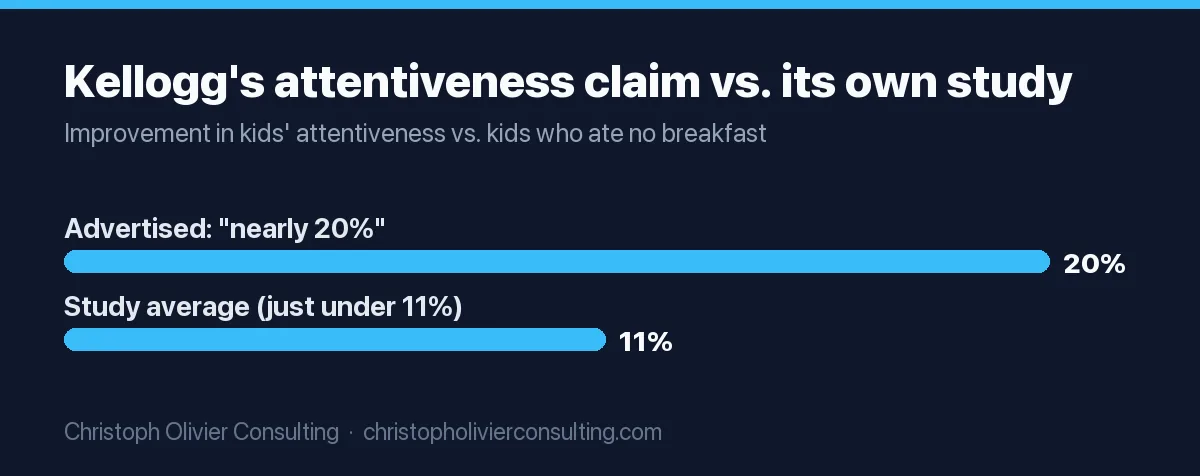
A national campaign said Frosted Mini-Wheats were “clinically shown to improve kids’ attentiveness by nearly 20%.” According to the FTC’s April 2009 complaint, only about half the children in Kellogg’s study improved at all, about one in nine improved by 20% or more, and the average gain versus no breakfast was just under 11%.
Lesson: presenting your best result as typical is misrepresentation, even when the study is real.
4. Dannon Activia and DanActive (2010): $21 million to states
Dannon called Activia (for irregularity) and DanActive (for colds and flu) “clinically proven.” The FTC’s December 2010 settlement said Dannon lacked substantiation and that the “clinically proven” claims were false. Dannon paid $21 million to 39 states, and Activia ads had to state that three daily servings were needed.
Lesson: leaving out the real dose is a deceptive omission.
5. L’Oréal Génifique and Youth Code (2014): final order
L’Oréal promoted Génifique as “clinically proven” to boost genes’ activity and sold Youth Code as “gene science.” The FTC’s final order (September 2014) bars gene-based anti-aging claims without competent and reliable scientific evidence. It carried no payment.
Lesson: science-flavored language creates an implied claim you must prove.
6. Lumosity (2016): $2 million paid, $50 million suspended
Lumos Labs claimed its brain games improved work and school performance and could delay cognitive decline and dementia. The FTC said it “simply did not have the science to back up its ads,” and that testimonials came from undisclosed prize contests. Lumosity paid $2 million against a $50 million judgment that was suspended because of its finances.
Lesson: a prize for a testimonial is a material connection to disclose.
Environmental and origin claims: Volkswagen and Kubota
Environmental and “Made in USA” claims are deceptive when the product does not match the label. Volkswagen sold “clean diesel” cars that cheated emissions tests, which produced the largest redress order of any case here. Kubota labeled overseas parts as American made.
7. Volkswagen “clean diesel” (2016): $10 billion order
Volkswagen advertised “clean diesel” cars while fitting them with illegal defeat devices that cheated emissions tests. In October 2016 a federal judge approved the FTC’s $10 billion order, covering about 500,000 owners of 2.0 liter VW and Audi diesels. Most owners were set to receive $12,500 to $44,000 each.
Lesson: a brand word like “clean” is a factual claim when performance can be measured.
8. Kubota “Made in USA” (2024): $2 million civil penalty
From at least 2021, Kubota labeled thousands of replacement parts “Made in USA” that were made entirely overseas. In January 2024 the FTC announced a $2 million civil penalty, which it called the largest ever under the Made in USA Labeling Rule.
Lesson: claims go stale when operations change.
Earnings and “free” offers: Uber, Herbalife and TurboTax
Earnings claims and “free” offers are misleading advertising examples because they describe an outcome most people will not get. Uber advertised median driver pay its drivers did not earn, Herbalife used deceptive earnings claims to recruit distributors, and Intuit advertised free filing that most taxpayers could not use.
9. Uber driver earnings (2017): $20 million
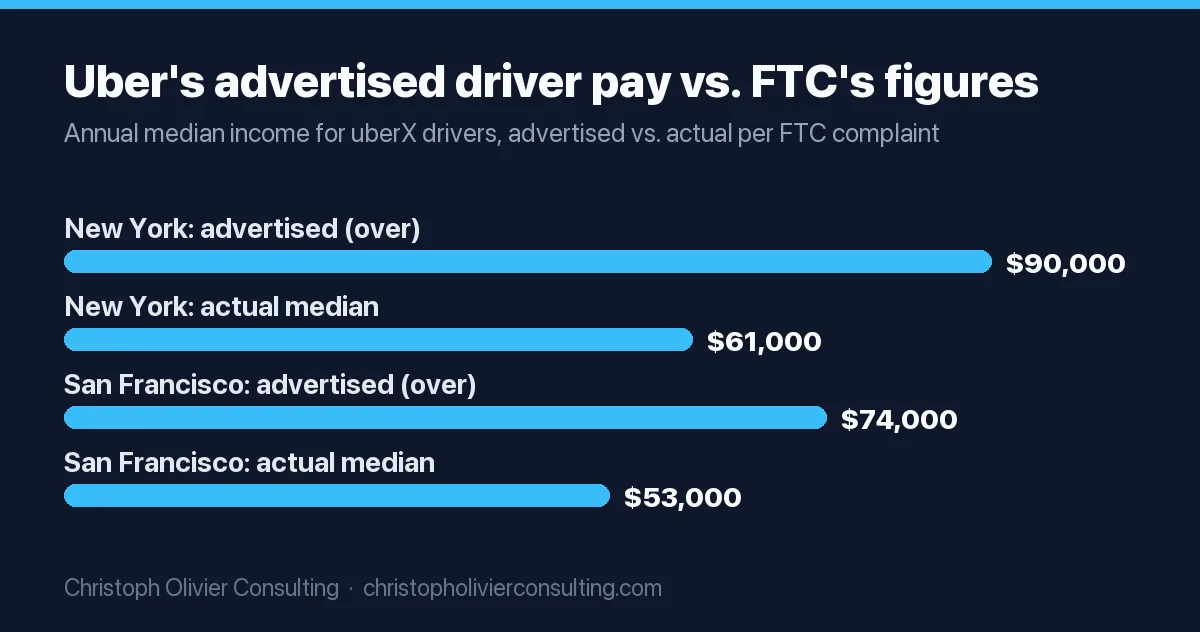
Uber’s website said median annual income for uberX drivers was over $90,000 in New York and over $74,000 in San Francisco. According to the FTC’s January 2017 complaint, the real medians were $61,000 and $53,000, and fewer than 10% of drivers in those cities earned the advertised amounts. Uber paid $20 million for driver refunds.
Lesson: a published median must match your data.
10. Herbalife (2016): $200 million and a restructured business
The FTC charged that Herbalife drew people in with deceptive earnings claims. In July 2016 it agreed to pay $200 million and restructure its U.S. business. In January 2017 the FTC mailed checks to nearly 350,000 people, mostly for $100 to $500.
Lesson: income promises are judged against typical earnings.
11. Intuit TurboTax (2024): limits on “free”
In January 2024 the FTC issued an opinion finding Intuit’s “free” TurboTax ads deceptive because a majority of consumers did not qualify. Intuit may not call a product free unless it is free for all or the ad discloses the share who qualify. The order carried no fine or refund requirement.
Lesson: put the qualifier next to the “free.”
Fake endorsements and filtered reviews: the newest false advertising cases
Endorsement and review cases are a modern form of false advertising, made easier by social and review platforms where opinions are cheap to fake. Google paid radio hosts to describe a phone they had not used, Fashion Nova hid its bad reviews, and Fyre Festival’s celebrity-fueled promotion ended in a fraud conviction.
12. Google and iHeartMedia Pixel 4 ads (2022): $9.4 million
In 2019 Google hired iHeartMedia and 11 other radio networks to have on-air hosts endorse the Pixel 4 from scripts Most hosts had not received the phone before recording. The FTC and seven states announced in November 2022 that nearly 29,000 deceptive endorsements had aired. The states secured $9.4 million in penalties.
Lesson: scripts are fine; invented experience is not.
13. Fashion Nova (2022): $4.2 million
Fashion Nova’s site presented customer reviews as if they reflected all buyers, but it held back every review under four stars. The FTC’s final order (March 2022) required a $4.2 million payment and bars the company from suppressing reviews.
Lesson: a filtered review set presented as complete is a false claim.
14. Fyre Festival (2018): six years in prison
Fyre Festival was sold as “a luxury musical festival in the Caribbean,” promoted on social media by celebrities including Kendall Jenner and Bella Hadid. Attendees found FEMA tents and no concert. Founder Billy McFarland was sentenced to six years in October 2018 for fraud that cost investors and customers over $26 million.
Lesson: borrowed credibility amplifies a promise; it does not make it true.
The same rules apply to testimonials and case studies for coaches and consultants.
Puffery or promise: why Red Bull settled over “gives you wings”
Puffery is vague, subjective boasting that no reasonable person takes literally, and it is generally not false advertising. “Gives you wings” reads as puffery. Red Bull’s 2014 class action settlement came from a different allegation: that it marketed functional benefits beyond other caffeine products and implied scientific support it did not have.
15. Red Bull (2014): $13 million class settlement
Consumers in Wolf v. Red Bull and Careathers v. Red Bull alleged the company marketed its drinks as superior to other caffeine-only products without “credible and reliable scientific evidence.” Red Bull North America agreed in July 2014 to a $13 million settlement, offering class members $10 cash or about $15 in product. Final approval followed in 2015.
Lesson: the slogan can stay; the functional claims around it need evidence.
My breakdown of famous ads shows memorable creative that stays on the safe side of puffery.
What counts as false advertising: the legal test
In the U.S., an ad is false or deceptive when it contains a representation or omission that is likely to mislead a reasonable consumer, and that matters to the purchase decision. The FTC enforces this under Section 5 of the FTC Act. Competitors can sue under Section 43(a) of the Lanham Act, and consumers can bring state-law class actions.
The FTC’s 1983 Policy Statement on Deception sets out three elements. First, there must be “a representation, omission or practice that is likely to mislead the consumer.” Second, it is judged from the perspective of a consumer acting reasonably. Third, it must be “material,” meaning it is likely to affect the buyer’s decision. If an ad conveys two meanings and one is false, the seller is liable for the misleading one.
| Route | Legal hook | Typical remedy |
|---|---|---|
| FTC enforcement | FTC Act Section 5 (deceptive acts or practices) | Orders, redress, penalties for order violations |
| FTC rule violation | Specific rules (Made in USA Labeling Rule, fake reviews rule) | Civil penalties per violation |
| State attorneys general | State consumer protection statutes | Penalties and settlements |
| Competitor lawsuit (any business harmed) | Lanham Act Section 43(a)(1)(B) | Injunctions and damages |
| Consumer class action | State consumer and false advertising laws | Class settlements |
| Criminal prosecution | Wire fraud and related statutes | Prison, forfeiture |
For service firms, the competitor route matters. Under 15 U.S.C. 1125(a)(1)(B), anyone who “misrepresents the nature, characteristics, qualities, or geographic origin” of goods or services in commercial advertising can be sued by “any person who believes that he or she is or is likely to be damaged.”
Substantiation, endorsements and the 2024 fake reviews rule
Substantiation means having objective evidence for a claim before you publish it. The FTC says advertisers need proof for express and implied claims, and at minimum the level of evidence the ad says they have. Since 2024, a separate FTC rule on fake reviews and testimonials lets the agency seek civil penalties from knowing violators.
Substantiation basics
The FTC’s advertising guide for small businesses sets three standards: ads must be truthful and not deceptive, claims need evidence, and ads cannot be unfair. In practice:
- “At a minimum, an advertiser must have the level of evidence that it says it has.” If you say “studies show,” you need studies.
- A money-back guarantee “is not a substitute for substantiation,” and fine print cannot fix a misleading headline.
- Testimonials must reflect typical results or disclose what buyers can generally expect. “Your results may vary” is not enough.
The fake reviews and testimonials rule
On August 14, 2024, the FTC announced a final rule banning fake reviews and testimonials. It prohibits:
- Fake reviews or testimonials, including AI-generated ones.
- Rewards for reviews that express a particular sentiment.
- Undisclosed insider reviews from officers, managers or staff.
- Company-controlled “independent” review sites.
- Suppressing negative reviews through threats or baseless legal claims.
- Buying or selling fake followers or views for commercial purposes.
The FTC’s inflation-adjusted maximum civil penalty for violations covered by Sections 5(l) and 5(m) of the FTC Act rose to $53,088 per violation effective January 17, 2025. Because penalties are assessed per violation, totals can climb quickly.
Five patterns behind misleading advertising examples
Almost every case above fits one of five patterns: an inflated number, a borrowed authority, a hidden condition, a curated sample, or a claim that went stale. Knowing the pattern helps you spot risk in your own copy before a regulator, competitor or customer does.
- The inflated number: Reebok’s 28%, Kellogg’s “nearly 20%,” Uber’s $90,000.
- The borrowed authority: “clinically proven,” “gene science” or an expert with an undisclosed tie (Dannon, L’Oréal, Skechers).
- The hidden condition: three servings a day, or qualifying for “free” (Dannon, Intuit).
- The curated sample: testimonials or reviews that are not typical (Lumosity, Fashion Nova, Google).
- The stale claim: copy that was once true (Kubota).
Service businesses usually trip on patterns 1, 4 and 5: a best-ever result shown as typical, a testimonials page that drops unhappy clients, or a client count nobody has rechecked. This check belongs in your paid advertising process, not only in legal review.
Pre-publish ad claims checklist for service businesses
A pre-publish claims check is a short review that matches every factual statement in an ad to the evidence behind it before the ad runs. Use the steps below for paid ads, landing pages, case studies and sales decks, and keep a simple claims log so you can show your evidence later.
- List every claim, including implied ones. “Clients see results in 30 days” implies most clients do.
- Classify each claim as fact, opinion or puffery. Only puffery escapes the evidence test.
- Attach the evidence. If the ad says “proven,” the proof must exist today.
- Check typicality. If a result is not typical, state what clients generally achieve, next to it.
- Disclose connections behind every endorsement: payment, discounts, free service, family or employment ties.
- Put conditions beside the headline, not in a footnote.
- Audit the review page. No filtering, buying, gating or undisclosed staff reviews.
- Date the claim and set a reminder to recheck counts, rankings and “Made in” statements.
Claims log template
| Claim (exact wording) | Type | Evidence on file | Typical or best case? | Disclosure needed | Last verified |
|---|---|---|---|---|---|
| “Trusted by 200+ firms” | Fact | CRM export of active and past clients | n/a | None | Date |
| “Cut onboarding time in half” | Fact (result) | Before and after data for the named client | Best case | “Results vary; typical clients see X” | Date |
| Testimonial from a referral partner | Endorsement | Signed permission | n/a | Disclose referral fee | Date |
| “The most responsive team in the region” | Puffery | None needed | n/a | None | Date |
The rows are illustrations, not real client data.
Worked example: fixing a risky service-business ad
The fastest way to apply these false advertising examples is to rewrite one of your own ads. Below is a hypothetical paid social ad for a bookkeeping firm, the problems a regulator or competitor could raise, and a version the firm can prove.
Original (hypothetical): “Clinically proven to save you 10 hours a week. Our clients grow 3x faster. Rated 5 stars by every customer. Free setup.”
- “Clinically proven” borrows authority the firm does not have (the Dannon and L’Oréal pattern).
- “10 hours a week” is a specific number that needs measurement across clients (Reebok).
- “Grow 3x faster” implies a typical result the firm cannot show (Uber).
- “Rated 5 stars by every customer” is false if any lower review exists or was removed (Fashion Nova).
- “Free setup” needs its conditions beside it (TurboTax).
Revised: “Spend less time on the books. In our last client survey, most respondents said month-end close got faster after switching. See all our reviews, good and bad. Setup is free on annual plans.”
The revised ad still sells, and every claim points to something the firm can show. If the survey does not exist yet, run it before using the line. More creative that persuades without overclaiming: these social media ads examples.
If you want a second set of eyes on your claims before they run, you can book a consultation and we can walk through them together.
Frequently asked questions
What are some examples of false advertising?
Well-documented examples include Volkswagen's "clean diesel" cars, which cheated emissions tests and led to a $10 billion FTC order; Skechers' Shape-ups toning claims ($40 million); Uber's inflated driver pay claims ($20 million); Google's Pixel 4 radio endorsements by hosts who had not used the phone ($9.4 million to states); and Fashion Nova hiding reviews under four stars ($4.2 million).
What is the biggest false advertising case in FTC history?
Volkswagen's "clean diesel" case is the largest in this list by far. In October 2016 a federal judge approved a $10 billion FTC order covering about 500,000 owners of certain 2.0 liter VW and Audi diesel cars, with most owners set to receive between $12,500 and $44,000 each, depending on the car and its condition.
What makes an ad legally false or deceptive?
Under the FTC's 1983 Policy Statement on Deception, an ad is deceptive if it contains a representation, omission or practice likely to mislead a consumer acting reasonably, and the claim is material, meaning it is likely to affect the purchase decision. Both express claims and implied claims count, and fine print usually cannot fix a misleading headline.
Is puffery considered false advertising?
Generally no. Puffery is vague, subjective boasting that no reasonable buyer takes literally, such as "the best coffee in town." The risk starts when a slogan is paired with specific, measurable claims. Red Bull's $13 million class settlement was not about the "gives you wings" line itself but about alleged functional benefit claims without reliable scientific support.
Can a competitor sue you for false advertising?
Yes. Section 43(a)(1)(B) of the Lanham Act lets any person who believes they are or are likely to be damaged sue a business that misrepresents the nature, characteristics, qualities or geographic origin of goods or services in commercial advertising. This is separate from FTC enforcement and state consumer class actions, and it is often how competitor disputes over comparative claims start.
What does the FTC fake reviews rule ban?
The rule, announced August 14, 2024, bans fake or AI-generated reviews and testimonials, rewards conditioned on positive or negative sentiment, undisclosed insider reviews, company-controlled "independent" review sites, suppressing negative reviews through threats or baseless legal claims, and buying or selling fake followers or views. The FTC can seek civil penalties from knowing violators.
What are the penalties for false advertising?
Penalties depend on who brings the case. The FTC can obtain orders and consumer redress, and civil penalties for rule or order violations, capped at $53,088 per violation after the January 2025 inflation adjustment. State attorneys general can collect penalties, consumers can win class settlements, and outright fraud can lead to criminal charges, as in the Fyre Festival case.
More Paid Advertising guides
- TikTok Ads for B2B: When It Works
- Instagram Story Ads Examples: Patterns That Convert by Objective
- Podcast Advertising Buyer Guide 2026
- Amazon PPC: Campaign Types, ACoS, and TACoS Explained
- What Is an Ad? Definition, Types, and the 5 Parts Every Advertisement Has
- Facebook Ads Cost 2026: Real Numbers
- All Paid Advertising guides →