
Last reviewed: October 2026

What is cause marketing? Cause marketing is a partnership between a for-profit business and a nonprofit or social cause, where the business promotes the cause and the cause benefits, usually through a donation tied to sales, customer actions or a licensed product. Done well, the nonprofit gets money and attention, and the business earns trust and differentiation. Done badly, it reads as cause-washing and can break state charity laws.
Below: the types of cause-related marketing, nine verified examples, what consumer research shows, the state co-venturer rules most articles skip, and a step-by-step plan with a disclosure template for service businesses.
What is cause marketing?
Cause marketing is a program in which a company and a nonprofit or cause work together for mutual benefit. The company commits money, products or reach to the cause and tells customers about it. State charity regulators call the most common form a “charitable sales promotion”: a company advertising that buying its goods or services will benefit a charity.
The Perlman & Perlman commercial co-venturer chart (2026) defines the activity as promotions “in which the company advertises that the purchase or use of certain goods or services will benefit a nonprofit organization or charitable purpose,” and notes that companies doing this are called “commercial co-venturers” under state charitable solicitation laws. If your campaign says “buy this, and we give,” you are in that category.
Every cause campaign has three parts: a cause partner (usually a registered charity), a mechanism (how value flows to the cause), and a promise to the public (the claim in your ads, proposals or posts). The promise is what regulators and customers judge.
Cause marketing vs cause-related marketing, CSR and purpose-driven marketing
Cause marketing and cause-related marketing mean the same thing. Corporate social responsibility (CSR) is broader: it covers how a whole company affects society. Purpose-driven marketing communicates a company’s reason for existing beyond profit. Cause marketing is the campaign layer: a specific partner, a specific mechanism and a specific promise.
| Term | What it is | Time frame | Typical example |
|---|---|---|---|
| Cause marketing / cause-related marketing | A company and a cause partner run a promotion that benefits both | Campaign or multi-year program | A set dollar amount per product sold goes to a named charity |
| Corporate social responsibility (CSR) | The company’s overall social and environmental conduct | Ongoing, company wide | Supplier standards, emissions targets, community grants |
| Purpose-driven marketing | Marketing that leads with why the company exists | Ongoing, brand level | A brand platform built around one social mission |
The useful test: if customers are told their purchase or action triggers a benefit, treat it as cause marketing and apply the disclosure rules below.
The main types of cause marketing
There are six common cause marketing models: transactional (a gift per purchase), percentage-of-sales pledges, buy-one-give-one, licensing a cause brand, message promotion (awareness without a per-sale gift), and employee or action-triggered giving. Each carries different costs, legal exposure and credibility. Pick the model before you pick the creative.
| Type | How it works | Verified example | Best for | Watch-outs |
|---|---|---|---|---|
| Transactional | A fixed amount per sale or per use goes to the cause | American Express, 1983: a penny per card use | Retail, high-volume services | Usually triggers commercial co-venturer rules; needs caps and minimums disclosed |
| Percentage-of-sales pledge | A set share of revenue is given, often year round | 1% for the Planet members give 1% of annual sales | Brands that want a permanent commitment | Say “sales” or “revenue,” not vague “profits” |
| Buy-one-give-one | Each purchase triggers an in-kind donation | Warby Parker Buy a Pair, Give a Pair; TOMS One for One (since evolved) | Physical products | In-kind gifts must be disclosed as in-kind |
| Licensing | A company pays to use a cause brand on its products | (RED) partner products funding the Global Fund | Consumer brands with large reach | Consumers need to see what share reaches the cause |
| Message promotion | The brand funds and spreads a cause message or program | Dove Self-Esteem Project | Brands with a natural link to the issue | Highest cause-washing risk if actions don’t match words |
| Employee or action-triggered giving | Gifts or volunteer time tied to staff or customer actions (event days, likes, sign-ups) | Chili’s Create-A-Pepper days for St. Jude | Local and service businesses | Social-media “like to give” campaigns still need full terms |
For most service firms, the realistic options are a capped per-client donation, a percentage pledge, or employee volunteering with a matched gift.
9 cause marketing examples, verified
The best cause marketing examples share three traits: a clear link between the brand and the cause, a simple mechanism customers can understand, and public reporting of results. The nine below are checked against the brand’s or partner’s own figures or contemporaneous reporting.
1. American Express and the Statue of Liberty (1983)
In the fall of 1983, American Express ran TV spots offering to contribute a penny for each use of its cards to the Statue of Liberty renovation. According to The Christian Science Monitor (1985), the campaign cost an estimated $4 million; the company had predicted an 18 percent increase in card use and was reported to have gained 28 percent. The same article notes it was “not clear how much the foundation’s drive benefited.” That caveat is the lesson: report the gift, not just the lift.
2. Patagonia and 1% for the Planet
In 2002, Patagonia founder Yvon Chouinard and Blue Ribbon Flies founder Craig Mathews created 1% for the Planet, pledging 1% of annual sales, “not profits,” to environmental organizations. Other brands followed suit, including Klean Kanteen and New Belgium Brewing. The organization says it has certified over $939 million in contributions to environmental causes (1% for the Planet, Our Story). It turned one pledge into a membership network any size of business can join.
3. (RED): licensing a brand to fund the Global Fund
(RED) partners with brands to create (RED) products, and purchases send money to the Global Fund. On its own site, (RED) reports $800 million or more raised for the Global Fund, programs that have reached 350 million or more people, and 20 years in the fight to end AIDS. It shows how one cause brand can be licensed across many companies.
4. TOMS: from One for One to grants
TOMS made buy-one-give-one famous with its One for One shoe model. Its impact page now says “our giving model has evolved since our start in 2006,” moving to a focus on children’s education, health and well-being, and reports $200 million or more given as grants and shoe donations since 2006. The lesson: a giving model may need to change as you learn what the cause actually needs.
5. Warby Parker: Buy a Pair, Give a Pair
Warby Parker says that for every pair of glasses or sunglasses it sells, a pair is distributed to someone in need. Its 2024 Impact Report states the program had passed 20 million pairs distributed. The brand-cause fit is direct.
6. Dove Self-Esteem Project: message promotion at scale
The Dove Self-Esteem Project is message-promotion cause marketing: Dove funds education and campaigns on body confidence rather than promising a gift per bar of soap. Dove says the project has reached over 160 million young people since 2004. Its films, such as Reverse Selfie from the official Dove US channel, carry the message; the education program is the proof behind it. It is a fixture on any list of famous ads for good reason: the work and the claim line up.
7. Chili’s Create-A-Pepper for St. Jude
Chili’s asked guests to give at least $1 to color a pepper pinup, and gave 100 percent of its profits from one Monday to St. Jude Children’s Research Hospital. A November 2006 release reported the September campaign raised more than $5 million against a $3 million goal, as part of a 10-year plan to raise $50 million. A multi-location service business can copy it: one recurring day, one partner, one ask.
8. Lewes FC and White Ribbon Day
For White Ribbon Day 2023, English football club Lewes FC partnered with Survivors Network on a campaign against gender-based violence: the men’s team wore white armbands and a player recorded a social conversation with a Survivors Network representative, as described by Brandwatch. No per-ticket donation, just a credible partner and a message the club could own: a good template for small organizations with an audience but a modest budget.
9. Small-business members of 1% for the Planet
You don’t need a national brand. 1% for the Planet’s own history names companies such as Klean Kanteen and New Belgium Brewing among the brands that followed suit and joined with the same 1%-of-sales pledge. A membership model gives a small company a standard commitment and a third party that certifies the giving.
For more campaigns that broke through, browse these innovative marketing campaigns.
Why cause marketing works: what consumer research says
Consumer surveys consistently show a stated preference for purpose-driven companies, especially when price and quality are equal. In Porter Novelli’s 2021 Purpose Perception Study, 71% of US adults said they would buy from a purpose-driven company over the alternative when cost and quality are equal. Stated intent is not behavior, so treat these as directional.
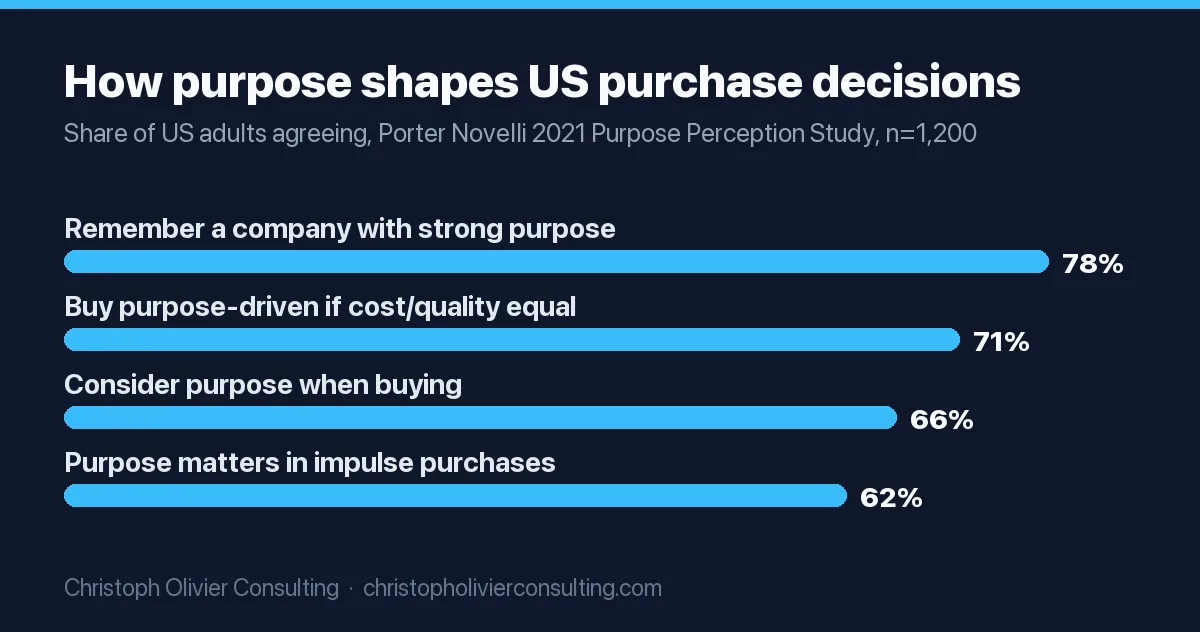
The Porter Novelli 2021 Purpose Perception Study surveyed 1,200 US adults aged 18 to 69 online. Beyond the 71% finding, 66% said they would consider a company’s purpose when making purchase decisions, 62% said purpose is an important factor in quick or impulse purchases, and 78% said they were more likely to remember a company with a strong purpose. When a company leads with purpose, respondents said they were 76% more likely to trust it and 72% more likely to be loyal.
An earlier wave, the 2018 Cone/Porter Novelli Purpose Study, found 66% of Americans would switch from a product they typically buy to one from a purpose-driven company.
Two caveats. These surveys measure what people say, and “all else equal” does a lot of work: purpose tips close decisions but rarely beats a clearly better price or product. And professional-service buyers decide through referrals and risk reduction, so a cause program supports trust but never replaces proof of competence.
Cause marketing laws: commercial co-venturer rules and FTC claims
In the US, a business that advertises that purchases will benefit a charity can be a “commercial co-venturer” under state charitable solicitation laws. Some states require registration, a bond, contract filing before the campaign and a report afterward. Environmental claims tied to a cause also fall under the FTC’s Green Guides. Check both before launch.
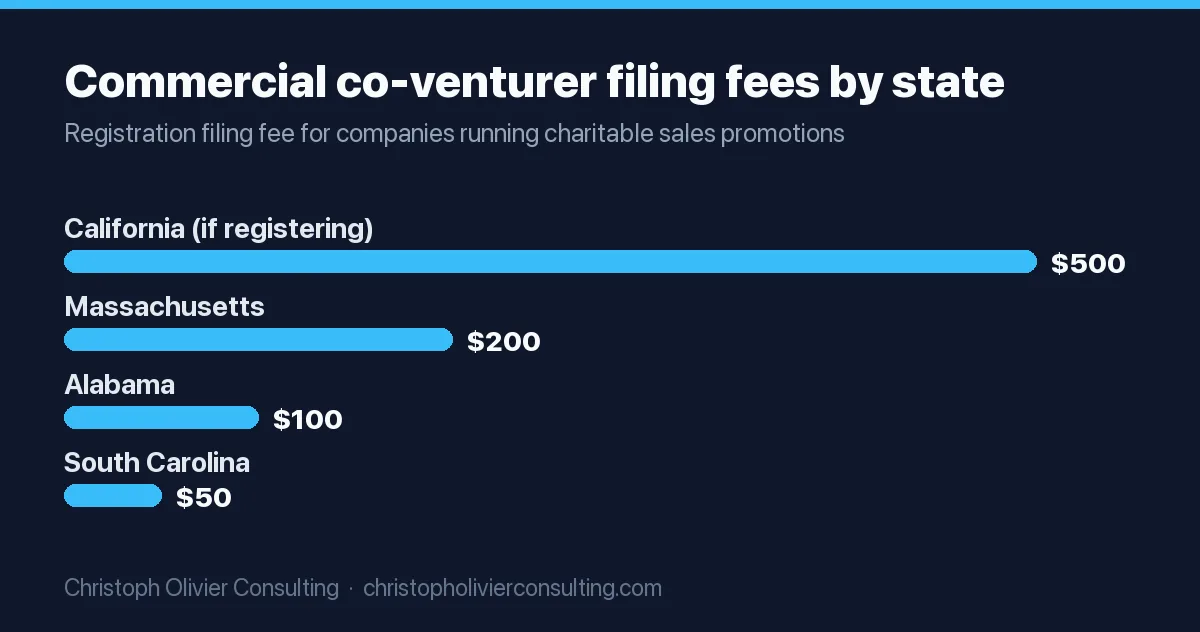
Requirements vary sharply by state. This summary comes from the Perlman & Perlman CCV registration and reporting chart, © 2026, which states it is informational and not legal advice:
| State | Registration | Contract filing | Campaign report |
|---|---|---|---|
| Alabama | Required; $100 fee; $10,000 bond; renew by Sept 30 | Within 10 days of execution and at least 15 days before performance | Within 90 days after the contract ends |
| California | Register ($500 fee, no bond) or comply with contract rules, including transfers every 90 days | Only if staff overlap with the nonprofit | By January 30 for promotions active the prior year |
| Hawaii | Not required | Contract or written consent at least 10 days before the promotion | Not required |
| Illinois | AG position: register under charitable trust law | Before the promotion starts; $15 fee | 6 months after the promotion ends |
| Massachusetts | Required; $200 fee; $25,000 bond; renew by Dec 31 | Contract plus signed notice within 10 days of execution | By February 28 for promotions active the prior year |
| Mississippi | Not required | At least 7 days before the promotion | Within 30 days after it ends |
| South Carolina | Required above $10,000 in expected contributions (amended 6/18/26); $50 fee | At least 10 days before the promotion | Within 90 days after it ends |
Online promotions have extra rules: California (from 1/1/24) and Hawaii (from 7/1/26) require any entity running online charitable sales promotions that benefit seven or more nonprofits in a calendar year to register as a “charitable fundraising platform.” Some states also require the nonprofit to file, so expect paperwork requests.
Disclosure standards regulators expect
Two standards set the bar. The BBB Standards for Charity Accountability (Standard 19) call for disclosing, at the point of solicitation, how the charity benefits, the duration of the campaign, and any maximum or guaranteed minimum contribution. The New York Attorney General’s “Five Best Practices for Transparent Cause Marketing,” summarized by Perlman & Perlman (2012), go further:
- Clearly describe the promotion: the charity’s name and mission, the benefit per purchase, any flat donation, minimum or cap, any consumer action required, and start and end dates.
- Let consumers work out the donation: a fixed dollar amount per unit, or a fixed percentage of the price, instead of vague “profits” or “proceeds.”
- Disclose what is not obvious: flat gifts that don’t depend on purchases, in-kind gifts, and whether a ribbon or cause logo actually triggers a donation.
- Apply the same transparency on social media, including “like” or follow campaigns, ideally with real-time tracking.
- Tell the public how much was raised after the campaign ends.
FTC rules on green and cause claims
If your cause is environmental, the FTC’s Green Guides apply to the claim. Under 16 CFR 260.4, “it is deceptive to misrepresent, directly or by implication, that a product, package, or service offers a general environmental benefit,” and marketers “should not make unqualified general environmental benefit claims.” Name the exact benefit rather than calling a service “eco-friendly.”
How to run a cause marketing campaign as a service business
A service business can run cause marketing in eight steps: pick a cause that fits your clients and brand, vet a partner, choose a simple mechanism, set caps and minimums, sign a written agreement, check state rules, launch with full disclosure, then report results publicly. Most problems come from skipping the agreement or the disclosure.
- Start from brand fit. An estate-planning firm and an elder-care charity fits; a random trending cause does not. If your positioning is fuzzy, sort out your brand strategy first, because the cause amplifies whatever story you already tell.
- Know who your clients give to. Giving habits differ by age, income and region; check donor demographics before you pick.
- Vet the partner. Confirm registration, read its public filings and ask how it will use the funds. Knowing how nonprofit marketing works helps you fit their calendar and brand rules.
- Choose one mechanism. Flat gift, per-client amount, percentage of fees or volunteer hours. One mechanism, explained in one sentence.
- Set the numbers. Dollar amount per unit, a cap, any guaranteed minimum, and start and end dates. Avoid “a portion of proceeds.”
- Put it in writing. Cover the mechanism, logo approvals, payment timing, reporting and an exit clause. Several states require filing the contract before launch.
- Check the rules. Review co-venturer requirements in every state where you advertise, plus your profession’s conduct rules. Ask counsel if unsure.
- Launch, then report. Disclose on every touchpoint, pay on schedule, and publish the final amount.
Worked example: a cause campaign template for a 15-person firm
Here is an illustrative cause marketing plan for a hypothetical 15-person accounting firm: a capped per-client donation to a local food bank during tax season, with a guaranteed minimum, a written agreement and public reporting. The numbers are placeholders to show structure, not a forecast of results.
The hypothetical firm commits $25 for each new individual tax client signed between February 1 and April 15, with a $1,000 guaranteed minimum and a $5,000 cap, plus one staff volunteer Saturday at the food bank. Its disclosure, built from the template below, appears on every touchpoint.
Donation information (template label)
- Charity: [Name], [one-line mission], [registration number if applicable]
- How it works: We donate $[amount] for each [unit: new client, completed project, purchase]
- Dates: [start date] to [end date]
- Guaranteed minimum: $[amount], paid regardless of sales
- Maximum: $[cap]; once reached, further purchases do not add to the gift
- Action required: [None / sign engagement letter / register by date]
- Type of gift: [Cash / in-kind: describe]
- Results: We will publish the total donated at [URL] by [date]
Cause-washing: the risks and how to avoid them
Cause-washing is promoting a cause more than you actually support it, through vague claims, tiny gifts behind big messaging, or values your conduct contradicts. The risks are regulatory complaints, partner fallout and public backlash. The fix is proportion: say less than you do, use exact numbers, and publish results.
Common failure patterns:
- Vague donation language such as “proceeds,” which the New York AG warns against.
- Symbol without substance: a ribbon or cause color with no disclosure of whether a purchase triggers a gift.
- Hidden caps: running the promotion after the cap is hit, so later buyers think they are giving.
- Unqualified green claims like “eco-friendly,” which the Green Guides treat as deceptive.
- Mismatch with conduct: championing a cause your own policies undercut.
- One-and-done: a single campaign in a crisis month, then silence.
In my view, the safest posture for a professional-service firm is modest and specific: one partner, multiple years, exact amounts, published totals.
How to measure a cause marketing campaign
Measure cause marketing on two scorecards: impact for the cause (dollars given, people served, partner-confirmed outcomes) and impact for the business (awareness, engagement, leads, conversion and retention compared with a baseline). Set both before launch, agree on the cause metrics with your partner, and report the cause numbers publicly.
- Cause: total donated (cash and in-kind), confirmed by the partner, and outcomes funded from the partner’s program reporting.
- Business: reach and engagement, leads and new clients versus the same period last year, and retention or referrals among participating clients.
Be careful with attribution: a campaign during your busiest season will look better than it is without a fair baseline. And remember the American Express lesson: the business lift was widely reported, the cause benefit far less so. Publish both.
If you want help choosing a cause, structuring the agreement and building the campaign into your wider marketing plan, you can book a consultation and we can walk through what fits your firm.
Frequently asked questions
What is cause marketing in simple terms?
Cause marketing is when a business partners with a nonprofit or social cause and tells customers about it, usually promising a donation tied to purchases, actions or a licensed product. The charity gains money and awareness, and the business gains trust and differentiation. In most US states, advertising that a purchase benefits a charity makes the business a commercial co-venturer under charity law.
What is the difference between cause marketing and cause-related marketing?
There is no real difference. Cause marketing and cause-related marketing are used interchangeably for promotions where a company and a cause partner benefit together. The BBB Standards for Charity Accountability use the term cause-related marketing for the sale of products or services that benefit a charity. Purpose-driven marketing and CSR are broader ideas about a brand's mission and overall conduct.
What are some examples of cause marketing?
Well-documented examples include American Express's 1983 penny-per-card-use campaign for the Statue of Liberty renovation, Patagonia co-founding 1% for the Planet, (RED) partner products funding the Global Fund, TOMS One for One, Warby Parker's Buy a Pair, Give a Pair, the Dove Self-Esteem Project and Chili's Create-A-Pepper campaign for St. Jude Children's Research Hospital.
Do I need to register to run a cause marketing campaign?
It depends on the states where you advertise. A 2026 Perlman & Perlman chart shows Alabama and Massachusetts require commercial co-venturer registration with a bond, California allows registration or compliance with contract rules, and several states require filing the contract before the promotion starts. Rules change, so check current state requirements or ask counsel before launch.
What should a cause marketing disclosure include?
Following the BBB Standard 19 and New York Attorney General best practices, disclose the charity's name and mission, the exact amount or fixed percentage donated per purchase, any minimum guarantee or cap, any action the customer must take, the campaign start and end dates, whether the gift is cash or in-kind, and where the final total will be published.
Can a small service business do cause marketing?
Yes. A service firm can pledge a set amount per new client with a cap, commit a percentage of revenue through a network such as 1% for the Planet, or pair staff volunteering with a matched gift. Keep one partner, one simple mechanism and exact numbers, sign a written agreement, check state co-venturer rules, and publish the results afterward.
What is cause-washing?
Cause-washing is promoting a cause more than you actually support it: vague claims like 'a portion of proceeds,' tiny donations behind large campaigns, cause symbols with no gift attached, or values your own conduct contradicts. It can lead to regulatory complaints and public backlash. Exact amounts, long-term partnerships and published results are the most practical defenses.
More Growth Consulting guides
- Nonprofit Marketing: A Small-Budget Playbook That Wins Donors
- How to Get More Google Reviews (Without Breaking Google’s Rules)
- ABM: A Practical Playbook for Service Firms
- Painting Company Marketing: Cost Per Booked Job by Channel
- Why Is Marketing Important? The Business Case in Dollars, Not Adjectives
- The History of Marketing: 6 Eras That Rewrote How Companies Sell
- All Growth Consulting guides →