
Last reviewed: October 2026

Book promotion services are paid help that gets a book in front of readers: deal newsletters such as BookBub, Amazon Ads management, publicists, podcast tour bookers and launch support. Prices run from about $5 for a small newsletter listing to $1,370 or more a month for a publicist. For a consultant, coach or advisor, the best service is the one that turns readers into clients, not the one that sells the most $0.99 copies.
This guide compares every major type of book promotion service side by side with verified 2026 prices, shows what fits an author-expert versus a fiction author, and gives you a 90-day launch plan, a buying checklist, the questions to ask, and the scam warning signs that writers’ organizations keep reporting.
Want content that brings in clients, not just traffic? See how CO Consulting runs content marketing for service businesses.
What book promotion services actually do
Book promotion services sell attention for your book. Some sell access to an audience they already own, such as a deal newsletter. Some run ads on a platform for you, such as Amazon or BookBub. Others pitch you to media, podcasts and reviewers. None can rescue a weak cover or a vague promise.
Sort the market into three buckets before you compare vendors:
- Audience rental: deal newsletters and promo sites. You pay a flat fee to appear in an email that goes to readers who opted in for your category.
- Paid media: Amazon Ads, BookBub Ads and social ads. You pay per click or impression, and you or a hired manager control targeting and budget.
- Earned media and relationships: publicists, podcast tour bookers, launch teams and speaking. You pay for labor and contacts, and the outlet decides whether to cover you.
Most lists for “book promotion services” are fiction deal-site directories. If you wrote a business book to win clients, the right mix looks different, and this page is weighted toward you.
Types of book promotion services compared
The main book promotion services are deal newsletters, BookBub Featured Deals, Amazon Ads, BookBub Ads, publicists, podcast tours, launch teams and freelance book marketers. They differ on cost, control and fit. Deal newsletters are cheap and fast but built for discounted ebooks. Publicists and podcast tours cost more but suit expert nonfiction better.
| Service type | What you get | Verified price or market range | Best for | Fit for author-experts |
|---|---|---|---|---|
| Small promo newsletters | One listing in a genre email or social post | Listed starting prices from $5 to $320 per placement (Reedsy directory) | Discounted fiction ebooks | Low: few have business categories |
| BookBub Featured Deal | A slot in BookBub’s daily deal email for your category | Business category: $304 (free book) to $1,435 (priced $3+) (BookBub pricing) | Backlist titles, series, price promotions | Medium: reach is real, but you must discount 50%+ |
| Amazon Ads (Sponsored Products) | Pay-per-click ads on Amazon search and product pages | Auction-based cost per click, $1.00 minimum daily budget (Amazon Ads FAQ) | Steady sales at full price | Medium: good for discoverability, weak for lead capture |
| BookBub Ads | Self-serve ads inside BookBub emails and site | Self-serve auction: you set the budget and bids (BookBub tools overview) | Authors willing to test creative | Medium |
| Freelance book marketer | Strategy, ad setup, blurb and metadata, email | $570 to $1,320 per project, Reedsy averages by task (Reedsy) | Authors who need a plan and setup | High, if they understand B2B buyers |
| Book publicist | Pitches, press kit, media and podcast outreach | Median $1,370 for a month-long campaign on Reedsy; independent retainers from about $3,000 a month | Timely, newsworthy nonfiction | High: podcasts and trade press fit experts |
| Podcast tour booking | Guest spots on shows your buyers listen to | A la carte podcast pitching from a $5,000 minimum at one publicist (Publishing Confidential) | Nonfiction with a clear point of view | Very high |
| Launch team | Early readers who read and share in launch week | Mostly your time plus advance copies | Authors with a list or network | Very high |
Prices are vendor-listed or marketplace figures as published in 2026. Treat the publicist and marketer numbers as market ranges, not quotes. Scope, experience and timeline move them a lot.
Book promotion services cost in 2026: verified prices
Book promotion costs range from free (a launch team) to several thousand dollars a month (a publicist on retainer). Reedsy, based on more than 230,000 freelancer quotes, puts total self-publishing marketing at $60 to $1,500, while BookBub Featured Deals for business books cost $304 to $1,435 per feature depending on your deal price.
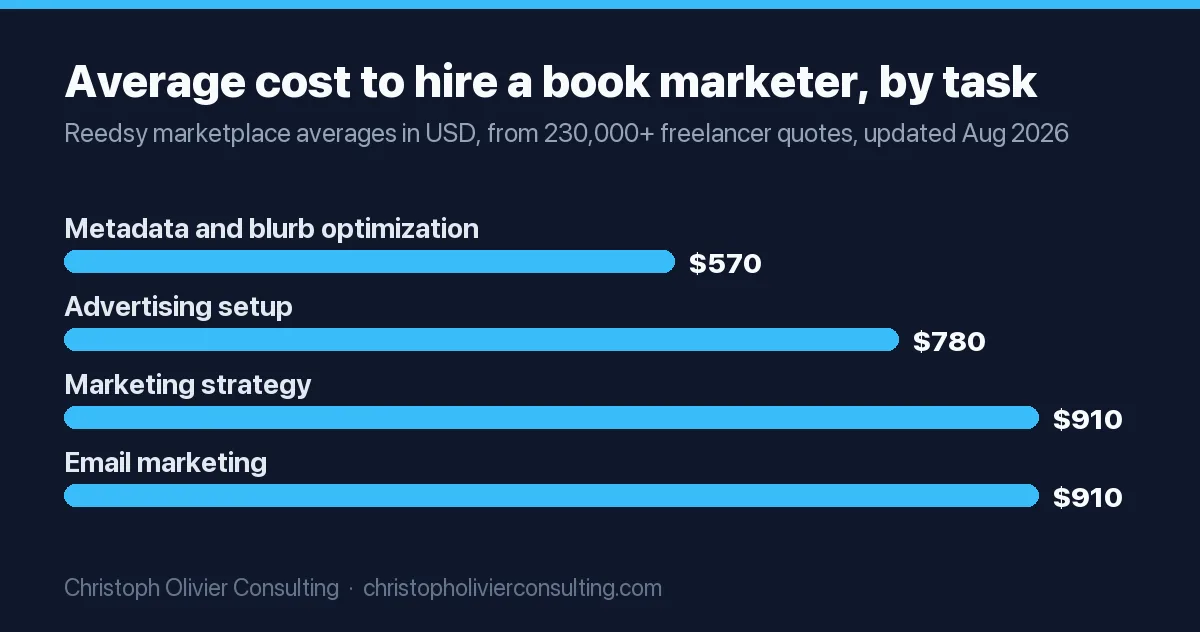
Those figures come from Reedsy’s self-publishing cost guide, which also lists price-promotion listings at $15 to $120 (usually under $100) and suggests testing ads from $5 a day. For hired help, Reedsy’s averages by task are $910 for a marketing strategy, $780 for advertising setup, $570 for metadata and blurb work, and $910 for email marketing.
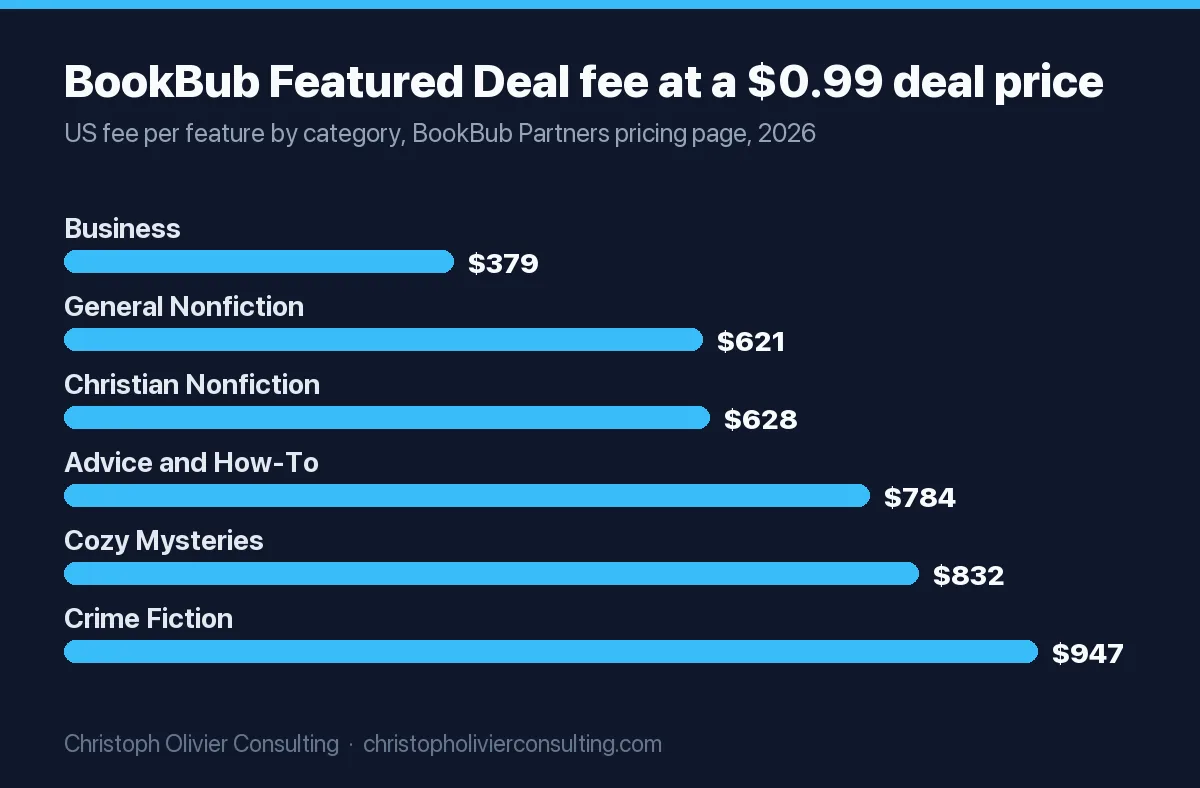
The chart above shows how much a single BookBub Featured Deal costs at a $0.99 deal price across categories. Business is one of the cheaper categories because its list is smaller than the big fiction genres. The subsections below break down each channel.
BookBub Featured Deals
A BookBub Featured Deal puts your discounted ebook in a daily email sent to readers who chose your category. It is the largest single deal channel, and it is selective. BookBub says it can select only about 10 to 15% of books submitted for US Featured Deals, and your book must be discounted at least 50% off its recent price.
Those rules come from BookBub’s submission requirements. If you are not selected, you can resubmit after four weeks. Fees depend on category and deal price. Here is what BookBub’s own pricing page lists for the categories most author-experts would choose:
| BookBub category | Free | $0.99 | $1 to $2 | $2 to $3 | $3+ | Eligible subscribers | Paid click range |
|---|---|---|---|---|---|---|---|
| Business | $304 | $379 | $705 | $1,026 | $1,435 | 400,000+ | 1,050 to 1,900 |
| General Nonfiction | $457 | $621 | $1,135 | $1,639 | $2,293 | 1,070,000+ | 2,000 to 3,500 |
| Christian Nonfiction | $465 | $628 | $1,173 | $1,666 | $2,331 | 410,000+ | 1,075 to 2,000 |
| Advice and How-To | $629 | $784 | $1,454 | $2,115 | $2,958 | 650,000+ | 2,000 to 3,500 |
BookBub reports the click range as the 25th to 75th percentile for paid deals and states it is not a guarantee. A quick sanity check: a $379 Business feature at $0.99 that lands in that click range works out to roughly 20 to 36 cents per click. That is cheap traffic, but each click is a reader looking for a bargain, not necessarily a buyer of your services.
Amazon Ads for authors
Amazon Ads lets you promote your book on Amazon and pay only when a shopper clicks. Sponsored Products is the default format for authors. It uses auction-based cost-per-click pricing, the minimum daily budget is $1.00, and you launch it straight from your KDP bookshelf under “promote and advertise.”
Per the Amazon Ads FAQ, daily budgets are not paced across the day, so a small budget can be spent within minutes. Amazon’s author advertising guide adds that Sponsored Brands ads require three or more eligible titles under the same author name, so most first-time business authors start with Sponsored Products. Ads are reviewed against Amazon’s book ad policies, and poor cover quality or typos can get them rejected.
Publicists and podcast tours
A book publicist pitches you to media, podcasts and reviewers, writes your press materials and preps you for interviews. Reedsy reports a median of $1,370 for a month-long campaign on its marketplace. Independent publicists often charge more, with retainers starting around $3,000 a month, and nobody can promise coverage.
The Reedsy publicity guide recommends hiring about six months before launch so there is time to pitch outlets and send advance copies. Publicist Kathleen Schmidt, writing in Publishing Confidential, notes that budgets under about $5,000 are unlikely to go far, that podcasts work best for nonfiction, and that anyone guaranteeing national media or bestseller status is running a scam.
Podcasts are a strong fit for experts because of reach and attention. In Edison Research’s Infinite Dial 2026 (2,050 Americans 12+, fielded January 2026), 58% had listened to a podcast in the last month and 45% in the last week, and 68% of 35 to 54 year olds were monthly listeners.
Newsletter promo sites
Newsletter promo sites sell one-time placements in genre emails. They are the cheapest paid book promotion, often under $50, and they work best when you stack several around a price drop. For business and how-to books, check that the site actually has a nonfiction or business category before you pay.
The Reedsy promotion directory lists many placements from $5 to $25, with larger lists such as NewInBooks from $299. Ask each site for subscriber counts in your exact category, not the total list.
Book marketing services for author-experts: a different goal
If you are a consultant, coach, advisor or agency owner, your book is a sales asset first and a product second. The goal is qualified conversations, speaking invitations and a bigger email list. Book marketing services that optimize only for unit sales and rankings can hit their targets while doing little for your business.
That changes how you judge a vendor. A good fit for an author-expert:
- Asks who your ideal client is before asking about your genre.
- Prioritizes podcasts, trade publications and industry newsletters your buyers read.
- Builds a path from reader to subscriber, such as a companion workbook or assessment offered inside the book.
- Reports on leads, list growth and booked calls, not just rank and royalties.
Your book should sit inside your wider content marketing system, where chapters become articles, talks, episodes and emails. A service that only covers launch week misses most of that value.
How to promote a book: a 90-day launch plan
To promote a book well, start before it exists in stores. Spend the first month building a launch list and pitching podcasts, the second month preparing advance readers and assets, and the third month launching with coordinated email, podcast appearances and a small ad test. Then measure and keep the evergreen channels running.
This plan assumes about 90 days before launch. If you plan to hire a publicist, add three more months in front of it.
- Days 1 to 10: Define the reader and the offer. Write one sentence on who the book is for and what they get. Decide what you want readers to do next, such as download a template, take an assessment or book a call.
- Days 10 to 30: Build the bridge to your business. Create a reader bonus that requires an email address. Our lead magnet ideas for business coaches work just as well as book companions.
- Days 10 to 45: Pitch podcasts. List 30 to 50 shows your buyers listen to. Pitch a specific episode idea, not the book. Use our guide to podcast marketing to plan your own show or guest strategy.
- Days 30 to 60: Recruit a launch team. Invite clients, peers and newsletter readers to read early. Give them the advance copy, a launch-week calendar and ready-to-share posts. Never pay or trade for reviews.
- Days 45 to 75: Prepare assets. Finalize your Amazon description, author page and categories. Draft three launch emails and five social posts. Schedule podcast recordings to air in launch week where you can.
- Days 75 to 90: Launch. Email your list, publish the episodes, ask the launch team to share, and start a small Amazon Sponsored Products test at a budget you can afford to lose.
- Days 90+: Keep it working. Turn chapters into talks and articles, pitch speaking slots, and consider a BookBub or newsletter price promotion months later to revive sales.
How to choose book promotion services: a buying checklist
Choose a book promotion service by matching it to your goal, your book’s format and price, and your budget, then checking evidence. Ask for category-level audience data, sample results stated as ranges, clear deliverables and a written scope. Walk away from anyone who contacted you cold or promises rankings, bestseller status or coverage.
Copy this checklist into your notes and fill it in for each vendor you consider:
| Check | What a good answer looks like | Your notes |
|---|---|---|
| Goal fit | They can explain how the service supports leads or authority, not only sales | |
| Audience proof | Subscriber or listener numbers for your category, not the total list | |
| Deliverables | A written list: number of pitches, placements, ads, reports | |
| Timeline | Start date, launch date and when each deliverable lands | |
| Price and terms | Fixed fee or retainer, cancellation terms, what is extra | |
| Ownership | You keep ad accounts, email lists and assets | |
| Reporting | Clicks, list sign-ups, booked calls, media hits | |
| References | Two authors in nonfiction you can contact yourself | |
| Who found whom | You approached them, not the other way round |
Questions to ask before you hire a book marketing service
Before you hire a book marketing service, ask what success looks like in numbers, who does the work, what you own at the end and what happens if results miss. Honest vendors answer in ranges and caveats. Vague answers, pressure to pay today or a promised outcome are reasons to keep looking.
- What have you done for nonfiction or business books in the last 12 months, and can I speak to one of those authors?
- What results do you typically see, stated as a range, and what drove the low end?
- Exactly what will you deliver each week, and who on your team does it?
- Which outlets, podcasts or lists will you pitch, and why do they fit my buyers?
- Will ads run in my account, and will I keep the data and creative?
- How do you track whether readers join my list or book calls?
- What is not included, and what costs extra?
- How do we end the engagement, and what notice is needed?
Red flags and book promotion scams to avoid
The biggest red flags are unsolicited offers, guaranteed results, payment to a third party and pressure to pay quickly. Writer Beware and the Authors Guild report a wave of AI-written marketing pitches since 2025 that flatter your book in detail and then ask for fees. Legitimate marketers rarely find clients by cold email.
Writer Beware’s 2025 year in review groups these scams into four types: general marketing and PR offers, fake book club invitations with an appearance fee, “private review communities” that want reader “tips,” and impersonations of famous authors who refer you to paid services. Its advice is blunt: “legitimate offers will not come to you out of the blue.”
The Authors Guild scam alerts add more patterns, including fake paid podcast interviews, book fair “sponsorship” fees and offers to review your book for a fee. One alert reports an author losing $120,000 to overpriced marketing services that were not delivered. Watch for these signs:
- They contacted you first, often from a free email address, with praise that reads like a summary of your book.
- They promise bestseller status, a set number of sales or national media.
- They ask you to pay an “assistant,” a “payment processor” or an unrelated company.
- They sell reviews, or a famous name’s endorsement, for a fee.
- They push you to decide today or stack new fees after the first payment.
- You cannot find independent reviews, a real team or a business address.
If something feels off, search the company name with “Writer Beware” before you reply.
Worked example: a $3,000 promotion budget for a business book
A consultant with a $3,000 budget and a new business book will usually get more client value from podcasts, a reader bonus and a small ad test than from one big paid feature. Here is one way to allocate it using the published prices in this guide. It is a planning template, not a forecast.
| Line item | Budget | Basis | What you measure |
|---|---|---|---|
| Freelance marketer: strategy and ad setup | $1,690 | Reedsy averages: strategy $910 + ad setup $780 | A written plan and live campaigns |
| Amazon Sponsored Products test | $450 | $15 a day for 30 days | Clicks, sales, search terms |
| BookBub Featured Deal (Business, $0.99), months later | $379 | BookBub pricing page; only if selected | Clicks, rank lift, follow-on sales |
| Reader bonus page and email setup | $300 | Within Reedsy’s $60 to $500 a year for website and newsletter | Bonus downloads, list growth |
| Small newsletter promos with a business category | $181 | Vendor-listed fees, usually under $100 each | Clicks per site |
Here you run the podcast pitching yourself. If podcasts are where your buyers are, it may pay to drop the BookBub line and the marketer and hire a publicist for podcast outreach instead.
Turn your book into a lead engine
A book becomes a lead engine when every reader has a reason to give you their email and a clear next step. Add a reader bonus, a short newsletter that continues the book’s ideas, and talks built from the chapters. Promotion then compounds, because each reader, listener and audience member can enter your pipeline.
- Reader bonus: mention it in the introduction and at the end of key chapters.
- Newsletter: send one useful idea a week. These email newsletter examples show formats that keep readers engaged.
- Speaking: a book makes you easier to book. Pair it with a signature talk, as covered in our guide to speaking and keynotes for business coaches.
- Podcasts: every guest spot should point to the bonus, not just the Amazon page.
In my experience, the authors who get the most from a book treat launch week as the start of a system, not the finish line.
When to get outside help with book promotion
Get outside help when you know your goal but lack the time or skills to run ads, pitch shows or build the reader funnel. Start with an audit of your book, offer and audience so you buy the right service. Hiring before the strategy is clear is how authors overspend on the wrong channel.
If you want a second opinion, CO Consulting works audit-first: we review your book, offer and channels, build a 90-day plan, and then match you with the right type of help, whether that is a publicist, an ads manager or your own team. Christoph Olivier has built content systems that produced more than 200 million organic views and has managed millions in ad spend. Even so, no one can guarantee book sales or leads, and we do not. If that sounds useful, you can book a consultation and look at your plan together.
Work with CO Consulting
Content that earns rankings, citations and clients
- Content systems Christoph Olivier has built have generated more than 200 million organic views
- A roadmap tied to the questions your buyers ask Google and AI assistants
- Strategy, production planning and distribution in one engagement
- No guaranteed views or lead counts; reporting on leads and consultations
Frequently asked questions
How much do book promotion services cost?
It depends on the channel. Small newsletter promo sites list starting prices from about $5 to $320 per placement. A BookBub Featured Deal in the Business category costs $304 to $1,435 depending on your deal price. Reedsy reports a median of $1,370 for a month-long publicist campaign, and its book marketer averages run $570 to $910 per task. Amazon Ads are pay per click with a $1 minimum daily budget.
Are book promotion services worth it for a nonfiction business book?
They can be, if you judge them on leads and authority rather than unit sales alone. Deal newsletters are built mostly for discounted fiction, so results for business books are often modest. Podcast tours, trade media, a reader bonus that captures emails and speaking tend to fit author-experts better. Start small, measure list growth and booked calls, and scale what works.
What is the best way to promote a book?
For most author-experts, the best approach combines your own email list, a launch team of early readers, podcast guest appearances and a small Amazon Sponsored Products test, started about 90 days before launch. Add a reader bonus that collects emails so readers can become subscribers and clients. Paid deal promotions such as BookBub work best months later to revive sales.
How hard is it to get a BookBub Featured Deal?
It is competitive. BookBub says it can select only about 10 to 15 percent of books submitted for US Featured Deals, and the book must be discounted at least 50 percent off its recent price. If you are not selected, you can resubmit after four weeks. Books that have built up reviews and a platform tend to perform best.
How do I spot a book marketing scam?
Be wary of unsolicited emails that praise your book in detail and then sell visibility, reviews, book club spots or podcast interviews for a fee. Writer Beware and the Authors Guild warn that legitimate offers rarely arrive out of the blue. Other red flags include guaranteed bestseller status, payment to a third party and pressure to pay quickly.
When should I hire a book publicist?
Reedsy recommends hiring a publicist about six months before your planned launch, so there is time to pitch outlets, line up podcasts and send advance copies. Budgets vary widely: Reedsy's marketplace median is $1,370 for a month-long campaign, while independent publicists often charge retainers from around $3,000 a month. No legitimate publicist guarantees coverage.
More Content Marketing guides
- Podcast Marketing: Launch & Grow a Branded Show
- LinkedIn Marketing for Founders and Advisors
- SaaS Content Marketing: A Product-Led Playbook
- YouTube Marketing for B2B & Service Businesses
- Brand Positioning Framework for Founders
- Podcast Marketing Strategy: A Pipeline-First Playbook
- All Content Marketing guides →