

The best email newsletter examples to study in 2026 are Morning Brew, TLDR, Lenny’s Newsletter, Stratechery, First Round Review, Marketing Examples, Kitces Weekend Reading, Ahrefs’ Digest and REI’s member emails, plus client newsletters from firms like Plante Moran and Jones Walker. Each one serves one reader, keeps a fixed structure with named sections, and sends on a schedule readers can predict.
Below are 23 real newsletters, each checked against its own signup or archive page on 1 November 2026, grouped by the job they do: sales, authority, community and retention, with a separate set from a law firm, a CPA firm and an agency. After the examples you get a copy-ready newsletter template, subject-line patterns taken from real issues, and benchmarks from Mailchimp, MailerLite and beehiiv, each labeled as vendor data.
23 email newsletter examples at a glance
Subscriber figures appear only when the publisher states them on its own signup page or a dated press report says so. “Not stated” means we found no number we could verify. Click a name to open its signup or archive page.
| Newsletter | Publisher | Goal | Frequency | Format | Audience claim |
|---|---|---|---|---|---|
| REI emails | REI Co-op | Sales | Not stated | Offers, events, new gear | Not stated |
| Patagonia emails | Patagonia | Sales | Not stated | Products, stories, activism | Not stated |
| Ahrefs’ Digest | Ahrefs | Sales | Weekly | Curated SEO news plus own posts | 284K SEOs and marketers |
| Stratechery | Ben Thompson | Sales (paid tier) | Free weekly article, 3 paid updates a week | Analysis column | Subscribers in 85+ countries |
| The Pragmatic Engineer | Gergely Orosz | Sales (paid tier) | Tuesday and Thursday | Deep dives | 1 million+ readers |
| First Round Review | First Round Capital | Authority | Weekly | Long-form tactical articles | 200K+ readers |
| Marketing Examples | Harry Dry | Authority | Every Monday | 3-2-1 recipe | 130k |
| Marketing Brew | Morning Brew Inc. | Authority | Weekdays | Trade news briefing | 250,000 (May 2022) |
| Management Tip of the Day | Harvard Business Review | Authority | Daily | One tip per email | Not stated |
| Weekend Reading for Financial Planners | Michael Kitces | Authority | Weekly | Expert-annotated curation | Not stated |
| Client alerts and newsletters | Jones Walker LLP (law firm) | Authority | As news breaks, by topic | Practice-area alerts | Not stated |
| Legal Alert | Pushor Mitchell LLP (law firm) | Retention | Monthly | Articles, firm news, lawyer profiles | Not stated |
| State and local tax advisor | Plante Moran (CPA firm) | Authority | Monthly | Updates grouped by state | Not stated |
| Professional Services Marketing Today | Hinge (agency) | Authority | Weekly or daily, reader picks | Blog digest | Not stated |
| Lenny’s Newsletter | Lenny Rachitsky | Community | Not stated | Advice column plus Slack | Over 1,200,000 subscribers |
| Dense Discovery | Kai (curator) | Community | Weekly | Curated links, named sections | 38,000+ readers |
| Really Good Emails | Really Good Emails | Community | Not stated | Curated email library | 300,000 email pros (site users) |
| Growth.Design | Growth.Design | Community | Weekly | Comic-style case studies | 132,793 (signup counter) |
| Morning Brew | Morning Brew Inc. | Retention | Every day of the week | Daily business briefing | 4 million (May 2022) |
| The Hustle | HubSpot | Retention | Daily, plus Sunday originals | News briefs plus features | 2M+ |
| TLDR | TLDR | Retention | Daily | Link summaries with read times | 8,000,000+ readers |
| Daily Skimm | theSkimm | Retention | Daily | News plus “what it means for you” | 10+ million readers |
| What’s New | Notion | Retention | Per release | Product update notes | Not stated |
The 2022 figures for Morning Brew and Marketing Brew come from Talking Biz News (25 May 2022, citing Axios). Every other figure is the publisher’s own claim on the linked page.
Newsletter examples that drive sales
Sales newsletters work when the reader gets something useful even in the issues that sell nothing. The five below sell gear, software or a paid subscription, and none of them is a weekly price list.
REI: a signup offer tied to the brand’s own products
REI’s email signup page promises “co-op offers, events & cool new gear” and gives new subscribers 15% off one full-price REI Co-op brand item, valid for 30 days and excluding bicycles. The offer is on REI’s own label, not on brands it resells, so the discount pushes the products it earns most from. What to copy: a signup incentive that points at your highest-value offer, with an expiry date that gets a first action inside a month.
Patagonia: content in the consent line, not only promotions
Patagonia’s newsletter signup form asks consent to send “product highlights, original stories, activism awareness, event updates and more,” while its FAQ says the emails also cover promotions and web specials. The mix is the point: stories and activism give readers reasons to open between sales. What to copy: say in the signup form exactly which content types you will send, so the first promotional email is expected.
Ahrefs’ Digest: a weekly roundup that features the brand’s own posts
Ahrefs’ Digest is a free weekly email “read by 284K SEOs and marketers.” The page lists four parts: SEO industry news, reads for digital marketers, the best new posts from the Ahrefs blog, and “occasional memes, surveys and giveaways.” Issues are numbered (the sample is #148) and the archive copies are public. The product shows up only through the company’s own articles, which is how a software or service brand sells without pitching.
Stratechery: the free issue sells the paid one
Ben Thompson’s about page lays out the split: weekly articles are free, and three Daily Updates a week are for subscribers only, and subscribers come from more than 85 countries. A consultancy can run the same model with a free monthly analysis and a client-only briefing, where the free issue is the proof of quality for the paid work.
The Pragmatic Engineer: named days, named sections
Gergely Orosz’s about page claims more than 1 million readers. Free subscribers get the first part of a Tuesday deep dive; paid subscribers at $15 a month or $150 a year get the full Tuesday article plus The Pulse on Thursdays, and the newsletter takes no sponsorships of any kind. Fixed days and named sections make a paid product feel predictable.
Newsletter examples that build authority (B2B and professional)
Authority newsletters sell by never selling. They teach a skill or interpret a market better than anyone else in the inbox, and the business result shows up later as deal flow, hiring or inbound inquiries.
First Round Review: 600+ evergreen pieces from a venture firm
First Round Capital’s Review says 200K+ readers subscribe for “5K words on not just what to do, but exactly how to do it,” delivered weekly for more than 10 years, backed by an archive of 600+ pieces. Its newsletter page calls the email “weekly(ish)” and adds a curated roundup of useful resources. A firm newsletter does not need to be short. It needs to be the most useful thing on its topic.
Marketing Examples: the 3-2-1 recipe
Harry Dry’s newsletter page spells out the format: every Monday, 3 short examples, 2 copywriting tips and 1 favourite tweet, read by 130k. A numbered recipe solves the blank page. You always know what the issue needs before you start writing.
Marketing Brew: a proven format narrowed to one profession
Marketing Brew covers brand strategy, social media and ad tech for marketing professionals in a weekday newsletter, with events and guides around it. It had 250,000 subscribers in May 2022 per Talking Biz News. It is the Morning Brew format applied to one job title, the same move a firm makes when it writes only for dental practice owners or only for family offices.
HBR Management Tip of the Day: one idea per email
Harvard Business Review’s newsletter page lists Management Tip of the Day as a daily email of “quick, practical management advice to help you do your job better,” next to a weekly HBR Executive Agenda and a biweekly Leadership newsletter. One tip per email is the easiest format for a partner to write in a single short sitting.
Kitces Weekend Reading: the expert who reads everything
Michael Kitces publishes Weekend Reading for Financial Planners every week, and each edition “kicks off with” one news story before rounding up articles with his commentary. The 31 October to 1 November 2026 edition opened with a Charles Schwab survey of RIAs on firms looking beyond AUM to track growth. That job, reading the industry so clients do not have to, fits an accounting, legal or wealth firm just as well.
Business newsletter examples from a law firm, a CPA firm and an agency
These are the closest models for a professional-service firm. None of them is flashy. They win on relevance: the right topic for the right client, on a schedule the client can count on.
Jones Walker (law firm): alerts by practice area
Jones Walker’s subscription page separates two products. Client alerts are “timely updates on legal developments that affect your business,” written by the firm’s attorneys. Newsletters cover a whole industry: news from major publications, court decisions, upcoming events and firm news. Readers subscribe by practice area or industry, so a construction client never gets the healthcare alert. If you run a small firm, one opt-in alert list for urgent rulings plus one monthly newsletter gives you the same structure without the subscription center; our guide to small law firm marketing covers where a newsletter fits in a limited budget.
Pushor Mitchell (law firm): a monthly Legal Alert
Pushor Mitchell LLP, a Kelowna, British Columbia firm, describes Legal Alert as its “free monthly e-newsletter” with articles on legal developments, firm news and lawyer profiles. The title is the lesson: “Legal Alert” tells clients the email is about their risk, not about the firm. Firm news is there, but as one section among several.
Plante Moran (CPA firm): a subscription center and a monthly tax advisor
Plante Moran’s subscribe page asks readers to pick subscriptions by industry (automotive, banks, construction, healthcare and more) and by interest (audit and accounting updates, employee benefit plans and others). Its State and local tax advisor: September 2026 calls itself a “monthly tax advisor” and opens with a jump list of the states covered (California, Colorado, Illinois, Michigan, New York City and others). A client scans for their state and skips the rest. For a smaller practice, the newsletter templates for accounting firms turn this into a month-by-month plan.
Hinge (agency): let readers choose the frequency
Hinge, a marketing firm for professional services, offers its blog as “Professional Services Marketing Today,” described as “FREE and Delivered Weekly,” and the signup form lets subscribers choose daily or weekly delivery. Offering a slower option keeps readers who would otherwise unsubscribe.
Newsletter examples that build community
Community newsletters give readers a place to belong, not only something to read. The email is the front door to a Slack group, a library or a long-running conversation.
Lenny’s Newsletter: value stacked around the email
Lenny Rachitsky’s subscribe page shows over 1,200,000 subscribers. His about page calls it a “deeply researched advice column” and lists what paid members get: every issue, interviews, the archive, a private Slack community “30k+ members strong,” and a free year of 15+ premium products. The email is only one part of what readers pay for.
Dense Discovery: eight named sections, 412 issues
Dense Discovery promises “one email worth opening, every week,” reports 38,000+ readers and 412 issues since 2018, and lists its sections by name: Tools, Books, Media, Inspiration, Guests, Numbers, Polls and Socials. Its curator, Kai, plants one native Australian tree per issue sent. Polls and guest contributions turn readers into participants.
Really Good Emails: a library the newsletter draws from
Really Good Emails says 300,000 email pros learn and hang out on the site, runs a public library with a newsletter category, and hosts “Feedback Friday” critiques of real emails. A firm with an archive of articles or client questions has the same raw material for a newsletter.
Growth.Design: case studies as comics
Growth.Design sends “fun weekly comics that dig into the psychology behind great products,” readable in about 5 minutes, and its signup counter showed 132,793 people when we checked. Illustrated panels take real design time, so the lighter version for a firm is one simple diagram per issue.
Newsletter examples built for retention and daily habit
Retention newsletters win by becoming a routine. They are short, they arrive at the same time, and the order of sections never changes. Most service firms should copy their style, not their daily cadence.
Morning Brew: plain-English business news every day
Morning Brew promises to make you “smarter in just 5 minutes” with business updates “every day of the week.” It had 4 million subscribers in May 2022, per Talking Biz News. The lesson is tone: short paragraphs, jokes that never bury the facts, and the same running order every morning.
The Hustle: a daily habit plus a Sunday feature
The Hustle, now published under HubSpot’s copyright, claims 2M+ readers for its “5-minute newsletter.” It splits into daily News Briefs and Sunday Hustle Originals of original reporting. A light frequent issue builds the habit; a deeper one builds the reputation.
TLDR: a read time on every item
TLDR is a free daily email of summaries on startups, tech and programming and claims 8,000,000+ readers. Every story carries its source and a read time such as “5 min read,” so subscribers triage the issue in seconds. That small label is worth copying in any curated format.
theSkimm: always end with what it means for you
theSkimm invites readers to “join us and 10+ million readers” and describes the Daily Skimm as what is happening and “what it means for your life.” For a firm, every update should end the same way: what this change means for the client reading it.
Notion What’s New: the product newsletter pattern
For product newsletter examples, look at how Notion structures its What’s New page. Each release has a date and a version headline, such as “Notion 3.8: Context for your agents” on 13 October 2026, followed by short feature subheads that each say what the user can now do. That format, one headline benefit and four to six one-line features, is a ready structure for a monthly product update email, whether you sell software or a service with new offerings.
Which newsletter example should you copy?
Pick the model by goal first and by the writing time you can protect second. A format you cannot sustain for a year is the wrong format, however good the example looks.
| Your goal | Writing time you can protect | Copy this example | Realistic cadence |
|---|---|---|---|
| Win consultations or inquiries | 2 to 3 hours a month | Kitces (curation with commentary) or Pushor Mitchell (monthly alert) | Monthly |
| Prove deep expertise in a niche | A day a month | First Round Review (one long tactical piece) | Monthly |
| Serve clients in several industries | Shared across partners | Plante Moran or Jones Walker (topic-based lists) | Monthly per list, alerts as needed |
| Quick wins for busy owners | 1 hour a week | Marketing Examples (fixed 3-2-1 recipe) or HBR (one tip) | Weekly or biweekly |
| Sell products or a paid tier | Weekly content plus offers | REI, Patagonia, Ahrefs’ Digest, Stratechery | Weekly |
| Build a peer community | Weekly, plus moderation | Lenny’s Newsletter, Dense Discovery | Weekly |
| Keep existing customers engaged | Per release or monthly | Notion What’s New, The Hustle’s two formats | Monthly |
The planning work behind this choice, audience, list growth and how a newsletter feeds pipeline, is in our email newsletter strategy guide. If you want a second opinion on which format suits your firm, you can book a consultation.
Copy-ready email newsletter template
This template combines the fixed recipe from Marketing Examples, the “what it means for you” close from theSkimm, the expert curation from Kitces and the jump list from Plante Moran. Word counts are my recommendations for a professional-service firm; adjust them once you see which sections get clicks.
| Section | Length | What goes in it | Borrowed from |
|---|---|---|---|
| Subject line | Short, specific noun first | The one change or question this issue answers. Pattern list below. | Ahrefs’ Digest, Plante Moran |
| Preview text | One sentence | Finishes the subject line’s thought or names the second topic. | Standard practice |
| 1. In this issue | 3 bullets | Jump list of topics, each with a read time (“2 min”). | Plante Moran, TLDR |
| 2. Opening note | 40 to 60 words | What clients asked this month, signed by a named partner. | Kitces |
| 3. The main story | 250 to 400 words | One topic: what changed, who it affects, and three “what this means for you” bullets. | theSkimm, First Round Review |
| 4. One action this month | 1 to 2 sentences | A step the reader can take without hiring you. | HBR Management Tip |
| 5. Worth reading | 3 to 5 links | Curated items with one line of your judgment each. | Kitces, Dense Discovery |
| 6. Reader question | 50 to 100 words | Answer one anonymized client question; ask readers to reply with theirs. | Dense Discovery polls |
| 7. Soft invitation | 1 sentence | “If this applies to you, reply and we will point you in the right direction.” | Authority newsletters |
| Footer | 3 lines | Physical postal address, working unsubscribe link, link to the archive. | CAN-SPAM rules |
The 3 to 5 link range is not arbitrary: beehiiv’s State of Newsletters 2026 reports that issues with 3 to 5 relevant links consistently beat link-heavy digests on its platform (vendor data).
Newsletter article example: a filled-in issue for an accounting firm
Here is the template filled in, so you can see the voice and length. Swap the topic for your own field.
Subject: Signing a new office lease? Send us these 3 clauses
Preview: Plus: the one document to pull before year-end.In this issue: Lease clauses that change your tax picture (3 min) · Your year-end document checklist (1 min) · This month’s reader question (1 min)
From [Partner name]: Several clients asked us about new leases this month, and the clauses that mattered most were buried deep in the document. So this month is about leases.
The main story: Before you sign, send us the rent escalation clause, the tenant improvement allowance and the term and renewal options. Each one changes how the lease is recorded and when costs hit your books. What this means for you: (1) do not sign until we have seen those three pages, (2) ask the landlord for the improvement allowance in writing, (3) put the renewal deadline in your calendar today.
One action this month: Find your current lease and note its end date and renewal deadline.
Worth reading: [Link 1, with one line on why it matters] · [Link 2] · [Link 3]
Reader question: “Should I pay down the equipment loan or hold cash?” Our short answer, and the two numbers that decide it. Reply with your question and we may answer it next month, with no identifying details.
Sign-off: If a lease is on your desk right now, reply to this email and we will tell you what to send.
The sample deliberately contains no tax figures. In a real issue, every rule, threshold or deadline you state should link to its official source.
Newsletter subject line patterns from real issues
These patterns come from the examples above. Use the series patterns for authority newsletters, where recognition drives opens, and the specific-result patterns for sales and curated issues.
| Pattern | Real title or section name | Publisher | Your version |
|---|---|---|---|
| Series name plus month | “State and local tax advisor: September 2026” | Plante Moran | “Owner’s tax brief: November 2026” |
| Series name plus dates | “Weekend Reading For Financial Planners” plus the weekend’s dates | Kitces | “Friday read for practice owners (Nov 6)” |
| Issue number plus topics, “and more” | “Ahrefs’ Digest #148: New Twitter algorithm, hiring an SEO consultant, and more” | Ahrefs | “#12: Lease clauses, payroll deadlines, and more” |
| Result-led curiosity | “We blocked two high-ranking pages to see what happened, and more” | Ahrefs (archived sample) | “We reviewed 3 client leases. Here is what we flagged” |
| Two-word hook | “Nothing scarier” (31 October 2026 issue) | Morning Brew | “Read before signing” |
| Named recurring section | “The Pulse” | The Pragmatic Engineer | “The Monthly Check-in: 3 dates to know” |
More subject-line formulas written for advisers are in our list of email subject lines for coaches and consultants.
Email newsletter benchmarks: what good looks like
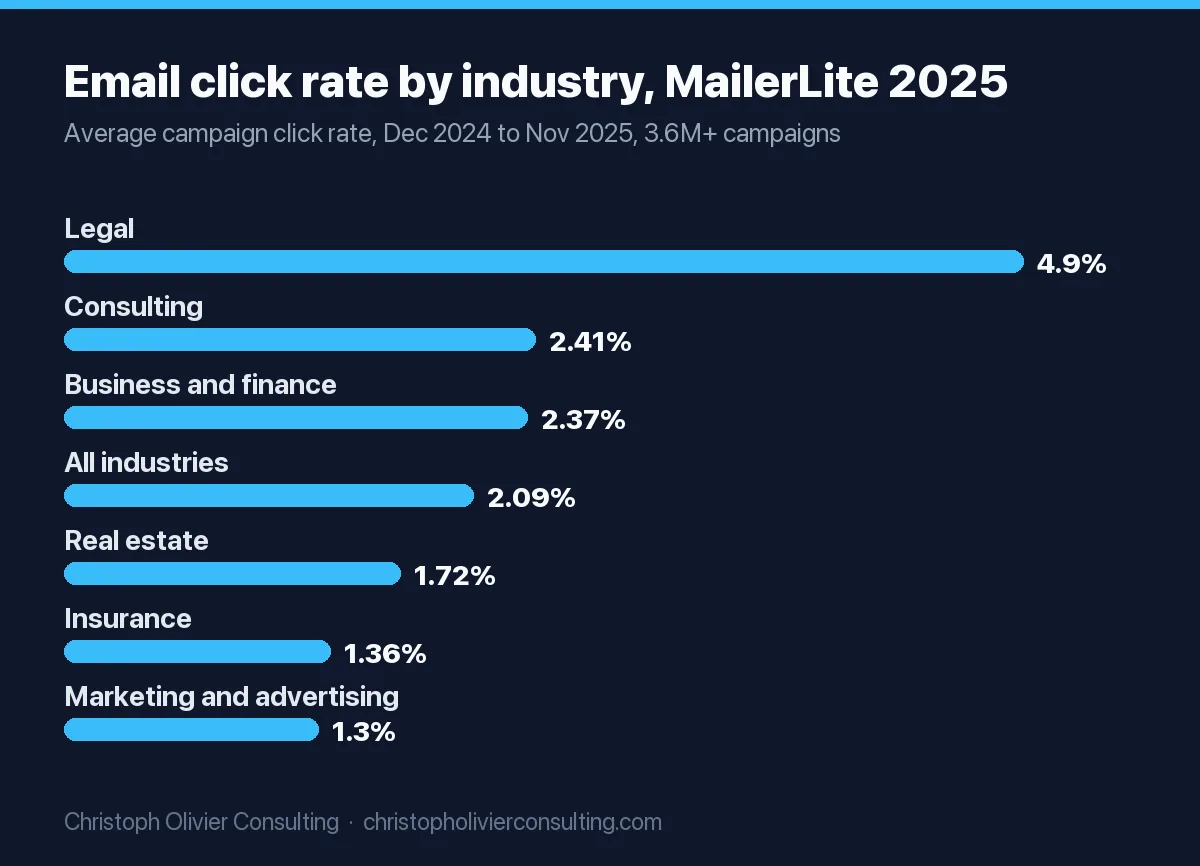
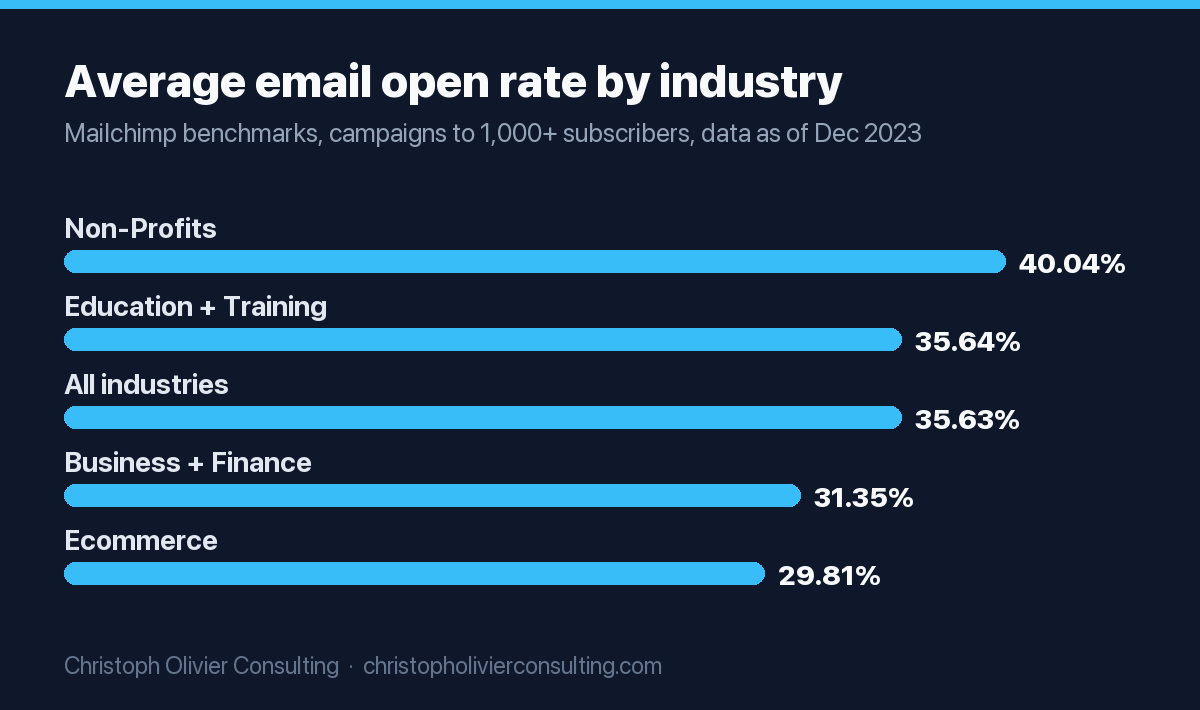
Vendor benchmarks disagree because each measures its own customers. MailerLite’s 2025 data puts the average open rate at 43.46% and click rate at 2.09%; Mailchimp’s figures (data as of December 2023) put them at 35.63% and 2.62%. Compare yourself with the dataset closest to your industry, and weigh clicks over opens.
| Source (vendor data) | Segment | Open rate | Click rate | Unsubscribe rate |
|---|---|---|---|---|
| MailerLite, Dec 2024 to Nov 2025, 3.6M+ campaigns, 181,000 accounts | All industries | 43.46% | 2.09% | 0.22% |
| MailerLite 2025 | Legal | 42.58% | 4.9% | 0.09% |
| MailerLite 2025 | Consulting | 45.96% | 2.41% | 0.23% |
| MailerLite 2025 | Business and finance | 43.34% | 2.37% | 0.16% |
| Mailchimp, data as of Dec 2023, campaigns to 1,000+ subscribers | All users | 35.63% | 2.62% | 0.22% |
| Mailchimp | Business and finance | 31.35% | 2.78% | 0.15% |
| beehiiv, 28 billion emails sent in 2025 | All newsletters on beehiiv | 41.24% | 3.23% | Not published |
Two cautions. First, MailerLite states that Apple Mail Privacy Protection marks emails as opened automatically, so real open rates are lower than dashboards show. Second, beehiiv’s figures describe creator newsletters, which skew toward hobby and media niches; its click rate fell from 4.74% in 2024 to 3.23% in 2025. For a firm newsletter, replies, consultation requests and clicks on the main story are the numbers that matter. Our email marketing benchmarks page collects the wider set of figures by metric.
How often should a newsletter go out?
Weekly is the most common cadence among newsletter creators. In beehiiv’s 2025 data, 46.67% of creators sent weekly, 27.15% monthly and 1.37% daily, and beehiiv says weekly correlates with the strongest subscriber growth on its platform. For a service firm with no editor, monthly on a fixed date is the safer promise; a quarterly newsletter works only as a supplement to something more frequent, because readers forget who you are between issues.
Pre-send checklist: pass or fail
Run every issue through these checks. One fail means it does not go out yet.
- One reader, one promise: pass if you can name the reader and the single takeaway in one sentence.
- Fixed structure: pass if the section order matches last issue.
- Client-first lead: pass if the main story is about the reader’s decision, not firm news or awards.
- Sourced claims: pass if every figure, rule and deadline links to its original source.
- One call to action: pass if there is exactly one ask (reply, book, read).
- Mobile and images off: pass if the issue reads clearly on a phone with images blocked.
- CAN-SPAM: pass if the footer has a valid physical postal address and a working opt-out. The FTC’s compliance guide says opt-outs must be honored within 10 business days, the law covers all commercial messages including business-to-business email, and each violating email can cost up to $53,088.
A newsletter is one program among several. If you are planning the rest of the calendar, our list of email marketing ideas covers 46 campaigns by goal, and these email drip campaign examples show the automated sequences that pair with a newsletter for new subscribers.
Frequently asked questions
What are the best email newsletter examples?
Strong examples in 2026 include Morning Brew and TLDR for daily briefings, Stratechery and The Pragmatic Engineer for paid analysis, First Round Review and Marketing Examples for B2B authority, Lenny's Newsletter for community, REI and Patagonia for retail, and Kitces Weekend Reading, Plante Moran and Jones Walker for professional services. Each serves one reader, keeps a fixed structure and sends on a predictable schedule.
What is a good business newsletter example?
First Round Review is one of the clearest business newsletter examples. The venture firm says 200K+ readers subscribe to weekly long-form tactical articles, backed by an archive of 600+ pieces, and it never pitches its own services. For a smaller firm, Plante Moran's monthly State and local tax advisor shows how a CPA firm can organize updates so each client finds their section fast.
What should a newsletter include?
A useful newsletter includes a specific subject line, a short in-this-issue list, a brief note from a named person, one main story with what it means for the reader, one action to take, three to five curated links with commentary, a reader question and a single call to action. The footer needs a physical postal address and a working unsubscribe link under CAN-SPAM.
What are good law firm email newsletter examples?
Jones Walker lets readers subscribe to attorney-written client alerts and industry newsletters by practice area, so each client only gets relevant updates. Pushor Mitchell, a Kelowna, British Columbia firm, sends Legal Alert, a free monthly e-newsletter with articles on legal developments, firm news and lawyer profiles. A small firm can copy both with one urgent-alert list and one monthly issue.
What are good accounting newsletter examples?
Plante Moran's monthly State and local tax advisor opens with a jump list of the states it covers, and its subscribe page lets readers choose topics by industry and by interest. Kitces Weekend Reading for Financial Planners shows the curation model: one lead news story each week, then annotated links. Both work because clients can find what applies to them in seconds.
How often should you send an email newsletter?
Weekly is the most common cadence among creators: in beehiiv's 2025 platform data, 46.67% sent weekly, 27.15% monthly and 1.37% daily. For a professional-service firm without an editor, monthly on a fixed date is usually the safer promise. A quarterly newsletter is too infrequent to build habit on its own, so pair it with something more regular.
What is a good open rate for an email newsletter?
It depends on the vendor's dataset. MailerLite's 2025 benchmarks put the all-industry open rate at 43.46% and click rate at 2.09%, while Mailchimp's figures, based on data as of December 2023, show 35.63% and 2.62%. Apple Mail Privacy Protection inflates opens, so compare clicks, replies and inquiries against your own past issues instead.
More Funnels & Email guides
- Email Newsletter Strategy: How to Grow an Audience and Pipeline
- What Is a Sales Funnel? Anatomy & Examples
- Product Funnel: How to Sequence Your Offers From Lead Magnet to Premium
- Best Email Marketing Platforms for Small Business: How to Choose
- Funnel Marketing Agency: What They Do, When to Hire One, and How to Choose
- Conversion Funnel Optimization Audit
- All Funnels & Email guides →