
An email newsletter strategy is the plan that turns a recurring email into an owned audience and a source of qualified pipeline. It sets one clear promise, a sustainable cadence, a repeatable content format, a list-growth engine, and a small set of metrics that survive privacy changes. A newsletter you own beats rented social reach because you control distribution and can email subscribers directly, again and again.
Last reviewed: October 2026

This guide treats a newsletter as an audience-growth and editorial asset, distinct from automated email sequences that nurture a single lead toward a purchase. Both belong in a wider content marketing engine, but they play different roles and are measured differently.
What is an email newsletter strategy, and how does it differ from email automation?
An email newsletter strategy is a plan for a recurring publication that grows an audience and builds trust over time. It is broadcast editorial sent on a schedule to your whole list or a segment. Email automation, by contrast, is a triggered sequence (a welcome series, an abandoned-cart flow, a lead-nurture drip) aimed at moving one contact toward one action.
The practical difference is intent. A newsletter earns attention by being genuinely useful whether or not the reader ever buys. Automation assumes a specific next step and optimizes for conversion on that step. Confusing the two is the most common mistake: a promotional blast dressed as a newsletter trains subscribers to ignore you.
| Dimension | Email newsletter | Email automation |
|---|---|---|
| Trigger | Editorial calendar (recurring) | Behavior or event (one-time per contact) |
| Primary goal | Audience growth, trust, top-of-mind | Move one lead to one action |
| Content | Ideas, analysis, curation, stories | Offers, onboarding, reminders |
| Success metric | Reply rate, click-to-open, list growth | Conversion rate, revenue per send |
How do you set newsletter positioning and a one-sentence promise?
Positioning is a single promise about who the newsletter serves and what they get every issue. Write it as one sentence: for [specific reader], every [cadence] you get [specific value] so you can [outcome]. A sharp promise makes the sign-up decision easy and gives you an editorial filter for every issue.
Narrow beats broad. A newsletter for “marketers” competes with thousands; one for “heads of demand gen at Series A SaaS” can own a niche. The tighter the reader, the higher the open and reply rates, because the content feels written for one person.
- Reader: the one role or situation you serve, named specifically.
- Value: the recurring benefit (a framework, a curated signal, a contrarian take).
- Proof of difference: what you cover that competitors skip or get wrong.
How often should you send a newsletter?
Send on the most frequent cadence you can sustain with quality, and never miss it. Consistency matters more than frequency: a reliable monthly issue outperforms an erratic weekly one because subscribers learn when to expect you and deliverability rewards steady sending patterns. Pick a cadence, publish the same day, and protect it.
Higher-cadence programs often keep complaint rates low, which reflects list hygiene and reader expectation rather than fatigue. The risk is not frequency itself; it is publishing thin issues to hit a schedule you cannot support. Start slower than feels ambitious, then increase once the format is repeatable.
| Cadence | Best for | Main risk |
|---|---|---|
| Weekly | Curation, news, timely commentary | Burnout, thin issues |
| Biweekly | Analysis, original frameworks | Losing top-of-mind between sends |
| Monthly | Deep reports, small teams | Weak recall, easy to forget |
What should go in every issue?
Every issue should deliver one clear idea the reader can use, wrapped in a repeatable structure so writing gets faster over time. A predictable template (a hook, one main idea, a supporting example, and a single call to action) trains readers on what to expect and lowers your production cost per send. Curation, original analysis, short case studies, and answers to reader questions are reliable formats.
Lead with value, not the ask. When readers sign up they expect to be informed, not sold to, so keep any promotion to a small, honest footer. You can repurpose each issue into search content and social posts, feeding both your SEO lead generation and social media lead generation so one piece of thinking works across channels.
How do you grow your newsletter subscriber list?
Grow a list by giving people a specific reason to subscribe and by placing sign-up prompts where interested readers already are. The highest-yield tactics are a clear value proposition on a dedicated landing page, a useful lead magnet, cross-promotion with adjacent newsletters, and consistent calls to subscribe across your owned channels. Buying lists or using generic “subscribe for updates” forms rarely works.
- Build a dedicated sign-up page that states the one-sentence promise, shows a sample issue, and sets frequency expectations.
- Offer a lead magnet tied to the newsletter topic (a template, checklist, or short guide), so the incentive attracts the right reader.
- Add sign-up prompts to your site header, high-traffic articles, email signature, and social profiles.
- Cross-promote with newsletters that share your audience but not your exact topic, recommending each other to warm readers.
- Convert social reach by posting a genuinely useful excerpt with a link to get the rest by email.
| Channel | Effort | Lead quality |
|---|---|---|
| Lead magnet + landing page | Medium | High |
| Newsletter cross-promotion | Low | High |
| Site sign-up forms | Low | Medium |
| Paid recommendations | High (cost) | Variable |
How do you keep a newsletter out of the spam folder?
Deliverability depends on list hygiene, sender reputation, and authentication. Keep hard bounces under roughly 0.25% per send, remove unengaged subscribers periodically, and set up SPF, DKIM, and DMARC records so mailbox providers trust your domain. A clean, engaged list is the single biggest lever on whether your email reaches the inbox.
Send from a consistent domain and a recognizable name, make unsubscribing easy (a frustrated reader who cannot leave will mark you as spam), and warm up any new sending domain gradually. Gmail and Yahoo enforce bulk-sender rules including authentication and a one-click unsubscribe, so treat those as baseline requirements rather than options.
Which newsletter metrics actually matter in 2026?
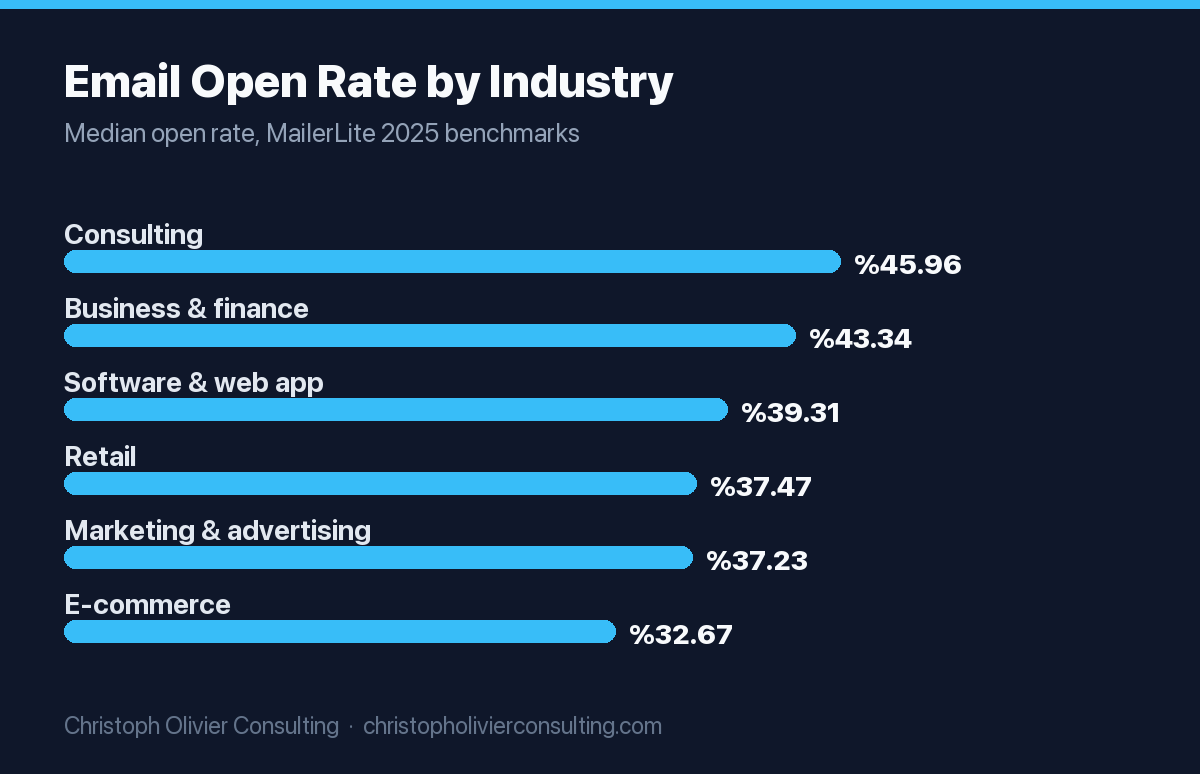
Track click-to-open rate, reply rate, list growth, and unsubscribe or complaint rate, and treat open rate as a rough signal only. Apple Mail Privacy Protection auto-loads images and inflates reported opens by roughly 15 to 20 points, so open rate no longer measures real attention. The metrics below reflect common 2026 benchmarks; use them as reference points, not guarantees.
| Metric | Typical 2026 range | What it tells you |
|---|---|---|
| Open rate (reported) | ~35% to 42% | Subject-line appeal, but inflated by Apple MPP |
| Click-to-open rate | ~6% to 7% | Whether engaged readers found the content useful |
| Bounce rate | Under 0.25% per send | List quality and hygiene |
| Unsubscribe rate | Under ~0.5% | Fit between promise and content |
Reply rate is the most honest engagement signal and the hardest to game. Ask a simple question in an issue and count the responses; a newsletter people answer is a newsletter people trust.
How do you turn a newsletter into pipeline and revenue?
A newsletter generates pipeline by building trust first and treating engagement as an intent signal, not by pitching in every issue. Track which subscribers open and click consistently, pass that engagement to your CRM, and let sales reach the readers who are already warm. The three common revenue models are sponsorships, paid subscriptions, and your own products or services.
For a B2B consultancy, the newsletter itself is often the offer: it demonstrates expertise so readers self-select into a conversation. Keep the primary call to action soft and consistent, and route interested readers to your fractional CMO services when the timing is theirs, not yours.
| Model | Works when | Rough economics |
|---|---|---|
| Sponsorships | Niche audience, ~10k+ engaged | Often $50 to $150 CPM per issue |
| Paid subscription | Content readers cannot get free | Recurring, needs high retention |
| Own products/services | Newsletter proves expertise | Pipeline value, not per-send revenue |
A 30-day plan to launch your newsletter
Launching in 30 days is realistic if you lock positioning first and keep the first issues simple. The plan below moves from promise to repeatable publishing without waiting for a large list, because writing to a small, engaged audience is how the format gets good.
- Days 1 to 5: Write the one-sentence promise, name the reader, and choose a cadence you can sustain.
- Days 6 to 12: Build a sign-up page and a lead magnet, and connect an email platform with SPF, DKIM, and DMARC set up.
- Days 13 to 20: Draft an issue template and write your first two issues before you announce anything.
- Days 21 to 27: Open sign-ups, add forms across your site, and invite your existing contacts and social followers.
- Days 28 to 30: Send issue one, ask one question to prompt replies, and set a recurring block to write the next issue.
Frequently asked questions
What is a good open rate for a newsletter in 2026?
Reported open rates commonly fall around 35% to 42%, but Apple Mail Privacy Protection auto-loads images and can inflate that figure by 15 to 20 points. Use open rate only as a rough check on subject lines and deliverability. Click-to-open rate (often 6% to 7%) and reply rate are more honest measures of whether readers actually engage with your content.
How often should I send my email newsletter?
Send on the most frequent schedule you can sustain with quality, and never miss it. Consistency matters more than raw frequency, so a reliable monthly issue beats an erratic weekly one. Weekly suits curation and news, biweekly suits original analysis, and monthly suits deep reports or small teams. Start slower than feels ambitious, then increase once your format is repeatable.
What is the difference between a newsletter and email marketing automation?
A newsletter is recurring editorial sent on a schedule to grow an audience and build trust. Email automation is a triggered sequence, such as a welcome series or nurture drip, aimed at moving one lead toward one action. A newsletter earns attention by being useful whether or not the reader buys, while automation optimizes for a specific conversion step.
How do I grow my newsletter list without buying subscribers?
Give people a specific reason to subscribe and place sign-up prompts where interested readers already are. Build a dedicated sign-up page with a clear promise, offer a topic-relevant lead magnet, add forms to your site and email signature, and cross-promote with newsletters that share your audience. These methods attract engaged readers, unlike bought lists that damage deliverability.
Can a small newsletter generate B2B leads?
Yes. A small, tightly targeted newsletter often outperforms a large generic one because engagement is higher and the audience matches your ideal customer. Track which subscribers open and click consistently, treat that as an intent signal, and pass it to your CRM so sales can reach warm readers. For a consultancy, the newsletter itself demonstrates expertise and invites the conversation.
How do I keep my newsletter out of the spam folder?
Focus on list hygiene, sender reputation, and authentication. Keep bounces under about 0.25% per send, remove unengaged subscribers periodically, and set up SPF, DKIM, and DMARC so mailbox providers trust your domain. Send from a consistent name and domain, make unsubscribing easy, and include a one-click unsubscribe, which Gmail and Yahoo now require from bulk senders.
More Funnels, Conversion & Email guides
- Best Email Newsletter Examples: 17 to Study in 2026
- Email Marketing Ideas: 46 Campaigns by Goal (2026)
- Growth Marketing Strategy: The Experiment-Driven Playbook
- How to Get More Google Reviews (Without Breaking Google's Rules)
- Influencer Marketing Strategy: A Step-by-Step Playbook
- LinkedIn Marketing for B2B: The Full Playbook
- Podcast Marketing Strategy: A Pipeline-First Playbook
- Product Marketing Strategy: How to Build One That Drives Pipeline