
Last reviewed: October 2026
Affordable SEO services for a small business usually cost $500 to $2,000 a month in the US market. In Ahrefs’ survey of 439 SEO providers, the most common retainer was $501 to $1,000 a month, freelancers averaged $1,348.63, and agencies averaged $3,209. Below roughly $500 a month, you are buying a few hours of work, so scope matters more than price.
This guide is for owners and partners who want search traffic without paying agency rates for it. It compares DIY, freelancers, agencies and fractional help, shows what each budget level buys in hours, lists what cheap SEO quietly removes, and gives you a hiring checklist built from Google’s own guidance.
Would you rather hand SEO to a specialist? CO Consulting’s SEO services start with a month-one audit that decides the plan, and AI search optimization is included.
How much do affordable SEO services cost in 2026?
Affordable SEO services typically run $500 to $1,500 a month for a freelancer or small agency, $75 to $150 an hour for project work, and $2,500 to $5,000 for a one-time audit or setup project. These are market ranges from provider surveys, not fixed prices. What you pay depends on scope, competition and who does the work.
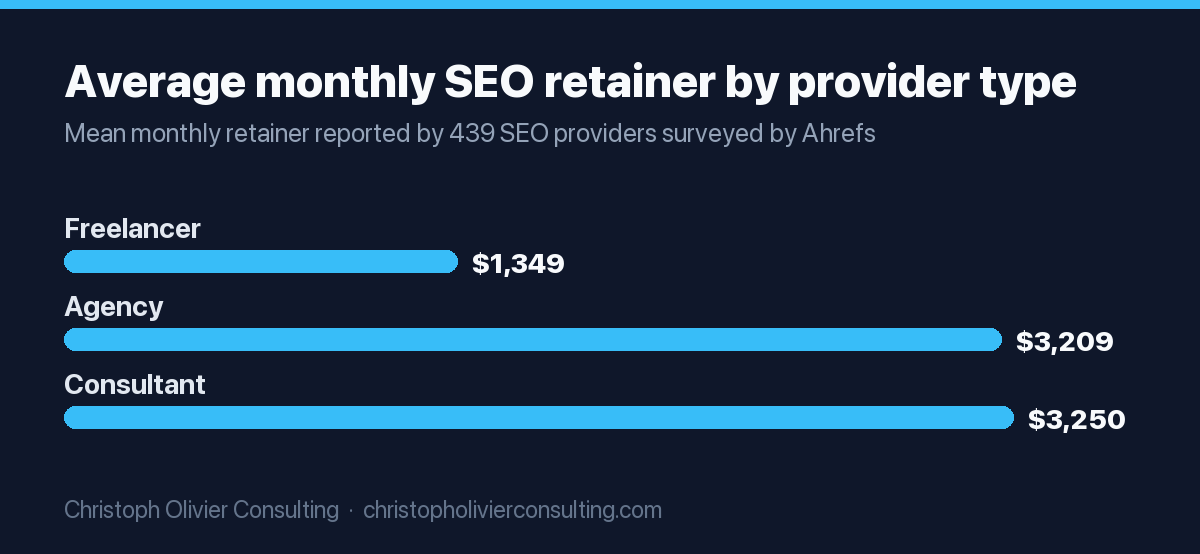
The best public benchmark is still the Ahrefs SEO pricing study, which polled 439 providers (article last updated August 2024). Its headline findings:
- 78.2% of providers charge a monthly retainer, 48.9% sell per-project work and 34.8% bill hourly.
- The most popular retainer band is $501 to $1,000 a month, chosen by 20.4% of respondents, and 42.8% charge between $501 and $2,000.
- The average hourly rate is $111, and the most common hourly band is $75 to $100.
- The most common project fee is $2,501 to $5,000.
| Provider type | Average monthly retainer | Most common retainer band | Share charging $1,001+/mo | Average project fee |
|---|---|---|---|---|
| Freelancer | $1,348.63 | $251 to $500 | 32.2% | $2,348.63 |
| Agency | $3,209 | $500 to $1,000 | 57.4% | $9,507.84 |
| Consultant | $3,250 | $2,501 to $5,000 | 70.6% | $8,685.53 |
Two caveats. First, the survey predates 2026, and labor and tool costs have not fallen since, so treat these numbers as a floor. Second, location moves price a lot: Ahrefs found 76% of India-based SEOs charge $1,000 a month or less for retainers. That is why “cheap SEO services” offers often come from offshore teams. Offshore is not automatically bad, but you need tighter oversight. For a fuller breakdown by pricing model, see our guide on how much SEO costs.
What $300 to $1,500 a month realistically buys
A monthly SEO budget buys hours. At the $111 average hourly rate Ahrefs reported, $300 buys under 3 hours, $500 buys about 4.5 hours, $1,000 buys about 9 hours and $1,500 buys about 13.5 hours. Every affordable SEO package is a decision about how to spend those hours.
Here is what that time can realistically cover. The hour figures are simple arithmetic on the Ahrefs average, not a quote from any provider.
| Monthly budget | Approx. hours at $111/hr | What it can realistically cover | What it usually cannot cover |
|---|---|---|---|
| $300 | About 2.7 | Rank and traffic report, Google Business Profile posts, a few title and meta fixes | Content, link earning, technical fixes, strategy |
| $500 | About 4.5 | One optimized page or short article, basic reporting, light local SEO upkeep | A real content cadence or digital PR |
| $1,000 | About 9 | Two to three solid pages a month, on-page fixes, monthly reporting tied to leads | Competitive head terms, sustained PR outreach |
| $1,500 | About 13.5 | Three to four pages, technical upkeep, some outreach, quarterly planning | Multi-location or national campaigns |
If a $300 package promises keyword research, technical fixes, ten blog posts, link building and a monthly strategy call, the math does not work. Something on that list is either automated, outsourced to the lowest bidder, or not happening.
Affordable SEO vs cheap SEO services: where the line is
Affordable SEO is a small, honest scope done well: fewer deliverables, real expertise, clear reporting. Cheap SEO is a large promised scope at a price that cannot pay for it, which forces shortcuts like automated content or bought links. The difference is not the invoice. It is whether the deliverables fit the hours.
A useful test: ask the provider to estimate the hours behind each line item. A good affordable provider answers quickly and the numbers add up. A cheap one dodges, or quotes hours that would put their effective rate far below anything in the Ahrefs data.
Signs you are looking at affordable, not cheap
- The scope is short and specific: “audit plus fixes to your 8 service pages,” not “full SEO.”
- Reporting ties to calls, form fills or booked consultations, not only rankings.
- They tell you what they will not do at this price.
- You keep ownership of the site, content, Google Business Profile and analytics accounts.
DIY, freelancer, agency or fractional: comparing your options
On a budget you have four realistic paths: do it yourself with a one-time audit, hire a freelancer, buy a small agency package, or bring in fractional senior help for strategy while cheaper hands execute. The right choice depends on your time, your competition and whether you need judgment or labor.
| Option | Typical cost (market range) | Best for | Main risk |
|---|---|---|---|
| DIY plus one-time audit | Your time plus a project fee (most common band $2,501 to $5,000) | Owners with a few hours a week and a simple local market | The work stalls when you get busy |
| Freelancer | Average $1,348.63/mo; common band $251 to $500 | Defined tasks: page writing, on-page fixes, GBP upkeep | One person, uneven skills, no backup |
| Small agency package | Common band $500 to $1,000/mo; average $3,209 | Businesses that want a process and reporting handled | Junior staff on low tiers, templated work |
| Fractional or consultant | Common band $2,501 to $5,000/mo; or a project audit | Firms where strategy, positioning and lead quality matter most | Higher monthly cost; needs execution help |
All figures come from the Ahrefs pricing study and are averages or most common bands, not quotes. A hybrid often gives the best value for a professional-service firm: pay a senior person once for the audit and 90-day plan, then pay a freelancer or your own staff to execute it. If you want a deeper comparison of provider types, our SEO services buyer’s guide walks through each one.
What cheap SEO cuts first
When the price is too low for the promised scope, providers cut the work that is slow and skilled: strategy, original content, technical fixes and earned links. They keep what is fast and visible: reports, automated posts and link counts. The result often looks busy on paper while the pages that bring in clients stay unchanged.
- Strategy. No real keyword or competitor research, so effort goes to terms nobody buying searches for.
- Content quality. Spun or mass-produced articles. Google’s spam policies define scaled content abuse as “many pages are generated for the primary purpose of manipulating search rankings and not helping users.”
- Technical work. The audit is a tool export with no fixes made.
- Links. Earned mentions get replaced by link packages, directory blasts and forum spam.
- Reporting honesty. Ranking reports for long, zero-volume phrases you would rank for anyway.
Red flags in low cost SEO for small business
The biggest red flags are guaranteed rankings, link packages sold by the count, unsolicited outreach, and secrecy about what changes are being made. Google states that “No one can guarantee a #1 ranking on Google,” and its spam policies list buying links for ranking purposes as link spam that can trigger a manual action.
Google’s own guidance on hiring an SEO warns against firms that are secretive, that ask you to link to them, or that promote link popularity schemes. It suggests reserving “the same skepticism for unsolicited email about search engines as you do for ‘burn fat at night’ diet pills.”
The link side matters most for budget buyers, because link packages are cheap to produce. Google’s spam policies name these as link spam:
- Buying or selling links for ranking purposes, including exchanging money for posts that contain links.
- Excessive link exchanges (“link to me and I’ll link to you”).
- Using automated programs or services to create links.
- Low-quality directory links and keyword-rich links hidden in widgets.
Google says sites that violate these policies may “rank lower in results or not appear in results at all.” Paid links are allowed only when they are marked with rel=”sponsored” or rel=”nofollow”, which means they pass no ranking value. So a package that sells “50 high DA backlinks” is either selling something against policy or selling links that do nothing for rankings.
For local businesses, also watch for anyone selling a better map ranking. Google is explicit: “There’s no way to request or pay for a better local ranking on Google” (Google Business Profile help). We cover more warning signs in how to hire an SEO service without getting burned.
How to get real value from affordable SEO packages
The best way to stretch a small SEO budget is to buy expertise once and labor ongoing. Pay for a proper audit and plan, do the free foundational work yourself, then spend your monthly budget on the few pages that drive revenue. Small, focused scope usually beats a long list of thin deliverables.
- Set up the free foundations yourself. Claim and complete your Google Business Profile, which Google lets you manage “at no charge” (Google). Connect Google Search Console so you can see the queries, impressions and clicks your site already earns.
- Buy one audit, not a retainer, first. A project audit with a prioritized fix list and a 90-day plan tells you what actually needs doing before you commit monthly money.
- Fix your money pages before writing new ones. Your service pages, location pages and contact path usually matter more than a blog. Make them clear, specific and fast.
- Buy content by the page, with a brief. Two genuinely useful pages a month that answer real buyer questions often outperform ten generic posts.
- Earn links through real assets. Local partnerships, association listings, original data and press mentions take longer but stay clean.
- Measure leads, not rankings. Track calls, forms and booked consultations from organic search. Review every 90 days and cut what is not moving them.
Keep timelines realistic. Google’s SEO Starter Guide notes that “some changes might take effect in a few hours, others could take several months.” Plan on a quarter before judging a budget engagement, and be wary of anyone promising results in weeks.
Worked example: a $1,000 a month budget for a service firm
A $1,000 monthly budget, or about 9 hours at the average Ahrefs rate, is enough for a focused local or niche program if you front-load a one-time audit. Here is one way a small professional-service firm could structure the first six months. It is an illustration of the allocation logic, not a promised outcome.
Assume a five-person accounting or law practice in one metro area, a decent website, and no SEO history. The firm spends roughly $3,000 once on an audit and plan (inside the most common project band in the Ahrefs data), then $1,000 a month.
| Period | Focus | Approx. hours | Deliverables |
|---|---|---|---|
| Month 0 (project) | Audit and 90-day plan | Project fee | Technical audit, keyword and competitor review, prioritized fix list |
| Months 1 to 2 | Foundations | About 9/mo | Fix indexing and speed issues, rewrite 4 to 6 core service pages, tighten Google Business Profile |
| Months 3 to 4 | Buyer-question content | About 9/mo | 2 to 3 pages a month answering the questions prospects ask on consult calls |
| Months 5 to 6 | Authority and review | About 9/mo | Association and partner mentions, one data or guide asset, 90-day review against lead data |
Notice what is missing: no link packages, no 20-posts-a-month content mill, no ranking guarantee. The budget goes to fewer things done properly. If you want this kind of scope packaged as a fixed entry offer, our SEO starter package guide lists what a good one should include and what to walk away from.
Hiring checklist: questions to ask before you sign
Before you hire any affordable SEO provider, ask for examples of previous work, how they follow Google Search Essentials, what results they expect and when, and whether they will share every change they make. These questions come straight from Google, and a good provider answers them without hesitation.
Google’s hiring guidance suggests asking these questions:
- Can you show me examples of your previous work and share some success stories?
- Do you follow the Google Search Essentials?
- What kind of results do you expect to see, and in what timeframe?
- What’s your experience in my industry?
- What’s your experience in my country or city?
- How long have you been in business?
- Will you share with me all the changes you make to my site?
Add four budget-specific questions of your own:
- How many hours per month does this price cover, and who does them?
- How do you get links, specifically, and do you ever pay for them?
- What is the minimum contract term, and what happens to the content if I leave?
- Which metric will we judge this on at 90 days?
Google also points out that “a great time to hire is when you’re considering a site redesign,” so if a rebuild is on your calendar, bring SEO in before the design is locked.
When cheap SEO is fine and when it is dangerous
Cheap SEO is fine when the task is small, defined and easy to check, like updating a Google Business Profile or fixing title tags. It becomes dangerous when a low price buys links, mass content or anything you cannot see or verify, because those shortcuts can lead to manual actions that cost far more to clean up.
| Usually fine on a low budget | Usually dangerous on a low budget |
|---|---|
| Google Business Profile setup and updates | “Guaranteed page one” packages |
| Title tags, meta descriptions, internal links | Link packages sold by quantity or “DA” |
| Fixing broken links and redirects | Bulk AI or spun articles with no editing |
| Basic schema and site speed fixes | Private blog networks or link exchanges |
| Citations on real, relevant directories | Anything done in accounts you do not control |
The rule of thumb: if you can verify the work by looking at your own site, a low price is fine. If the work happens somewhere you cannot see, on other sites or in tools you do not own, low price is where the risk lives.
Where CO Consulting fits
CO Consulting is not the cheapest option, and it is not trying to be. It suits professional-service firms that want senior strategy with an audit-first plan, then decide how much execution to buy. If a freelancer or DIY path fits your budget better, that is a reasonable choice, and the checklist above still applies.
I built content systems that have generated more than 200 million organic views and have managed millions in ad spend, and our SEO services start the same way every time: an audit, then a 90-day plan tied to booked consultations rather than rankings. There are no ranking guarantees, because no honest provider can give one.
If you want a second opinion on a quote you have received, or help deciding which budget path fits your firm, you can book a consultation and we will walk through it together.
Work with CO Consulting
Want SEO that brings in qualified clients?
- A month-one audit that decides the mix, written into a 90-day plan you can hold us to
- Technical, on-page, local, content and AI search work in one engagement
- Monthly tracking of whether ChatGPT, Perplexity and Google AI Overviews cite your business
- Reporting tied to pipeline, not vanity rankings. No ranking guarantees, ever
Frequently asked questions
How much do affordable SEO services cost per month?
In the US market, affordable SEO services usually run $500 to $2,000 a month. Ahrefs' survey of 439 providers found the most common retainer was $501 to $1,000 a month, freelancers averaged $1,348.63 and agencies averaged $3,209. Treat these as market ranges, not fixed prices, and judge any quote by the hours and deliverables behind it.
Are cheap SEO services worth it?
Cheap SEO can be worth it for small, verifiable tasks such as Google Business Profile updates, title tag fixes or broken link repairs. It is risky when a low price buys link packages, mass-produced content or work you cannot see. Google lists buying links for ranking purposes as link spam, which can lead to lower rankings or removal from results.
What should an affordable SEO package include?
A fair affordable SEO package should include a technical audit with actual fixes, optimization of your core service pages, Google Business Profile work if you serve a local market, analytics and Search Console tracking, and a small amount of useful content. It should also state the hours involved and report on leads, not only rankings.
Can I do SEO myself to save money?
Yes, many small businesses handle the foundations themselves. You can manage a Google Business Profile at no charge, connect Google Search Console, and improve your own service pages. A practical hybrid is to pay once for a professional audit and 90-day plan, then execute it yourself or with a freelancer, which keeps monthly costs low.
How long does affordable SEO take to work?
It depends on your site, competition and the work done. Google's SEO Starter Guide says some changes take effect in a few hours and others take several months. On a small budget, plan to give a focused program at least one quarter before judging it, and be wary of anyone promising results within weeks.
What are the red flags with low cost SEO companies?
Watch for guaranteed rankings, link packages sold by quantity, unsolicited cold emails, secrecy about changes, requests to link back to the provider, and offers to improve your map ranking for a fee. Google says no one can guarantee a number one ranking, and there is no way to pay for a better local ranking.