

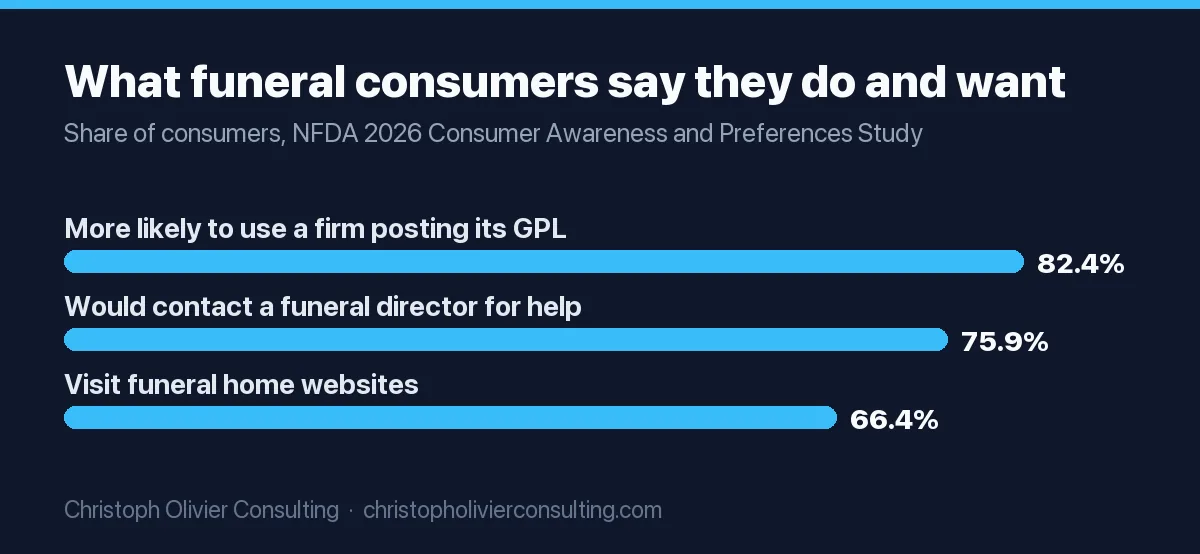
Funeral home marketing works when a grieving family can find you in one search, see your prices without having to call, and hear your name from someone they already trust. The decision usually happens in hours, often late at night, but almost everything that wins it was built months or years earlier. NFDA’s 2026 consumer study found that 82.4% of consumers are more likely to engage a firm that posts its General Price List online, yet when FTC staff reviewed funeral provider websites, fewer than 40 percent showed any prices at all. That gap is the single biggest opening most independent firms have.
This guide is written for the owner of an independent funeral home, the person who takes the 2 a.m. call and also signs the marketing checks. It follows the family’s path, moment by moment, and shows what to fix at each step, which federal and state rules shape your marketing, and how to tell which efforts actually bring in cases.
Want a specialist to build this for your business? See how CO Consulting’s marketing services work, starting with a diagnostic and audit.
Funeral home marketing runs on two clocks
Most marketing advice treats your business like a restaurant: more posts, more ads, more reach. Funeral service doesn’t work that way. You are marketing to two very different moments, and they need different tools.
| At-need (the hours clock) | Preneed (the years clock) | |
|---|---|---|
| Who is deciding | An adult child, spouse or executor, usually in shock | The person themselves, often 60+, sometimes with an adult child |
| Time to decide | Hours to a day or two | Months to years |
| What they check | Google results, your map listing, reviews, prices, who answers the phone | Your reputation, your people, how clearly you explain options and money |
| What wins | Being findable, priced, reviewed and reachable right now | Trust built through education, community presence and referral partners |
| What fails | Brand ads with no prices, voicemail, a slow mobile site | Pushy follow-up, vague contract terms, sales language |
| Main rules in play | FTC Funeral Rule (price lists, phone disclosures), state website rules | State preneed laws (permits, trusting, disclosures) plus the Funeral Rule |
Keep both clocks in view as you read. The at-need work pays back fastest. The preneed work is what keeps an independent firm’s call volume steady when a new competitor or a direct-cremation provider opens down the road.
“Someone just died. Who do we call?”
This is the moment most of your revenue depends on, and it is mostly decided on a phone screen. A family member types “funeral home near me” or “cremation [your town]” and picks from the map results and the first few listings. If you are not there, nothing else in your marketing matters for that family.
Your Google Business Profile is your real front door
For an independent firm, the map listing often does more work than the website. Make sure each location has its own verified profile with the correct primary category, your real hours (and a clear note that you answer 24/7 if you do), current photos of the building, chapel, arrangement room and parking, and a phone number that reaches a person. The full method for ranking in the map pack is the same one any local service business uses, and it is laid out in our local SEO playbook for service businesses. The funeral-specific parts are simple: list both funeral and cremation services, keep each branch’s name, address and phone identical everywhere, and answer every review with the restraint you would use in the arrangement room.
The phone is a marketing channel, and the FTC regulates it
Many owners spend on ads and then lose the family at the first ring. The Funeral Rule shapes what happens on that call. Under the FTC’s compliance guide, you must give accurate price information from your price lists to anyone who asks by phone, and you cannot require callers to give their name, address or phone number first, or insist they come in to get prices. That matters for marketing in two ways. First, any call-tracking or intake script that “captures the lead before quoting” can put you on the wrong side of the rule. Second, a calm, direct answer about price is itself persuasive. Families comparing homes remember who simply told them.
A sample opening for whoever answers after hours:
“This is [Name] at [Funeral Home]. I’m so sorry. I can help you right now. Is your loved one at home, at a hospital, or in hospice care? … If it helps, I can also tell you our prices over the phone, or text you a link to our full price list. There’s no obligation and you don’t need to give me any details to hear them.”
That last sentence does compliance and trust in one breath.
Funeral home digital marketing: the comparison moment
Once a family has two or three names, they compare. NFDA’s 2026 study reported that 66.4% of consumers visit funeral home websites to review options, contact details and pricing, and that 33.2% of families said online reviews solidified their choice of provider, up from 14.4% in the 2025 study. Your website and your reviews are where this round is won.
Post your General Price List, and make it easy to read
There is still no federal requirement to put prices online. The FTC opened a review of the Funeral Rule in 2020 and in November 2022 asked for comment on improving the public accessibility of funeral home price information, held a public workshop on September 7, 2023, and as of the latest federal regulatory agenda the item is still at the pre-rule stage, with staff reviewing comments. So posting is a choice in most states, not an obligation. Some states go further: in California, a funeral establishment with a website must post the list of goods and services required on its General Price List, or put the words “price information” on its homepage with a link to the GPL itself, under Business and Professions Code section 7685. Check your own state board’s rules before assuming you are exempt.
The commercial case is stronger than the legal one. Given the 82.4% figure above, hiding prices mostly hands the comparison to whoever shows theirs. And posting the list is not enough on its own: the same NFDA study found only 65.7% of people who received a GPL found it easy to understand. Put a plain-language summary above the PDF. Sample copy:
Our prices, in plain English. Below is our complete General Price List, the same one we hand every family in person. Most families choose one of three paths: direct cremation (no service), cremation with a memorial or visitation, or a traditional funeral with burial. We’ve shown the most common choices for each so you can see a realistic total. You can call us any time to talk it through. You never have to buy a package, and you can choose only the items you want.
That final sentence is not just good copy. The Funeral Rule requires that families be able to buy goods and services individually, and saying so out loud signals you are the honest option.
Reviews: ask everyone, the same way
Because reviews now carry more weight in the decision, the temptation is to ask only the families you know were happy. Google’s policy prohibits exactly that: businesses may not “selectively solicit positive reviews from customers”, offer incentives such as discounts, or pressure people to review while on the premises, and reviews based on a conflict of interest, such as current or former employment, are not allowed. Separately, the FTC’s August 2024 final rule on fake reviews bars buying reviews, undisclosed insider reviews and intimidation used to remove negative ones, and it allows civil penalties against knowing violators.
The practical approach: send every family the same short, gentle request a few weeks after the service, as part of aftercare, with a direct link. No gifts, no filtering, no staff writing reviews.
The arrangement conference is marketing too
Word of mouth is still the strongest force in this business, and it is created in the arrangement room. Every family who walks out feeling they were treated fairly becomes a referral source. Every family who feels upsold tells people for years.
The Funeral Rule sets the floor. According to the FTC guide, you must offer a General Price List the family can keep before discussing arrangements, goods or prices; offer the casket price list before showing caskets; give an itemized Statement of Funeral Goods and Services Selected at the end of the conference; state that embalming is not required by law (except in the special cases where it is); offer an alternative container for direct cremation; and never charge a fee for a casket bought elsewhere. Treat those as marketing standards, not just legal ones. A family that sees the price list first, without being asked, notices.
Market to the families you actually serve now
Many funeral home websites still read as if every family wants a traditional casketed funeral. The numbers say otherwise. NFDA projects the U.S. cremation rate at 63.4% for 2025, against a burial rate of 31.6%, rising to 82.3% by 2045. The Cremation Association of North America reports the rate has grown from 5% in 1972 to 60.6% in 2023, with growth starting to slow as some states approach 70%.
For marketing, that means three things:
- Give cremation its own pages. Direct cremation, cremation with a memorial, and cremation with visitation are different products for different families. Each deserves a page with what’s included and a price.
- Sell the gathering, not the disposition. A cremation family is often deciding whether to hold any service at all. Show the memorial and celebration options you offer and where they can happen.
- Show you are flexible about who leads. In the 2026 NFDA study, 48.0% of consumers were open to a certified celebrant, up from 36.3% a year earlier, and 62.1% had attended a service led by someone other than a faith leader. If you have a celebrant on staff or a trusted list, say so.
After the service: obituaries and aftercare
Your obituary pages are often among the most-visited parts of your website, because everyone who knew the person searches their name. That makes them a quiet but powerful way for people across your community to meet your firm, often long before they need you. Handle them with care:
- Publish obituaries on your own domain first, with the family’s approval of the text and photos, and make them easy to share by text and email.
- Keep service times, livestream links and directions on the same page, and update them if anything changes.
- Keep the page about the person. No preneed pop-ups, no sales banners. A small, consistent footer with your name and phone number is enough.
- Make tribute walls and memory books easy to use, and moderate them.
Aftercare is where the at-need clock hands off to the preneed clock. A grief resource email at one month, an invitation to a remembrance event in the holiday season, and an anniversary card are services first. They also keep your firm in the minds of the extended family, which is where most future calls come from.
Preneed marketing: the long clock
Preneed is where independent firms can build a moat. It is also the part of funeral home marketing with the most rules, and they are set state by state.
Know your state’s preneed rules before you advertise
Trusting percentages, who may sell, agent licensing and contract disclosures all vary by state. In Texas, for example, any funeral home or cemetery that sells prepaid funeral merchandise or services must hold a trust-funded permit from the Texas Department of Banking, or sell through a third-party trust-funded or insurance-funded permit holder. Other states require specific disclosures in the contract or licensing for the person selling. Before you run a preneed seminar, mailer or ad, ask your state board or regulator (and the insurer or trust you sell through) what the advertising and contract rules are. Remember that the Funeral Rule also applies: the GPL requirements cover preneed arrangements, and items must be offered individually, not only in packages.
Education beats selling
The preneed buyer wants to protect their family from hard decisions and surprise costs. Content that answers their real questions earns trust: what happens in the first 48 hours after a death, how cremation works, what a preneed contract protects and what it doesn’t, what happens if you move. A steady, useful article and email program, built the way our content marketing guide describes, does more over three years than any single campaign.
A sample invitation for a planning seminar, written for the person, not the prospect list:
“What My Family Should Know”: a free planning evening. Join us Tuesday at 6 p.m. in our community room for a relaxed, no-pressure conversation about end-of-life planning. We’ll cover what happens after a death, how to write down your wishes, and how to talk with your family about them. You’ll leave with a free planning guide you can fill in at home. Coffee and dessert provided. No one will call you afterward unless you ask us to.
That last promise matters. It removes the fear that keeps most people from showing up.
Referral partners: hospice, faith communities and senior living
Many first calls start with a hospice nurse, a pastor or a senior living director. These relationships are built over years, through reliability and usefulness, not gifts. Show up when a removal is needed at 3 a.m. Offer grief workshops or caregiver education to hospice teams and senior living residents. Be the firm that makes the clergy’s job easier on the day of a service. Our referral marketing guide covers how to structure and track these partnerships. It also helps to understand how your partners market themselves: churches are working on their own outreach, as our guide to church marketing shows, and senior living communities speak to the same adult children you do, as covered in our senior living marketing guide. Keep your gifts and hospitality modest; many hospices and health systems have strict gift policies for their staff.
Funeral marketing rules at a glance
This matrix maps the rules most likely to affect your marketing to what they mean in practice. It is a starting point, not legal advice; confirm details with your state board and counsel.
| Rule | What it requires | What it means for your marketing |
|---|---|---|
| FTC Funeral Rule: telephone prices | Give accurate prices from your price lists to phone callers; don’t require name, address or phone first, or an in-person visit | Intake scripts and call tracking must not gate prices behind lead capture |
| FTC Funeral Rule: General Price List | Offer a GPL the family can keep before discussing arrangements or prices; itemized prices and required disclosures; applies to preneed too | Your online price page should match the GPL you hand out. Promote “choose only what you want” |
| FTC Funeral Rule: caskets and cremation | Casket price list before showing caskets; alternative container for direct cremation; no fee for third-party caskets | Don’t advertise packages in a way that implies items are required. Show the direct cremation option clearly |
| FTC Funeral Rule: embalming | Disclose that embalming is not required by law except in special cases; charge only with permission or legal requirement | Website and brochure copy must not imply embalming is mandatory |
| FTC review of online price posting | Pre-rule stage; no federal online price requirement yet | Post anyway for the commercial benefit, and watch for a proposed rule |
| California B&P Code 7685 | Websites must post the GPL goods and services list, or link to the GPL from the homepage with the word “price” | California firms need a homepage “price information” link |
| State preneed law (Texas example) | Sellers need a Texas Department of Banking permit or must sell through a permit holder | Confirm your permit and your state’s ad and contract rules before any preneed campaign |
| Google review policy | No incentives, no selective solicitation, no conflict-of-interest reviews, no on-premises pressure | Ask every family the same way, by email or text, after the service |
| FTC fake reviews rule (2024) | No fake or bought reviews, no undisclosed insider reviews, no review suppression by threats | Never let staff or relatives review the firm; never threaten a critical reviewer |
What to fix first: a 30-day order of work
If you are starting from a typical independent firm’s position, this is the order I would work in, because each step makes the next one pay off faster:
- Week 1: Fix the phone. Test-call your own number after hours. Write a short, compliant intake script that offers prices without asking for details. Make sure every call reaches a person.
- Week 1: Clean up your Google Business Profile. Correct category, hours, photos, services (funeral and cremation), and one profile per location.
- Week 2: Publish your prices. Post the full GPL plus a plain-language summary of your three most common paths. Add a “Pricing” link to your main menu. California firms add the required homepage link.
- Week 2: Build separate cremation pages. One page each for direct cremation, cremation with memorial, and cremation with visitation, each with what’s included and the price.
- Week 3: Start a uniform review request. Same message, same timing, every family, sent as part of aftercare.
- Week 3: Tidy your obituary pages. Remove sales pop-ups, add service details and sharing buttons, check mobile speed.
- Week 4: Start tracking the first call source. Ask every family “How did you first hear about us?” and record it on the case file. This is the number that tells you where to spend.
- Week 4: Book one referral conversation. One hospice, one congregation or one senior living community this month, with something useful to offer them.
How to tell whether your funeral marketing strategies are working
Clicks, likes and impressions are weak signals in this business. Count cases. For each at-need case, record the first source (map listing, website, a specific referral partner, a past family, a preneed contract). For preneed, record contracts written and where each lead came from. Review it quarterly. Over a year you will see which channels bring families and which only bring traffic, and you can move budget accordingly.
A few honest caveats. Small firms have small numbers, so a single quarter can mislead you; look at a rolling twelve months. Preneed work pays back over years, so judge it by contracts and by the share of at-need calls from people who had a preneed or seminar touchpoint, not by this month’s cases. And no channel replaces the experience families have with your staff. If you want an outside view of where your firm’s first calls come from and what to fund next, you can book a consultation and we can work through your numbers together.
Work with CO Consulting
Want this done for your business?
- A diagnostic call and an audit of your current marketing and numbers
- A prioritized 90-day plan built for your market
- Execution across SEO and AI search, paid ads, content, funnels and automation
- Weekly check-ins and monthly reporting, led by a fractional CMO
Frequently asked questions
What is the most effective funeral home marketing?
For most independent firms, the highest-return work is being findable and trusted at the moment of need: a complete Google Business Profile for each location, a phone answered by a person, prices posted online with a plain-language summary, and a steady flow of reviews requested the same way from every family. Referral relationships and preneed education then build demand over years.
Are funeral homes required to post prices online?
Not under federal law today. The FTC began reviewing the Funeral Rule in 2020 and asked in 2022 whether online price posting should be required, but the item remains at the pre-rule stage. Some states have their own rules; California, for example, requires websites to post the GPL goods and services list or link to the GPL from the homepage. Check your state board.
Can a funeral home ask for a caller's contact details before giving prices?
No. The FTC Funeral Rule requires funeral providers to give accurate price information from their price lists to telephone callers, and providers cannot require callers to give their name, address or phone number first, or to come in person to get prices. Intake scripts and call-tracking systems should offer prices freely and only then ask how you can help.
How should a funeral home get more online reviews?
Ask every family the same way, usually by email or text a few weeks after the service as part of aftercare, with a direct link to your review profile. Google prohibits offering incentives, selectively asking only happy customers, pressuring people on the premises, and reviews from employees. The FTC's 2024 rule also bans fake, bought and undisclosed insider reviews.
What is preneed marketing and what rules apply?
Preneed marketing promotes planning and prepaying for funeral goods and services before they are needed, through seminars, education content, mail and referral partners. It is governed mostly by state law, which sets permits, trusting requirements, who may sell and contract disclosures. In Texas, for example, sellers need a Department of Banking permit or must sell through a permit holder. The FTC Funeral Rule's price list rules also apply.
How should funeral homes market cremation services?
Treat cremation as several products, not one. Give direct cremation, cremation with a memorial, and cremation with visitation their own pages with inclusions and prices, show where gatherings can be held, and mention celebrant options. NFDA projects the U.S. cremation rate at 63.4% for 2025, so a website built mainly around traditional burial often misses most of the families searching.
How do you measure whether funeral home marketing is working?
Count cases, not clicks. Ask every family how they first heard about your firm and record the answer on the case file, then review sources quarterly on a rolling twelve-month basis because small firms have small numbers. Judge preneed efforts by contracts written and by later at-need calls from people who attended a seminar or signed a contract.
More Growth Consulting guides
- Dental Marketing: What Works and What It Costs Per Patient
- Veterinary Marketing: What Wins New Clients and Keeps Them
- Marketing 101: The Complete Beginner’s Guide to How Marketing Actually Works
- What Is B2B Marketing? Modern Definition
- Optometry Marketing: A Practice Owner’s Guide to Lower Cost Per New Patient
- The Best Client Management Apps for Service Businesses (2026)
- All Growth Consulting guides →