

A major studio blockbuster’s worldwide marketing budget usually lands between about $100 million and $175 million, based on figures reported by Variety, Deadline and The Hollywood Reporter. Studios almost never publish these numbers, so every figure below is either a trade estimate or a line from a reconstructed profit ledger, and we say which. The table covers the films people search for most, from Barbie and Superman (2025) to The Odyssey and Project Hail Mary.
Short answer: Reported worldwide marketing spend for recent tentpoles runs from roughly $90 million (Wicked: For Good) to $175 million (Barbie, in Deadline’s ledger). The Hollywood Reporter called $150 million “the usual” global spend for an all-audience summer tentpole in 2025. For the last year the MPAA published averages (2007), a studio film cost $70.8 million to make and $35.9 million to advertise.
Movie marketing budgets: the master table
Every number is linked to the outlet that published it, with the publication date. “Ledger” means a line from Deadline’s Most Valuable Blockbuster profit tables, which Deadline builds from “seasoned and trusted sources,” not from studio filings. “Estimate” means a figure attributed to rival executives or unnamed sources. Worldwide grosses come from Box Office Mojo as of November 9, 2026.
| Film (studio, US release) | Production budget (reported) | Worldwide marketing / P&A | Figure type | Reported by (date) | Worldwide box office |
|---|---|---|---|---|---|
| The Odyssey (Universal, Jul 17, 2026) | $250M | $125M | Reported | Variety (Jul 19, 2026) | $1.80B |
| Project Hail Mary (Amazon MGM, Mar 2026) | $200M | Not reported | Not disclosed | Variety (Mar 22, 2026): “many millions more to market” | $684.6M |
| Marty Supreme (A24, Dec 25, 2025) | $70M (Variety); about $60M (NBC News) | Not disclosed | Not disclosed | NBC News (Dec 12, 2025) | $192.4M |
| Wicked: For Good (Universal, Nov 21, 2025) | $300M for both Wicked films combined | About $90M | Reported | Variety (Nov 13, 2025) | $540.8M |
| Superman (Warner Bros./DC, Jul 11, 2025) | $225M net; $363.8M gross in an Ohio incentive filing | About $100M; up to $200M | Reported ($100M); pre-release estimate ($200M) | Variety (Jul 13, 2025); THR (Jun 5, 2025) | $618.7M |
| Sinners (Warner Bros., Apr 2025) | $90M | $50M to $60M global; $21.6M on US national TV | Estimate; iSpot-tracked TV spend | Variety (Apr 21, 2025); Deadline (Apr 22, 2025) | $379.7M |
| Wicked (Universal, Nov 2024) | $300M for both parts combined | $150M to $170M | Estimate ($150M); ledger ($170M) | Variety (Nov 25, 2024); Deadline (Apr 28, 2025) | $764.2M |
| Barbie (Warner Bros., Jul 21, 2023) | $145M | $150M to $175M | Estimate ($150M); ledger ($175M) | Variety (Jul 23, 2023); Deadline (May 6, 2024) | $1.45B |
| Oppenheimer (Universal, Jul 21, 2023) | $100M | At least $100M (contract); $170M P&A | Reported deal term; ledger | Variety (Jul 21, 2026); Deadline (May 1, 2024) | $975.8M |
| Avengers: Endgame (Disney, Apr 2019) | $356M net | $155M worldwide prints and ads | Ledger | Deadline (Apr 24, 2020) | $2.80B original run |
| Black Panther (Disney, Feb 2018) | $210M | $140M global P&A | Ledger (projection) | Deadline (Mar 17, 2018) | $1.35B |
Two patterns jump out. First, the same film often carries two numbers: the release-week estimate from rival executives (Variety’s $150 million for Barbie) and the later ledger figure (Deadline’s $175 million). Second, the newest releases are the least documented. Neither Amazon MGM nor A24 has let a marketing figure for Project Hail Mary or Marty Supreme into the trade press, so we list them as not reported rather than guess.
What the studio ledgers show
Deadline’s annual profit tournament is the closest thing to a consistent public dataset. Each entry lists production cost, “prints and ads,” participations, residuals and interest against theatrical, home entertainment and TV revenue. The P&A lines for the searched films that appear in it:
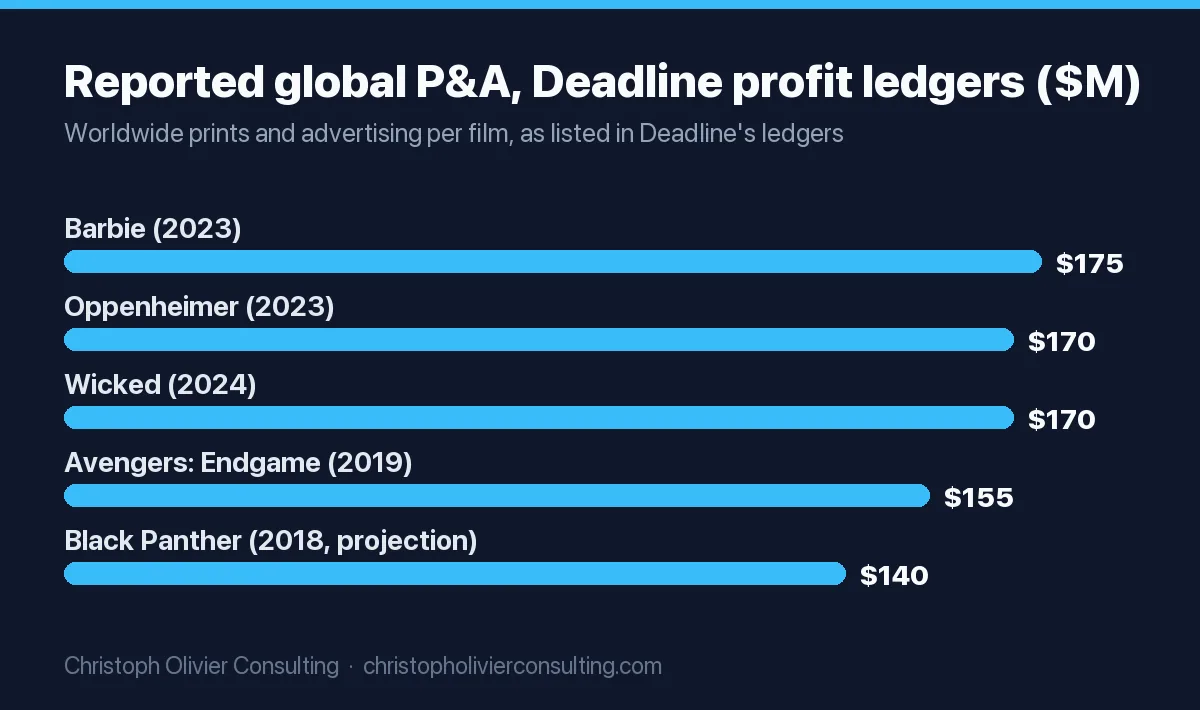
- Barbie: $175 million P&A, $145 million production, $421 million studio net (Deadline, May 2024).
- Oppenheimer: $170 million prints and ads, $100 million production, $201.9 million net (Deadline, May 2024).
- Wicked: a 360-degree campaign “figured at a global cost of $170 million,” $230 million net after ancillaries (Deadline, April 2025).
- Avengers: Endgame: $155 million worldwide prints and ads against a $356 million net production cost, $890 million net (Deadline’s published ledger).
- Black Panther: $140 million global P&A and $210 million production in Deadline’s March 2018 projection; its final 2019 ledger put net profit at $476.8 million (Deadline, April 2019).
We found no Deadline ledger for 2025 releases as of November 2026, so Superman, Sinners and Wicked: For Good have no ledger line. Their figures come from release-week reporting only.
Marketing budget for each film people search
Superman (2025) marketing budget
Variety reported that Superman “cost a hefty $225 million to produce and roughly $100 million to promote” in its opening-weekend story (July 13, 2025). A month earlier, The Hollywood Reporter quoted sources saying DC and Warner Bros. “could spend as much as $200 million on the global marketing campaign, compared with the usual $150 million for an all-audience summer tentpole” (THR, June 5, 2025). The $200 million figure many blogs repeat as fact was that pre-release ceiling, not a reported final spend. THR also noted that an Ohio incentive filing listed a gross budget of $363.8 million, while DC described the budget as a net $225 million after incentives. The film grossed $618.7 million worldwide, and Variety later reported it was expected to generate around $125 million in theatrical profit, a figure a studio insider disputed (Variety, Sept. 7, 2025).
Marketing budget for Sinners
Warner Bros. spent $90 million to produce Sinners “and roughly $50 million to $60 million on global marketing expenses,” per Variety (April 21, 2025). The one hard tracked number: iSpot measured $21.6 million in US national TV ad spend through opening weekend, more than the $13.9 million Warner Bros. spent on A Minecraft Movie (Deadline, April 22, 2025). That TV buy included spots during Christmas NBA games and the Grammys. The film finished at $379.7 million worldwide including a 2026 re-release, and Variety’s sources expected around $60 million in theatrical profit.
Marketing budget for Wicked
For the first Wicked (2024), rival studio executives told Variety the global campaign cost an estimated $150 million, excluding the combined $300 million production budget for both parts. Deadline’s later ledger put it at $170 million. Universal’s marketing chief Michael Moses declined to give a number: “I’m not going to tell you.” The campaign included a $7 million Super Bowl spot and more than 400 brand partners. For the sequel, Wicked: For Good, Universal spent roughly $90 million on global promotion, about 40% less, partly because the property never left public view between releases (Variety, Nov. 13, 2025).
Marketing budget for the Barbie movie
Variety’s release-weekend estimate, from rival studio executives, was $150 million “not including the $145 million production budget” (Variety, July 23, 2023). Deadline’s 2024 ledger put global P&A at $175 million, offset in part by 165 promotional partnerships “from Crocs to Cold Stone ice cream” (Deadline). Warner Bros. marketing president Josh Goldstine would only say the studio “spent responsibly for an event movie” and that the ubiquity was “a combination of paid media and how many partners came to play with us.” Barbie grossed $1.45 billion.
Marketing budget for The Odyssey
Universal spent $250 million to produce Christopher Nolan’s The Odyssey “and another $125 million to market to global audiences,” according to Variety (July 19, 2026). It opened in the US on July 17, 2026. The campaign’s distinctive lever was time: Imax tickets went on sale a full year before release and sold out, and a six-minute prologue played ahead of Imax 70mm screenings of Sinners and One Battle After Another in December 2025 (Variety, July 20, 2026). It has grossed $1.80 billion worldwide.
Marketing budget for Project Hail Mary
Not reported. Amazon MGM’s Project Hail Mary opened in March 2026, and Variety says only that it “cost $200 million to produce and many millions more to market” (Variety, March 22, 2026). Treat any precise marketing figure you see online as unsourced. What is on record: Amazon MGM told Variety it judges theatrical releases on “earning back marketing and distribution costs,” and Variety’s rule for a $200 million tentpole was “at least $500 million to break even” (Variety, March 17, 2026). The film reached $684.6 million worldwide.
Marketing budget for Marty Supreme
Not disclosed. A24 released Marty Supreme nationwide on Christmas Day 2025, and NBC News reported that “the marketing is an additional cost, which A24 has not disclosed,” though it is “widely believed to be less expensive than a traditional campaign” because it leaned on stunts over TV and outdoor ads (NBC News, Dec. 12, 2025). Those stunts included an orange blimp, a Wheaties box and a scripted 18-minute Zoom “marketing meeting” with Timothée Chalamet (THR, Jan. 14, 2026). Production cost was $70 million per Variety, A24’s most expensive film. Worldwide gross: $192.4 million.
Marketing budget for Avengers: Endgame
Deadline’s ledger lists $155 million in worldwide prints and ads against a $356 million net production cost, a combined $511 million that the $1.2 billion global opening weekend covered on its own (Deadline, April 24, 2020). The “$200 million marketing” figure that circulates on blogs has no primary source we could find. Original-run gross was $2.80 billion; a 2026 re-release lifted the lifetime total to $2.94 billion.
Marketing budget for Oppenheimer
Universal’s deal with Nolan “committed in writing to a marketing spend equal to the film’s $100 million budget,” Variety reported (Variety, July 21, 2026). Deadline’s ledger puts actual prints and ads at $170 million (Deadline, May 1, 2024). That makes Oppenheimer the clearest case of marketing outspending production: 1.7 times. Worldwide gross: $975.8 million.
Marketing budget for Black Panther
Deadline’s financial sources projected a $210 million production cost and $140 million in global P&A, for $350 million in total costs before participations (Deadline, March 17, 2018). Disney did not supply those estimates. The film grossed $1.35 billion.
Reported marketing spend compared
The chart uses only Deadline’s ledger figures, so all five bars measure the same thing the same way. Release-week estimates from other outlets run lower for the same films.
What a typical marketing budget for Hollywood movies looks like
There is no current official average. The Motion Picture Association stopped publishing cost data after its 2007 report, which put the average MPAA-member film at $70.8 million to produce and $35.9 million to advertise. Specialty-division films averaged $49.2 million and $25.7 million (Variety, March 2008). Today’s tentpole benchmarks come from trade reporting:
- “A movie of this scope and scale usually costs $100 million to $150 million to market” (Variety’s framing for an event film, July 2023).
- “The usual $150 million for an all-audience summer tentpole” (THR, June 2025).
- A sequel released soon after its predecessor can run far lower: Wicked: For Good at about $90 million.
Mid-budget originals sit well below that. Sinners ran $50 million to $60 million. If you are planning any launch budget, the same logic of setting spend against expected return applies at every scale, which is the method in our guide on how to set a marketing budget.
What P&A actually pays for: media, non-media and partner value
P&A stands for prints and advertising. Physical prints are mostly gone, but the label stuck for the full cost of releasing a film. It splits three ways.
- Paid media. TV, outdoor, digital, press and radio. In UK releases, TV took 49% of movie media spend in 2018, outdoor 28%, online 15%, press 6% and radio around 3%, per estimates for 1,288 films compiled by film-data researcher Stephen Follows. In the MPAA’s 2007 data, “other media” (cable TV, radio, magazines, billboards) was the largest US line at 24% and the internet just 4.4% (Variety). For channel cost context, see our out-of-home advertising statistics and connected TV advertising statistics.
- Non-media. Trailers and creative, publicity, premieres, market research and exhibitor services. The MPAA’s majors put 21.8% of 2007 ad budgets here.
- Partner and owned value. Brand tie-ins (165 for Barbie, 400 for each Wicked film) buy reach the studio does not pay for in full. “Our ubiquity wasn’t always funded from the studio alone,” Moses told Variety. NBCUniversal’s internal cross-promotion for Wicked: For Good, such as a “Wicked Week” on Today and The Tonight Show, sat outside the film’s marketing budget entirely.
That third bucket is why a campaign can look like it cost $300 million while the studio’s reported cash spend is half that. Timing matters too: studios often spend “the majority of P&A in the final two weeks before theatrical release,” Deadline noted in its Sinners analysis.
Marketing vs production budget, and the breakeven math
Marketing as a share of production varies far more than the “half the budget” rule suggests. Ratios below are calculated from the figures in the master table.
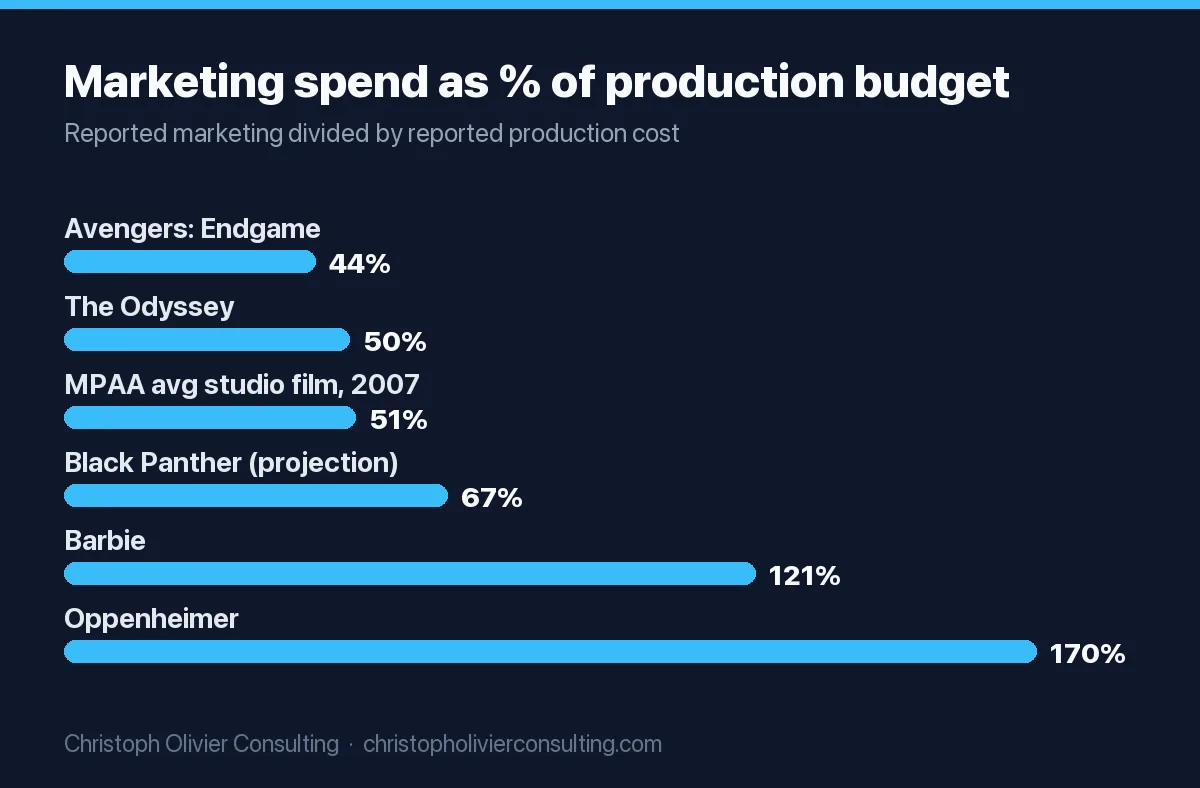
| Film or benchmark | Marketing | Production | Marketing as % of production |
|---|---|---|---|
| Avengers: Endgame (Deadline ledger) | $155M | $356M | 44% |
| Superman (Variety / THR ceiling) | $100M to $200M | $225M net | 44% to 89% |
| The Odyssey (Variety) | $125M | $250M | 50% |
| MPAA average studio film, 2007 | $35.9M | $70.8M | 51% |
| Sinners (Variety) | $50M to $60M | $90M | 56% to 67% |
| Black Panther (Deadline projection) | $140M | $210M | 67% |
| Barbie (Variety / Deadline) | $150M to $175M | $145M | 103% to 121% |
| Oppenheimer (Deadline ledger) | $170M | $100M | 170% |
The pattern: franchise films with big production costs spend less than half again on marketing, while originals and event films with modest budgets can spend more on marketing than on the movie.
The breakeven rule of thumb. IndieWire describes the “back-of-the-napkin” method: assume marketing is half the production budget, add the two, then double the total because theaters keep roughly half of ticket sales (IndieWire, April 2025). Variety applies a similar shortcut: a $200 million tentpole “needs to earn at least $500 million to break even,” or 2.5 times production. Worked on reported figures:
- Sinners: IndieWire’s version gives $90M + $45M = $135M, doubled to $270M. Variety’s sources, using the actual $50M to $60M marketing estimate, put theatrical breakeven at $200M to $225M. It grossed $370.5M in its original run.
- The Odyssey: $250M + $125M = $375M, doubled to $750M. It grossed $1.80B.
- Superman: $225M + $100M = $325M, doubled to $650M, above its $618.7M gross. Yet Variety’s sources expected about $125M in theatrical profit. The napkin math ignores rental shares that vary by film and market, plus home entertainment and TV revenue, which added $300 million (Oppenheimer) to $608 million (Endgame) in the Deadline ledgers above.
Use the rule to sanity-check a headline, not to declare a film a hit or a flop.
How to read a reported movie marketing number
Before you quote or compare any figure, run it through these five checks. A figure that fails two or more is not comparable to the numbers in the master table.
| Check | Pass | Fail | Example |
|---|---|---|---|
| Who is the source? | Named trade outlet citing studio, rival or financier sources | Blog, social post or “budget database” with no citation | Endgame “$200M marketing” on blogs vs Deadline ledger $155M |
| When was it published? | After release, or a ledger compiled after the run | Pre-release “could spend as much as” | Superman: THR’s $200M ceiling (June) vs Variety’s roughly $100M (July) |
| Global or domestic? | Says worldwide or global | US-only figure presented as total | Sinners: $21.6M is US national TV only, not the $50M to $60M global spend |
| Cash or total value? | Studio spend only | Includes partner or sister-network promotion | Wicked: For Good’s NBC cross-promotion sat outside its $90M budget |
| Net or gross production? | States net after incentives | Mixes gross budget into the ratio | Superman: $225M net vs $363.8M gross |
Film marketing budget breakdown template
This is a planning template, not studio data. The starting weights come from the two public sources on how film ad money is split: the MPAA’s 2007 non-media share and Stephen Follows’ 2018 UK media mix. Copy the table, swap in your total, then adjust each line to your audience and release pattern.
| Line item | What goes in it | Starting weight | Worked example: $20M P&A |
|---|---|---|---|
| Non-media | Trailers, key art, publicity, premieres, research, exhibitor services | 21.8% of total | $4.36M |
| TV | Network, cable and streaming spots, event placements | 49% of media | $7.66M |
| Outdoor | Billboards, transit, digital out-of-home | 28% of media | $4.38M |
| Online | Social, video pre-roll, search, site takeovers | 15% of media | $2.35M |
| Press | Print and newspaper ads | 6% of media | $0.94M |
| Radio | Radio and audio | About 3% of media (takes the remainder) | $0.31M |
| Promo partners | Brand tie-ins that pay for their own media | Not cash: track reach separately | $0 in budget |
| Total | $20.00M |
How the example works: $20M × 21.8% = $4.36M non-media, leaving $15.64M for media. TV is $15.64M × 49% = $7.66M, outdoor × 28% = $4.38M, online × 15% = $2.35M, press × 6% = $0.94M. Radio takes the $0.31M remainder because the source’s shares round to 101%. Then schedule: put the bulk of the media line in the last two weeks before release, as Deadline describes. If your audience skews younger, shift weight from TV to online; Follows found horror leads all genres on online share. For buying mechanics, our media buying guide covers direct versus programmatic deals.
What a service business can take from studio launch budgets
- Concentrate spend near the decision. Studios push most P&A into the final two weeks. A firm launching a new service should weight spend toward the window when buyers actually choose.
- Count partner reach separately from cash. Barbie and Wicked used hundreds of partners to look bigger than their budgets. Co-marketing with referral partners works the same way at small scale.
- Reuse what the last campaign built. Wicked: For Good spent about 40% less because the first film’s awareness carried over. Your second launch to the same list should cost less than the first.
To compare your spend with other industries, see our marketing budget benchmarks, or book a consultation if you want a launch budget built around your numbers.
Ready to scale your revenue?
Book a free 30-min consultation. We’ll diagnose your growth bottleneck and map out the 3 highest-leverage moves for your business.
Frequently asked questions
What was the marketing budget for Superman 2025?
Variety reported that Superman cost $225 million to produce and roughly $100 million to promote. Before release, The Hollywood Reporter quoted sources saying Warner Bros. and DC could spend as much as $200 million globally. Warner Bros. never confirmed a figure, so the reported range is about $100 million to $200 million. The film grossed $618.7 million worldwide.
How much did Barbie spend on marketing?
Rival studio executives told Variety in July 2023 that the Barbie campaign cost about $150 million, on top of a $145 million production budget. Deadline's 2024 profit ledger put global prints and advertising at $175 million, partly offset by 165 promotional partners. Warner Bros. only said it spent responsibly for an event movie.
What is the average marketing budget for a Hollywood movie?
No official average exists today. The last MPAA figures, for 2007, put the average member-studio film at $70.8 million to produce and $35.9 million to advertise. For current tentpoles, The Hollywood Reporter called $150 million the usual global marketing spend for an all-audience summer release, and Variety framed $100 million to $150 million as typical for an event film.
What was the marketing budget for The Odyssey?
Variety reported that Universal spent $250 million to produce Christopher Nolan's The Odyssey and another $125 million to market it to global audiences. It opened in the US on July 17, 2026, and has grossed about $1.80 billion worldwide, according to Box Office Mojo.
What was the marketing budget for Project Hail Mary?
No credible figure has been published. Variety reported that Project Hail Mary cost $200 million to produce and many millions more to market, without a number. Amazon MGM says it judges theatrical releases on earning back marketing and distribution costs. The film grossed about $684.6 million worldwide.
How much does a movie need to make to break even after marketing?
A common shortcut, described by IndieWire, adds production cost plus marketing (often assumed at half of production) and doubles it, because theaters keep about half of ticket sales. Variety uses a similar rule: a $200 million tentpole needs at least $500 million. Home entertainment and TV revenue can change the real answer considerably.
Does a movie marketing budget include brand partnerships?
Usually not as cash. Partners such as Starbucks or Crocs pay for much of their own promotion, which adds reach beyond the studio's reported spend. Universal's marketing chief said Wicked's ubiquity was not always funded by the studio alone, and NBCUniversal's in-house promotion for Wicked: For Good sat outside its roughly $90 million budget.