
To set a marketing budget, start from a revenue target, work backward to the pipeline and channel spend needed to hit it, then sanity-check the total against a percent-of-revenue benchmark for your stage and model. Use the benchmark as a guardrail, not the answer. Split the total across brand and demand, hold back a test reserve, and review the plan every quarter against actual results.
Last reviewed: October 2026

Most owners ask the wrong first question. “What percent of revenue should I spend?” gives you a category average, not a plan tied to your own goals. The stronger approach builds the number from a target and uses the benchmark only to catch a figure that is wildly high or low. This guide covers both methods, the brand versus demand split, zero-based budgeting, how to reallocate on performance, and a step-by-step build with a worked example. For the wider planning context, see the sales and marketing strategy hub.
What are the two main ways to set a marketing budget?
There are two core methods: percent-of-revenue and goal-based. Percent-of-revenue takes a share of current or projected revenue as the budget, which is fast and easy to defend. Goal-based works backward from a revenue or pipeline target to the spend required to reach it. Most disciplined teams build with goal-based and use percent-of-revenue as a reality check on the total.
Percent-of-revenue answers “is this in a normal range?” Goal-based answers “will this hit the number?” You want both. The benchmark keeps you from overspending in a lean year; the goal-based math keeps you from underfunding a real target and then blaming the channels.
How much should you spend? Percent-of-revenue benchmarks
Marketing spend commonly runs from about 5% to 15% of revenue, with the average across companies often cited near 7% to 10%. B2B firms tend to sit lower (roughly 6% to 9%), B2C product companies higher (often 12% to 16%), and early-stage or high-growth software companies higher still. Treat these as ranges to bracket your plan, not targets to copy.
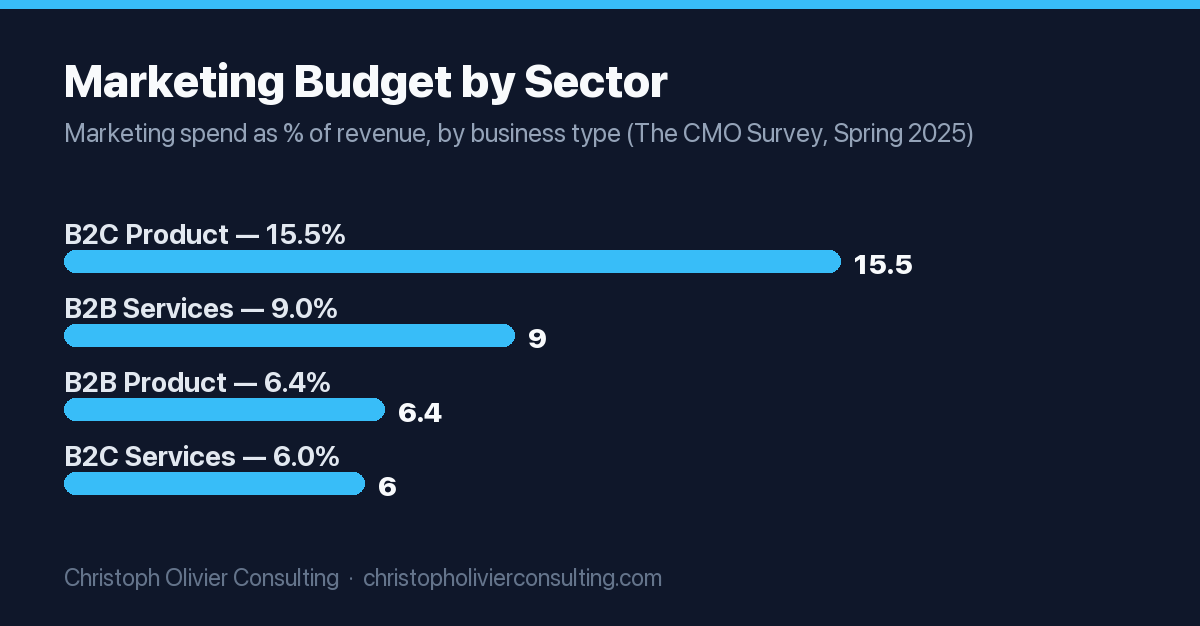
The figure moves with company stage and growth rate. A business defending a mature market can hold the low end; a company creating demand from a small revenue base often spends a far larger share because it is buying awareness and pipeline it does not yet have.
| Business type / stage | Typical marketing spend (% of revenue) | Why |
|---|---|---|
| Established B2B services | 6% to 9% | Longer cycles, relationship-led, lower media intensity |
| B2B product / SaaS (growth) | 10% to 20% | Land-and-expand, pipeline creation from a small base |
| B2C product / e-commerce | 12% to 16% | High competition for attention, paid media reliance |
| Early stage / pre-product-market-fit | 20%+ (often much higher) | Buying awareness and learning before scale |
| Mature / cost-defensive | 3% to 6% | Protecting share, efficiency over growth |
These bands come from surveys such as the Gartner CMO Spend Survey and the Deloitte/Duke CMO Survey, which report averages near 8% to 10% but wide variation by sector. Use the row that matches your model, then decide where in the range your growth ambition places you. Our roundup of CMO and marketing budget statistics collects the Gartner and CMO Survey benchmarks behind those ranges.
Percent-of-revenue vs goal-based: which method should you use?
Use goal-based when you have a specific revenue or lead target and some history on conversion and cost per acquisition. Use percent-of-revenue when you need a quick, defensible ceiling or you lack conversion data. In practice you run goal-based to size the plan and percent-of-revenue to check it against your peers.
| Factor | Percent-of-revenue | Goal-based |
|---|---|---|
| Starting point | A share of revenue | A target (revenue, leads, customers) |
| Speed | Fast | Slower, needs data |
| Best for | Sanity check, mature firms | New markets, growth targets |
| Main risk | Funds the average, not the goal | Garbage in if conversion data is weak |
| Ties to a real outcome | Weak | Strong |
How does the goal-based method work step by step?
The goal-based method converts a revenue target into a spend number using your funnel math: customers needed, then leads needed, then media and program cost, then people and tools. It ties every dollar to a real outcome instead of a category average. The steps below build the budget in order.
- Set the revenue target. Decide the new revenue marketing is accountable for this year, separate from renewals or referrals you would get anyway.
- Convert revenue to customers. Divide the target by average deal or order value to get the number of new customers required.
- Convert customers to leads. Apply your lead-to-customer conversion rate to find how many qualified leads you need.
- Cost the leads. Multiply leads needed by your realistic cost per lead or cost per acquisition to get baseline channel spend.
- Add programs, tools, and people. Layer in content, creative, software, and any agency or salary costs the channels depend on.
- Add a test reserve. Hold 10% to 15% for new channels and experiments so the plan can improve during the year.
- Check against the benchmark. Express the total as a percent of revenue and confirm it sits near your stage’s range; investigate any large gap.
If the goal-based total lands far above your benchmark range, either the target is too aggressive for the spend or your conversion rates need work before you scale. That tension is the point: it surfaces the problem before you commit the money. A marketing plan should carry this math so the budget and the goals stay linked.
How should you split the budget between brand and demand?
Split the budget across brand (long-term awareness and trust) and demand (near-term pipeline and conversions). A common B2B starting point is roughly 60% to 70% demand, 20% to 30% brand, and 10% test-and-learn, then adjust for stage and category maturity. Newer categories and crowded markets justify more brand; a healthy near-term pipeline lets you protect it.
Underfunding brand is the quiet mistake. Pure demand spend converts the people already in-market, but it does nothing to grow the pool for next year, so cost per lead creeps up. Reserve a meaningful brand share even when pipeline pressure is high, because it feeds future demand at a lower cost.
| Priority | Demand | Brand | Test |
|---|---|---|---|
| Near-term pipeline pressure | 65% to 70% | 20% | 10% to 15% |
| Balanced growth | 55% to 60% | 30% | 10% to 15% |
| New or crowded category | 45% to 50% | 40% to 45% | 10% |
What about zero-based budgeting and reallocating on performance?
Zero-based budgeting rebuilds the budget from zero each cycle, justifying every line by its expected return rather than last year’s number plus a bump. It kills legacy spend that no longer performs but takes more time. Pair it with quarterly reallocation: move money from channels missing their cost-per-acquisition target toward those beating it.
Treat the annual budget as a plan, not a contract. Set a review rhythm, usually quarterly, where you compare each channel’s actual cost per lead and pipeline contribution against plan, then shift the test reserve and any underperforming spend into winners. This is where budget discipline actually compounds, and it applies most sharply to B2B lead generation strategies where channel economics vary widely.
Worked example: setting a budget for a B2B services firm
Consider a B2B services firm targeting $1,000,000 in new revenue next year. Its average deal is $25,000, so it needs 40 new customers. At a 20% lead-to-customer rate, that is 200 qualified leads. At a $500 cost per lead, baseline channel spend is $100,000. Programs, tools, and a test reserve bring the total near $150,000, or about 15% of the revenue goal.
That 15% sits above the 6% to 9% band for established B2B services, which is a signal, not a failure. It tells the owner two things: the target is ambitious for a firm this size, and improving the lead-to-customer rate from 20% to 30% would cut required leads to roughly 133 and channel spend to about $67,000. The math turns a vague “spend more” into a specific choice between funding the gap or fixing conversion first.
| Step | Figure |
|---|---|
| New revenue target | $1,000,000 |
| Average deal value | $25,000 |
| Customers needed | 40 |
| Lead-to-customer rate | 20% |
| Qualified leads needed | 200 |
| Cost per lead | $500 |
| Baseline channel spend | $100,000 |
| Programs, tools, test reserve | ~$50,000 |
| Total budget (~15% of target) | ~$150,000 |
Split that $150,000 with the balanced-growth mix and you might fund roughly $90,000 demand, $45,000 brand, and $15,000 test, then reallocate quarterly as channels report back. If you would rather pressure-test this build with someone who has run it, the fractional CMO services page explains how that engagement works.
Frequently asked questions
What percentage of revenue should go to marketing?
Marketing spend commonly runs from about 5% to 15% of revenue, with averages often cited near 7% to 10%. Established B2B services sit lower (roughly 6% to 9%), while B2C product and growth-stage software companies run higher (often 12% to 20%). Use the range as a guardrail and let your growth stage decide where in it you land.
What is goal-based marketing budgeting?
Goal-based budgeting works backward from a target to the spend needed to reach it. You convert a revenue goal into customers needed, then qualified leads, then channel cost using your conversion rate and cost per acquisition, then add programs, tools, people, and a test reserve. It ties every dollar to a real outcome instead of a category average.
How do you split a marketing budget between brand and demand?
A common B2B starting point is roughly 60% to 70% demand generation, 20% to 30% brand, and 10% test-and-learn, then adjusted for stage and category maturity. New or crowded categories justify more brand. Underfunding brand raises cost per lead over time because demand spend only converts people already in-market and does not grow future demand.
How often should you review a marketing budget?
Review the budget at least quarterly. Compare each channel’s actual cost per lead and pipeline contribution against plan, then move money from channels missing their target toward those beating it. Treating the annual budget as a plan rather than a contract, and shifting the test reserve into proven winners, is where budget discipline compounds.
What is zero-based budgeting in marketing?
Zero-based budgeting rebuilds the budget from zero each cycle, justifying every line item by its expected return rather than starting from last year’s number. It removes legacy spend that no longer performs, though it takes more time to build. It pairs well with quarterly reallocation, which moves spend toward the channels delivering the best cost per acquisition.
How do you set a marketing budget for a startup with no revenue?
With little or no revenue, use goal-based math against a pipeline or customer target and expect a high percentage figure, often 20% or more, because you are buying awareness from a small base. Fund the smallest set of channels that can prove the model, hold a larger test reserve, and reforecast frequently as conversion data arrives.
More Growth, Strategy & Sales guides
- Integrated Marketing Communications: The Practical Build Guide
- Marketing Maturity Model: Stages, Dimensions, and a Self-Assessment
- How to Build a Marketing Technology Stack
- Media Buying: A Practical Guide to Programmatic, Direct, Models, and Fraud
- Partnership Marketing: Types, Structure, and How to Run a Program
- Brand Equity: What It Is, How to Measure It, and How to Build It