

The Certified Exit Planning Advisor (CEPA) program costs $3,500 at list price, and that fee covers the five-day online program, your first exam attempt and one year of membership, according to the Exit Planning Institute 2026 brochure. To keep the credential after year one you pay at least $495 a year for EPI’s lowest membership tier and complete 40 hours of continuing education every three years, so the realistic three-year cash cost is about $4,490. On November 12, 2026, EPI’s registration page showed a promotional price of $2,400 that ends November 30.
Below you get every CEPA fee from EPI’s own pages, the same breakdown for five other exit and succession credentials taken from each issuer’s site, a first-year and three-year cost-of-ownership table, and a payback worksheet you can rerun with your own fee. All prices were checked on November 12, 2026. Where an issuer does not publish a number, the table says so.
Short answer: CEPA tuition is $3,500 list ($2,400 on promotion through November 30, 2026), the exam is included, retakes are $50, and year one of membership is included. After that you pay $495 a year minimum to stay active. Three-year total: about $4,490 at list price, or $3,390 at the promotional price, before any optional prep course ($349) or paid continuing education.
Every CEPA fee, line by line (checked November 12, 2026)
EPI spreads its pricing across four places: the registration page, the FAQ, the membership page and the brochure. Here is all of it in one table, each line linked to the page that states it.
| Cost item | Amount | What it covers | Source |
|---|---|---|---|
| CEPA Credentialing Program, list price | $3,500 | 5-day online program, 17 modules, 6 hours a day, program manual, pre-CEPA onboarding, exam fee, 1 year of membership, a copy of Walking to Destiny | EPI brochure 2026 |
| Promotional price (“Season of Deals”) | $2,400 | Same program; offer ends 11/30/2026 | EPI registration |
| Exam, first attempt | $0 (included) | Closed-book, proctored online, taken within one week of the program | EPI FAQ |
| Exam retake | $50 per attempt | Up to 3 attempts total; after a third fail you need written approval and must pay for and retake the program | EPI FAQ |
| CEPA Exam Prep course (optional) | $349 | On-demand prep course plus digital study guide | EPI brochure 2026 |
| Annual membership, CEPA tier (minimum to stay active) | $495 a year | Credential maintenance, CEPA materials and official logos | EPI member benefits |
| Annual membership, CEPA Plus | $3,600 a year | Adds mastermind groups and Exit Planning Summit registration after one full year of membership | EPI member benefits |
| Annual membership, CEPA Mastery | $23,000 a year (or $1,917 a month committed) | Limited to 100 members; winter retreat and a DriveValue.com expert profile | EPI FAQ |
| Recertification | Every 3 years | 40 hours of exit-planning CE, at least 20 from EPI; ethics hours do not count | EPI FAQ |
Two details change the math. First, the brochure lists “1-Year of Credentialed Plus Membership” inside the registration fee, so you do not pay dues in year one. Second, the FAQ is explicit that if the annual membership fee lapses, “the CEPA credential will be de-activated.” The $495 is not optional if you want to keep the letters on your website.
Eligibility is light: the EPI comparison page lists one prerequisite, being 18 or older. Before the program you must read Walking to Destiny, which ships in your CEPA box. The program runs online only, Monday to Friday, and EPI lists monthly cohorts on the registration page from November 2026 through November 2027.
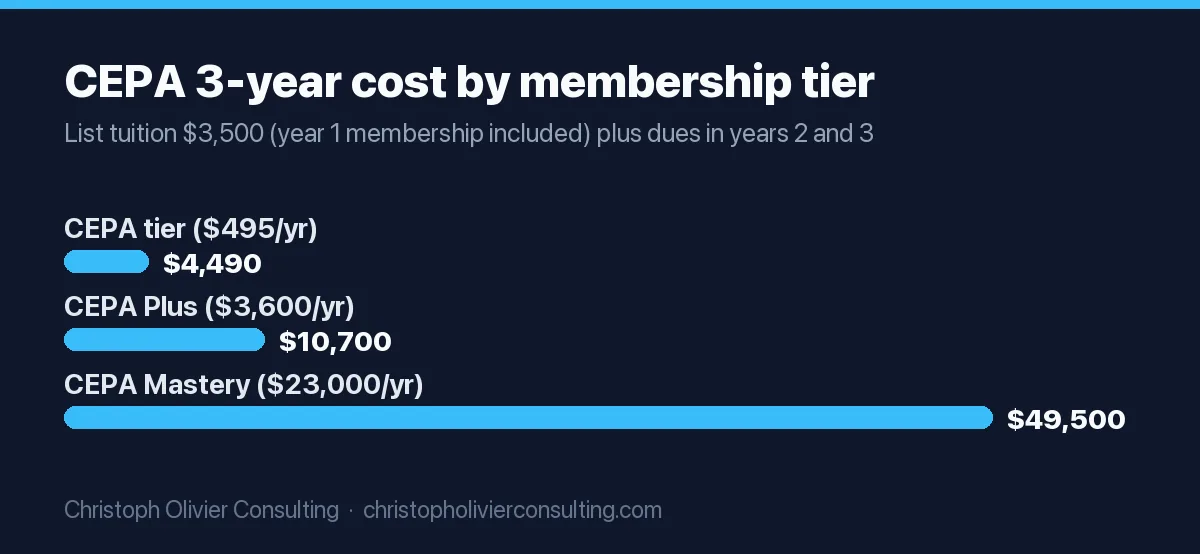
CEPA cost by membership tier: first year and three years
Most cost articles stop at tuition. The bigger number is the membership tier you pick after year one, because it repeats. This table assumes list tuition, one exam attempt, no prep course and no paid CE beyond what the tier includes.
| Scenario | Year 1 | Year 2 | Year 3 | 3-year total |
|---|---|---|---|---|
| CEPA tier, promotional tuition ($2,400) | $2,400 | $495 | $495 | $3,390 |
| CEPA tier, list tuition ($3,500) | $3,500 | $495 | $495 | $4,490 |
| List tuition + Exam Prep ($349) + one retake ($50) | $3,899 | $495 | $495 | $4,889 |
| CEPA Plus tier from year 2 | $3,500 | $3,600 | $3,600 | $10,700 |
| CEPA Mastery tier from year 2 | $3,500 | $23,000 | $23,000 | $49,500 |
Math, so you can check it: $3,500 + $495 + $495 = $4,490. Tier prices are from the EPI member benefits page; tuition and prep course from the 2026 brochure; retake fee from the FAQ.
What the table leaves out: the 20 EPI-sourced CE hours you need every three years. EPI names the Exit Planning Summit, EPI Academy courses, chapter events, think tanks and webinars as qualifying sources but does not publish one price for “20 hours,” so your cost depends on what you choose. If you already attend a chapter or buy Academy courses, the extra cost may be close to zero. If you plan to attend the Summit, price the CEPA Plus tier against buying a Summit ticket on its own.
CEPA vs CExP, CBEC, CM&AA and CVGA: what each credential really costs
EPI publishes its own certification comparison, but its competitor prices are stamped “as of May 29, 2025” and its CExP format (a 4-day virtual boot camp) no longer matches BEI’s current on-demand boot camp. So every figure below comes from the issuer’s own site, fetched November 12, 2026.
| Credential (issuer) | Tuition and exam | Ongoing fee to stay active | CE to maintain | Format and time | Eligibility |
|---|---|---|---|---|---|
| CEPA (Exit Planning Institute) | $3,500 list, exam included; $50 retakes (brochure) | $495/yr minimum; year 1 included (EPI) | 40 hrs per 3 yrs, 20 from EPI (FAQ) | Online only; 5 days, 6 hrs/day; exam within 1 week | 18 or older |
| CExP (Business Enterprise Institute) | $1,495 Boot Camp + $4,000 Advanced Exit Planning Course + $1,795 exam = $7,290 (BEI) | $200/yr renewal dues, due January 31 (BEI) | 30 credits per 2 yrs, at least 15 from BEI | Virtual on demand; est. 6 + 30+ + 15+ hrs; 60 days for Boot Camp, 1 yr each for the course and exam | Not published on the CExP page |
| CBEC (International Exit Planning Association) | $3,000 course (IEPA) + $350 application fee (IEPA application) | IEPA membership required; tiers from $995/yr (IEPA); year 1 Engagement Tools tier included | Not published on the pages checked | Virtual: 6 weekly 90-min study groups + self-paced modules; must complete a real exit plan | Application reviewed by committee |
| CM&AA (Alliance of M&A Advisors) | Online: $2,150 member price or $2,750 bundle with 1-yr membership. In person: $4,950 member or $5,495 bundle (AM&AA); exam included | $595/yr renewing membership (AM&AA) | 4 CPE hrs every 12 months (AM&AA) | 5 days, 10 classes of about 4 hrs; 40 CPE | Preferred: degree and/or CPA, CFA, CVGA, CEPA or M&A experience |
| CVGA (Corporate Value Metrics) | $6,495 certification only, or $7,995 with 3 months of group coaching (CVGA 2026 registration) | Not published; 1 year of community access included | Not published | Virtual, Tue/Thu sessions Sept 15 to Oct 22, 2026; 40 CPE; live case study + online exam (CVM) | 5+ yrs professional experience and a bachelor’s degree |
The CM&AA has a quirk worth knowing: AM&AA’s membership page lists individual membership at $545 a year, and the online member price is $2,150. Joining first ($545 + $2,150 = $2,695) is $55 cheaper than the $2,750 bundle on paper, but confirm with AM&AA that a new membership qualifies before you book. The same membership page also lists a “CM&AA 5 Day Program” at $5,200 including first-year membership, which does not match the $4,950 and $5,495 on the CM&AA page; ask which applies to your cohort.
The CBEC page still advertises a Winter 2026 session (February 18 to March 25, 2026) as the next date, so confirm the current schedule and price with IEPA. The CVGA price comes from Corporate Value Metrics’ 2026 registration form, not from its CVGA program page, which shows no price.
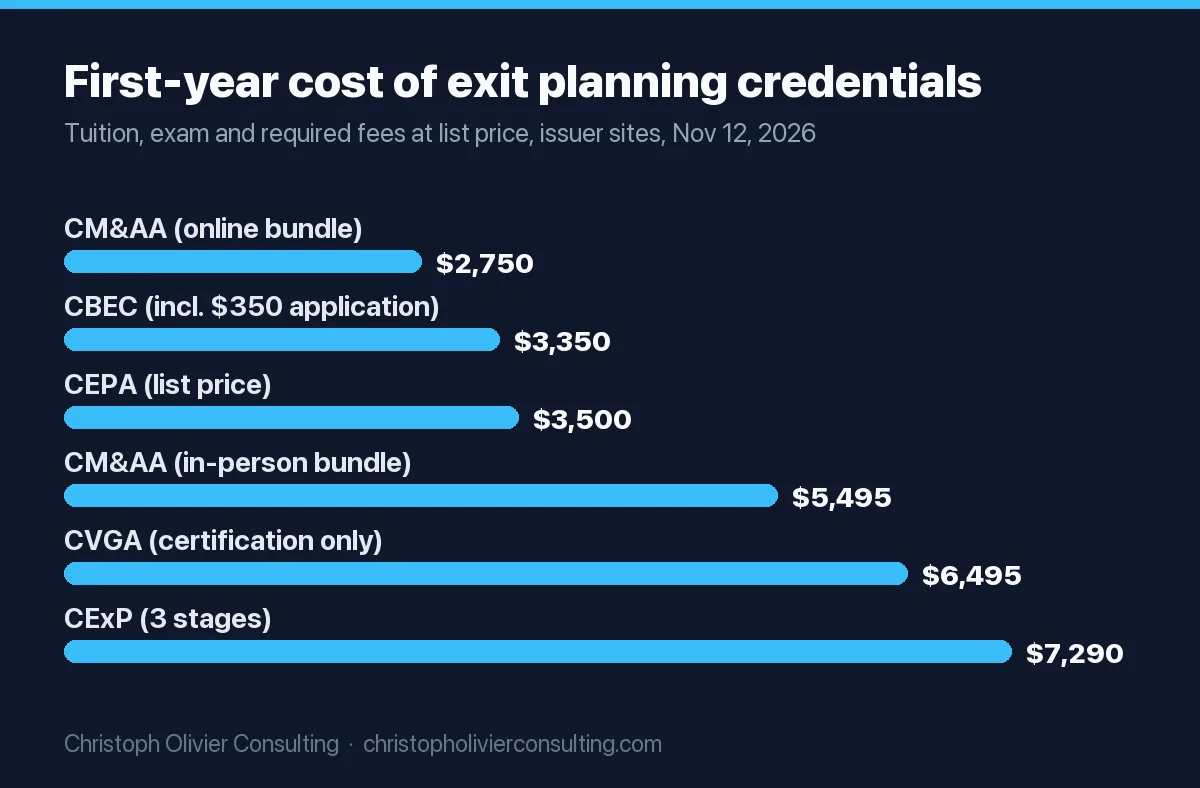
First-year and 3-year cost of ownership, side by side
This is the table to use when you budget. It adds tuition, exam, required application fees and the minimum membership or dues each issuer requires to keep the credential active. It excludes optional prep, travel, and the cost of meeting CE hours, because none of the issuers prices those as a fixed bundle.
| Credential (cheapest published path) | Year 1 cash | Years 2 and 3 | 3-year cash total | Program hours (issuer estimate) |
|---|---|---|---|---|
| CM&AA, online bundle | $2,750 | $595 + $595 | $3,940 | 40 (10 classes) |
| CEPA, list price | $3,500 | $495 + $495 | $4,490 | 30 (5 days x 6 hrs) |
| CEPA, promo through 11/30/2026 | $2,400 | $495 + $495 | $3,390 | 30 |
| CBEC | $3,350 | $995 + $995 | $5,340 | 9 live (6 x 90 min) + self-paced, total not published |
| CM&AA, in-person bundle | $5,495 | $595 + $595 | $6,685 + travel | 40 |
| CVGA, certification only | $6,495 | Not published | $6,495 + renewal (not published) | 40 CPE |
| CExP | $7,290 | $200 + $200 | $7,690 | 51+ (6 + 30+ + 15+) |
Assumptions, stated plainly: CEPA and CM&AA bundles include year-one membership, so dues start in year two. BEI does not say on its renewal page when the first $200 is due, so the CExP row assumes dues start in year two; add $200 if yours starts in year one. For CBEC we used the lowest IEPA tier ($995) for years two and three; IEPA says designees must “maintain membership” but does not say which tier, so check before you budget. Program hours are the issuer’s own estimates and do not include pre-reading or study time.
How many engagements pay back the credential? A worked payback calculation
None of the five issuers publishes what credential holders charge for exit planning work, so the fees below are hypothetical. Swap in your own numbers. The formula:
Engagements to break even = (3-year cash cost + program hours x your hourly value) / fee per engagement, rounded up. If you want to be strict, multiply the fee by your margin first.
Hypothetical inputs used here: a $3,000 fee for a one-off readiness assessment, a $10,000 fee for a multi-month planning engagement, and $150 an hour as the value of your time spent in class.
| Credential | 3-yr cash | Time cost (hrs x $150) | All-in cost | Engagements at $3,000 (hypothetical) | Engagements at $10,000 (hypothetical) |
|---|---|---|---|---|---|
| CEPA (list) | $4,490 | 30 x $150 = $4,500 | $8,990 | 3 | 1 |
| CM&AA online | $3,940 | 40 x $150 = $6,000 | $9,940 | 4 | 1 |
| CBEC | $5,340 | 9 x $150 = $1,350 (floor; self-paced hours not published) | $6,690+ | 3+ | 1 |
| CM&AA in person | $6,685 | 40 x $150 = $6,000 | $12,685 + travel | 5 | 2 |
| CVGA | $6,495+ | 40 x $150 = $6,000 | $12,495+ | 5+ | 2+ |
| CExP | $7,690 | 51 x $150 = $7,650 | $15,340 | 6 | 2 |
Example for CEPA: $4,490 + (30 x $150) = $8,990. Divide by $3,000 and you get 3.0, so three assessments cover it. At $10,000 per engagement, one does. If you take the promotional price, the all-in figure drops to $7,890 and you still need three $3,000 assessments, because 2.63 rounds up.
The honest reading: on cash alone, every credential here pays back with one or two engagements at a mid-size fee. The real cost is whether you actually land those engagements. A credential does not create demand by itself; it makes a referral or a website visitor more comfortable saying yes.
How long CEPA takes and how hard the exam is
- Before the program: read Walking to Destiny and book a one-hour pre-CEPA call (EPI FAQ).
- Program week: five days, Monday to Friday, 17 modules, about six hours a day, with daily faculty meet-ups.
- Exam: closed-book and proctored online, taken within one week after the program ends.
- If you fail: two more attempts at $50 each. After three fails, further attempts need written approval plus paying for and retaking the program.
So the whole path takes about two weeks plus reading time. EPI does not publish a pass rate on any page we checked, so be skeptical of any number you see quoted. For contrast, AM&AA does publish its exam rules: 100 questions drawn from a bank of 150, four hours in one sitting, 70% to pass, two attempts in the window, and you may use your course materials, according to the {a(AMAA_NOV, ‘November 2026 CM&AA registration page’)}.
On CE credit, EPI’s own pages disagree: the FAQ and brochure say up to 18 CPE and 14 CFP hours, while the comparison page says “up to 21.5 CPE Hours and 14.5 CFP Credits” in one place and “Up to 19 CPE Hours & 14 CFP Credits” in another. Use 18 and 14 for planning, and confirm with your licensing body. The same pages also quote different headcounts: over 3,000 CEPAs, over 10,000, and “more than 11,000” on the newest membership page.
Using the credential in your marketing (and what you lose if you lapse)
The letters only earn their cost if business owners see them at the moment they are deciding. Here is what each issuer gives you to market with, and the rule that takes it away:
| Credential | Marketing assets the issuer lists | What happens if you stop paying |
|---|---|---|
| CEPA | Official logos and CEPA materials (CEPA tier); a DriveValue.com expert profile (Mastery tier only) (EPI) | Credential de-activated and membership terminated (FAQ) |
| CExP | Official seal and badge, listing in BEI’s certified advisor directory (BEI) | Dues are “required each year to maintain active status” |
| CBEC | Use of the CBEC marks; Engagement Tools membership in year 1 (IEPA) | Must maintain IEPA membership to keep using the marks |
| CM&AA | Listing on the CM&AA registry (AM&AA) | Removed from the registry and must “cease and desist” using CM&AA in marketing |
Where the credential does the most work: on your About page and bio, in the first line of a referral partner one-pager, and in your Google Business Profile description. If you are adding CEPA to a practice that already has CFP or CPA clients, the credential is a reason to send an announcement email to existing owner clients, which is often the cheapest first engagement. Our list of marketing ideas for exit planning advisors covers the full set of channels, and the guide on how exit planning advisors get clients shows where first engagements usually come from.
Three practical rules. Put the credential next to a specific outcome, not alone: “CEPA helping manufacturing owners close their value gap before a sale” beats a logo strip; our piece on how to niche and position an exit planning practice walks through that wording. Second, make the credential findable by AI and search: state it in plain text on your bio page, not only in an image, as covered in our guide to building a personal brand as an exit planning advisor. Third, tie it to referral sources. CPAs and attorneys refer more readily when they know what you will deliver, which is why the centers-of-influence referral playbook matters more than the letters themselves.
In my view, a $4,490 credential that sits on a bio nobody reads is the expensive option. If you have the CEPA but the phone is quiet, the problem is usually positioning and referral flow, not another designation. That is the work we do in a fractional CMO consultation.
Which exit planning certification fits your budget and practice
| If you are… | Lowest-cost fit | Why |
|---|---|---|
| A financial advisor or CPA adding exit planning conversations | CEPA | Lowest ongoing minimum ($495/yr), no experience prerequisite, monthly online cohorts |
| An M&A advisor or banker doing transactions | CM&AA online | Lowest 3-year cash cost ($3,940); curriculum is deal process, valuation, tax and legal |
| An advisor who wants a done-for-you planning process and software | CExP (plus optional BEI membership) | Credential dues are only $200/yr, but BEI tools sit in memberships from $500 to $10,000/yr |
| An advisor who wants proof of a completed plan | CBEC | Requires a real exit plan with a business owner before you are certified |
| A consultant focused on operational value growth | CVGA | Eight-category value diagnostic and intrinsic value model; highest entry price, needs 5+ years’ experience |
Several practitioners hold more than one. The CM&AA page itself lists CEPA and CVGA as preferred prerequisites, and testimonials on the CVGA page come from advisors who also hold CEPA, CBEC and CM&AA. If you plan to stack credentials, start with the one whose annual fee you would pay anyway.
Ready to scale your revenue?
Book a free 30-min consultation. We’ll diagnose your growth bottleneck and map out the 3 highest-leverage moves for your business.
Frequently asked questions
How much does the CEPA certification cost?
The Exit Planning Institute lists the CEPA program at $3,500, which includes the five-day online program, the first exam attempt and one year of membership. On November 12, 2026 EPI showed a $2,400 promotional price ending November 30. After year one you pay at least $495 a year in membership dues, so three years cost about $4,490 at list price.
Is there a separate fee for the CEPA exam?
No. EPI's FAQ says the first exam attempt is included in the program cost. If you do not pass, you can retake it twice more at $50 per attempt. After a third failed attempt you need written approval from EPI and must pay for and go through the program again. An optional Exam Prep course costs $349.
What are the annual fees to keep the CEPA credential?
EPI requires an active annual membership. The CEPA tier costs $495 a year, CEPA Plus costs $3,600 a year and CEPA Mastery costs $23,000 a year. If the membership lapses, EPI de-activates the credential. You also need 40 hours of continuing education every three years, with at least 20 hours from EPI programs.
How long does CEPA certification take?
About two weeks plus pre-reading. You read Walking to Destiny, attend a one-hour pre-CEPA call, complete the five-day online program from Monday to Friday, then take the closed-book proctored exam within one week after the program ends. EPI lists monthly cohorts from November 2026 through November 2027.
What is the pass rate for the CEPA exam?
The Exit Planning Institute does not publish a CEPA exam pass rate on its FAQ, registration, membership or comparison pages. What it does publish: the exam is closed-book and proctored online, you get three attempts, and each retake costs $50. Treat any pass rate quoted elsewhere as unverified unless it links to EPI.
Is CEPA cheaper than other exit planning certifications?
On first-year cash it sits in the middle. Issuer prices on November 12, 2026: CM&AA online bundle $2,750, CBEC $3,350 including the application fee, CEPA $3,500, CVGA $6,495 and CExP $7,290. Over three years CEPA costs about $4,490, against $3,940 for CM&AA online and $7,690 for CExP.
Is a CEPA worth it?
On cash alone it pays back quickly: three years cost about $4,490, so one $10,000 engagement or two $3,000 assessments cover it (hypothetical fees). Adding 30 class hours at $150 an hour raises the all-in cost to $8,990. The deciding factor is whether you market it well enough to win those engagements.