

Privacy-first marketing measurement agencies set up the plumbing that lets you count results when many people say no to tracking: Google consent mode, server-side tagging, modeled conversions, marketing mix modeling (MMM) and data clean rooms. The need is measurable. In etracker’s 2025 study of 500 websites, sites with an equal “reject” button on the first layer had a median consent rate of 40%, Adjust puts Apple’s App Tracking Transparency opt-in at 35% of users shown the prompt, 24 US states have signed comprehensive privacy laws, and California’s largest CCPA penalty so far is $12.75 million (General Motors, May 2026).
Below: every statistic with its source, sample, date and method; the five types of privacy-first measurement providers with what each one’s own page says; an RFP scorecard; and a test list built from the enforcement actions that actually cost companies money.
Data privacy stats at a glance: source, sample, date and method
Vendor studies are labeled as vendor. Survey numbers are what people say, not what they do. Anything measured before 2023 is marked historical.
| Statistic | Source | Sample | Date | Method |
|---|---|---|---|---|
| 81% of US adults are very or somewhat concerned about how companies use data collected about them | Pew Research Center | 5,101 US adults | Fielded May 15 to 21, 2023 | American Trends Panel, address-recruited online panel, weighted |
| 73% say they have little or no control over data companies collect | Pew Research Center | Same | May 2023 | Same |
| 75% will not buy from an organization they do not trust with their data | Cisco 2024 Consumer Privacy Survey | 2,600+ adults, 12 countries | Summer 2024 | Double-blind survey |
| 69% manage cookie preferences instead of accepting all, up from 55% in 2023 | Cisco 2024 | Same | Summer 2024 | Same |
| Median consent rate 40% with an equal reject button on the first layer, 54% without | etracker Consent Benchmark 2025 (vendor) | 500 websites across sectors | June 2025 | Visits with at least statistics consent ÷ all visits |
| 25.4% of users accept all cookies on the first banner layer | Advance Metrics (vendor) | International B2B sites; size not published | Jan 1 to Jun 30, 2023 | Aggregated, anonymized consent logs |
| ATT opt-in 35% (34.5% in Q2 2024, 34% in Q2 2023) | Adjust (vendor) | Apps measured by Adjust | Q2 2025 | Opt-ins ÷ users shown the prompt |
| 45% of sites that sell or share data honored a GPC opt-out through all their privacy strings | Hausladen et al., USENIX Security 2025 | 1,620 of 3,566 qualifying sites, from 11,708 crawled | April 2024 | Crawler sends GPC, reads the site’s privacy strings |
| 24 states with signed comprehensive privacy laws; 20 in effect | ComplyJet state list | All 50 states | October 16, 2026 | Legal tracker; counts Florida |
| About €1.2 billion in GDPR fines in 2025; €7.1 billion since May 2018 | DLA Piper GDPR survey | European jurisdictions surveyed | Published January 21, 2026 | Tally of published fines to January 10, 2026 |
| $12.75 million, largest CCPA penalty to date (General Motors) | California Attorney General | One settlement | May 8, 2026 | Settlement, subject to court approval |
| Only 39% of US buy-side decision-makers use incrementality tests, attribution and MMM together | IAB State of Data 2026 | 430 senior planning and analytics leaders at brands and agencies | February 2026 | Survey with BWG Global |
Privacy-first marketing measurement agencies: what they actually set up
“Privacy-first measurement” is not one product. It is five jobs, and most providers do one or two of them well. Ask which of these you are buying.
- Consent mode. Google’s tags read the visitor’s banner choice. In basic mode tags stay blocked until the visitor answers, and Google Ads falls back to a general model. In advanced mode tags load with consent defaulted to denied and send cookieless pings, which supports an advertiser-specific model. The “v2” parameters,
ad_user_dataandad_personalization, are both needed for personalized advertising, per Google’s EEA consent help page; denyingad_user_dataalso switches off enhanced conversions data. - Modeled conversions. Google estimates conversions from visitors who declined cookies, using consented journeys and history. Eligibility, per Google Ads help: consent mode correctly implemented and 700 ad clicks over 7 days per country and domain grouping.
- Server-side tagging. Tags fire from your own server container instead of the browser, so you decide what each vendor receives. It does not remove the duty to respect consent.
- Marketing mix modeling. MMM works on aggregated spend and outcome data, no user-level tracking. Google made its open-source Meridian MMM available to everyone on January 29, 2025, with “over 20” certified measurement partners. Our marketing mix modeling explainer covers data needs.
- Clean rooms. You join your customer data with a media owner’s data and get only aggregated results. Google’s Ads Data Hub is in closed beta through your Google account team, and its privacy checks can filter rows without warning.
Types of privacy-first measurement providers
Named firms are examples, not a ranking. Each description comes from the firm’s own page, so treat it as self-reported.
| Provider type | Typical scope | Example and what its page says | Published price |
|---|---|---|---|
| Google-stack analytics consultancy | Consent mode, CMP setup, GTM client and server-side, GA4 and BigQuery | InfoTrust lists consent management, consent monitoring, CMP implementation and server-side tagging; Google Marketing Platform Certified Sales Partner; Osano consent partner | None |
| Agency network data practice | GA4, consent mode, enhanced conversions, Conversions API, Google tag gateway | Merkle (March 26, 2026) describes a Privacy Impact Calculator scoring consent rate performance, sitewide tagging, measurement impact with and without durable solutions, and privacy maturity | None |
| Server-side tagging host | Managed server-side Google Tag Manager containers | Stape: Free up to 10K requests; Pro $17, Business $83, Enterprise $167 per month billed annually, for 500K, 5M and 20M requests | Yes (USD) |
| MMM and incrementality specialist | Bayesian MMM, geo lift tests, budget scenarios | Recast: proprietary Bayesian MMM with time-varying ROI plus GeoLift by Recast; runs with Recast’s team or certified “Operator” consultancies; SOC 2, Meta Measurement Partner badge | None (demo request) |
| Clean room platform | First-party data matched with media owner data, aggregated outputs | InfoSum: a clean room to “connect to infinite datasets without sharing data”; cites Deliveroo measuring uplift with Channel 4 audience data | None |
| Consent management platform (CMP) | The banner, consent signals, IAB TCF strings | Google requires publishers on AdSense, Ad Manager or AdMob to use a Google-certified CMP for personalized ads: EEA and UK since January 16, 2024, Switzerland since July 31, 2024 | Varies by vendor |
A small firm rarely needs all six. My rule of thumb: get consent mode and server-side tagging right first, because every model downstream inherits their errors. If you want the measurement methods compared side by side, our guide on how to measure marketing effectiveness walks through attribution, MMM and geo holdouts with worked numbers.
Worked example: what consent does to your numbers
Take a professional-service firm with 30,000 sessions a month, a compliant banner and $7 average cost per click on Google Ads (the CPC is an assumption for the math).
- Observed sessions. At etracker’s 40% median for compliant banners, about 12,000 sessions carry analytics cookies. The other 18,000 show up only as cookieless pings, and only if you run advanced consent mode.
- The nudge temptation. At the 54% median for non-compliant banners you would see 16,200. That 4,200-session gap is what dark-pattern banners buy, and it is what Honda, PlayOn Sports and Tractor Supply paid for (table below).
- Modeling eligibility. 700 clicks in 7 days at $7 is $4,900 a week, or about $21,000 a month ($4,900 × 30 ÷ 7) per country and domain grouping. Below that, Google’s conversion-modeling criteria are not met, so lean on offline conversion imports, MMM or geo tests instead.
- Bias check. etracker found consent rates swing by more than 36% around a site’s own average depending on referrer and medium. Do not assume the consented 40% look like everyone else. Compare channel mix in consented data with server logs before you trust channel-level ROI.
RFP questions for a privacy-first measurement agency
Use this on the first call. A provider should pass at least 7 of 9.
| # | Ask | Pass | Fail |
|---|---|---|---|
| 1 | Basic or advanced consent mode for us, and why? | Explains cookieless pings, general vs advertiser-specific model, and defers the legal call to your counsel | “Just turn on v2” |
| 2 | Do we clear 700 ad clicks per 7 days per country and domain grouping? | Checks your account before promising modeled conversions | Promises recovered conversions regardless |
| 3 | How will GPC stop ad tags, including server-side and for logged-in users on every device? | Shows a test: GPC on, no ad pixels fire, opt-out stored on the account | “The CMP handles it” |
| 4 | Who hosts server-side tagging and what does it cost per month? | Names the host and a monthly figure | “It depends” with no range |
| 5 | Which MMM engine, how many weeks of data, and how is it calibrated? | Names it (Meridian, Robyn or proprietary) and calibrates with lift tests | A black box with no validation |
| 6 | Do we have the scale for a clean room? | Says no when you lack the records or media spend | Sells a clean room first |
| 7 | Which state laws apply to our customers? | Maps your customer states to the table below | Mentions only GDPR or only “CCPA” |
| 8 | Do you earn fees from the CMP, hosting or MMM vendor you recommend? | Discloses in writing | Dodges |
| 9 | What do we own if we leave? | Containers, models, code and documentation in your accounts | Proprietary connectors only they can run |
Consumer attitudes: Pew and Cisco privacy surveys
The latest Pew privacy survey (5,101 US adults, May 2023) found 81% concerned about how companies use their data and 73% feeling little or no control over it, against 79% for government data. 67% say they understand little or nothing about what companies do with their data, up from 59% in Pew’s 2019 survey (historical). 56% click “agree” without reading privacy policies always, almost always or often. 72% want more government regulation of what companies can do with personal data, including 78% of Democrats and 68% of Republicans (Pew key findings). Among those who have heard of AI, 70% have little or no trust in companies to use it responsibly.
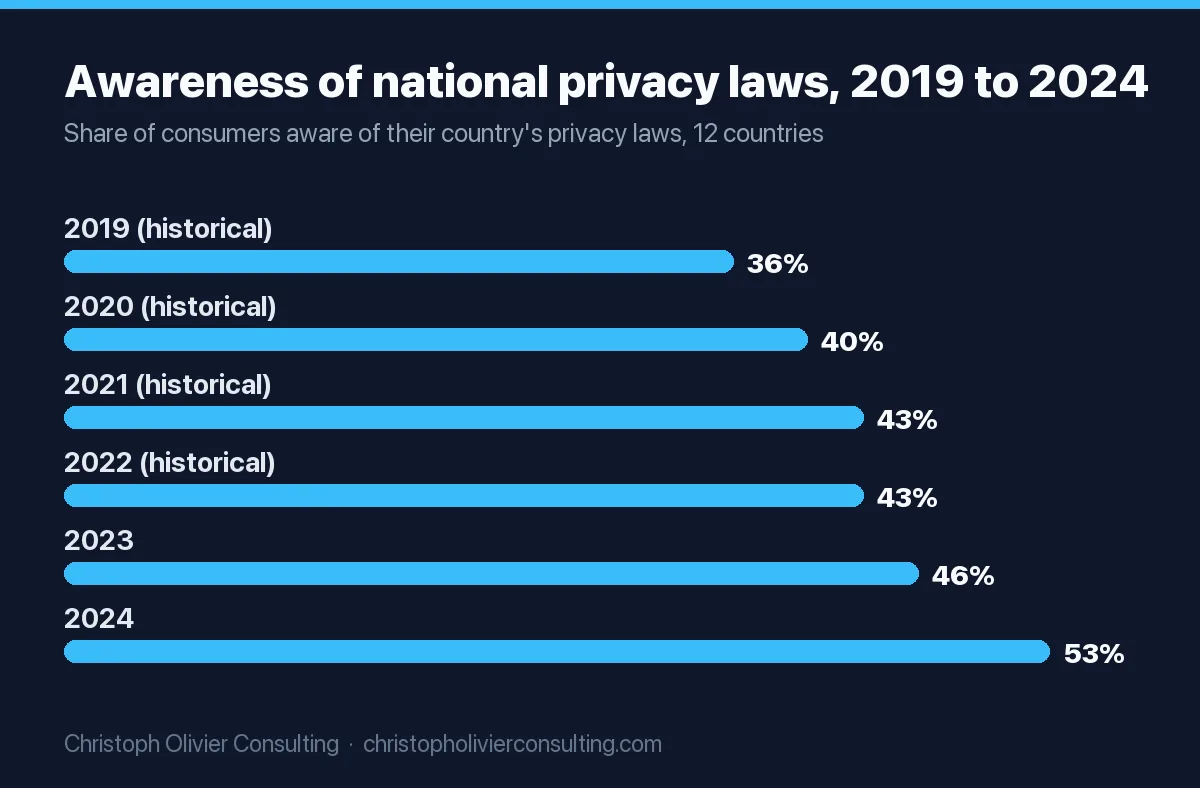
Cisco’s 2024 survey (2,600+ adults in Australia, Brazil, China, France, Germany, India, Italy, Japan, Mexico, Spain, the UK and the US) shows behavior shifting, not just attitudes:
| Cisco 2024 measure | 2024 | Earlier |
|---|---|---|
| Aware of their country’s privacy laws | 53% | 46% (2023); 36% (2019, historical) |
| Feel able to protect their data: aware vs not aware of laws | 81% vs 44% | n/a |
| “Privacy Actives”: care, willing to act, and have switched companies over data practices | 38% | 33% (2023); 32% (2022, historical) |
| Exercised a data subject access request | 36% | 28% (2023); 24% (2022, historical) |
| Manage cookie preferences instead of accepting all | 69% | 55% (2023) |
| Aware respondents who say privacy laws have a positive impact | 70% | 66% (2023); 61% (2022, historical) |
| US respondents who want a federal privacy law | 81% | n/a |
US awareness was lower than the global figure, at 48%. Cisco has not published a newer consumer edition as of November 2026.
Consent and opt-in rates: cookie banners, ATT and GPC
Cookie banner consent rates
etracker’s 2025 benchmark PDF is the most transparent recent source because it defines the metric: consent rate equals visits with at least statistics consent divided by all visits, not just visits that interacted with the banner. Its findings for 500 websites in June 2025:
- Median consent rate 40% with an equal reject button on the first layer, 54% without one. On average, compliant design costs 14 percentage points of consent.
- More than 20% of compliant sites have a consent rate under 10%.
- Sites offering “reject” on the first layer rose from 80% (2023) to 87% (2025). Equal button design rose from 27% (November 2023) to 52% (May 2025).
- 48% of sites still nudge, usually with a paler reject button or a text link.
- Banks and insurers with compliant banners recorded higher consent rates. Service businesses lost almost 50%.
Advance Metrics, measuring international B2B sites in the first half of 2023, found 25.4% accept all on the first layer and only 0.4% open the settings. Its denominator differs from etracker’s, so do not compare the two numbers directly.
Apple ATT opt-in rates
All ATT figures come from attribution vendors, and their denominators differ. Adjust reports 35% of users shown the prompt in Q2 2025, with Brazil at 50%, the UAE at 49%, Canada at 29% and Australia at 27%; sports games lead at 50% and education apps sit at 14%. AppsFlyer reported a global 50% and a US 44% for Q1 2024 (April 26, 2024 release) without publishing its method. The gap between 35% and 50% is mostly definition, so quote the vendor and the denominator together.
Global Privacy Control adoption
No independent study counts how many people have GPC switched on. The GPC project says “Join over 150 million users,” which is the reach of supporting browsers and extensions (Brave, DuckDuckGo, Firefox, Privacy Badger and others), not active signals. The better number is on the receiving end: the USENIX study found 44% of qualifying sites honored GPC in December 2023, 43% in February 2024 and 45% in April 2024. Twelve state laws in ComplyJet’s list require honoring a universal opt-out signal.
US state privacy laws: 24 states and their effective dates
Twenty states have comprehensive privacy laws in effect as of November 2026, counting Florida’s narrower law, and four more are signed with later dates. Dates are from ComplyJet’s list dated October 16, 2026. The first-party data strategy playbook uses the same table and shows what each law changes for ad pixels and Customer Match.
| State | In effect | Must honor a universal opt-out signal such as GPC |
|---|---|---|
| California (CCPA, amended by CPRA) | Jan 1, 2020 (CPRA Jan 1, 2023) | Yes |
| Virginia | Jan 1, 2023 | Not listed |
| Colorado | Jul 1, 2023 | Yes |
| Connecticut | Jul 1, 2023 (amendments Jul 1, 2026) | Yes |
| Utah | Dec 31, 2023 | Not listed |
| Texas | Jul 1, 2024 | Yes |
| Oregon | Jul 1, 2024 | Yes, mandatory from Jan 1, 2026 |
| Florida (narrower scope) | Jul 1, 2024 | Not listed |
| Montana | Oct 1, 2024 | Yes |
| Delaware, Iowa, Nebraska, New Hampshire | Jan 1, 2025 | Yes except Iowa |
| New Jersey | Jan 15, 2025 | Yes |
| Tennessee | Jul 1, 2025 | Not listed |
| Minnesota | Jul 31, 2025 | Yes |
| Maryland | Oct 1, 2025 (applies to processing from Apr 1, 2026) | Yes |
| Indiana, Kentucky, Rhode Island | Jan 1, 2026 | Not listed |
| Oklahoma, Louisiana | Jan 1, 2027 | Not listed |
| Alabama | May 1, 2027 | Not listed |
| Vermont (signed June 16, 2026) | Jan 1, 2028 | Not listed |
“Not listed” means the source does not list the state as requiring signal recognition, not that you may ignore the signal. In California, the CPPA’s 2025 inflation adjustment set the revenue threshold at $26,625,000 and fines at up to $2,663 per violation and $7,988 per intentional violation, effective January 1, 2025.
Privacy enforcement: FTC, California and GDPR fines
US privacy penalties are small next to GDPR fines, but almost every one targets something a marketing team configured: a banner, a pixel, an opt-out form. California figures come from the Attorney General’s enforcement actions list and the CPPA’s announcements.
| Date | Company | Regulator | Amount | What went wrong |
|---|---|---|---|---|
| Aug 24, 2022 (historical) | Sephora | CA Attorney General | $1.2M | Third-party trackers counted as a “sale”; GPC opt-outs ignored (release) |
| Mar 2, 2023 | BetterHelp | FTC | $7.8M | Emails, IPs and health questionnaire answers shared with Facebook, Snapchat, Criteo and Pinterest for ads (release) |
| Feb 21, 2024 | DoorDash | CA Attorney General | $375,000 | Customer data sold through marketing co-ops without notice or opt-out |
| Mar 12, 2025 | American Honda | CPPA | $632,500 | Excess verification for opt-outs, asymmetric privacy tool, no required contracts with ad tech firms (release) |
| May 6, 2025 | Todd Snyder | CPPA | $345,178 | Misconfigured privacy portal left opt-outs unprocessed for 40 days; ID required before opt-out (release) |
| Jul 1, 2025 | Healthline Media | CA Attorney General | $1.55M | Targeted-advertising opt-outs not honored; health-related data shared |
| Sep 30, 2025 | Tractor Supply | CPPA | $1.35M | No effective opt-out, including GPC; no contracts with data recipients (release) |
| Oct 30, 2025 | Sling TV and Dish Media | CA Attorney General | $530,000 | Hard-to-use opt-out, none in apps; no child-profile ad protections |
| Nov 21, 2025 | Jam City | CA Attorney General | $1.4M | No compliant opt-out in 21 apps; data of 13 to 15 year olds sold without opt-in |
| Feb 11, 2026 | Disney | CA Attorney General | $2.75M | Opt-outs, including GPC, applied only to one device or one service (release) |
| Mar 3, 2026 | PlayOn Sports | CPPA | $1.10M | Forced “agree” to tracking to use tickets; sent users to NAI and DAA opt-outs; ignored opt-out signals (release) |
| Mar 5, 2026 | Ford | CPPA | $375,703 | Email verification required before processing opt-outs (release) |
| May 4, 2026 | Kochava | FTC | No money stated | Barred from selling sensitive location data without affirmative express consent (release) |
| May 8, 2026 | General Motors | CA AG with four district attorneys | $12.75M | Sold OnStar driving and location data to data brokers; first data minimization case |
| May 21, 2026 | Cox Media Group, MindSift, 1010 Digital Works | FTC | $930,000 | Sold a fake “Active Listening” ad product and claimed consumers had opted in (release) |
In Europe, DLA Piper counts about €1.2 billion in GDPR fines in 2025, level with 2024, and €7.1 billion cumulative from May 2018 to January 10, 2026. The largest 2025 fine was €530 million from Ireland’s Data Protection Commission (April 2025) against a social media company over international data transfers; the record remains Meta’s €1.2 billion in 2023. Ireland accounts for €4.04 billion of the cumulative total. Breach notifications averaged 443 a day, up 22% from 363.
Eight tests built from these enforcement actions
- GPC test (Sephora, Tractor Supply, PlayOn). Turn on GPC in Firefox or Brave, load your site, and confirm in the network tab that no ad pixel fires.
- Account-wide opt-out (Disney). Opt out while logged in on a laptop, then check a phone or app on the same account.
- No verification gate (Ford, Honda, Todd Snyder). Submit a “Do Not Sell or Share” request without confirming an email. It should go through.
- Backlog age (Todd Snyder). Check the oldest unprocessed opt-out in your CMP or portal. Measure days, not just whether the form works.
- Symmetric banner (Honda). Reject must take the same number of clicks as accept, with equal visual weight.
- No tracking wall (PlayOn). A customer must be able to use what they paid for without agreeing to ad tracking.
- Contracts for every recipient (Honda, Tractor Supply). List every pixel and tag vendor and match each to a signed contract with the required privacy terms.
- Sensitive data out of pixels (BetterHelp, Healthline, GM). Health, location and children’s data should not reach ad platforms, and data collected for one purpose should not be resold.
Michael Macko, quoted in the CPPA’s Todd Snyder release, put it plainly: “Using a consent management platform doesn’t get you off the hook for compliance.”
Do third-party cookies still work in Chrome?
Yes. On April 22, 2025 Google said it would “maintain our current approach to offering users third-party cookie choice in Chrome” and would not launch a standalone prompt; Incognito “already blocks third-party cookies by default.” On October 17, 2025 it retired Topics, Protected Audience, Attribution Reporting, Private Aggregation, Related Website Sets, IP Protection and others, keeping CHIPS, FedCM and Private State Tokens. So signal loss now comes from consent, opt-out laws, Apple and blockers rather than a Chrome deadline. Blockers are their own leak: the ad blocking statistics page shows how to measure your block rate, and the contextual advertising statistics cover targeting that needs no identifier at all.
What marketers report about measurement under privacy limits
IAB’s State of Data 2024 (500+ experts at brands, agencies and publishers, released March 14, 2024) found 95% expect continued signal loss or privacy legislation, 71% growing or planning to grow first-party datasets (41% two years earlier), and 55% expecting it to get harder to track conversions, attribute performance and measure ROI. 82% said legislation and signal loss had already changed their organization’s structure.
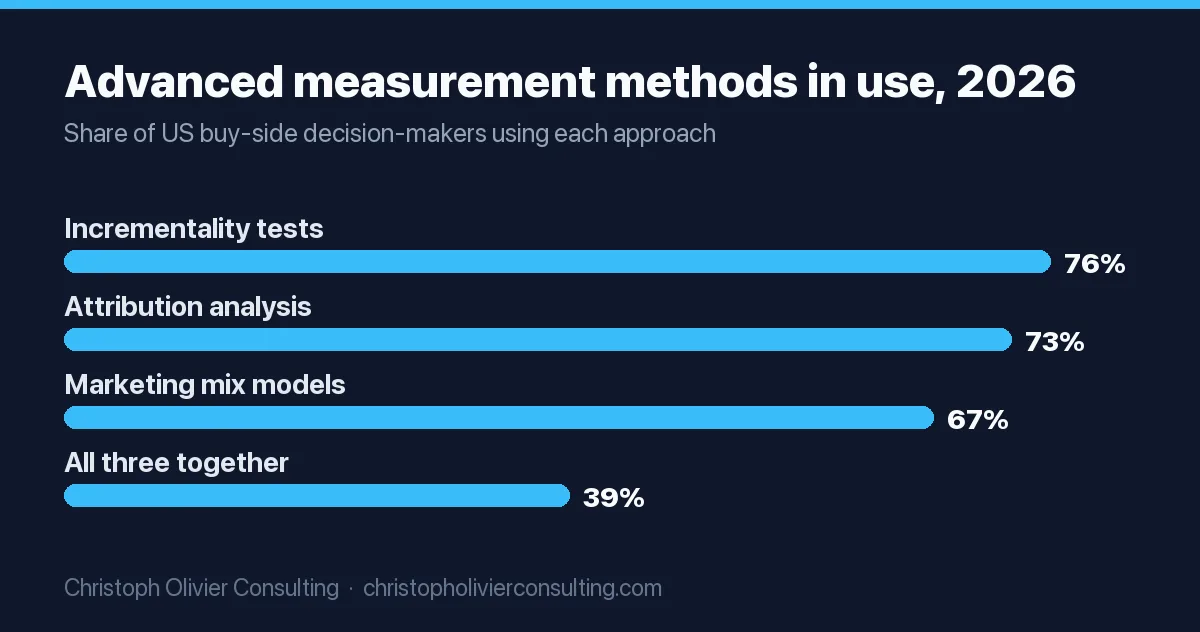
The 2026 edition (430 senior planning and analytics decision-makers at US brands and agencies, with BWG Global) looked at the fixes. Incrementality tests are used by 76%, attribution analysis by 73% and MMM by 67%, but only 39% use all three. Between 60% and 75% say advanced measurement underperforms on rigor, timeliness, trust or efficiency. Among MMM users who can see each channel, 77% say gaming is underrepresented in their models, versus 35% for paid search and social and 31% for display.
If you want an outside operator to run the consent, tagging and measurement setup above, you can book a consultation and bring the RFP scorecard.
Frequently asked questions
What do privacy-first marketing measurement agencies do?
They set up measurement that works when many visitors decline tracking: Google consent mode (basic or advanced), server-side tagging, modeled conversions, marketing mix modeling and data clean rooms. Most providers specialize: Google-stack consultancies handle consent and tagging, MMM specialists model aggregated spend, and clean room platforms join your data with media owners' data. Ask which of these jobs you are buying before comparing proposals.
What are the key data privacy stats for marketers in 2026?
Pew found 81% of US adults concerned about how companies use their data (May 2023, n=5,101). Cisco's 2024 survey found 75% will not buy from a company they do not trust with data. etracker's 2025 study of 500 sites found a 40% median consent rate with a compliant banner. Adjust puts ATT opt-in at 35% (Q2 2025). 24 US states have signed comprehensive privacy laws.
What is the average cookie consent rate?
It depends on banner design and on the denominator. etracker's 2025 benchmark of 500 websites found a median consent rate of 40% when the reject button is equal and on the first layer, versus 54% without that, counting all visits. Advance Metrics found 25.4% of users accept all on the first layer for international B2B sites in the first half of 2023.
What is the App Tracking Transparency opt-in rate?
Adjust reports an industry-wide 35% of users shown the prompt in Q2 2025, up from 34.5% in Q2 2024 and 34% in Q2 2023, with Brazil at 50% and Australia at 27%. AppsFlyer reported 50% globally and 44% in the US for Q1 2024 but did not publish its method. Both are vendor figures with different denominators, so quote the source with the number.
How many US states have data privacy laws in 2026?
Twenty-four states have signed comprehensive consumer privacy laws and 20 are in effect as of November 2026, counting Florida's narrower law. Indiana, Kentucky and Rhode Island took effect January 1, 2026. Oklahoma and Louisiana follow on January 1, 2027, Alabama on May 1, 2027 and Vermont on January 1, 2028, per ComplyJet's October 2026 list.
What is the largest CCPA fine so far?
General Motors agreed to pay $12.75 million in civil penalties, announced May 8, 2026 by the California Attorney General with four district attorneys, for selling OnStar driving and location data to data brokers. It is described as the largest CCPA penalty to date. The settlement was subject to court approval. Disney's $2.75 million in February 2026 was the previous record.
How much are GDPR fines in total?
DLA Piper's January 2026 survey counts about EUR 1.2 billion in GDPR fines in 2025, level with 2024, and EUR 7.1 billion from May 2018 to January 10, 2026. Ireland accounts for EUR 4.04 billion of that. The largest single fine remains EUR 1.2 billion against Meta in 2023. Breach notifications averaged 443 a day, up 22%.
Advertising & ad-tech research