
Last reviewed: October 2026
Every tax planning firm owner eventually asks the same question: what is the right number to put behind marketing? You are not selling a commodity. You are selling judgment, planning, and a relationship that can last decades, often at a higher fee than a seasonal preparer charges. That changes both how much you should spend and where the money should go.
This article gives you a practical way to set a marketing budget for a tax planning firm, a channel allocation you can actually work from, and the compliance guardrails that shape what the budget is allowed to fund. It is general marketing guidance, not legal or tax advice.
By Christoph Olivier
What “marketing budget” actually means for a tax planning firm
Start by defining the number honestly. A marketing budget is the total you commit over a year to attract, convert, and retain clients. For a planning firm that usually includes your website, content and SEO, paid search, email and CRM tools, events or webinars, referral and partner development, brand and design, and any outside help such as a fractional marketing lead, a writer, or an agency.
Two distinctions matter before you pick a percentage. First, separate growth spend from maintenance spend. Keeping your site online and your Google Business Profile current is the cost of being in business. Running a paid campaign to book planning consultations is growth. Second, decide whether staff time counts. If a senior planner spends ten hours a week writing articles or hosting webinars, that is a real cost even if no invoice shows it. Firms that ignore internal time tend to underinvest in the systems that would make that time pay off.
How much should you budget?
There is no single correct figure, and you should treat any percentage you read online as a planning starting point, not a measured benchmark for your firm. Professional services firms commonly frame marketing as a share of gross revenue. The right share for you depends on your stage, your margins, and how aggressively you want to grow.
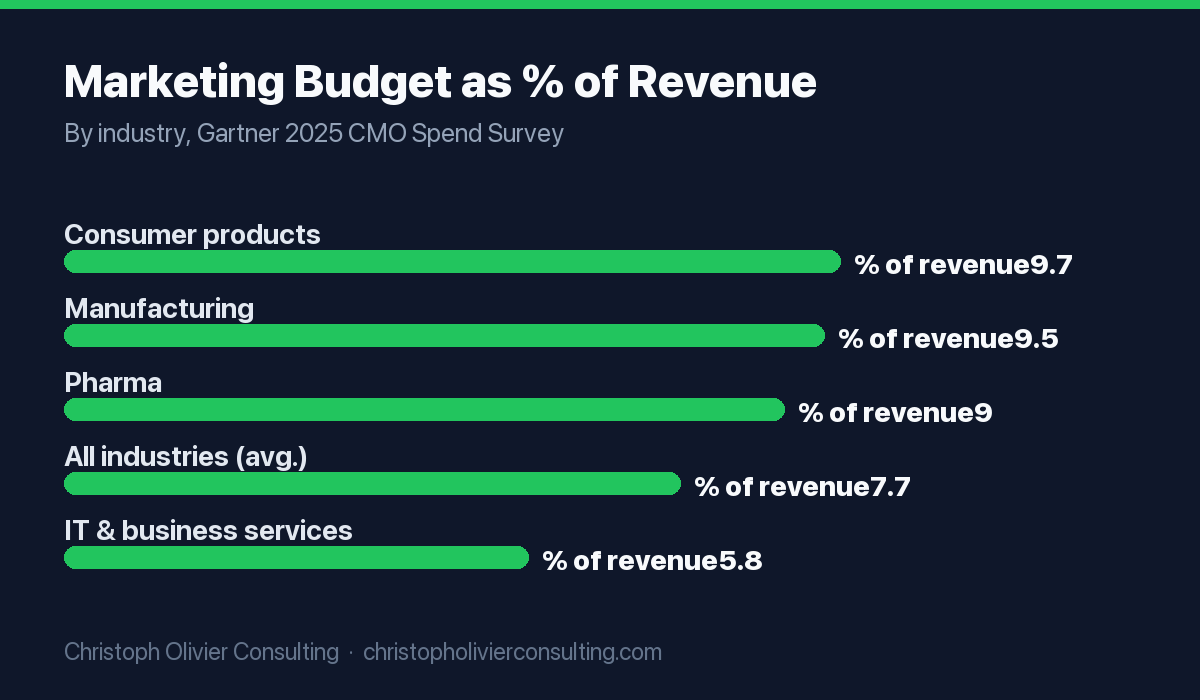
The ranges below are illustrative planning ranges to help you frame a decision. They are not measured data or a promise of results. Your own numbers, tested over a few quarters, always beat a generic figure.
| Firm stage | Illustrative marketing spend (share of gross revenue) | Primary goal |
|---|---|---|
| New or rebuilding (under 3 years, or resetting positioning) | Higher end of your comfort range | Build visibility, website, and a repeatable lead source |
| Steady, growing deliberately | Moderate, sustained investment | Compound SEO and referrals, protect margin |
| Established, referral-rich, capacity-constrained | Lower, focused on retention and selectivity | Nurture existing clients, attract better-fit clients |
Two practical rules keep you out of trouble. Do not set a budget you cannot fund for at least four quarters, because SEO and reputation building rarely pay back in one. And do not scale spend faster than you can serve the clients it brings. A planning firm that books consultations it cannot staff damages the relationship and the referrals that follow.
Anchor the budget to a client, not a percentage
A cleaner way to size the budget is to work from unit economics. Estimate the lifetime value of a planning client, then decide what you can afford to spend to acquire one and still hit your margin. A planning relationship that renews for years can support a meaningfully higher acquisition cost than a one-time return. Once you know your rough cost to acquire a client and your target number of new clients, the budget builds itself from the bottom up instead of from a number someone posted on a forum.
How to allocate the budget
Allocation matters more than the total. A tax planning firm sells expertise and trust, so the money should concentrate where prospects evaluate expertise and trust: your site, your content, your search visibility, and your referral relationships. Paid channels have a place, but they work best once the foundation converts.
The split below is an illustrative starting allocation, not a formula. Adjust it to your market, your capacity, and what your own tracking tells you over time.
| Category | Illustrative share of budget | What it funds |
|---|---|---|
| Website and conversion | Largest single slice early on | Fast, clear site; service pages; consultation booking; analytics |
| Content and SEO | Large, sustained | Planning-focused articles, guides, and search visibility that compound |
| Referral and partner development | Meaningful and ongoing | Attorney, financial advisor, and CPA relationships; client referral systems |
| Paid search and social | Modest, scaled by results | Targeted campaigns for high-intent planning searches |
| Email, CRM, and retention | Modest but non-negotiable | Nurture, seasonal touchpoints, review requests, tools |
| Brand, design, and reserve | Small | Visual identity, testing budget, unplanned opportunities |
Weight the early money toward the website and content. For a planning firm, organic search and referrals usually produce the best-fit clients at the lowest long-run cost, but they take time to build. Paid channels can bridge the gap while your organic presence matures, then shrink as a share of the total once your pipeline fills itself.
Fund the foundation before the ads
A common and expensive mistake is buying traffic to a site that does not convert. If your service pages do not explain who you help, what planning problem you solve, and how to book a consultation, paid clicks leak away. Fix the foundation first: clear positioning, credible proof, a simple path to a call. Then turn on paid.
Compliance and the mistakes to avoid
Your marketing budget funds public communications, and for tax practitioners those communications sit under IRS Circular 230. Section 10.30 governs advertising and solicitation. In plain terms, you may not use false, fraudulent, misleading, deceptive, or coercive claims in any public communication. You may publish your name, address, hours, and a written schedule of fees, including fixed fees for routine services, hourly rates, and fee ranges. Uninvited solicitation that violates federal or state law is off limits, and you are expected to keep a copy of a broadcast or communication for at least 36 months from its last use. Treat that record retention rule as a line item in your process, not an afterthought. This is general guidance; confirm specifics with your own compliance counsel.
The budget-level takeaway is simple. Anything the money funds, an ad, a landing page, a testimonial, a webinar script, has to clear the same standard. Build compliance review into the workflow so it does not become a scramble later.
The mistakes that hurt tax planning firms most:
- Promising outcomes. Copy that guarantees a refund, a specific tax saving, or an audit-proof result is exactly the kind of claim that draws scrutiny. Sell your process and judgment, not a number.
- Seasonal on, off, on, off. Cutting all marketing after April and restarting in January kills the compounding that SEO and referrals depend on. Planning demand runs year round, so fund it year round.
- Buying leads before the site converts. Paid spend on a weak foundation is money you will not get back.
- Ignoring existing clients. Retention and referrals are the cheapest growth a planning firm has. If none of the budget protects the client relationship, you are overpaying for new ones.
- No tracking. If you cannot see which channel produces booked consultations, you cannot allocate. Set up simple attribution before you scale.
How this fits your bigger marketing picture
A budget is one decision inside a larger system: positioning, channels, content, compliance, and measurement all have to work together. The number only pays off when it is pointed at the right audience through the right channels with the right message. If you want to see how budgeting connects to the rest, our marketing plan for tax planning firms lays out the full approach so your spend supports a strategy rather than standing in for one.
Frequently asked questions
Below are the questions tax planning firm owners ask most about setting and allocating a marketing budget.
Close
Set a budget you can sustain for a year, point most of it at your website, content, and referral relationships, and keep every dollar inside Circular 230’s advertising rules. If you want a second set of eyes on the number and the plan behind it, book a call or start with the marketing plan for tax planning firms.
Frequently asked questions
How much should a tax planning firm spend on marketing?
There is no single correct figure. Professional services firms often frame marketing as a share of gross revenue, with newer or rebuilding firms investing more heavily and established, referral-rich firms spending less. Treat any percentage as an illustrative planning starting point, not a measured benchmark, and refine it using your own cost to acquire a client and the lifetime value of a planning relationship.
How should I allocate a tax planning firm's marketing budget?
Concentrate early spend on your website and conversion path, then content and SEO, then referral and partner development, since those channels produce the best-fit planning clients over time. Keep paid search and social modest and scale it by results, and always reserve a slice for email, CRM, and client retention. The specific split should follow your own tracking, not a fixed formula.
Should marketing spend change with tax season?
Your visibility should not switch off after April. Turning marketing on and off seasonally interrupts the compounding that SEO and referrals depend on, and planning demand runs year round. It is usually better to fund a steady program all year than to spike spending in season and go dark afterward.
What does IRS Circular 230 mean for my marketing?
Circular 230 section 10.30 governs advertising and solicitation for tax practitioners. You may not use false, misleading, or coercive claims, you may publish your name, hours, and a written schedule of fees, and you should avoid uninvited solicitation that breaks federal or state law. You are also expected to keep a copy of a communication for at least 36 months from its last use. Confirm specifics with your own compliance counsel.
Should I count staff time in the marketing budget?
Yes. If a senior planner spends hours each week writing articles, hosting webinars, or nurturing referral partners, that is a real cost even without an invoice. Counting internal time gives you an honest total and helps you decide when outside help, such as a writer or a fractional marketing lead, would free that time for higher-value work.
Is it better to spend on ads or on SEO and referrals?
For most tax planning firms, organic search and referrals produce better-fit clients at a lower long-run cost, but they take time to build. Paid channels can bridge the gap while your organic presence matures, then shrink as a share of the budget once your pipeline fills itself. Fund a site that actually converts before you buy traffic to it.
More marketing guides for tax planning firms
- How Tax Planning Firms Get Cited and Recommended by AI Search
- Marketing KPIs and Metrics a Tax Planning Firm Should Track
- CRM and Client Follow-Up for Tax Planning Firms
- How Tax Planning Firms Get More Online Reviews and Manage Reputation
- How a Tax Planning Firm Builds a Website That Converts Visitors Into Consultations
- Lead Magnet Ideas for Tax Planning Firms