

The best lead magnet for coaches is a short diagnostic, usually a 10 to 15 question scorecard, because it gives the reader a personal result and gives you a reason to offer a call about that result. Templates and scripts work next best for buyers who already know their problem, and case studies or an application-gated strategy session work for buyers who are close to deciding. Below are 22 lead magnet ideas for coaches with a copy-ready title, format, build time, tool and price, buyer stage, and the follow-up email that turns each one into a booked call.
Titles use [brackets] for your niche. Build times are my working estimates for a first usable version, not measured data. Tool prices were checked on the vendors’ pricing pages on November 1, 2026.
22 lead magnet ideas for coaches, with titles you can copy
Buyer stage tells you where the idea fits. Problem-aware readers feel a symptom but cannot name the cause. Solution-aware readers know the problem and want a method. Decision readers are comparing coaches and need proof or a direct conversation.
| # | Copy-ready title | Format | Build time | Tool and price | Buyer stage |
|---|---|---|---|---|---|
| 1 | The Owner-Dependence Scorecard: find out in 4 minutes which part of your business stops when you take a week off | Scored quiz with results page | 6 to 8 hours | Tally (free) or ScoreApp Starter ($39/mo) | Problem-aware |
| 2 | What Is Your Hour Actually Worth? The [Founder] Hourly Value Calculator | Calculator form | 3 hours | Tally (free, calculations included) | Problem-aware |
| 3 | 9 Hiring Mistakes That Keep [Agency Owners] Doing Every Sales Call Themselves | One-page checklist PDF | 2 hours | Canva (free plan) | Problem-aware |
| 4 | The 20-Minute Calendar Audit: Sort Last Week Into Keep, Delegate, Delete | Fillable worksheet | 2 hours | Google Docs (free) | Problem-aware |
| 5 | How Your Margins Compare: [Industry] Benchmarks on One Page | Data one-pager built from a named public source | 5 hours | Canva (free plan) | Problem-aware |
| 6 | Send Me Your [Pricing Page], Get a 5-Minute Video Teardown | Personal video review | 15 minutes per request | Loom Starter (free, 5-minute recordings) | Problem-aware to decision |
| 7 | The One-Page 90-Day Plan for [Service Firm Owners] | Template | 3 hours | Google Docs (free) | Solution-aware |
| 8 | The 45-Minute Weekly Leadership Meeting Agenda (Copy It Into Your Calendar) | Template | 1 hour | Google Docs (free) | Solution-aware |
| 9 | 7 Word-for-Word Scripts for Raising Prices With Existing Clients | Swipe file | 3 hours | Google Docs (free) | Solution-aware |
| 10 | The First 5 SOPs to Write So Your Team Stops Asking You | Template pack | 4 hours | Google Docs (free) | Solution-aware |
| 11 | The 5-Day Delegation Sprint: One Email, One 15-Minute Task, Every Morning | Email course | 5 hours | Kit Creator ($390/yr for 1,000 subscribers) | Solution-aware |
| 12 | Build Your First Sales Pipeline Review in 3 Short Videos | Mini video course | 4 hours | Loom Business ($18 per user/mo) | Solution-aware |
| 13 | The Hiring Scorecard for Your First [Operations Manager] | Template | 2 hours | Google Docs (free) | Solution-aware |
| 14 | The 5-Day Pricing Challenge: Reprice One Offer by Friday | Email challenge with daily task | 6 hours | Kit Creator ($390/yr) | Solution-aware |
| 15 | The [2027] Annual Planning Workbook for [Practice Owners] | Designed workbook | 8 hours | Canva Pro ($18/mo or $144/yr) | Solution-aware |
| 16 | The Tool Stack I Recommend for a [10-Person Firm], With Prices | Resource list | 3 hours plus quarterly price checks | Canva (free plan) | Solution-aware |
| 17 | How [Client Type] Cut Owner Hours From [X] to [Y]: The Full Plan | Case study PDF | 4 hours | Canva (free plan) | Decision |
| 18 | 3 Anonymized Teardowns: What I Changed in Each [Business] and Why | Teardown collection | 6 hours | Google Docs (free) plus Loom Starter (free) | Decision |
| 19 | Live: Build Your [Q1] Plan in 60 Minutes (Bring Last Quarter’s Numbers) | Live workshop | 6 hours | Tally (free) registration form | Solution-aware to decision |
| 20 | The Recorded Masterclass: The 4 Stages of Getting Out of Delivery | Recorded training | 5 hours | Loom Business ($18 per user/mo) for unlimited length | Solution-aware |
| 21 | Apply for a 30-Minute Growth Diagnostic (6 Spots a Month) | Application-gated call | 2 hours | Tally (free) | Decision |
| 22 | Your Personal [Business Health] Report, Sent as a PDF | Scorecard with personalized PDF | 10 hours | ScoreApp Business ($99/mo) | Problem-aware to decision |
Only use a spot limit like “6 spots a month” in idea 21 if it is true. Fake scarcity costs you the skeptical buyers you most want, and the FTC rules below treat false urgency claims seriously.
The follow-up email that turns each lead magnet into a call
Every magnet needs one email whose only job is the call ask. Send it after the reader has had time to use the asset, usually on day 2 or 3. The pattern is the same each time: reference what they just did, name the gap the magnet exposed, and offer a short call about that gap. Pair each idea with the subject line and ask below.
| Ideas | Subject line | The call ask (copy and adapt) |
|---|---|---|
| 1, 22 (scorecard, PDF report) | Your lowest score was [pillar] | “Your answers on [pillar] point to one or two specific fixes. Want 20 minutes to walk through your answers? Pick a time here.” |
| 2 (calculator) | [First name], about that hourly number | “If your number surprised you, reply with the three tasks that ate most of last week. I will tell you which one to hand off first, or we can do it live in 20 minutes.” |
| 3, 5 (checklist, benchmarks) | Which one did you tick? | “Hit reply with the number of the mistake you recognized. If it is more than two, a 20-minute call is the quickest way to pick which one to fix first.” |
| 4, 7, 8, 10, 13 (worksheets, templates) | Did you fill it in? | “Send me a photo or link of your filled-in [template]. I will reply with the one line I would change. If you want me to go through all of it, book a call here.” |
| 6, 18 (teardowns) | Your teardown is ready | “Here is your video. I covered 3 fixes; there were 4 more I did not have time for. Want them on a 20-minute call?” |
| 9, 14 (scripts, pricing challenge) | How did the first price conversation go? | “If a client pushed back, reply with what they said. Pricing objections are where a 20-minute call is worth the most.” |
| 11, 12, 20 (courses, masterclass) | You finished. Now what? | “You have the method. The hard part is doing it with your actual team. If you want help applying it, I take [number] diagnostic calls a month. Here is the link.” |
| 15, 16 (workbook, tool list) | The page most people skip | “Page [6] is where most plans fall apart. If yours is blank, let’s fill it in together on a 30-minute call.” |
| 17 (case study) | Want to see if this fits your business? | “[Client type] had [situation]. If yours looks similar, I can tell you in 20 minutes whether the same plan would work, and if it would not.” |
| 19 (workshop) | Replay plus your next step | “Attendees who want help finishing their plan can book one of [number] review calls this week.” |
| 21 (application) | Your application: next step | “Thanks for applying. Based on your answers, a call makes sense. Pick a time here and come with [one specific item].” |
What happens on that call is a separate skill. The 30-minute discovery call script for coaches covers the questions, the fit decision and the no-show emails.
Tool prices for building lead magnets (checked November 2026)
You can build most of the 22 ideas for $0. You start paying when you need automated email sequences, branding removed, or personalized reports at volume.
| Tool | Free plan | First paid plan (USD) | What the paid plan adds for a lead magnet |
|---|---|---|---|
| Tally | Unlimited forms and submissions (fair use), conditional logic, calculations, redirects, custom thank-you pages | Pro: $24/mo billed monthly | Removes Tally branding, custom domain, partial submissions, Meta Pixel and Google Analytics |
| Typeform | Yes, with a limited number of responses per month | Basic: $39/mo, or $28/mo billed yearly | 100 responses a month, 1 user. Plus is $79/mo ($56/mo yearly) for 1,000 responses |
| ScoreApp | 1 live scorecard, 10 responses a month | Starter: $39/mo, or $30/mo billed yearly ($351/yr) | 3 scorecards, 100 responses a month, dynamic result pages, CRM connection. Business ($99/mo) adds the dynamic PDF report, abandon email and custom domain |
| Canva | Yes | Pro: $18/mo or $144/yr for one person | Premium templates and brand kit for workbooks and designed PDFs |
| Loom | Starter: 25 videos per person, 5-minute recordings, 720p | Business: $18 per user/mo | Unlimited videos and recording length |
| Google Docs | Anyone with a Google account can create documents | Not needed for a lead magnet | Share as “anyone with the link can view,” and readers make a copy |
| Kit | Up to 10,000 subscribers, unlimited forms and landing pages, broadcasts | Creator: $390/yr ($33/mo) for 1,000 subscribers | Automated email sequences and visual automations. The free plan does not include automated sequences |
The Kit line matters more than it looks. A lead magnet without an automated follow-up sequence is a file download, not a lead source. If you stay on a free email plan, you will be sending the call-ask email by hand.
The scorecard lead magnet for coaches: questions, scoring and results copy
A scorecard works for coaches because the result is personal (“you scored 55%, your weakest area is Team”) and the natural next step is “want help with that?” Here is a complete build for idea 1, the Owner-Dependence Scorecard. Swap the five pillars for the five areas of your own coaching framework.
Question structure: 15 questions in 3 blocks
- Block A, qualifiers (3 questions, not scored). Annual revenue band (under $500k, $500k to $2M, $2M to $10M, over $10M). Team size. Your role (owner, partner, manager). These route leads, they do not affect the score.
- Block B, scored questions (10 questions, 2 per pillar). Each answer is Never (0), Rarely (1), Sometimes (2), Usually (3), Always (4). Maximum 40 points.
- Block C, intent (2 questions, not scored). “What is the one thing you would fix first?” (open text) and “Would you like a 20-minute walkthrough of your results?” (yes / not now). The yes answers are your call list.
The 10 scored questions, ready to paste:
| Pillar | Question 1 | Question 2 |
|---|---|---|
| Sales | New clients close without you on the final call. | Someone other than you follows up on every proposal within 2 business days. |
| Delivery | Client work is done to a written standard someone else can check. | A client project finishes on time when you are away for a week. |
| Team | Your direct reports make decisions under a set dollar amount without asking you. | You have a named backup for every role, including yours. |
| Finance | You see last month’s profit by the 10th of this month. | You know your gross margin by service line. |
| Time | You spend at least 4 hours a week on work only the owner can do. | You took 5 consecutive days off in the last 12 months without checking email. |
Scoring bands, with a worked example
Score = total points divided by 40, times 100. Pillar score = pillar points divided by 8, times 100. Use three bands:
- 0 to 49%: Owner-run. The business stops when you stop.
- 50 to 74%: Owner-led. It runs, but you are the bottleneck in one or two areas.
- 75 to 100%: Team-run. You have room to work on the business.
Worked example: a reader answers Sales 3 and 2, Delivery 4 and 3, Team 1 and 1, Finance 2 and 3, Time 1 and 2. Total is 22 of 40, so the score is 55%, Owner-led. Their weakest pillar is Team at 2 of 8, or 25%. The results page leads with the overall band and then names Team as the first fix. That pairing (overall band plus weakest pillar) is what makes the follow-up email specific.
Results page copy for each band
Owner-run (0 to 49%). “You scored [score]%. Right now the business depends on you for almost everything, and your lowest area is [weakest pillar]. That is a common starting point for owners who grew by doing the work well. The fastest gain usually comes from fixing [weakest pillar] before anything else. Below are the two changes to make this month. If you want a second opinion on which to start with, book a 20-minute walkthrough.”
Owner-led (50 to 74%). “You scored [score]%. The business runs without you in most areas, but [weakest pillar] still routes through you. That one area is likely where most of your week goes. Here is the one system that removes you from it, and a 20-minute call link if you want to map it to your team.”
Team-run (75 to 100%). “You scored [score]%. Your team carries the day-to-day. Your next constraint is likely [weakest pillar] at scale, or the strategic work you have not had time for. Here is the planning template I would use next.”
Notice what the copy does not say. It does not promise revenue, hours saved, or a result. A score describes where the reader is today, which keeps the results page clear of the income-claim problems covered below.
How to build it: Tally free vs ScoreApp
- Tally, $0. Create the form, add a calculated field named “score,” and add each answer’s points to it. Calculations, conditional logic and redirects are on the free plan. Use conditional redirects to send each band to its own results page on your site. Pillar-level scores need one calculated field per pillar.
- ScoreApp Starter, $39/mo. Built for this format: categories, scoring and dynamic result pages are native, and it connects to a CRM. The cap is 100 responses a month and 3 live scorecards. If you want each lead to receive a personalized PDF (idea 22), that is the Business plan at $99/mo.
- Typeform Basic, $39/mo. Works too, at 100 responses a month. Choose it if you already pay for it.
Collect the email before showing results, and ask only for first name and email at that point. The qualifiers in Block A do the routing work.
Opt-in page structure for a coaching lead magnet
A lead magnet opt-in page is a landing page, so judge it against landing page data. Across 41,000 landing pages and more than 57 million conversions, the median page converted at 6.6% and the top 25% converted at 11.4% or higher, according to Unbounce’s Conversion Benchmark Report. Our landing page conversion rate benchmarks break that down by industry and traffic source.
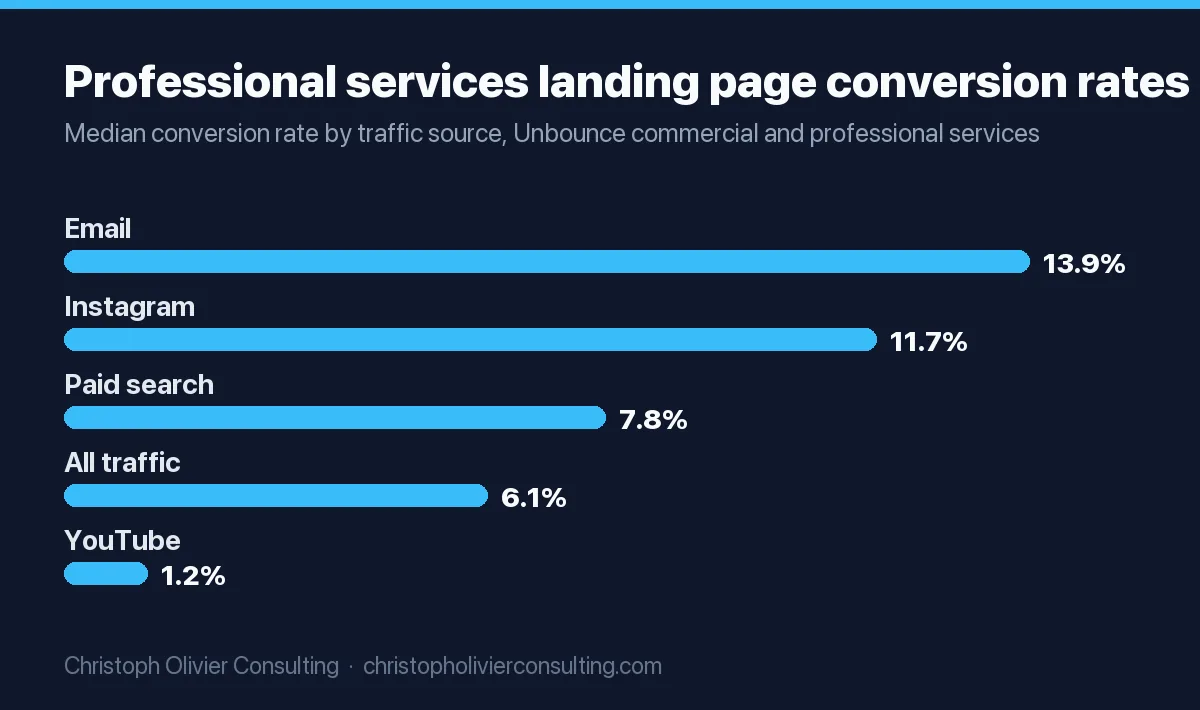
The closest Unbounce category for coaching is commercial and professional services, where the median was 6.1%. In that category, Unbounce reports email traffic converted at a 13.9% median and paid search at 7.8%. Copy written at a 5th to 7th grade reading level had a 12.9% median versus 6.6% for 8th to 9th grade, and pages of 275 to 745 words produced the highest median.
Worked math: 600 visitors a month from your newsletter at a 13.9% rate is about 83 opt-ins. The same 600 visitors from paid search at 7.8% is about 47. If your page converts well below these medians for its traffic source, fix the page before you buy more traffic.
Build the page in this order:
- Headline: the title from the table above, with the time or number promise. “Find out in 4 minutes which part of your business stops when you take a week off.”
- Subhead naming who it is for: “For owners of service firms with 5 to 50 staff.” This filters out readers you cannot help.
- Three bullets on what they get: “Your overall score,” “Your weakest of 5 areas,” “Two changes to make this month.”
- A picture of the asset: a screenshot of the results page or the PDF cover.
- The form: first name and email. Add one routing question only if you will act on the answer.
- Button copy that repeats the outcome: “Show me my score,” not “Submit.”
- One credibility line that is literally true: years coaching, the number of owners you have worked with, a named credential.
- A privacy line: “You will get your results plus 4 emails over 10 days. Unsubscribe anytime.”
Keep the page between 275 and 745 words and write it in short, plain sentences. If you run idea 21, the application questions matter more than the page; the coaching application form questions guide has a full set.
The lead magnet email sequence (5 emails over 10 days)
This sequence follows the scorecard, but the shape works for any idea in the table. Replace the bracketed parts. Every email needs your postal address and a working unsubscribe link: under the FTC’s CAN-SPAM guide, opt-outs must be honored within 10 business days and the link must work for at least 30 days after you send.
| Day | Subject | Job of the email | Key line |
|---|---|---|---|
| 0 (instant) | Your score: [score]% | Deliver the result and the link | “Your weakest area was [pillar]. Here is your full results page.” |
| 2 | Your lowest score was [pillar] | The call ask | “Want 20 minutes to walk through your answers? Pick a time here.” |
| 4 | The [pillar] fix most owners do backwards | Teach one thing about the weakest pillar | “If you hire before you document, the new hire learns from you, not from a system.” |
| 7 | What it looked like for [client type] | Proof, with a typical-results line | “[Client] went from [X] to [Y] in [months]. Across the [N] clients who finished the program in [year], the median change was [Z].” |
| 10 | Closing your file | Last call ask, then move to the newsletter | “I am moving you to my regular weekly email. If you still want the walkthrough, reply ‘call’ and I will send times.” |
Day 7 is where most coaching sequences break the rules: one great client story with no typical-results line. The FTC section below explains why that line has to be there. For longer nurture after day 10, adapt the lead nurture email sequence for coaches.
Lead magnet email sequence for health coaches
Health coaches can run the same five emails with two changes. First, swap the scorecard for a habit or routine assessment (“The 10-Question Sleep Routine Check”) and keep the results descriptive: “you scored lowest on evening routine.” Second, the proof email carries a heavier burden. The FTC’s Health Products Compliance Guidance says health claims need competent and reliable scientific evidence, that the same principles apply to any health-related product, and that consumer testimonials are never enough on their own to substantiate a health effect.
| Business coach version | Health coach version | |
|---|---|---|
| Day 0 | “Your weakest area was Team.” | “Your lowest score was evening routine.” |
| Day 2 | “Want 20 minutes on your answers?” | “Want 20 minutes to build a routine around your schedule?” |
| Day 4 | One fix for the weakest pillar | One habit change, framed as a behavior, not a medical outcome |
| Day 7 | Client result plus median result | A client’s experience of the process (what they changed, how they found it), no weight, lab or symptom outcomes unless you hold scientific substantiation |
| Day 10 | Close the file | Close the file |
FTC rules for income and results claims in lead magnets
Coaching lead magnets get into trouble in the case study, the testimonial on the opt-in page, and the proof email. This is general information, not legal advice. The rules that apply:
- Testimonials imply typical results. Under 16 CFR 255.2(b), a client testimonial about a key result will likely be read as what people generally achieve. If you cannot substantiate that, you must clearly and conspicuously disclose the generally expected result, and you need substantiation for that figure too.
- “Results not typical” does not fix it. In the rule’s heat pump example, a disclaimer like that was not enough; the advertiser had to disclose typical savings instead. The weight-loss example adds that a figure based only on people who finished a program can still mislead if most people do not finish, and that the median can be the more accurate figure when outliers skew the average.
- Endorsements need the same proof as direct claims. 255.2(a) says you must hold the same substantiation for a claim made through a testimonial as you would if you said it yourself.
- Earnings claims are a known FTC target in coaching. In October 2021 the FTC sent a Notice of Penalty Offenses on money-making claims to more than 1,100 businesses, including business coaching firms. It covers false earnings claims, presenting profits as typical, and false claims that buyers must act immediately.
Rewrite the risky lines before you publish:
| Risky lead magnet copy | Why | Compliant rewrite |
|---|---|---|
| “The scorecard my clients use to hit 7 figures” | Implies a typical income outcome | “The scorecard I use in the first session with every client” |
| Case study title: “How Sam doubled revenue in 90 days” | One standout result read as typical | Keep Sam’s story and add: “Of [14] clients who finished in [2025], the median revenue change was [+18%].” (your real numbers) |
| “Results not typical” under a testimonial | Rejected as a fix in 255.2 examples | State the generally expected result in the same view as the testimonial |
| “Only 3 spots left” on a page that resets | False urgency | A real cap you enforce, or no cap |
| Health coach: “Lose 10 lbs with my free 5-day plan” | Health claim needing scientific substantiation | “A 5-day meal planning routine you can fit into a 50-hour work week” |
| Testimonial from a client who got free sessions, no mention | Undisclosed material connection | “[Name] received complimentary sessions in exchange for feedback.” |
The full rules for client stories, including how to collect the median number you need, are in how business coaches can use testimonials and case studies without breaking FTC rules.
Which lead magnet to build first
Pick by the problem in your pipeline, not by the format you like making.
| Your situation | Build first | Measure |
|---|---|---|
| No email list yet | Idea 4 or 7 (free Google Docs template), delivered through a free email plan | Opt-ins per month from your existing posts and talks |
| List exists, few calls booked | Idea 1 scorecard with the day 2 call-ask email | Share of completions answering “yes” to the walkthrough question |
| Calls booked, many poor fits | Idea 21 application-gated diagnostic | Share of calls that meet your fit criteria |
| Good-fit calls, slow decisions | Idea 17 case study with a typical-results line | Days from first call to signed proposal |
| Busy schedule, little build time | Idea 6 Loom teardown on the free plan | Teardowns sent vs calls booked |
In my view, most coaches should build one scorecard and one template, then stop making new magnets until both have at least a quarter of data. A lead magnet is one piece of the plan; the other channels that feed it are in these 27 marketing ideas for business coaches. If you want help choosing the scorecard pillars for your framework, you can book a consultation.
Frequently asked questions
What is the best lead magnet for coaches?
For most coaches it is a short scorecard: 10 scored questions across the five areas of your framework, plus qualifier and intent questions. It gives the reader a personal result and gives you a specific reason to offer a call about their weakest area. Templates and scripts suit readers who already know their problem, and case studies suit readers comparing coaches.
What are good lead magnet ideas for coaches with no budget?
Use free tools. A Google Docs template such as a one-page 90-day plan, a Canva checklist on the free plan, a Tally calculator or scored quiz (calculations and redirects are free), and a 5-minute Loom video teardown on Loom's free Starter plan. The main paid cost is email automation: Kit's free plan does not include automated sequences.
How much does it cost to build a scorecard lead magnet?
It can cost $0 with Tally, which includes calculations, conditional logic and redirects on its free plan. ScoreApp Starter is $39 a month, or $30 a month billed yearly, for 3 scorecards and 100 responses a month. The personalized PDF report needs ScoreApp Business at $99 a month. Typeform Basic is $39 a month for 100 responses.
What should a lead magnet email sequence for health coaches include?
The same five emails as any coach: deliver the result, ask for a call on day 2, teach one habit on day 4, share proof on day 7 and close on day 10. The difference is claims. FTC guidance says health claims need competent and reliable scientific evidence and testimonials alone are not enough, so describe behaviors and client experience, not weight or symptom outcomes.
What is a good conversion rate for a coaching lead magnet opt-in page?
Unbounce's benchmark report puts the median landing page at 6.6% and the top quarter at 11.4% or higher. For commercial and professional services the median was 6.1%, with email traffic at 13.9% and paid search at 7.8%. Compare your page against the median for its traffic source, not one blended number.
Can I put client income results in my coaching lead magnet?
Yes, if you can substantiate them. Under 16 CFR 255.2(b) a client result is read as typical, so if it is not, you must clearly disclose what clients generally achieve, and back that number up too. A 'results not typical' line is not enough. Use your real median result across clients who finished, not only the best case.
Why do business coaches recommend getting leads first?
Because a lead you can email again is worth more than a one-time visitor. A lead magnet turns attention from a post, talk or ad into a contact you can follow up with, and the follow-up email is where the call gets booked. Without a list, every sale depends on someone finding you at the exact moment they are ready.
More marketing guides for business coaches
- How a Business Coach or Consultant Builds a Personal Brand That Attracts Clients
- When Should a Business Coach or Consultant Hire Marketing Help?
- Google Ads for Business Coaches: What Works and What Gets You Flagged
- Lead Generation for Business Coaches: A Practical Playbook
- How Business Coaches and Consultants Get Cited by AI Search
- How Much Should a Business Coach or Consultant Spend on Marketing?