

LP reporting best practice for fund managers in 2026 comes down to three things. Send a quarterly package within 60 days of quarter-end (120 days for the year-end quarter), the timeline ILPA recommends for direct funds. Build the fee and performance pages on the updated ILPA Reporting Template, which applies from Q1 2026. And attach a plain-language manager letter that explains every valuation change. Below are the exact contents, deadlines, template versions, current SEC rule status, re-up data, a copy-ready letter and what reporting software costs. This is general information, not legal or tax advice. Your LPA, side letters and fund counsel decide what you actually owe your investors.
LP reporting best practices: the 12-point pass/fail scorecard
I built this scorecard from the ILPA Principles 3.0 reporting sections and ILPA’s 2025 template guidance. Score your last quarterly package against it. Each line is a yes or no. An institutional LP’s operations team will check most of these whether or not you do.
| # | Practice | Pass if | Where the standard comes from |
|---|---|---|---|
| 1 | On time | Q1 to Q3 reports land within 60 days of quarter-end, Q4 within 120 days (direct funds) | ILPA template FAQs, 2025 |
| 2 | Capital account statement | Each LP sees their own QTD, YTD and ITD capital account, plus total fund and GP allocation | ILPA Reporting Template levels and periodicity |
| 3 | Management fees, gross to net | Fee shown before and after each rebate, waiver and offset, step by step | ILPA Reporting Template, 2025 changes |
| 4 | Expenses split by who got paid | Internal chargebacks (GP and related persons) shown apart from third-party partnership expenses | ILPA Reporting Template, 2025 changes |
| 5 | “Other” kept small | The “Other” expense line holds 5% or less of total fund expenses, or the excess is footnoted | ILPA template FAQs |
| 6 | Carry reconciled | Opening carry balance, plus accrued, minus paid, equals closing balance; escrow shown | ILPA Reporting Template carry section |
| 7 | Net performance, both ways | Net IRR and TVPI (or MOIC) shown with and without the subscription line | ILPA Principles 3.0; Performance Template |
| 8 | Valuation changes explained | Every quarter-to-quarter mark change has a reason, including any change in methodology | ILPA Principles 3.0, quarterly disclosures |
| 9 | Cash flows tie out | Summary of all capital calls and distributions, with uncalled commitment balance per LP | ILPA Principles 3.0, quarterly disclosures |
| 10 | Borrowing disclosed | Subscription line commitment and outstanding balance in every quarterly and annual report | ILPA Principles 3.0, subscription lines |
| 11 | Forward look on cash | Estimated capital calls and distributions for the coming quarters | ILPA Principles 3.0, capital calls and distributions |
| 12 | Sensitive data separated | Commercially sensitive portfolio company detail sent apart from the fund-level report | ILPA Principles 3.0, portfolio company information |
Scoring rule of thumb (mine, not ILPA’s): 11 or 12 passes means an institutional LP can ingest your report without emailing you. 8 to 10 means you will get follow-up questions every quarter. Under 8, fix the package before you start talking about your next fund, because the same people who read your reports will run diligence on Fund II.
How many days after quarter-end LP reports are due
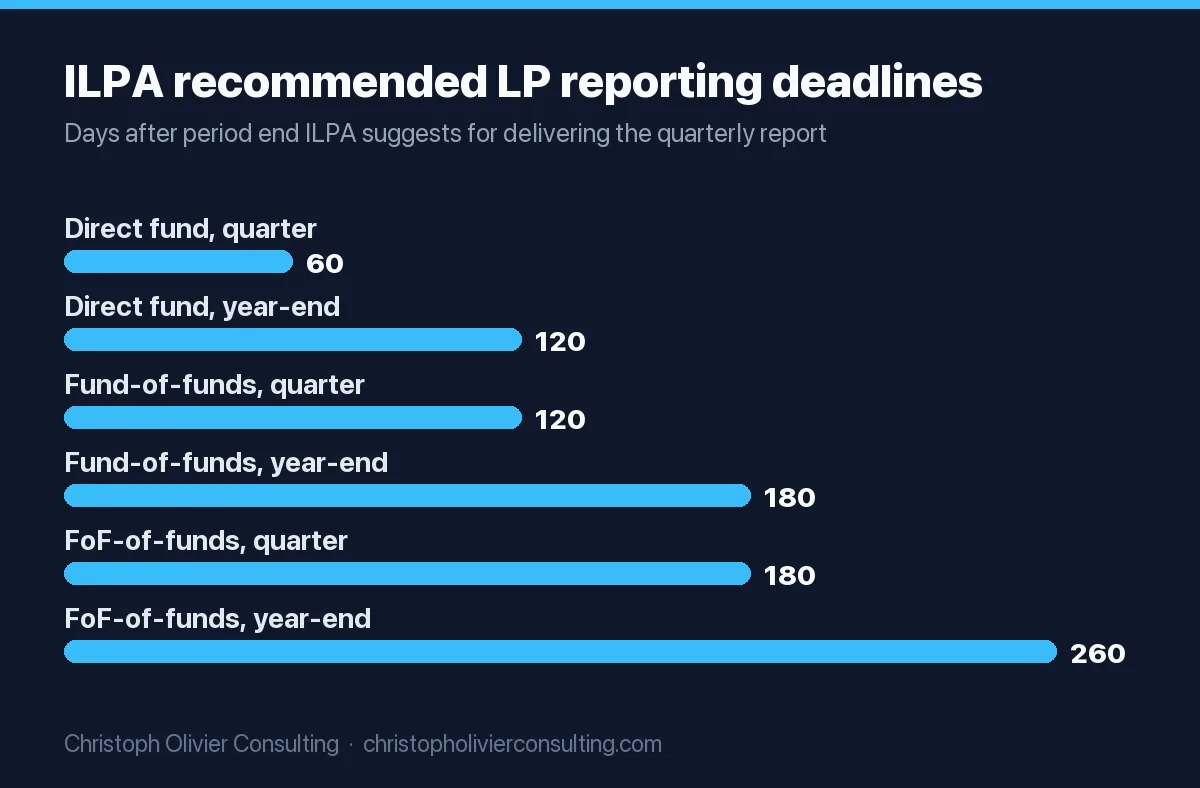
ILPA defers to your LPA and local rules on timing, but it does publish a recommended framework with the 2025 templates. From the ILPA Templates FAQs v1.1 and the ILPA Combined Overview:
| Fund type | Quarterly report (Q1 to Q3) | Year-end quarter |
|---|---|---|
| Direct fund | 60 days | 120 days |
| Fund-of-funds | 120 days | 180 days |
| Fund-of-fund-of-funds | 180 days | 260 days |
Two other clocks sit on top of that. Annual audited financial statements: an SEC-registered adviser relying on the audit approach under the custody rule must distribute audited GAAP financials to all limited partners “within 120 days of the end of its fiscal year,” audited by a PCAOB-registered and inspected accountant (17 CFR 275.206(4)-2(b)(4)). ILPA Principles 3.0 asks for more, faster: an annual package within 90 days of year-end with the audited financials, a management letter, IRR methodology and a carried interest schedule. If you cannot hit 90, say so in the LPA and hit 120 every year without exception.
K-1 timing: a partnership must furnish each partner’s information “on or before the day on which the partnership return for that taxable year is required to be filed (determined with regard to extensions)” (26 CFR 1.6031(b)-1T). Form 1065 is due by the 15th day of the 3rd month after year-end (IRS Form 1065 instructions), and Form 7004 gives an automatic extension that is “generally 6 months” (IRS Form 7004 instructions). So a calendar-year fund owes K-1s by March 15, or by September 15 if it extends. If your fund holds interests in other partnerships, you cannot finish your K-1s until theirs arrive, which is the usual reason to extend. Your LPs file their own returns on that schedule, so tell them in January which date you will hit, then hit it.
Your 2026 to 2027 reporting calendar (calendar-year direct fund)
| Deliverable | Period end | ILPA or legal deadline | Date |
|---|---|---|---|
| Q3 2026 quarterly report | Sep 30, 2026 | 60 days (ILPA) | Sun Nov 29, 2026 |
| Annual package per ILPA Principles 3.0 | Dec 31, 2026 | 90 days | Wed Mar 31, 2027 |
| K-1s, no extension | Dec 31, 2026 | Form 1065 due date | Mon Mar 15, 2027 |
| Q4 report and audited financials | Dec 31, 2026 | 120 days (ILPA year-end; custody rule audit) | Fri Apr 30, 2027 |
| Q1 2027 report, first Performance Template delivery for funds that commenced in Q1 2026 | Mar 31, 2027 | 60 days (ILPA) | Sun May 30, 2027 |
| K-1s, extended | Dec 31, 2026 | Form 7004 extension | Wed Sep 15, 2027 |
When a deadline falls on a weekend, send on the Friday before. A report on day 61 misses the ILPA guideline, whatever your LPA allows.
What goes in a quarterly LP report: the checklist
This is the package order I recommend, with each item mapped to the ILPA source that asks for it. Items 2 to 5 are the ILPA Reporting Template; item 6 is the Performance Template once it applies to you; the rest come from ILPA Principles 3.0.
- Manager letter, one to two pages. Principles 3.0 asks for “management comments about changes during the quarter.” What happened, what you did, what you are watching. Template below.
- Capital account statement. Beginning NAV, contributions, distributions, fees, expenses, gains and losses, carry, ending NAV, for the LP, the total fund and the GP, on a QTD, YTD and ITD basis. Use the “Partner Transfer” line for secondary transfers rather than burying them in contributions.
- Management fee, gross to net. Gross fee, then each offset, rebate and waiver, then net fee paid.
- Partnership expenses. Third-party lines (fund administration, third-party valuations, due diligence, broken deals, examination fees, subscription facility fees and interest) separated from internal chargebacks paid to the GP or related persons.
- Portfolio company fees and offsets. Fees the GP or affiliates receive from portfolio companies (the 2025 template adds arrangement, origination and consulting fees), and how much was offset. Principles 3.0’s position is that portfolio company fees should be 100% offset against the management fee.
- Performance. Net IRR and TVPI with and without the subscription line, plus DPI and RVPI; gross figures labeled with the method used.
- Schedule of investments and valuation bridge. Cost, fair value and multiple per company, plus a one-line reason for every mark that moved and any change in valuation methodology.
- Cash activity. Every capital call and distribution in the quarter, uncalled commitment balance, and estimated calls and distributions for the next quarters.
- Fund borrowing. Subscription line size and amount outstanding, and any other credit facility.
- Portfolio company updates. Revenue or EBITDA trend, key hires, follow-on plans. Principles 3.0 says commercially sensitive company data should go “separately and distinctly from fund-level reporting,” so put it in a separate, access-controlled file.
The notices themselves should match: ILPA Principles 3.0 asks that capital calls give LPs “a reasonable window of at least 10 business days” to fund. Our capital call notice templates are built around that window.
The ILPA Reporting Template and Performance Template: 2025 versions and effective dates
ILPA released the updated Reporting Template and the new Performance Template in January 2025, replacing the 2016 Reporting Template for funds still investing. ILPA recommends the templates; no regulator mandates them. The key dates and rules, from the ILPA Combined Overview (September 2025):
| Reporting Template (updated) | Performance Template (new) | Capital Call and Distribution Template | |
|---|---|---|---|
| What it covers | Fees, expenses, offsets, carry, capital account | Fund-to-investor cash flows and performance metrics | Each call and distribution, impact on unfunded commitment |
| Frequency | Quarterly | Quarterly, ITD data | With each notice |
| First use | Q1 2026 report (QTD data as of March 31, 2026) | Data capture from Q1 2026; first delivery Q1 2027 (ITD through March 31, 2027) | Q1 2027 |
| Which funds | Funds still in their investment period during Q1 2026, or that commenced operations on or after January 1, 2026 | Funds commencing operations on or after January 1, 2026 | Funds commencing operations on or after Q1 2026 (if using the Performance Template), otherwise on or after Q1 2027 |
| Legacy funds | Funds out of their investment period on January 1, 2026 may keep the 2016 template | Not applicable; go-forward only | Not applicable |
| Can you modify it? | No | Only footnoted changes to metric mapping | No |
Three rules catch new managers out:
- Same rules for small GPs. ILPA tested a longer runway for emerging and mid-market managers and dropped it: the Overview says the “same requirements across GPs regardless of size.” ILPA does encourage you to talk to LPs early if you need time.
- First report timing. For a new fund, Reporting Template delivery starts “after the first full quarter after the commencement of operations or within 18 months after the initial close (whichever is shorter).” Commencement can be your first sub line drawdown, first capital call, or when management fees start.
- Switching mid-life is easier than it looks. Active funds moving off the 2016 template can paste the old “Total Partnership Expense” figure into the “Other: 2016 ILPA Reporting Template Value” row and use the new categories only going forward, so you do not have to reclassify history (ILPA FAQs).
Granular or gross up: which Performance Template to use
The Performance Template comes in two versions. If you know at the time of each capital call what it funds (an investment, fees, expenses), ILPA says use the Granular Methodology: fund-level gross numbers exclude fee and expense calls, so they sit close to portfolio-level gross returns. If you call capital in round numbers without itemizing, use the Gross Up Methodology: it counts all capital called and adds back fees, expenses and carry. ILPA notes it produces a “slightly lower gross IRR and TVPI” but a smaller gross-to-net spread. Net fund-level metrics are required in both versions; gross fund-level metrics are optional. Pick one and keep it for the life of the fund.
ILPA Principles 3.0: the reporting expectations LPs will hold you to
ILPA Principles 3.0 (June 2019) sets out what ILPA expects from GPs on transparency, governance and alignment. Its reporting asks, beyond the templates:
- Quarterly: unaudited P&L with year-to-date results, material changes in investments and expenses, a summary of all calls and distributions with uncalled balances, management comments, and an explanation of every quarter-to-quarter valuation change.
- Annually, within 90 days: a management letter to the LPAC distributed to all LPs, audited financial statements with a clean opinion and a statement of other work the auditor did for the fund, IRR calculations with methodology, net IRR “on both a levered and unlevered basis,” a schedule of aggregate carry received, and political contributions to officials on investor boards.
- Annual risk reporting: concentration, FX, borrowing, realization, strategy, reputation and ESG risk, at fund and portfolio company level.
- Models on request: “GPs should provide the models used for calculations of fees, expenses, carried interest and net IRR calculations.” Keep a clean version of your waterfall model ready to share.
- Audit scope: fee and expense reporting inside the annual audit, including testing of a sample of LP-level expense allocations and waterfall calculations.
“More immediate reporting may be required for material events.” That line is your cue for event-driven notes: write-downs, key person changes, a covenant breach at a portfolio company. Send them before the next scheduled report. Our investor update email templates include a bad-news version.
SEC private fund rules: what is required now
The SEC’s Private Fund Adviser Rules, including the Quarterly Statement Rule (Rule 211(h)(1)-2) that would have mandated standardized quarterly fee, expense and performance statements from registered private fund advisers, never took effect. On June 5, 2024, the Fifth Circuit vacated the full package in National Association of Private Fund Managers v. SEC, No. 23-60471, including the audit, restricted activities, preferential treatment and adviser-led secondaries rules (Morrison Foerster). The compliance dates would have started September 14, 2024. The SEC let the July 22, 2024 deadline for en banc rehearing pass (Alston & Bird).
What that means for your reporting today:
- No federal quarterly statement mandate. Your quarterly obligations come from your LPA, side letters and investor expectations. ILPA’s FAQ says the template project began as a response to the SEC rule and continued as an “industry-driven solution” after the vacatur.
- The custody rule audit still applies to registered advisers using the audit approach: audited GAAP financials to LPs within 120 days of fiscal year-end.
- K-1 deadlines are statutory (IRC section 6031(b)), not optional.
- Marketing rules still bite when report content leaves the LP base. If you are raising under Rule 506(b), the SEC lists “no general solicitation or advertising to market the securities” as a condition. A strong quarter posted publicly while Fund II is in market is the classic mistake. ILPA’s FAQ adds that the Performance Template’s net portfolio table exists so that gross numbers used in marketing are paired with net numbers on the same basis, as the SEC Marketing Rule requires for registered advisers.
Alston & Bird noted after the ruling that the investor protection issues behind the rules “will continue to be a priority for the SEC during examinations and enforcement actions,” so a clean ILPA-format fee disclosure is also cheap insurance. Confirm your specific obligations with fund counsel.
LP retention: what actually drives re-ups
Be honest about the data first. In Coller Capital’s 41st Global Private Capital Barometer (December 2024, 107 private capital investors), 79% of LPs said they had declined to re-invest with at least one current GP in the prior 12 months, and 88% expected to do so again in the next 12 (press release coverage, Hedge Fund Alpha). The reasons: 42% performance, 29% the LP’s own capital availability, 16% a change in the LP’s strategy. Coller’s own re-investment findings describe a “relatively balanced distribution” between GP-related and LP-related reasons. Reporting quality was not a headline reason. In the 44th edition (June 2026), 23% of LPs expected to reduce the number of GP relationships over the next three years, up from 16% when Coller last asked in 2020 (Coller, Summer 2026).
My read: reporting will not save a fund with bad numbers, and it will not create capital an LP does not have. What it controls is how your performance is judged when LPs are cutting relationships. A manager whose reports explain every mark, reconcile every fee and arrive on day 55 makes a flat year look like a process that is working. A manager whose reports arrive late with unexplained write-downs makes the same year look like a risk. When an LP has to cut a quarter of its GP list, it starts with the ones that are hardest to monitor.
Make Fund I reports carry your Fund II pitch
Principles 3.0 lists what LPs expect in fund marketing materials. Every item depends on reporting you should already be producing:
| Fund II deck must show (Principles 3.0) | Fund I reporting that makes it easy |
|---|---|
| Values for each unrealized company in prior funds, based on the most recent audited financials | Schedule of investments that ties to the audit every year |
| Explanation of any values that deviate from the audited statements | Quarterly valuation bridge with reasons |
| Gross and net performance: IRR, multiple, DPI, and how IRR was derived | Consistent metric definitions and stated methodology since the first report |
| Valuation policy | The same policy quoted in every quarterly report |
| Subscription line policy | Quarterly sub line schedule, IRR with and without the line |
Face time matters too. Build your annual meeting around the questions your reports raised, using our LP annual meeting agenda template, and if you add a quarterly LP call, the logistics in our guide to investor webinars and events apply to closed, LP-only sessions as well.
Copy-ready quarterly LP letter template
This is the manager letter that sits on top of the ILPA pages. Keep it to two pages. Write the same sections in a bad quarter as in a good one.
Subject: [Fund name] Q[#] [Year] report: NAV [$X], net IRR [X%], [one-phrase headline]
Dear [First name],
1. The quarter in three lines. Fund NAV moved from [$X] to [$Y] ([+/-X%]). Net IRR since inception is [X%] ([X%] without the subscription line); TVPI [X.Xx], DPI [X.Xx]. The main driver was [company or event].
2. What moved and why. [Company A]: marked [up/down] [X%] because [metric or event, e.g. “trailing revenue grew from $4.1m to $5.0m; we held the multiple at 6x”]. [Company B]: [reason]. No change to our valuation methodology this quarter. [Or: we changed X because Y; impact $Z.]
3. Cash in and out. We called [$X] ([X%] of commitments) on [date] for [purpose] and distributed [$X] on [date] from [source]. Your uncalled commitment is [$X]. We expect to call about [$X] and distribute about [$X] over the next two quarters.
4. Fees and expenses. Gross management fee [$X], offsets [$X], net [$X]. Partnership expenses [$X], of which [$X] paid to the GP or related persons. Details are in the attached ILPA Reporting Template.
5. What did not go to plan. [One honest paragraph. If nothing: “Nothing material. The item we are watching most closely is X.”]
6. Next quarter. [Two or three specific things: an expected exit process, a follow-on, a hire.]
7. Dates. Next report by [date]. K-1s expected by [date]. Annual meeting [date and place].
Questions go to [name, direct line]. We reply within two business days.
[Signature]
Attachments: capital account statement, ILPA Reporting Template, schedule of investments, portfolio company updates (separate secure file).
More variants, including a first-quarter letter and a down-quarter letter, are in our quarterly investor letter template.
LP reporting solutions and services: software and what it costs
LP reporting solutions fall into two groups: software that hosts reports and the investor portal, and fund administrators who produce the numbers. Many vendors do both. Here is what each vendor publishes on its own site, checked November 1, 2026. The same vendors’ onboarding costs are in our LP onboarding checklist.
| Vendor | Fit | Reporting coverage (vendor stated) | Published pricing |
|---|---|---|---|
| Juniper Square | GPs wanting software plus fund administration | Professional, Enterprise and Fund Administration editions; capital events, closings and wires priced on its rate card | Platform fee by quote. Rate card v20250501: $2,500 per additional capital event and $2,000 per additional closing (Fund Administration); $250 per hour data processing, in 4-hour blocks; $25 per wire |
| AngelList (venture funds) | Emerging VC managers | Fund admin, LP portal and data room, K-1 distribution included; quarterly financial statements an add-on | Institutional: 0.1% of fund size plus $10k per year. Full Service: 0.15% plus $20k per year, adds fund taxes and K-1 prep. Implementation fee by quote |
| Sydecar (SPVs) | Deal-by-deal syndicates | K-1s and tax filings, investor communication tools, data rooms | 2% of capital raised, bounded $2,500 to $12,500, plus $2,000 regulatory fee; first distribution fee $1,000 |
| Visible | VC firms reporting portfolio metrics to LPs | LP reports, portfolio reports, tear sheets, fund-level dashboards, data room | Essential and Premium: custom pricing by portfolio size and team |
Worked math. A $50,000,000 venture fund on AngelList Full Service pays 0.15% x $50,000,000 = $75,000 plus $20,000, so $95,000 a year, with quarterly financial statements still an add-on. A Juniper Square Fund Administration client that runs four capital calls and two distributions more than its plan covers pays 6 x $2,500 = $15,000 on top of the platform fee. Carta also sells fund administration and LP reporting, but its pages blocked our check, so ask for a quote.
If you are hiring an LP reporting service (a fund administrator), ask these five questions in writing:
- Will you deliver the 2025 ILPA Reporting Template from Q1 2026, and which Performance Template methodology will you use for us?
- What is your contractual turnaround after quarter-end, in days, and is it 60 or better?
- When will K-1s go out, and do you assume an extension?
- What does each capital event, closing and LP transfer beyond the base fee cost?
- Can LPs pull data from the portal in a format their own systems can ingest?
If you want a second set of eyes on your reporting package and LP communication cadence before your next raise, you can book a consultation.
Frequently asked questions
What are LP reporting best practices for fund managers?
Send a quarterly package within 60 days of quarter-end (120 days at year-end), as ILPA recommends for direct funds. Use the updated ILPA Reporting Template for fees, expenses and carry, show net IRR and TVPI with and without the subscription line, explain every valuation change, and put a short plain-language manager letter on top. Deliver audited financials and K-1s on fixed dates every year.
How many days after quarter end should LP reports be sent?
ILPA's 2025 framework suggests 60 days after quarter-end for direct funds, 120 days for the fiscal year-end quarter. Fund-of-funds get 120 and 180 days, fund-of-fund-of-funds 180 and 260 days. ILPA defers to your LPA and local rules, so check what your fund documents promise and treat the stricter date as the deadline.
Is the ILPA Reporting Template mandatory?
No regulator requires it. ILPA recommends the updated Reporting Template for funds still in their investment period during Q1 2026 or that commenced operations on or after January 1, 2026, with first use for the Q1 2026 report. Many institutional LPs ask for it, and funds out of their investment period on January 1, 2026 may keep the 2016 version.
Do SEC rules require quarterly statements for private fund investors?
Not at present. The SEC's Quarterly Statement Rule was vacated with the rest of the Private Fund Adviser Rules by the Fifth Circuit on June 5, 2024, before its compliance date. Quarterly reporting duties now come from your LPA and side letters. Registered advisers using the custody rule audit approach must still deliver audited financials within 120 days of fiscal year-end. This is not legal advice.
When are K-1s due to limited partners?
A partnership must furnish K-1 information by the due date of its Form 1065, including extensions. For a calendar-year fund that is March 15, or September 15 if the fund files Form 7004 for the automatic six-month extension. Tell LPs early which date you expect to hit, because they file their own returns based on it.
What drives LP retention and re-ups?
Performance first. In Coller Capital's December 2024 Barometer, 79% of LPs had declined to re-invest with at least one current GP in the prior year; 42% cited performance, 29% their own capital availability and 16% a strategy change. Consistent, explained reporting does not replace returns, but it makes your results easier to judge when LPs trim manager lists.
What should an LP quarterly report include?
A manager letter, the LP's capital account statement (QTD, YTD, ITD), management fees gross to net with offsets, partnership expenses split between third parties and the GP, carried interest reconciliation, net performance with and without the subscription line, a schedule of investments with reasons for each valuation change, capital calls and distributions with uncalled balances, sub line usage, and portfolio company updates in a separate secure file.
More marketing guides for capital raisers
- Investor Onboarding for Fund Managers That Builds Trust and Re-Ups
- Marketing Calendar for Fund Managers: An Investor-Communication Cadence
- The Marketing and CRM Tech Stack for Fund Managers and Capital Raisers
- Strategic Partnerships for Fund Managers: Deal Flow and Capital
- Investor Meetings That Convert for Fund Managers
- AI Tools for Fund Manager Marketing: What Works Without Breaking Reg D
- Marketing for Capital Raisers & Fund Managers