

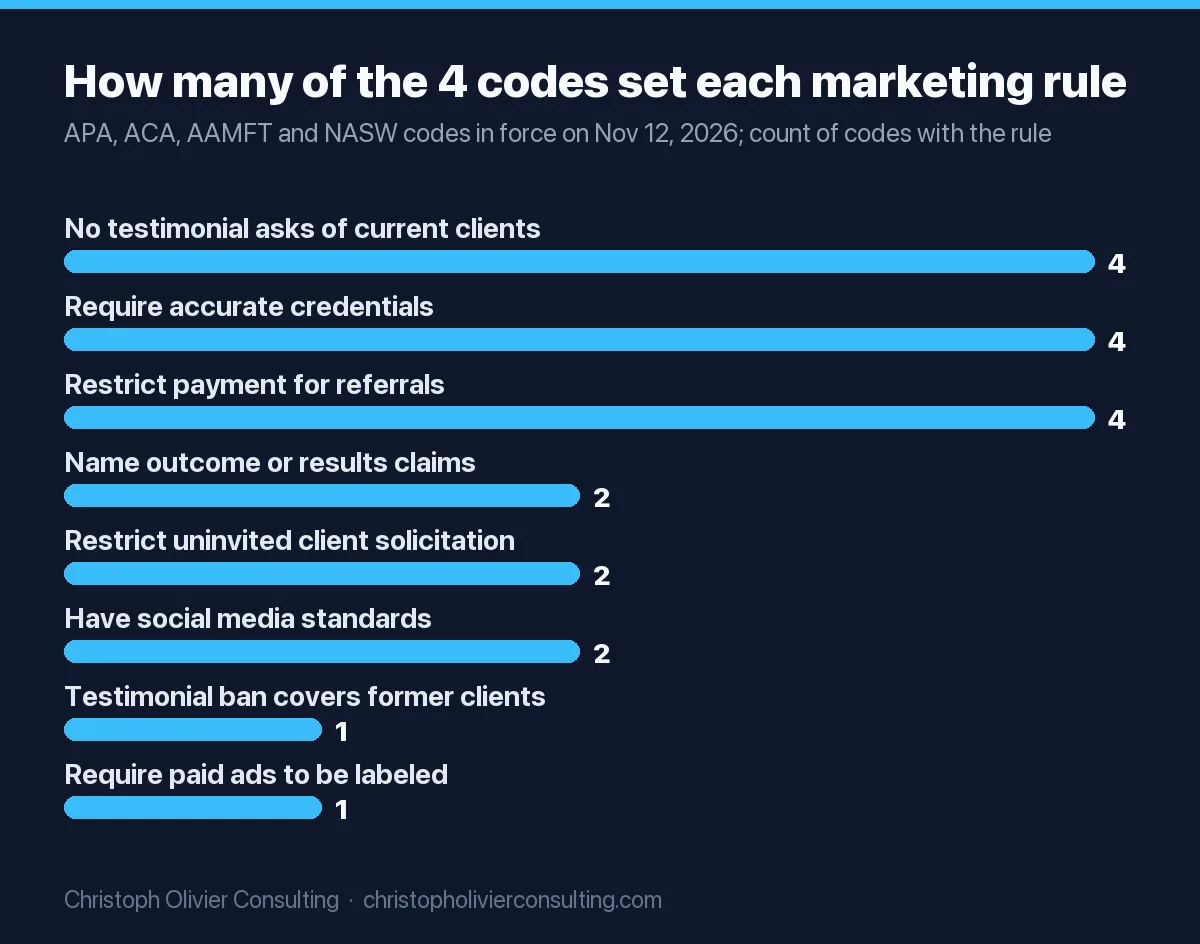
Ethical marketing for therapists comes down to four things every major code agrees on: say only what is true about your license, training and results; never ask current clients for testimonials or reviews; never approach vulnerable people uninvited; and never reveal that someone is your client. The details differ by profession. The ACA code also bars soliciting testimonials from former clients, the APA code requires paid ads to be recognizable as ads, and your state board adds its own rules, such as California’s requirement to print your license number on every ad.
Below is the side-by-side comparison most guides skip: what the APA, ACA, AAMFT and NASW codes actually say about advertising, quoted from the official text with standard numbers, plus three state board rules, the HIPAA limits that apply to marketing, and a pass/fail checklist to run on any ad, profile, post or page before it goes live. If you want the channel side (directories, Google, referral outreach and what each costs), read our guide on how to advertise as a therapist.
Short answer: You may advertise, use directories, run ads and publish content. You may not solicit testimonials from current clients (all four codes), or from former clients if you are a counselor bound by the ACA code (C.3.b). Claims about credentials and results must be accurate and provable, client details stay out of marketing unless the client authorized it in writing, and HIPAA covered practices need a signed authorization before using anyone’s information for marketing.
What APA, ACA, AAMFT and NASW say about advertising, side by side
Each code below was read in its official published form on November 12, 2026. Versions matter here. The APA Ethics Code in force is the 2002 code, amended effective June 1, 2010 and January 1, 2017; its Ethics Code Task Force is still reviewing comments on a revised draft and expects that review to finish in late 2026 or early 2027. The ACA says its 2014 code “remains the current version” until the Board of Directors adopts the revision, which ACA’s revision project page says will be published in fall 2026. The revised AAMFT Code of Ethics took effect January 1, 2026 and keeps advertising in Standard IX. The NASW Code of Ethics covers it in 4.06 and 4.07.
| Issue | APA (psychologists) | ACA (counselors) | AAMFT (MFTs) | NASW (social workers) |
|---|---|---|---|---|
| What counts as advertising | 5.01(a): public statements include “paid or unpaid advertising,” “directory listings,” brochures and “comments for use in media such as print or electronic transmission” | C.3.a: applies “when advertising or otherwise representing their services to the public” | 9.2: “advertisements and publications in any and all media” | 4.06(c): “representations to clients, agencies, and the public” |
| Soliciting testimonials | 5.05: no soliciting from “current therapy clients/patients or other persons who because of their particular circumstances are vulnerable to undue influence” | C.3.b: no soliciting from “current clients, former clients, or any other persons who may be vulnerable to undue influence”; counselors “obtain permission for the use of any testimonial” | 9.2: no soliciting “testimonials or endorsements from current clients” or other persons “vulnerable to undue influence” | 4.07(b): no soliciting testimonial endorsements, “including solicitation of consent to use a client’s prior statement,” from current clients or vulnerable people |
| Soliciting clients | 5.06: no “uninvited in-person solicitation of business,” “directly or through agents,” from actual or potential clients vulnerable to undue influence; disaster and community outreach are allowed | C.3.d: no using “places of employment or institutional affiliation to recruit clients” for a private practice | No separate solicitation standard; 9.2 requires ads to be “true, accurate” | 4.07(a): no “uninvited solicitation of potential clients” vulnerable to “undue influence, manipulation, or coercion” |
| Credentials | 5.01(b): no false statements about training, degrees, credentials or affiliations; 5.01(c): degrees only from a regionally accredited school or the degree the license was based on | C.3.a and C.4.a to C.4.d: claim only licenses “current and in good standing”; do not use “Dr.” in a counseling context unless the doctorate is in counseling or a related field; no “ABD” | 9.1: accurately represent “licensure, supervision status, educational degrees, competencies, training, and experience”; 9.3 limits which degrees you advertise | 4.06(c): “claim only those relevant professional credentials they actually possess” |
| Results and outcomes | 5.01(b)(6): nothing false about “the scientific or clinical basis for, or results or degree of success of, their services” | No outcome clause in C.3; C.6.c requires public statements to be “based on appropriate professional counseling literature and practice” | 9.2 (true, accurate) and 9.5: claim specialized services “only after taking reasonable steps to ensure the competence” | 4.06(c): representations of “services provided, or results to be achieved are accurate” |
| Ads placed by others (agencies, staff) | 5.02(a): psychologists who engage others to place statements “retain professional responsibility” | C.3.c: reasonable efforts to ensure statements by others “are accurate” | 9.4 (staff qualifications) and 9.6: correct false information “made on their behalf by others” | 4.06(c): correct “misrepresentations of their credentials by others” |
| Paid ads and publicity | 5.02(c): a paid ad “must be identified or clearly recognizable as such”; 5.02(b): no paying media staff for news coverage | No equivalent | No equivalent | No equivalent |
| Referral payments | 6.07: fee splits must be based on services, “not based on the referral itself” | A.10.b: no “commissions, rebates, or any other form of remuneration when referring clients” | 8.1: no “kickbacks, rebates, bonuses, or other remuneration for referrals” | 1.16(c): no payment for a referral “when no professional service is provided by the referring social worker” |
| Client stories and case examples | 4.07: no identifiable client information in “writings, lectures, or other public media” unless disguised, consented to in writing, or legally authorized | F.7.f (lectures and classrooms): client reviewed and agreed, or details modified; H.6.d: avoid disclosing confidential information through public social media | 2.4: client material in “writing” and “public presentations” only with written authorization or steps to protect identity | 1.07(r): no “identifying or confidential information about clients on professional Web sites or other forms of social media”; 1.07(u): no identifying details in teaching without consent |
| Social media | 5.04: public advice online must not “indicate that a professional relationship has been established” | H.6.a: separate professional and personal profiles; A.5.e: no personal virtual relationships with current clients | No social media standard in the 2026 code | 1.06(e) to (h): no personal technology contact with clients; avoid accepting clients’ social network requests |
Two patterns stand out. First, the testimonial rule is about asking. None of the four codes bans a testimonial that arrives unasked, but ACA C.3.b still requires you to discuss it with the client and get permission before you use it. Second, the APA and NASW codes are the only ones that name outcome claims directly, but every code requires ads to be accurate, so “results” language fails everywhere once it cannot be backed up.
Can therapists use testimonials?
Yes, with limits that depend on your license. You can use a testimonial you did not solicit, from someone who is not vulnerable to undue influence, with the client’s permission and, if you are a HIPAA covered entity, a valid written authorization. You cannot ask a current client for one under any of the four codes. Counselors under the ACA code cannot ask former clients either.
That last point matters because a common piece of advice is to wait until therapy ends and then ask. Under ACA C.3.b, that is still soliciting a testimonial from a former client. Under APA 5.05, AAMFT 9.2 and NASW 4.07(b), a former client is covered when “because of their particular circumstances” they are vulnerable to undue influence, which is a judgment you would have to defend if a board asked. NASW 4.07(b) also closes the workaround of asking a current client whether you may quote a thank-you note they already sent: it bans “solicitation of consent to use a client’s prior statement as a testimonial endorsement.”
State law can narrow this further, or set conditions. In New York, testimonials are allowed for licensees under Regents Rule 29.1(b)(12) only when “the patient or client expressly authorizes the portrayal in writing,” identity disclosures prevent misleading imagery, “reasonable disclaimers are included as to any statements made or results achieved,” and “fictional client testimonials are not permitted,” per the Rules of the Board of Regents, Part 29. Texas counselors may not use a testimonial that “fails to include disclaimers or warnings as to the credentials of the person making the testimonial” (22 TAC 681.49(b)(4)). California treats any testimonial “likely to mislead or deceive because of a failure to disclose material facts” as false advertising (Business and Professions Code 651(b)(8)).
What a testimonial permission form must contain under HIPAA
If you bill insurance electronically, you are probably a HIPAA covered entity: CMS lists psychologists among providers who are covered when they submit transactions like claims electronically. HHS says the Privacy Rule requires written authorization before protected health information is used for marketing, with narrow exceptions. A testimonial that identifies someone as your client should go through a signed authorization that meets 45 CFR 164.508(c). Copy this field list into your form:
- A specific description of what will be used (for example: “the quoted statement below, my first name and last initial”).
- Who is authorized to use it (your practice name).
- Where it will be published or who receives it (your website, your directory profile).
- The purpose (“marketing of [practice] services”).
- An expiration date or event.
- The client’s signature and date (and a personal representative’s authority, if one signs).
- A statement of the right to revoke in writing and how to do it.
- A statement that treatment does not depend on signing.
Under ACA C.3.b, add a line confirming you discussed “the implications” of the testimonial with the client. In New York, add the results disclaimer the Regents rule requires.
Google reviews and Psychology Today: what you can and cannot do
Review platforms add a second rulebook on top of your code. Google’s Maps user contributed content policy bars businesses from offering incentives such as payment, discounts or free services in exchange for reviews, and from trying to “selectively solicit positive reviews from customers.” The FTC’s Consumer Review rule (16 CFR Part 465) separately makes it unlawful to give incentives “conditioned expressly or by implication” on a positive or negative review (465.4) and to use groundless legal threats or intimidation to get a review removed (465.7).
Google does let businesses ask for reviews that “represent a genuine experience” as long as there is no incentive and no attempt “to influence the rating or the contents of the review.” Your ethics code is narrower. A review request card handed to a current client is solicitation under all four codes, and under ACA C.3.b a post-discharge email asking for a Google review is soliciting from a former client. The safe default for a therapy practice is not to ask at all, and to let reviews arrive on their own.
Psychology Today works differently. Its therapist listings show an “Endorsed” count next to a clinician’s name, as seen on its Philadelphia listings in November 2026, rather than client star ratings, so the review solicitation problem mostly does not arise there. The profile text itself is a “directory listing” under APA 5.01(a), so every credential and specialty claim on it has to meet the accuracy rules above.
Responding to a negative review without a HIPAA violation
The risk is in the reply, not the review. In 2023 HHS’s Office for Civil Rights settled with Manasa Health Center, a New Jersey psychiatric practice, for $30,000 after it answered a patient’s negative Google review with details of the patient’s diagnosis and treatment; the practice had done the same to three other patients, according to HIPAA Journal’s report of the OCR announcement. A reply that does not confirm a treatment relationship avoids that:
“Thank you for taking the time to write. Our privacy obligations mean we can’t confirm whether anyone is or was seen at our practice or discuss any care publicly. If you’d like to talk about a concern, please call our office at [number] and ask for [name].”
Use the same reply for positive reviews. Thanking someone by name for “our sessions” confirms they were a client. For the mechanics of building reviews in other industries without breaking platform rules, see our guide on how to get more Google reviews, and read it with your code’s testimonial standard in mind.
Solicitation: the line between outreach and pressure
The codes do not ban outreach. APA 5.06 explicitly preserves “disaster or community outreach services,” and ACA C.6.e encourages counselors to give time to “speaking to groups, sharing professional information.” What they ban is uninvited contact aimed at a vulnerable person. In practice:
| Activity | Allowed? | Why |
|---|---|---|
| Giving a talk at a library or school on anxiety in teens | Yes | Community outreach is carved out of APA 5.06 |
| Approaching an attendee after that talk who disclosed a crisis, to book a session | No | Uninvited in-person solicitation of a person vulnerable to undue influence (APA 5.06, NASW 4.07(a)) |
| Hiring a marketer to cold-message people in a grief support group | No | APA 5.06 covers solicitation “directly or through agents” |
| Telling clients at your agency job about your private practice | No for counselors | ACA C.3.d bars recruiting clients through your place of employment |
| Sending an introduction email to a primary care practice manager | Yes | A professional referral source is not a vulnerable potential client |
| Paying a lead service a fee for each client it sends you | Check carefully | APA 6.07, ACA A.10.b, AAMFT 8.1 and NASW 1.16(c) bar payment for referrals; a flat advertising fee for a directory listing is a different arrangement |
Credentials, titles and specialty claims
State rules get very specific here. The California Board of Behavioral Sciences advertising examples (revised March 2026, effective April 1, 2026) show what fails: an ad that “omits the license number,” the line “Curing Depression Through Psychology” (cure cannot be guaranteed, and “psychology” is a protected term for licensed psychologists), and a social worker’s ad that omits the last name. California associates must add a line such as “Supervised by a Licensed Therapist,” per the associate examples.
Texas requires every counseling ad to state licensure status with a title such as “LPC,” and an LPC Associate’s name “must be followed by the name of the supervisor” (22 TAC 681.49(g) and (h)). New York’s guideline for mental health practitioners says licensees who use “Doctor” must name the profession in which they hold the doctorate, and that using your license to suggest you are more qualified than an unlicensed coach can be charged as advertising “not in the public interest.”
The national codes line up with this. ACA C.4.d bars a master’s level counselor from implying “doctoral-level competence,” AAMFT 9.1 requires you to state “supervision status,” and AAMFT 9.5 lets you advertise a specialty only after “taking reasonable steps to ensure the competence of their work.” A practical test: for every specialty word on your profile, could you show the training certificate or supervised hours behind it?
Client stories, case examples and content
Composite stories are the most common way therapists write relatable content, and the codes allow it if no real client can be identified. APA 4.07 permits client material in public media only when you “take reasonable steps to disguise the person,” have written consent, or have legal authorization. AAMFT 2.4 requires written authorization or “appropriate steps” to protect identity. NASW 1.07(r) is blunter: no “identifying or confidential information about clients on professional Web sites or other forms of social media.” New York’s Regents rule permits “fictional situations or characters” in ads, but only “if no testimonials are included.”
Educational content has its own rule. APA 5.04 and ACA C.6.c require public advice to be grounded in the professional literature and to avoid suggesting that “a professional relationship has been established.” On a blog post or video, that means general information, no individual advice in the comments, and a clear route to book a consultation for anyone who wants personal help. Our mental health marketing guide covers which content formats bring in clients.
Social media: separate accounts and no client contact
ACA H.6.a asks counselors who keep both a personal and a professional presence to keep “separate professional and personal web pages and profiles.” ACA A.5.e prohibits a “personal virtual relationship” with a current client. NASW 1.06(h) tells social workers to “avoid accepting requests from or engaging in personal relationships with clients on social networking sites,” and 1.06(f) warns that posting personal information on professional sites “might cause boundary confusion.” Before you post, ask two questions: could this reveal that someone is my client, and would I be comfortable if a client read it? If either answer is a problem, it does not go up.
Paid ads: labels, prices and targeting
Paid ads raise three specific rules beyond accuracy.
- Labeling. APA 5.02(c): a paid ad “must be identified or clearly recognizable as such.” A sponsored article in a local magazine needs a “Sponsored” or “Advertisement” label. APA 5.02(b) and California BPC 651(d) bar paying media staff for news coverage, and New York’s Regents rule says a licensee “shall not compensate or give anything of value” to the press for publicity.
- Prices. California requires price ads to be “exact, without the use of phrases” like “as low as” or “and up” (651(c)). New York allows fixed prices or ranges for “specified routine professional services” if the ad states the period the prices apply. Texas bars advertising that copays or deductibles will be waived when they are required (681.49(b)(6)).
- Targeting. Google classifies “counseling services for mental health issues like depression, anxiety, and addiction” as a sensitive health category in its health in personalized advertising policy. That means no customer match, no “your data segments” (formerly remarketing), no lookalike segments and no audience expansion. Location targeting and predefined Google audiences such as in-market and affinity segments are still allowed.
If an agency runs your ads, APA 5.02(a) and Texas 681.49(c) put the responsibility on you, not the agency: a licensee “who retains or hires others to advertise or promote the licensee’s practice remains responsible for the statements and representations.” Approve every ad yourself. The healthcare marketing guide covers how clinics set up that approval step.
HIPAA basics for therapy marketing
HIPAA does not stop you from marketing your own practice. HHS’s marketing guidance defines marketing as “a communication about a product or service that encourages recipients of the communication to purchase or use the product or service,” and excludes communications describing a covered entity’s own health-related services. Three places where therapy practices do cross the line:
- Using client information to promote someone else’s product. That needs written authorization, and if a third party pays you, the authorization “must state that such remuneration is involved” (45 CFR 164.508(a)(3)).
- Tracking pixels on booking and intake pages. HHS’s online tracking bulletin says that when someone books an appointment through a covered provider’s website using third-party trackers, the vendor “is a business associate, and a BAA is required.” A June 20, 2024 federal court order vacated the part of the bulletin covering IP addresses on unauthenticated public pages; HHS says it “is evaluating its next steps.” Booking, intake and portal pages remain covered.
- Sharing data with ad platforms. Even outside HIPAA, the FTC required BetterHelp to pay $7.8 million in July 2023 over allegations it shared email addresses, IP addresses and health questionnaire information with Facebook, Snapchat, Criteo and Pinterest for advertising.
State licensing board rules: three examples that go further than the codes
State rules vary and change, and this article is not legal advice: check your own board’s current advertising rules before you publish. These three show how far beyond the national codes a board can go.
| State and rule | What it requires | What it means for your marketing |
|---|---|---|
| California: Business and Professions Code 651 and BBS examples | No public communication that is false, misleading or deceptive, including any claim “likely to create false or unjustified expectations of favorable results” (651(b)(3)), superiority claims that cannot be “substantiated with objective scientific evidence” (651(b)(6)) and unsubstantiated scientific claims (651(b)(7)); violation is a misdemeanor (651(f)). BBS examples require full name and license number | Put your full licensed name, license type and number on every ad and profile. Drop “best,” “proven” and “cure” unless you hold the evidence |
| New York: Regents Rule 29.1(b)(12) | Advertising “not in the public interest” includes ads that are misleading, “guarantees any service,” make unsubstantiated superiority claims, or offer “bonuses or inducements in any form other than a discount”; licensees must keep “an exact copy of each advertisement” for one year after it last appears | A free session pitched as a bonus or gift may read as an inducement (a plain fee discount is expressly allowed); get written authorization for any testimonial; keep an archive of every ad you run |
| Texas: 22 TAC 681.49 (amended March 17, 2025) and 882.31 | Ads must not be “false, inaccurate, misleading, incomplete, out of context, deceptive or not readily verifiable”; no unjustified expectations about results; no comparisons with other professionals unless “factually substantiated”; testimonials need credential disclaimers | “Readily verifiable” is a high bar: every claim on your site should be something the Council could check |
Pre-publish checklist for any therapy marketing piece
Run every website page, directory profile, social post, ad and email through this before it goes live. Any fail gets fixed first. The rule column tells you which standard to reread if you are unsure.
| # | Check | Pass if | Fail if | Rule |
|---|---|---|---|---|
| 1 | License shown | Full licensed name, license type and (where required) number appear | Nickname only, no license type, or number missing in a state that requires it | CA BBS examples; TX 681.49(g) |
| 2 | Associate status | Pre-licensed clinicians show associate status and supervisor | An associate is presented as independently licensed | AAMFT 9.1; TX 681.49(h); CA associate examples |
| 3 | Degrees and titles | “Dr.” only with the doctorate’s field stated; no ABD; only degrees from accredited schools | “Dr.” used for a non-counseling doctorate, or a degree implied that you do not hold | APA 5.01(c); ACA C.4.d; NY guideline |
| 4 | Specialty claims | Each “specializing in” has training or supervised experience you could document | A specialty is listed because it is popular in search | AAMFT 9.5; NY guideline |
| 5 | Outcome language | Describes what you do and how; no promised results | “Cure,” “guaranteed,” “fix,” “in 6 sessions,” “proven to work” | APA 5.01(b)(6); NASW 4.06(c); CA 651(b)(3) |
| 6 | Superiority claims | None, or each one has objective evidence linked | “Best therapist in [city],” “top rated” | CA 651(b)(6); NY 29.1(b)(12); TX 681.49(b)(3) |
| 7 | Testimonials | None solicited; any used has client permission and a signed HIPAA authorization | Requested from a current client (any code) or former client (ACA) | APA 5.05; ACA C.3.b; AAMFT 9.2; NASW 4.07(b) |
| 8 | Client stories | Composite or fully disguised, or written client consent on file | Any detail a client or their family could recognize | APA 4.07; AAMFT 2.4; NASW 1.07(r) |
| 9 | Review requests | No review requests to clients; no incentives | Review cards, post-discharge review emails, discounts for reviews | Codes above; Google policy; 16 CFR 465.4 |
| 10 | Review replies | Reply confirms nothing about care or the relationship | Reply mentions sessions, diagnosis or treatment | HIPAA Privacy Rule (Manasa settlement) |
| 11 | Paid label | Sponsored content is labeled | A paid placement reads like independent editorial | APA 5.02(c) |
| 12 | Prices | Exact fees, or a stated range with what it covers | “As low as,” “starting at” (CA), or copay waiver promises | CA 651(c); TX 681.49(b)(6) |
| 13 | Ad targeting | Location targeting and predefined Google audiences only | Customer match, remarketing lists or lookalikes | Google health personalized ads policy |
| 14 | Tracking | No third-party ad pixels on booking, intake or portal pages, or a BAA covers them | Meta or Google pixel firing on the booking form | HHS tracking bulletin |
| 15 | Advice content | General information with a booking route for personal help | Individual advice in comments or DMs | APA 5.04; ACA C.6.c |
| 16 | Agency work | You read and approved the final version | The agency published without your sign-off | APA 5.02(a); TX 681.49(c) |
| 17 | Referral deals | Flat fees for advertising services | Payment per client referred | APA 6.07; ACA A.10.b; AAMFT 8.1; NASW 1.16(c) |
| 18 | Archive (NY) | Exact copy of the ad saved | No record kept for one year after last run | NY 29.1(b)(12) |
If you only have time for three, I would start with 4, 7 and 14, because those are the ones a marketing vendor is most likely to suggest without knowing your code. If you want someone to run this audit across your site and profiles, you can book a consultation.
Ready to scale your revenue?
Book a free 30-min consultation. We’ll diagnose your growth bottleneck and map out the 3 highest-leverage moves for your business.
Frequently asked questions
Can therapists use testimonials?
Yes, with limits. All four major codes (APA 5.05, ACA C.3.b, AAMFT 9.2, NASW 4.07(b)) bar soliciting testimonials from current clients and others vulnerable to undue influence, and the ACA code also covers former clients. An unsolicited testimonial can be used with the client's permission, and HIPAA covered practices need a signed authorization. States like New York and Texas add written consent or disclaimer requirements.
What does the ACA Code of Ethics say about advertising?
Section C.3 of the 2014 ACA Code of Ethics, still the current version, requires accurate credentials in ads (C.3.a), bars soliciting testimonials from current or former clients and requires permission to use any testimonial (C.3.b), asks counselors to correct inaccurate statements others make about them (C.3.c), and forbids recruiting private clients through an employer (C.3.d). C.4 covers degrees, the Dr. title and memberships.
Can therapists ask clients for Google reviews?
Under the ethics codes, asking a current client for a review is soliciting a testimonial, and under ACA C.3.b asking a former client is too. Google itself allows review requests without incentives, but your code is stricter. The safer approach is not to ask, and to reply to any review without confirming that the reviewer was ever your client.
Is it ethical for therapists to run paid ads?
Yes. No major code bans paid advertising. The APA code requires a paid ad to be identified or clearly recognizable as an ad (5.02(c)), every code requires accuracy, and Google's health personalized advertising policy blocks customer match, remarketing data segments and lookalike audiences for mental health counseling ads. If an agency runs the ads, you remain responsible for what they say.
What is the 2 year rule for therapists?
It is not a marketing rule. APA Standard 10.08 bars psychologists from sexual intimacies with former clients for at least two years after therapy ends, and even after that only in the most unusual circumstances. Other codes differ: ACA A.5.c sets five years for counselors, and the 2026 AAMFT code (1.4) prohibits all sexual behavior with current and former clients.
Does HIPAA apply to therapist marketing?
If you submit claims or other HIPAA transactions electronically, you are likely a covered entity. Marketing your own services is allowed, but using client information for marketing generally requires written authorization under 45 CFR 164.508(a)(3), review replies must not reveal care details, and tracking tools on booking or intake pages need a business associate agreement or should be removed.