

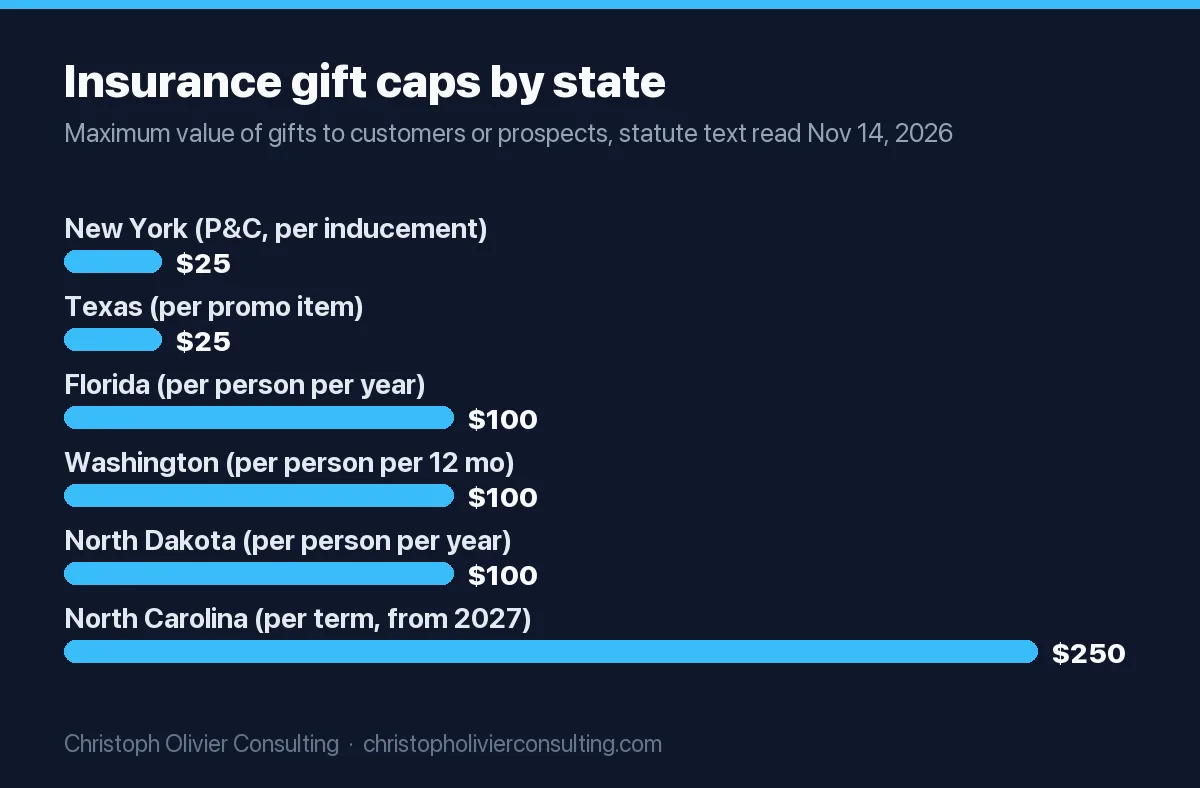
Yes, an insurance agent can usually pay a referral fee, but only under two conditions that most states copy almost word for word: the person referring does not discuss policy terms, and the payment does not depend on whether the referred person buys. A few states also cap the amount: Tennessee at $25 per referral, North Carolina at $50 for personal lines, and West Virginia at $100. Gifts to customers who refer friends are a separate question, governed by each state’s anti-rebating law, with limits that run from $25 in New York and Texas to $100 a year in Florida, Washington and North Dakota.
Short answer: You may pay an unlicensed person for a referral if they only pass along a name and contact details and you pay the same flat amount whether or not a policy is sold. Paying “$100 per policy written” to a car dealer, realtor or client is the classic violation. Dollar caps exist in some states (Tennessee $25, North Carolina $50 for personal lines, West Virginia $100), and gifts to customers fall under separate anti-rebating caps, typically $25 to $100.
Every rule on this page was read from the state legislature, the state insurance department or the National Association of Insurance Commissioners (NAIC) on November 14, 2026. Gift rules have moved a lot since the NAIC rewrote its model rebating language, so the date matters. This is a rules summary, not legal advice: confirm your state and line of business with your compliance contact or counsel before you launch a program.
Can insurance agents pay referral fees? The two tests every state uses
The starting point is the NAIC Producer Licensing Model Act (Model 218), Section 13. It bars an insurer or producer from paying “a commission, service fee, brokerage or other valuable consideration” to an unlicensed person for selling, soliciting or negotiating insurance. Section 13.D then allows payments to “persons who do not sell, solicit or negotiate insurance,” unless the payment would break the state’s anti-rebating statute.
So the legal question is never “is this a referral fee?” It is “did this person sell, solicit or negotiate?” States answer that with the same two tests. North Carolina’s definitions in G.S. 58-33-10 are typical: “negotiate” does not mean “a referral to a licensed insurance producer that does not include a discussion of specific insurance policy terms and conditions.”
- The referrer does not talk coverage. They can say “call my agent, here is her number.” They cannot explain deductibles, compare quotes, or say the policy is cheaper.
- The payment does not depend on a sale. New York’s Department of Financial Services put it bluntly in OGC Opinion 06-11-23: “A licensed insurance agent may not compensate a non-licensee for referrals contingent upon the placement of insurance.” Paying per policy sold would violate the statute, and the referring party would be acting as an unlicensed producer.
Some states add a third and fourth test: the fee must be “nominal,” “one-time” and “fixed” per referral, and it cannot scale with volume. Delaware’s 18 Del. C. § 1714(g) requires all of those for personal lines.
State referral fee and gift limits, with citations
The table below covers the NAIC models plus 13 states where we read the current text at the official source on November 14, 2026. “Referral fee” means payment to an unlicensed person for sending you a prospect. “Gifts” means things of value given to customers or prospects, which is where a “refer a friend” reward to a client usually lands.
| Jurisdiction | Referral fee to an unlicensed person | Gifts and inducements to customers | Recent change |
|---|---|---|---|
| NAIC models | Model 218 § 13: no pay to unlicensed persons who sell, solicit or negotiate; § 13.D allows pay to persons who do not, subject to anti-rebating law. No dollar figure. | Model 880 § 4.I(2)(f): non-cash gifts, meals or charitable donations up to an amount the commissioner deems reasonable per policy year. Drafting note suggests the lesser of 5% of premium or $250. | Model 880 amended at the 2021 Spring and 2024 Spring National Meetings. |
| California | No general nominal-fee statute found. Ins. Code § 763(b): bank deposit staff may get a one-time nominal fixed fee per referral that does not depend on a transaction. § 754: referral fees for goods or services paid by auto insurers are a misdemeanor, up to $1,000 per violation. | § 750(d) notes commission rebating by agents and brokers is authorized by Proposition 103 (1988). | § 1635 license exemptions amended 2021 (SB 272). |
| Connecticut | Not addressed in the section we read. | C.G.S. § 38a-825(d): non-cash gifts up to an amount the commissioner deems reasonable per policy year per term; purchase cannot be required. | Gift and value-added rules added by P.A. 22-106 (2022). |
| Delaware | 18 Del. C. § 1714(g): nominal, one-time, fixed per referral, not dependent on purchase, not contingent on volume. Applies to personal lines; commercial referrals fall under § 1714(d). | No dollar safe harbor found in Chapter 23 text. | None found. |
| Florida | F.S. 626.112(8): no fee to an unlicensed person (other than an agency) that is “in any way dependent upon whether the referral results in the purchase.” | F.S. 626.9541(1)(m): items worth $100 or less per insured or prospect per calendar year, plus up to $100 in charitable donations. Title agents: $25. Commission rebates allowed only under a filed, posted schedule (626.572). | Current text adds a value-added services exception for life and health insurers and agents (626.9541(1)(h)4.); see the 2023 Senate analysis of the NAIC-based bill. |
| Kansas | Not addressed in the section we read. | K.S.A. 40-2404(8): NAIC-style non-cash gifts up to an amount the commissioner deems reasonable per policy year; value-added services and one-year pilot programs. | Listed among early NAIC adopters in the 2023 Florida Senate analysis. |
| New York | Ins. Law § 2115 (P&C agents), § 2116 (brokers) and § 2114(a)(4) (life, A&H): allowed if no discussion of policy terms and pay “is not based upon the purchase of insurance.” No cap. | § 2324(a): valuable consideration up to $25 in value. Does not apply to life or A&H policies governed by § 4224. | The referral language in §§ 2115 and 2116 is marked “effective until September 10, 2029.” |
| North Carolina | G.S. 58-33-82(f): referral pay from an unlicensed individual to a personal lines producer capped at $50, fine up to $2,000 per violation. NCDOI FAQ says other referrals are fact-specific. | G.S. 58-63-15(8), version effective January 1, 2027: non-cash gifts, meals or donations up to $250 per policy term; raffle prizes up to $250. | Amended by S.L. 2022-46, 2024-11 and 2025-45. |
| North Dakota | Not addressed in the section we read. | N.D.C.C. 26.1-04-03(8)(c): gifts, meals or entertainment up to $100 aggregate retail value per person per year. Gift cards for specific merchandise allowed; no cash or cash cards. | Listed among early NAIC adopters in the 2023 Florida Senate analysis. |
| Pennsylvania | 40 P.S. § 310.72(b)(2) (Act 285 § 672-A): no discussion of terms; for personal, family or household lines, a one-time, nominal, fixed-dollar fee that does not depend on a sale. | 40 P.S. § 1171.5(a)(8) bans inducements not in the contract; no dollar safe harbor in the statute text we read. | Enforced in Woodford (Pa. 2020), discussed below. |
| Tennessee | T.C.A. § 56-6-113(e), as rewritten by Public Chapter 165 (2019): an unlicensed person not employed by or affiliated with you may get a fixed amount up to $25 per referral, not dependent on purchase. | Not covered here. | 2019 amendment kept the $25 cap. |
| Texas | Ins. Code § 4005.053(c)(2): no fee to an unlicensed person for a referral “based on that customer’s purchase of insurance.” No cap. | $25 promotional, educational or courtesy items: §§ 1806.059, 1806.1041, 1806.1541 and 4005.053(d). Life and health: non-cash gifts up to an amount the commissioner deems reasonable under Chapter 1702. | Chapter 1702 created by HB 2221, effective September 1, 2025. |
| Washington | RCW 48.30.133: non-cash referral rewards up to $100 per person per 12 months, no cash or checks; (4) allows a fee to an unlicensed non-customer conditioned on an application per RCW 48.17.490(4). WAC 284-17-825: no representations about terms. | RCW 48.30.140(4): prizes, gift cards or merchandise up to $100 per person per 12 months, offered to all insureds or prospects under similar circumstances. Not for title insurers. | RCW 48.30.140 amended 2019, 2020 and 2022. |
| West Virginia | W. Va. Code § 33-11A-7: no fee or a “nominal fee,” defined as a one-time fee of $100 or less, not based on application or purchase. | Not covered here. | None found. |
Two things jump out. First, no state we read lets you pay an unlicensed person per policy sold. Second, the dollar caps that exist are small, which is why most compliant programs pay a flat amount per qualified introduction rather than a share of commission.
Can insurance agents give gifts for referrals?
Usually yes, within the state’s gift cap, and only if the gift does not depend on the referred person buying. Washington is the only state in our table with a statute written specifically for referral gifts. RCW 48.30.133(1) lets a producer give “prizes, goods, wares, gift cards, gift certificates, or merchandise not exceeding one hundred dollars in value per person in any consecutive twelve-month period for the referral of insurance business,” as long as it is not “conditioned upon the person who is referred applying for or obtaining insurance.” Subsection (2) bans paying in “cash, currency, bills, coins, check, or by money order.”
Everywhere else, a thank-you to an existing client is analyzed as an inducement under the anti-rebating law. North Carolina’s insurance department makes that point in its referral fee FAQ: even where the commission statute allows a referral fee, a producer paying a “potential or existing customer” should “also review the rebating statutes.”
In practice that means three checks before you mail the gift card:
- Is it under the cap? $25 in New York (P&C) and Texas, $100 per year in Florida, Washington and North Dakota, $250 per policy term in North Carolina from January 1, 2027.
- Is it non-cash? Washington and North Dakota explicitly ban cash. The NAIC model and Connecticut, Kansas and North Carolina say “non-cash” or “noncash” gifts.
- Is it offered the same way to everyone? The NAIC model, Connecticut, Kansas and North Carolina all require the offer to be “not unfairly discriminatory,” and none allow you to require a purchase or renewal in exchange.
Gift caps compared
Every value in the chart below appears in the table above with its statute linked. The time basis differs by state, so read the label before comparing.
How much can an insurance agent pay for a referral?
Where a state sets a number, it is small. Tennessee caps referral pay to an unaffiliated unlicensed person at $25 per referral. North Carolina caps referral pay from an unlicensed individual to a personal lines producer at $50. West Virginia defines a permitted “nominal fee” as a one-time fee of $100 or less. Washington allows non-cash referral rewards up to $100 per person per 12 months.
Pennsylvania and Delaware say “nominal” without a dollar figure. New York and Texas set no cap at all, but the payment still cannot be tied to the sale. If your state is silent, “nominal” and “fixed per referral” are the safer reading, because that is what the regulators in the stricter states enforce.
A real enforcement case: the $50 car dealership fee
The Pennsylvania Supreme Court’s opinion in Woodford v. Insurance Department (December 22, 2020) describes an auto insurance agency that paid a “one-time” $50 referral fee to car dealership sales staff who sent over customers. The Department’s order to show cause alleged the agency paid referral fees to non-licensees “contingent on the sale,” and three dealership sales representatives filed affidavits saying they had received improper referral fees. The Commissioner imposed a $5,000 fine, which also covered a separate $60 to $70 application fee the agency charged customers, and noted that the owner’s dishonesty about the referral fees reflected on his fitness for licensure.
The lesson: $50 can be a perfectly legal amount. Tying it to a sale is what made it a problem.
Worked example: “The dealership wants $100 per referral”
This is one of the most common versions of the question. Say a dealership finance manager asks for $100 for every customer who buys a policy from you. That structure fails the second test in every state in our table, because the money depends on the purchase. Here is how to restructure it, using illustrative numbers.
| Structure | Example math (30 referrals a month, 9 policies sold) | Compliant? |
|---|---|---|
| $100 per policy sold | 9 x $100 = $900 a month | No. Contingent on purchase everywhere we checked. |
| Flat $30 per referral, paid whether or not they buy | 30 x $30 = $900 a month | Passes the two tests in New York and Texas, which set no cap. Fails Tennessee’s $25 cap. Within North Carolina’s $50 personal lines cap. Pennsylvania and Delaware also require the fee to be “nominal.” |
| Flat $25 per referral | 30 x $25 = $750 a month | Fits Tennessee’s cap and North Carolina’s $50 cap; still must be paid on every referral. |
| Fee that rises with volume (for example $25, then $40 after 20 referrals) | Varies | No in Delaware, which bans pay “contingent on the volume of insurance transacted.” |
Notice what the flat model does to your economics: you now pay for unqualified referrals too. That is the price of compliance, and it is why the referral source’s lead quality matters more than the fee. Track cost per bound policy, not cost per referral.
Insurance anti-rebating laws: what changed in 2020 to 2025
Anti-rebating laws ban giving a customer anything of value not stated in the policy as an inducement to buy. The NAIC model’s core sentence in Model 880 § 4.I(1) covers “any valuable consideration or inducement whatever not specified in the policy.” Most states copied it decades ago.
What changed is the list of exceptions. The NAIC amended Model 880 at its 2021 Spring National Meeting (and again in 2024) to allow three things:
- Value-added products or services that relate to the coverage and are primarily designed for loss control, claim cost reduction, risk education, risk monitoring, health, financial wellness, post-loss services, behavior change, or benefits administration. Cost must be reasonable compared with the premium, and availability must rest on “documented objective criteria.”
- Pilot programs for up to one year when you believe a service qualifies but lack evidence, with notice to the department, which has 21 days to object.
- Non-cash gifts, meals and charitable donations up to a commissioner-set amount, plus raffles that are free to enter and open to the public.
Adoption has been uneven. A 2023 Florida Senate bill analysis counted nine states that had enacted some form of the updated rebating provisions (Connecticut, Georgia for property and casualty, Kansas, Nebraska, New Mexico, North Dakota, Ohio, Rhode Island and Vermont) and eight more with pending bills. Since then, Texas moved life and health rebating into a new Chapter 1702 effective September 1, 2025, and North Carolina’s $250 per-term gift rule takes effect January 1, 2027. Florida’s current statute carries a value-added services exception limited to life and health insurers and agents, alongside its separate $100 per year gift allowance.
Two states go further and let agents rebate commission outright. Florida allows it under F.S. 626.572 if the rebate follows a schedule filed with the insurer, is applied uniformly, is posted in the office, and the insurer does not prohibit it. California’s Ins. Code § 750(d) refers to commission rebating “as authorized by Proposition 103.”
Insurance agency referral program: the compliance checklist
Use this before you launch a client reward, a realtor or dealer partnership, or a “refer a friend” campaign. Each line is pass or fail. One fail means fix it before launch.
| # | Check | Pass if | Source of the rule |
|---|---|---|---|
| 1 | Who is the referrer? | You have classified each source as licensed producer, unlicensed non-customer, or existing customer, and applied the right rule to each. | Model 218 § 13; state anti-rebating law |
| 2 | What may they say? | Their script is limited to your name, contact details and a reason to call. No prices, coverage, comparisons or advice. | NY §§ 2115, 2116; WAC 284-17-825(1)(c) |
| 3 | Is pay independent of the sale? | The same amount is paid for every referral whether or not a policy binds. | Every state in the table |
| 4 | Is pay independent of volume? | No tiers, bonuses or escalators tied to number of policies or premium. | 18 Del. C. § 1714(g)(3) |
| 5 | Is it under the state cap? | At or below $25 (TN), $50 (NC personal lines) or $100 (WV, WA non-cash). | State table above |
| 6 | Is the form allowed? | Non-cash where required (WA referral gifts, ND gifts); no cash, checks or money orders in WA. | RCW 48.30.133(2); N.D.C.C. 26.1-04-03(8)(c) |
| 7 | Personal or commercial lines? | You applied the personal lines limits where the statute draws the line (PA, DE, NC). | 40 P.S. § 310.72(b)(2); 18 Del. C. § 1714(g) |
| 8 | Customer gifts within the annual or per-term cap? | Per-person tracking shows each client stays under the cap for the period your state uses. | FL 626.9541(1)(m); RCW 48.30.140(4) |
| 9 | Offered without discrimination? | The same reward is offered to every client or prospect in the same situation, and no purchase or renewal is required. | Model 880 § 4.I(2)(f); C.G.S. § 38a-825(d) |
| 10 | Carrier rules checked? | Your carrier agreements allow the program. Florida bars rebates on policies from insurers that prohibit their agents from rebating. | F.S. 626.572(1)(d) |
| 11 | Records kept? | A log shows each referral, date, amount paid and outcome, so you can prove pay did not track sales. | Best practice; WA and NAIC require documented criteria for value-added services |
| 12 | Sunset dates noted? | Calendar reminders for New York’s September 10, 2029 sunset on referral language and North Carolina’s January 1, 2027 gift rule. | NY §§ 2115, 2116; G.S. 58-63-15(8) |
Once the rules are settled, the marketing side is the same as any other referral program: who you ask, when you ask, and how you thank. Our guide to designing and launching a referral program covers the mechanics, and the referral marketing overview explains why the ask matters more than the reward size. For where referrals sit next to paid search, SEO and lead vendors by line of business, see our insurance agency marketing playbook.
Copy-ready referral partner script
Give this to realtors, dealers, mortgage officers or clients so they stay on the right side of test one:
“I work with [Agent Name] at [Agency] for insurance. I can’t tell you what your policy should cover or what it will cost, but [Agent Name] can. Here’s the number: [phone]. Want me to send your name over so they can call you?”
Pair it with a written partner agreement that states the flat fee per referral, says it is paid regardless of whether a policy is purchased, and bars the partner from discussing coverage, price or carriers.
Who can share commission instead of a referral fee?
Another licensed agent can. Splitting commission with a licensed producer is not a referral fee problem. The NAIC model and states such as Pennsylvania (40 P.S. § 310.72(a)) let a licensee pay commission to another licensee for selling, soliciting or negotiating. Florida limits sharing to agents “appointed and licensed to write the same kind or kinds of insurance” under F.S. 626.753. If a referral partner wants a percentage of commission, the clean path is for them to get licensed and appointed.
Cross-profession referrals follow the same logic. A CPA or financial advisor who sends you clients is an unlicensed referrer for insurance purposes unless they hold the license, and their own professional rules may also restrict what they can accept. We cover the accounting side in can CPA firms pay referral fees and the advisor side in how financial advisors build referral partnerships with CPAs, estate attorneys and insurance agents.
Can an agent take a referral fee if another agent sells his home?
This question is about real estate agents, not insurance agents. Federal law allows it between real estate licensees: the Real Estate Settlement Procedures Act bans kickbacks for referring settlement business on federally related mortgage loans in 12 U.S.C. § 2607(a), but § 2607(c)(3) excepts “payments pursuant to cooperative brokerage and referral arrangements or agreements between real estate agents and brokers.” Whether a person can receive that fee also depends on state real estate license law, so check with your state real estate commission.
For insurance agents, the overlap is title insurance. Florida’s statute bars any payment “for the referral of title insurance business” (626.9541(1)(h)3.), and Washington’s insurance commissioner tells title companies they “may not pay fees for business referrals.” Do not extend a general referral program to title business.
Is it legal to pay referral fees?
For insurance, yes, in every state we read, provided the referrer stays out of coverage discussions and the fee is not tied to a sale. It becomes illegal when the referrer acts like an agent, when pay is per policy, or when it exceeds a state cap. Some industries are stricter: California makes it a crime for anyone who processes or negotiates insurance claims to pay or accept consideration for referring clients, with fines up to $50,000 under Ins. Code § 750.
My view after reading these statutes side by side: the fee is rarely what gets agencies in trouble. The trouble is the referral partner who starts quoting prices or the spreadsheet that shows payments only for sold policies. Design the program so neither can happen. If you want a second set of eyes on a referral program before launch, book a consultation, and loop in your compliance counsel for the state-specific sign-off.
Ready to scale your revenue?
Book a free 30-min consultation. We’ll diagnose your growth bottleneck and map out the 3 highest-leverage moves for your business.
Frequently asked questions
Can an insurance agent pay for referrals?
Yes, in the states we reviewed, if two conditions hold. The person referring cannot discuss policy terms, prices or coverage, and the payment cannot depend on whether the referred person buys. Some states add a dollar cap, such as $25 per referral in Tennessee, $50 for North Carolina personal lines and $100 in West Virginia. Paying per policy sold is not allowed.
How much can an insurance agent pay for a referral?
It depends on the state. Tennessee caps pay to an unaffiliated unlicensed referrer at $25 per referral, North Carolina caps referrals from unlicensed individuals to personal lines producers at $50, West Virginia allows a one-time fee of $100 or less, and Washington allows non-cash rewards up to $100 per person per 12 months. New York and Texas set no cap but ban pay based on purchase.
Can insurance agents give gifts to clients for referrals?
Usually, within the state's anti-rebating gift limit and only if the gift does not depend on the referred person buying. Washington allows non-cash referral gifts up to $100 per person per 12 months under RCW 48.30.133. Florida allows $100 per person per calendar year, New York $25 for property and casualty, and North Carolina $250 per policy term from January 1, 2027.
What are insurance anti-rebating laws?
Anti-rebating laws ban giving a customer anything of value not stated in the policy, such as a share of commission or cash, to induce a purchase. Most states follow NAIC Model 880. Since the NAIC's 2021 amendments, many states allow value-added services tied to the coverage and small non-cash gifts, meals or charitable donations up to a set amount.
Is it legal to pay referral fees to non-licensed people for insurance?
Yes, if the non-licensed person only passes along contact details and the fee is paid the same way whether or not a policy is sold. New York's Department of Financial Services has stated that an agent may not compensate a non-licensee for referrals contingent on placing insurance. Pennsylvania and Delaware also require the fee to be nominal and fixed per referral for personal lines.
Can an agent take a referral fee if another agent sells his home?
That is a real estate question. Federal RESPA section 8, at 12 U.S.C. 2607(c)(3), permits payments under cooperative brokerage and referral arrangements between real estate agents and brokers. Whether a particular person may receive the fee also depends on state real estate license law, so check with the state real estate commission.
Referral fee rules by profession