

No. On a residential mortgage covered by federal law, a mortgage broker cannot pay a referral fee to a real estate agent, a builder, another mortgage broker, a past client or anyone else outside its own payroll. RESPA Section 8 bans any “fee, kickback, or thing of value” given for a referral, and the regulation adds that “a company may not pay any other company or the employees of any other company for the referral of settlement service business.” What the law does allow is payment for real work at market value, payments to your own employees, and referral fees between real estate agents acting as agents.
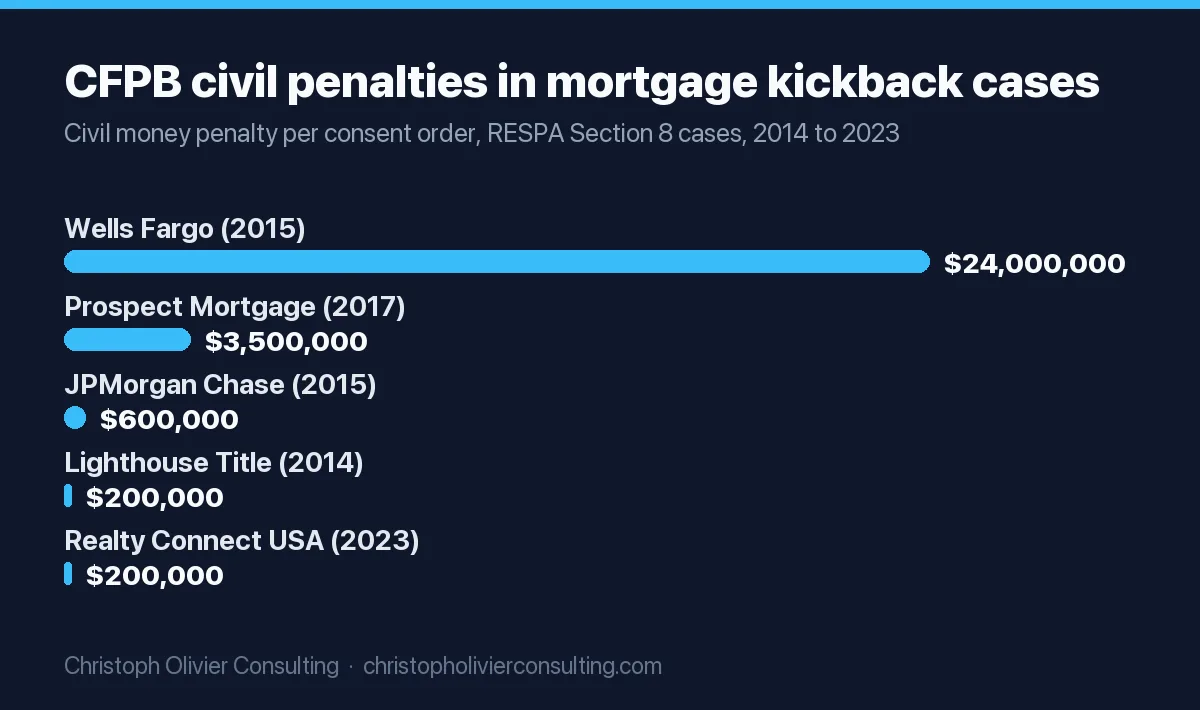
Short answer: A mortgage broker referral fee paid to an outside person is illegal under 12 U.S.C. 2607(a) for federally related mortgage loans. The only “reasonable” referral fee to a non-employee is $0. Violations carry a criminal fine of up to $10,000 and up to one year in prison, plus private liability of three times the settlement charge. CFPB orders have cost lenders up to $24 million in civil penalties.
This page quotes the primary text: the statute, Regulation X, the CFPB’s own FAQs and advisory opinion, and the consent orders. Law firm blogs and forum threads paraphrase these sources, sometimes wrongly. If you are building a referral program, read the decision table and the checklist, then have counsel review the final structure. Nothing here is legal advice.
What RESPA Section 8 actually says
Three short subsections do almost all the work. Here is the statutory text from 12 U.S.C. 2607, quoted exactly:
- 8(a), business referrals: “No person shall give and no person shall accept any fee, kickback, or thing of value pursuant to any agreement or understanding, oral or otherwise, that business incident to or a part of a real estate settlement service involving a federally related mortgage loan shall be referred to any person.”
- 8(b), splitting charges: “No person shall give and no person shall accept any portion, split, or percentage of any charge made or received for the rendering of a real estate settlement service in connection with a transaction involving a federally related mortgage loan other than for services actually performed.”
- 8(c), the exceptions: nothing in the section prohibits payments to attorneys for services actually rendered, “a bona fide salary or compensation or other payment for goods or facilities actually furnished or for services actually performed,” cooperative brokerage and referral arrangements “between real estate agents and brokers,” and affiliated business arrangements that meet disclosure and ownership conditions.
Note the word “person.” The ban runs both ways and applies to the payer and the receiver. A mortgage broker who pays and the agent who accepts are both exposed.
The four definitions that decide most cases
Regulation X, 12 CFR 1024.14, turns the statute into working rules. Four of its definitions matter most for a broker:
- Thing of value (1024.14(d)): “monies, things, discounts, salaries, commissions, fees, duplicate payments of a charge, stock, dividends,” plus “trips and payment of another person’s expenses,” “services of all types at special or free rates” and “lease or rental payments based in whole or in part on the amount of business referred.” The regulation adds that a payment “does not require transfer of money.” The statute’s own definition in 12 U.S.C. 2602(2) is “any payment, advance, funds, loan, service, or other consideration.”
- Referral (1024.14(f)): “any oral or written action directed to a person which has the effect of affirmatively influencing the selection by any person of a provider of a settlement service.” A text that says “use my lender” counts.
- Agreement or understanding (1024.14(e)): it “need not be written or verbalized but may be established by a practice, pattern or course of conduct.” And: “When a thing of value is received repeatedly and is connected in any way with the volume or value of the business referred, the receipt of the thing of value is evidence that it is made pursuant to an agreement or understanding.” You do not need a signed referral contract to violate Section 8.
- Market value test (1024.14(g)(2)): “If the payment of a thing of value bears no reasonable relationship to the market value of the goods or services provided, then the excess is not for services or goods actually performed or provided.” Also: “The value of a referral (i.e., the value of any additional business obtained thereby) is not to be taken into account.”
Settlement services include “the origination of a federally related mortgage loan (including, but not limited to, the taking of loan applications, loan processing, and the underwriting and funding of loans)” and “services rendered by a real estate agent or broker,” per 12 U.S.C. 2602(3). So mortgage brokering is squarely inside the rule.
Allowed vs prohibited: the referral payment decision table
We built this table from the regulation text, the CFPB’s FAQs and the consent orders cited below. Find the arrangement you are considering, then read the rule that decides it.
| Arrangement | RESPA status | Rule or case that decides it |
|---|---|---|
| Mortgage broker pays a real estate agent a flat fee per closed loan or per lead | Prohibited | 1024.14(b); Prospect Mortgage paid brokers “$25 to $500 per lead” and was fined (see enforcement table) |
| Mortgage broker pays another mortgage broker for a referred borrower | Prohibited | The cooperative brokerage exemption “has no applicability to any fee arrangements between real estate brokers and mortgage brokers or between mortgage brokers” (1024.14(g)(1)(v)) |
| Real estate agent pays another agent a referral fee for a buyer or seller | Allowed by RESPA | 12 U.S.C. 2607(c)(3); only when “all parties are acting in a real estate brokerage capacity” (1024.14(g)(1)(v)) |
| Broker pays its own loan officer, processor or receptionist a referral bonus | Allowed by RESPA, limited by Regulation Z | “An employer’s payment to its own employees for any referral activities” (1024.14(g)(1)(vii)); Reg Z 1026.36(d)(1) still bars loan originator pay based on loan terms |
| Lender pays its appointed agent or contractor for origination work actually done | Allowed | 1024.14(g)(1)(iii) |
| Marketing services agreement priced at fair market value for marketing actually performed | Not prohibited by itself | CFPB RESPA FAQs: MSAs “are not, by themselves, prohibited acts” |
| Monthly MSA payment adjusted by how many referrals the partner sends | Prohibited | CFPB FAQs; Prospect tracked a “capture rate” and cut payments when referrals fell |
| Free software subscriptions, tickets, meals or parties for referral partners | Prohibited when given to get referrals | 1024.14(d); Realty Connect USA order (2023) |
| Educational seminar open to all local agents, not tied to referrals, not covering their costs | Allowed | “Normal promotional and educational activities” (1024.14(g)(1)(vi)) |
| Renting a desk in a real estate office | Allowed only at market rent | 1024.14(g)(2); Prospect valued desk deals “in terms of the number of referrals they produced” |
| Owning part of an affiliated business and receiving returns on that ownership | Allowed with conditions | 2607(c)(4): written disclosure, no required use, and only a return on ownership |
| Paying for leads from a comparison-shopping website | Depends on how the site ranks you | CFPB Advisory Opinion, 88 FR 9162: a violation when the platform steers consumers non-neutrally in exchange for pay |
| Referral fee on a loan “primarily for a business, commercial, or agricultural purpose” | Outside RESPA | 1024.5(b)(2) exemption; state licensing law can still apply |
Can a realtor get a referral fee from a lender?
No, not for the referral itself. NAR’s own legal guidance, published January 15, 2026, puts it plainly: “A simple referral of business is not considered a service, according to the law.” The same article warns that “even a $5 coffee giftcard is considered ‘a thing of value’ under RESPA.”
The CFPB has enforced this against the agent side, not just the lender. In its August 17, 2023 consent order against Realty Connect USA Long Island, a real estate brokerage, the Bureau found that more than 100 of its agents took a property data subscription worth “at least $300 per month” through Freedom Mortgage’s account, and that those agents “made more than 400 mortgage referrals to Freedom.” The brokerage also received “$6,000 per month from Freedom under the MSA from January 2017 through at least December 2022,” a total of $432,000. Realty Connect was ordered to pay a $200,000 civil money penalty.
There is a second problem for an agent who takes lender money. Under Regulation Z, the definition of loan originator excludes a person who performs only real estate brokerage “unless such person is paid by a loan originator or a creditor for a particular consumer credit transaction” (official comment 36(a)-1.iv). An agent paid per loan by a lender can become an unlicensed loan originator on top of the RESPA issue.
Can a mortgage broker pay another mortgage broker a referral fee?
No. People often assume the agent-to-agent exception covers brokers. It does not. Regulation X states that the cooperative brokerage exemption “has no applicability to any fee arrangements between real estate brokers and mortgage brokers or between mortgage brokers” (1024.14(g)(1)(v)).
Paying your own employees for referrals
RESPA lets you pay your own staff for referrals: 1024.14(g)(1)(vii) permits “an employer’s payment to its own employees for any referral activities.” A front desk bonus for each borrower who applies is fine under RESPA. The limit comes from Regulation Z. 12 CFR 1026.36(d)(1) says no loan originator may be paid “compensation in an amount that is based on a term of a transaction,” and the amount of credit is not a term only when pay is “a fixed percentage of the amount of credit extended.” So a referral bonus that grows with the interest rate or the loan product fails, while a flat bonus per funded loan does not trigger that rule.
Paying past clients or friends for referrals
Regulation X lists the payments Section 8 permits in 1024.14(g)(1). Payments to consumers for sending you borrowers are not on that list, and the ban applies to “any person.” A gift card for each friend a past client refers fits the definition of a thing of value given for a referral. Treat consumer referral rewards on residential loans as prohibited unless your counsel signs off on a specific structure. A thank-you note costs nothing and carries no risk.
Commercial and business-purpose loans
RESPA does not cover “an extension of credit primarily for a business, commercial, or agricultural purpose,” according to 12 CFR 1024.5(b)(2). Referral fees on true commercial loans fall outside Section 8. State licensing law still applies, and a referrer who negotiates terms may need a license.
Marketing services agreements, co-marketing and buying leads
Most real enforcement involves arrangements that look like marketing on paper and work like referral fees in practice. The rules here changed, so check dates on anything you read.
- 2015 to 2020: CFPB Compliance Bulletin 2015-05 took a hard line on marketing services agreements. The Bureau rescinded it on October 7, 2020, and issued new FAQs the same day. The CFPB RESPA FAQs mark each Section 8 answer “Updated Oct. 7, 2020.”
- What the FAQs allow: “Entering into, performing services under, and making payments under MSAs are not, by themselves, prohibited acts under RESPA or Regulation X.” A lawful MSA requires that “the payments under the MSA are reasonably related to the value of services actually performed.”
- What they forbid: MSAs “structured or implemented to provide payments based on the number of referrals received,” and arrangements where “the services are not actually performed, the services are nominal, or the payments are duplicative.”
- Digital platforms: The CFPB’s February 13, 2023 advisory opinion on digital mortgage comparison-shopping platforms says an operator receives a prohibited referral fee when the platform “non-neutrally uses or presents information” about participating providers, that presentation steers the consumer, and the operator is paid at least in part for it. It adds that a higher fee for one provider “can be evidence of an illegal referral fee arrangement.”
Is that 2023 opinion still in force? On May 12, 2025 the CFPB withdrew 67 guidance documents in 90 FR 20084. That list includes Circular 2024-01 on preferencing and steering by digital intermediaries, but it does not list the 2023 RESPA advisory opinion. As of this writing the opinion has not been withdrawn in the Federal Register. Withdrawal of guidance never changes the statute or Regulation X, which remain in force.
How Prospect Mortgage’s MSAs crossed the line
The January 31, 2017 Prospect Mortgage consent order is the clearest public map of what not to do. Prospect entered lead agreements with “more than 200 different counterparties,” MSAs with “more than 120,” and desk licensing agreements with “more than 100.” Under the MSAs it paid brokers “ranging from a few hundred dollars to over $20,000 a month.” It then tracked each partner’s “capture rate,” the share of the partner’s buyers who used Prospect. Its own monthly checklist said to “review the capture rate and identify missed opportunities amongst agents and consumers,” and if the rate dropped, Prospect “might either lower the monthly amount it paid, or discontinue the MSA.” One broker passed lead money to its agents by handing out “$20 bills” at monthly meetings, one per referred consumer. Prospect paid a $3.5 million civil penalty.
What fees are prohibited by RESPA? Gifts, events and promotions
The CFPB’s FAQ answer to “Are gifts and promotions allowed under RESPA Section 8?” is “It depends.” There is “no exception to RESPA Section 8 solely based on the value of the gift or promotion.” A gift or promotion qualifies as normal promotional and educational activity only when both conditions hold: it is “not conditioned on referral of business,” and it does “not involve defraying expenses that otherwise would be incurred by the referral source.”
The FAQs give paired examples that make the line concrete:
| Likely allowed | Likely not allowed | Why |
|---|---|---|
| A one-time prize drawing announced to all previous customers and all loan originators in the city, with automatic entry | The same drawing announced only to select loan originators, with one entry per referral | Entries tied to referrals make it conditioned |
| A continuing education course agents need for their license, charged at fair market value, open to all local agents | The same course with the fee waived after an agent makes a set number of referrals | Conditioned on referrals and defrays the agent’s costs |
| Free public seminars on market developments, advertised to all area agents | The licensing course fee waived for every agent regardless of referrals | Still pays an expense the agent would otherwise carry |
The FAQs also state that tickets to sporting events, trips, restaurant meals and event sponsorships given in exchange for referrals under an agreement or understanding violate Section 8(a). Regulation X’s Appendix B gives an older example of the same principle: copying machines, computer terminals or printers “which have general use to the recipient and which are given in exchange for referrals of business also violate RESPA.”
RESPA kickback enforcement: what referral fees have cost
Every figure below comes from the CFPB consent order or the CFPB press release linked in the row. Settled orders are entered without admitting or denying the findings.
| Case and date | What was paid for referrals | Outcome |
|---|---|---|
| Wells Fargo, Jan 22, 2015 (orders revised Nov 5, 2015) | Genuine Title gave loan officers “cash, marketing materials, and consumer data” for referrals; more than 100 loan officers in at least 18 branches took part | $24,000,000 civil penalty plus $10.8 million redress |
| JPMorgan Chase, Jan 22, 2015 | Same Genuine Title scheme; at least six loan officers referred almost 200 loans | $600,000 civil penalty plus about $300,000 redress |
| Prospect Mortgage, Jan 31, 2017 | Per-lead fees, MSAs managed by capture rate, desk rentals valued by referrals | $3,500,000 civil penalty; two brokers and a servicer paid a combined $495,000 |
| Lighthouse Title, Sep 30, 2014 | MSAs with real estate brokers whose fees were set partly by referrals sent or expected | $200,000 civil penalty; barred from new MSAs with referral sources |
| Realty Connect USA Long Island, Aug 17, 2023 | Accepted subscriptions, events and $432,000 in MSA payments from Freedom Mortgage | $200,000 civil penalty |
| PHH Corp., Jun 4, 2015 | Mortgage reinsurance premiums paid to a PHH subsidiary by insurers it referred borrowers to | $109 million ordered, later overturned (see below) |
PHH matters because it limits how far the CFPB can push. The D.C. Circuit, sitting en banc in PHH Corp. v. CFPB, 881 F.3d 75 (2018), reinstated the panel ruling that payments between settlement service providers are permissible if they are “for goods or services actually provided and are for fair market value.” The CFPB then dismissed the case. The dismissal order said it was “the law of this case that PHH did not violate RESPA if it charged no more than the reasonable market value,” “even if the reinsurance was a quid pro quo for referrals,” as reported by Ballard Spahr’s Consumer Finance Monitor. That is a defense for real services at market price. It is not permission to pay for a bare referral.
RESPA penalties and deadlines
- Criminal: a violator “shall be fined not more than $10,000 or imprisoned for not more than one year, or both” (2607(d)(1)).
- Civil, private: violators are “jointly and severally liable” to the borrower “in an amount equal to three times the amount of any charge paid for such settlement service” (2607(d)(2)), plus court costs and attorneys’ fees (2607(d)(5)).
- Who enforces: the CFPB, HUD, state attorneys general and state insurance commissioners can sue to enjoin violations (2607(d)(4)).
- Time limits: private Section 8 suits must be filed within 1 year of the violation, and government actions within 3 years (12 U.S.C. 2614).
How much does a mortgage broker make on a $500,000 mortgage?
This question shows up right next to the referral fee question, and the answer explains why referral fees are tempting. There is no official average. NerdWallet says brokers “typically earn a commission of around 1%-2% of the loan value, which the borrower or the lender can pay.” Federal rules cap the structure, not a dollar amount:
| Line | On a $500,000 loan | Source |
|---|---|---|
| Broker compensation at 1% | $5,000 | NerdWallet’s typical range, our math |
| Broker compensation at 2% | $10,000 | NerdWallet’s typical range, our math |
| 2026 qualified mortgage limit on total points and fees (3% for loans of $137,958 or more) | $15,000 for all included fees combined | CFPB 2026 threshold rule, Dec 15, 2025 |
| Lender-paid broker compensation counted in points and fees? | Yes | 12 CFR 1026.32(b)(1)(ii) |
| Can the broker be paid by both borrower and lender on one loan? | No | Dual compensation ban, 1026.36(d)(2)(i) |
The math: $500,000 x 1% = $5,000 and $500,000 x 2% = $10,000. The 3% points and fees figure is the line above which a loan cannot be a qualified mortgage, and it covers the broker’s pay plus other included charges. A broker earning $10,000 who quietly hands $2,500 to the agent who sent the buyer has committed exactly the act Section 8(a) bans, and the borrower could sue for three times the charge.
What is a reasonable referral fee?
It depends who is paying whom:
- Mortgage broker to anyone outside its payroll, on a residential loan: $0. Any amount is a kickback.
- Real estate agent to real estate agent: RESPA allows it, and the market sets the price. The Consumer Federation of America reported in September 2020 that referral fees “are typically 25% of the agent’s commission,” and often higher when a referral company is involved.
- Payment for real services from a referral source: the market value of those services, with the value of any referral excluded, per 1024.14(g)(2).
Is a 3% realtor fee normal?
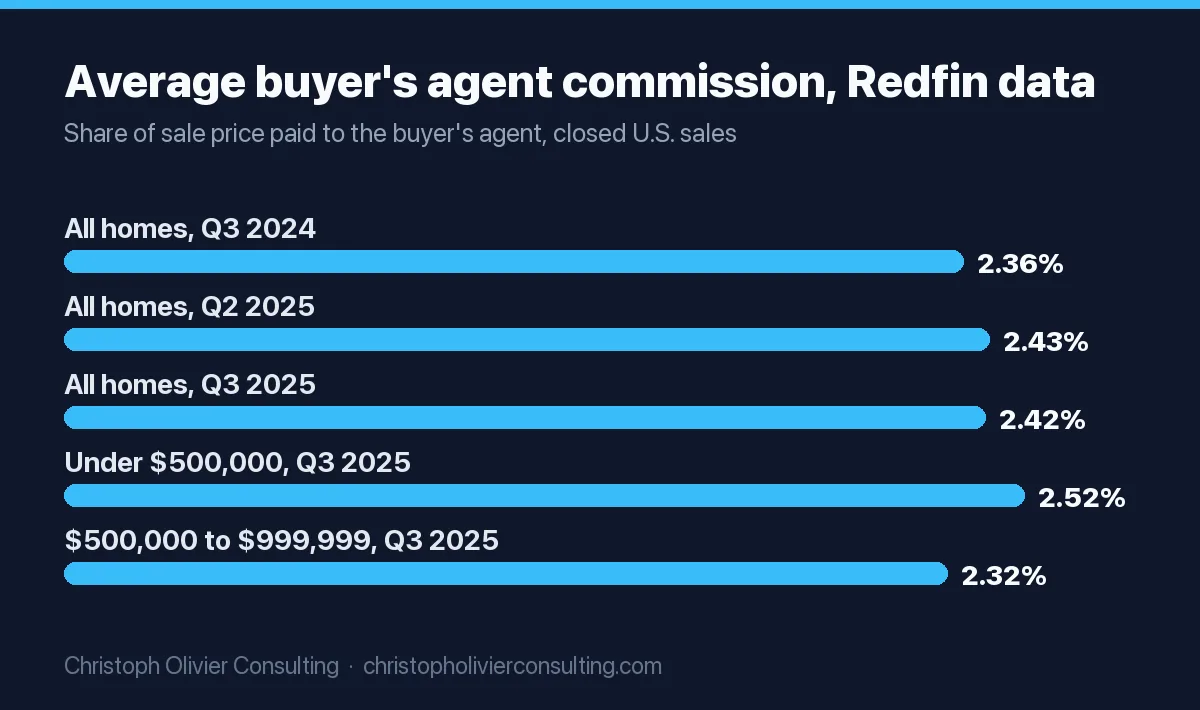
For the buyer’s side, it is above the recent national average. Redfin’s December 8, 2025 analysis of closed sales found the average U.S. buyer’s agent commission was 2.42% in the third quarter of 2025, up from 2.36% a year earlier. Commissions vary by price: 2.52% for homes under $500,000 and 2.32% for homes from $500,000 to $999,999. Redfin’s sample comes from its own agents’ listings and deals it referred to partner agents, “thousands of transactions per quarter,” not every sale in the country.
State law adds its own limits
RESPA sets a floor, and states add rules on top. Section 8 itself says state laws placing tighter limits on affiliated business arrangements are not inconsistent with it (2607(d)(6)). Two examples of how state law reaches referral payments:
- South Carolina: it is unlawful for a licensee to “pay, receive, or collect in whole or in part any commission, fee, or other compensation for a mortgage loan origination in violation of this chapter including any unlicensed person other than an exempt person” (S.C. Code 37-22-190(A)(4)).
- Every state, through Regulation Z: a person who refers consumers and is paid by a lender can meet the federal definition of loan originator. Comment 36(a)-1.i.A says “referring includes any oral or written action directed to a consumer that can affirmatively influence the consumer,” and under 1026.36(f) a loan originator must, “when required by applicable State or Federal law, be registered and licensed,” including under the SAFE Act.
Before launching a program in a new state, check that state’s mortgage licensing statute and its real estate commission rules on payments to licensees.
How to run a mortgage broker referral program that stays legal
You can still build a strong referral engine. You just pay for value, not for names. These structures fit the rules quoted above:
- Pay your own team. Referral bonuses to your employees are permitted by 1024.14(g)(1)(vii). Keep them flat per funded loan so they do not vary with loan terms.
- Co-market at your own share of the cost. If you and an agent run a joint ad or event, each side pays its pro rata share. Paying more than your share defrays the agent’s expenses.
- Teach. Open education events, priced at market or free to everyone and not tied to referrals, are the template the CFPB’s own examples approve.
- Buy advertising, not referrals. If you place ads on a partner’s website, pay a documented market rate that would be the same whether or not the partner ever sends you a borrower.
- Earn referrals with service. Fast pre-approvals, status updates to the agent and on-time closings are the referral program the law cannot touch. Our mortgage marketing playbook for loan officers covers the channels that produce funded loans without referral payments.
The general mechanics of asking for and tracking referrals are in our referral marketing guide, and the partner side is covered in partnership marketing. For mortgage brokers, every reward step in those playbooks has to pass the checklist below first. If you work the agent side of the relationship, our guide to lead generation for real estate agents covers channels that do not depend on lender money.
Referral program compliance checklist (pass/fail)
Copy this table into your program file. Every row must pass for every partner, every quarter. One fail means the arrangement needs to stop or be restructured with counsel.
| # | Check | Pass if | Fail if | Rule |
|---|---|---|---|---|
| 1 | Loan type | Payment relates only to business-purpose loans, or no payment is made | Any payment tied to a residential federally related mortgage loan | 1024.5(b)(2); 2607(a) |
| 2 | Who receives money | Your W-2 employees, or vendors performing real services | An agent, another broker, a builder or a past client, for a referral | 1024.14(b), (g)(1)(v), (g)(1)(vii) |
| 3 | Volume link | Amount stays the same whatever the partner refers | Payment rises, falls or ends based on referrals or “capture rate” | 1024.14(e); Prospect order |
| 4 | Services documented | Written proof of each service delivered (ad placements, impressions, event dates) | Services are nominal, duplicative or undocumented | CFPB MSA FAQs; 1024.14(c) |
| 5 | Market price | Price checked against at least one non-referral source of the same service | Price set by what the partner’s referrals are worth | 1024.14(g)(2) |
| 6 | Gifts and events | Open to all, not conditioned on referrals, not covering partner costs | Invites, entries or waivers limited to top referrers | 1024.14(g)(1)(vi); CFPB gift FAQs |
| 7 | Co-marketing split | Each party pays its pro rata share of shared costs | You pay the agent’s share of the ad, mailer or software | 1024.14(d), “payment of another person’s expenses” |
| 8 | Employee bonus design | Flat amount per funded loan or per application | Bonus varies with rate, points or product | Reg Z 1026.36(d)(1) |
| 9 | Digital lead sources | Platform ranks lenders on neutral criteria; same fee as other participants | You pay extra for top placement or steering | CFPB Advisory Opinion, 88 FR 9162 |
| 10 | Licensing | No unlicensed person is paid for a residential loan origination | A referrer paid per loan without a loan originator license | Reg Z comment 36(a)-1.iv; state law such as S.C. 37-22-190 |
| 11 | Records | Agreements and support kept at least 5 years | No file, or files purged early | 1024.14(h) |
What not to say to a mortgage broker (or a referral partner)
Because an “agreement or understanding” can be proven by conduct, your emails and texts become the evidence. The Prospect order quotes a sales manager’s suggested message to a broker: “will pay each agent $100 for each Qualified Buyer Lead that we send to Prospect.” Another manager listed “boosting referrals” as a meeting topic. Avoid any message that ties money, gifts or perks to referrals:
- “What’s in it for me if I send you my buyers?”
- “We’ll keep the marketing agreement going as long as the numbers hold up.”
- “Send us five deals this quarter and the event tickets are on us.”
- “Can you cover my share of the open house ad if I put your name on it?”
If a partner suggests any of these, decline in writing. If you want a second opinion on a referral or partner marketing plan before it goes live, book a consultation, and bring your counsel’s review along.
Ready to scale your revenue?
Book a free 30-min consultation. We’ll diagnose your growth bottleneck and map out the 3 highest-leverage moves for your business.
Frequently asked questions
Can mortgage brokers pay referral fees to real estate agents?
Not on a federally related residential mortgage. RESPA Section 8(a), 12 U.S.C. 2607(a), bars giving or accepting any fee, kickback or thing of value for referring settlement business, and Regulation X 1024.14(b) says a company may not pay another company or its employees for referrals. A broker can pay an agent only market value for services actually performed, never for the referral itself.
Can a realtor get a referral fee from a lender?
No. A referral is not a compensable service under 12 CFR 1024.14(b), and even small gifts count as a thing of value. In 2023 the CFPB fined Realty Connect USA Long Island $200,000 after its agents took free subscriptions, events and $432,000 in marketing agreement payments from Freedom Mortgage while sending it referrals. An agent paid per loan by a lender can also become a loan originator under Regulation Z.
Who is prohibited by RESPA from accepting fees for making referrals?
Any person. Section 8(a) says no person shall give and no person shall accept a fee, kickback or thing of value for referring settlement service business on a federally related mortgage loan. That covers real estate agents, mortgage brokers, loan officers at other companies, title agents, builders and consumers. The main exceptions are payments to your own employees and fee splits between real estate agents acting as agents.
What is an acceptable referral fee under RESPA?
For a mortgage broker paying anyone outside its payroll on a residential loan, the only acceptable referral fee is zero. RESPA does allow referral fees between real estate agents acting in a brokerage capacity, which the Consumer Federation of America reported are typically 25% of the agent's commission. Payments for real services must match market value, and the value of referrals cannot be counted.
How much does a mortgage broker make on a $500,000 mortgage?
NerdWallet puts typical broker pay at about 1% to 2% of the loan, which is $5,000 to $10,000 on $500,000, paid by the borrower or the lender but never both. For 2026, a loan of $137,958 or more cannot be a qualified mortgage if total points and fees exceed 3%, or $15,000 here, and lender-paid broker compensation counts toward that limit.
Can a mortgage broker pay a referral fee on a commercial loan?
RESPA does not apply to credit primarily for a business, commercial or agricultural purpose under 12 CFR 1024.5(b)(2), so Section 8 does not reach referral fees on true business-purpose loans. State law still does. Some states restrict payments to unlicensed persons, and a referrer who negotiates loan terms may need a license. Check the state mortgage licensing statute before paying.
What is the penalty for paying an illegal referral fee?
Under 12 U.S.C. 2607(d), a violator can be fined up to $10,000, imprisoned up to one year, or both, and is jointly and severally liable to the borrower for three times the settlement charge, plus attorneys' fees. Borrowers have 1 year to sue and regulators 3 years. CFPB civil penalties in kickback cases have reached $24 million, against Wells Fargo in 2015.
Referral fee rules by profession