

To schedule a marketing consultant, pick one of four formats (a pay-per-minute call, a mentor subscription, a fixed-price strategy hour or a matched fractional hire), send a one-page brief 48 hours before the call, and run a 60-minute agenda that ends with a written 30-day action list. Published prices on the main platforms run from $3.33 a minute on Clarity to $7,000 to $10,000 a month for a matched specialist through MarketerHire. If you searched this because you want to schedule your own marketing the way a consultant would, the second half of this page is a copy-ready 2027 marketing calendar for a business coach: monthly themes tied to real dates, three group-program launch windows, the email and LinkedIn schedule, and a time-blocked week with hours per task.
How to schedule a marketing consultant: formats and published prices
The format decides the price far more than the consultant does. Here is what each option costs and how booking works, using only prices the platform or consultant publishes. Prices were read on November 1, 2026.
| Format | Example | Published price | How booking works | Best for |
|---|---|---|---|---|
| Pay-per-minute call | Clarity, Customer Acquisition experts | Cheryl (Yeoh) Sew Hoy $3.33/min, Greg Hickman $4.17/min, Ali Maadelat $16.67/min. On the Business Coaching Advice page, Cameron Herold is $16.67/min | You propose 3 dates and times; the expert has 72 hours to accept. You are charged at request for the scheduled length, adjusted after the call. Full refund if you cancel 12+ hours ahead | One sharp question you can state in a sentence |
| Mentor subscription | GrowthMentor | $75 a month, unlimited 1:1 calls (one booked at a time); yearly plan advertised as “3 months free”; full refund within 14 days if the first call disappoints | 15, 30 or 60 minutes on Google Meet, Zoom or GrowthMentor Video, booked at least 48 hours out by default | Ongoing sparring while you do the work yourself |
| Fixed-price strategy hour | Margo Upson on Contra | From $150 for one hour, including the recording, a one-page write-up, a step-by-step plan and a time and cost estimate for further work | “Schedule a call” button to her calendar | A written plan you will execute alone |
| Free evaluation call from an agency | MarketKeep (Towson, MD) | Free SEO evaluation; ongoing packages from $450 a month, month to month | Form or phone; Zoom outside Baltimore | Scoping one channel before you buy it |
| Matched freelance or fractional marketer | MarketerHire | No rate card on the pricing page. Its own June 2026 rates guide puts mid-to-senior specialists in its network at $7,000 to $10,000 a month for 15 to 20 hours a week | Free consultation, a match in 24 to 48 hours, a two-week refundable trial, month to month | Someone to run the marketing, not just advise |
Clarity’s displayed rate is the expert’s hourly rate divided by 60, so $3.33 a minute is a $200 hourly rate and $16.67 is $1,000. Clarity does not enforce pricing guidelines, which is why two experts on the same topic page differ fivefold.
What one hour of marketing advice costs on each platform
Say you want two hours of outside marketing advice a month for a quarter. The math with published prices:
| Option | Math | Cost per month |
|---|---|---|
| Clarity at $3.33/min | 120 min x $3.33 | $399.60 |
| Clarity at $16.67/min | 120 min x $16.67 | $2,000.40 |
| Contra strategy hour | 2 x $150 starting price | $300 or more |
| GrowthMentor | Flat membership, calls booked one at a time | $75 |
| Hourly senior freelancer | 2 x $175 to $250 (MarketerHire’s senior range) | $350 to $500 |
The senior range comes from MarketerHire’s guide, which lists junior consultants at $50 to $100 an hour, mid-level at $100 to $175, senior (8 to 12 years) at $175 to $250, and fractional CMOs at $200 to $350. The same guide says paid discovery sessions typically run $200 to $500. If you are weighing the monthly retainer route instead, our fractional CMO cost breakdown covers that tier.
What to send before the call: the one-page brief
GrowthMentor tells members that a well-written request “is the difference between a fast acceptance and a decline,” and asks you to bring 2 or 3 specific questions plus your website, metrics or deck. A paid consultant needs the same. Copy this, fill it in, and send it 48 hours ahead:
| Field | What to write (business coach example) |
|---|---|
| One-line business | “I coach agency owners with 5 to 25 staff on profit. 1:1 retainer at $2,500/month, group program at $4,000.” |
| Last 90 days, in numbers | New email subscribers, discovery calls booked, calls held, clients signed, revenue. Leave blanks blank rather than guessing. |
| Where leads came from | Referral, LinkedIn, podcast guesting, webinar, other. Count, not feel. |
| What you already tried | “Posted daily on LinkedIn for 6 weeks in spring: 2 calls, 0 clients.” |
| The one decision you need help with | “Do I run a fall cohort or sell 1:1 only until I hit 10 clients?” |
| Constraints | Hours per week for marketing, budget, dates you cannot launch (client delivery, travel). |
| Links | Website, booking page, LinkedIn profile, last 3 newsletters, sales page. |
| What a good call gives you | “A yes/no on the cohort and a 30-day list I can start Monday.” |
Booking request you can paste
Use this in a Clarity reason-for-call box, a GrowthMentor session request or a consultant’s booking form:
I am a business coach serving [who] at [price point]. In the last 90 days I booked [X] discovery calls from [main channel] and signed [Y] clients. I need to decide [the one decision] by [date]. I have tried [what], which produced [result]. By the end of the call I want [a yes/no plus a 30-day action list]. My brief and links are attached.
Agenda for a first call with a marketing consultant (60 minutes)
- Minutes 0 to 5: the decision and the deadline. Read your one-line goal out loud. If the consultant restates it differently, settle that first.
- Minutes 5 to 15: the numbers walk. Leads, calls, close rate, average program price, list size. The consultant should ask for numbers you did not bring. That is a good sign.
- Minutes 15 to 30: the bottleneck. Too few people know you, too few book, or too few buy. Each needs a different fix, and a consultant who prescribes before naming one is guessing.
- Minutes 30 to 45: two or three options with trade-offs. Ask for the hours each option costs you per week, not only the money.
- Minutes 45 to 55: the 30-day list. No more than five actions, each with a date and a number that tells you it worked.
- Minutes 55 to 60: what further help would cost. Contra’s listing above bundles a time and cost estimate into the hour. Ask for the same, in writing.
Five questions to ask before you pay for more than one call: Which coaching or professional-service practices have you worked with, and what did you measure? What would you do first if you were me, with my hours? What will you need from me each week? How do we end the engagement if it is not working? Who does the work, you or a team? Our guide on how to hire a marketing consultant covers contracts and red flags in more depth.
If you want this exact agenda run on your coaching practice, you can book a consultation here and send the brief above in advance.
The 2027 marketing calendar for a business coach
This is the other reading of “schedule marketing”: a full-year plan you can paste into a spreadsheet. It assumes your clients are business owners, so their year is shaped by goal-setting in January, tax deadlines in March and April, a summer slowdown and planning season in Q4. Federal holiday dates come from OPM’s 2027 holiday table. Tax dates are derived from the rules in IRS Publication 509: partnership and S corporation returns on the 15th day of the 3rd month, individual returns on the 15th day of the 4th month, estimated tax on the 15th of the 4th, 6th and 9th months and the 1st month after year end, with 6-month automatic extensions. None of the 2027 dates below falls on a weekend, so none shifts.
| Month | Theme | Real 2027 dates to hook | Example newsletter or post | Selling mode |
|---|---|---|---|---|
| January | Set the 2027 numbers | Fri Jan 1 New Year’s Day; Fri Jan 15 Q4 2026 estimated tax due; Mon Jan 18 MLK Day | “The 4 numbers to set before February: revenue, margin, owner hours, cash floor” | Workshop, then cart open Jan 11 to 22 |
| February | Q1 pipeline while the cohort runs | Mon Feb 1 cohort starts; Mon Feb 15 Washington’s Birthday | “What your CPA will ask for before March 15, and how to have it ready” | Nurture, 1:1 calls only |
| March | Tax season: low ask, high help | Mon Mar 15 partnership and S corp returns due; Wed Mar 31 Q1 ends | “Your Q1 close in 30 minutes: the owner’s checklist” | Nurture. Owners are busy with their accountant |
| April | Q1 review and spring cohort | Thu Apr 15 Form 1040 and Q1 estimate due; workshop Tue Apr 20 | “Taxes filed. Now read your 2026 return as a business plan” | Cart open Apr 19 to 30 |
| May | Delivery and proof capture | Mon May 3 cohort starts; Mon May 31 Memorial Day | Client story with written permission | Nurture; collect testimonials |
| June | Mid-year reset | Tue Jun 15 Q2 estimate due; Fri Jun 18 Juneteenth (observed); Wed Jun 30 half-year | “Half the year is gone: the 3-question mid-year review” | Small offer: mid-year review sessions |
| July | Summer slowdown: batch and rest | Mon Jul 5 Independence Day (observed) | Short newsletters; repost your best spring content | Quiet. Batch September content |
| August | Fall runway | Mon Aug 16 runway starts | “Why Q4 is won or lost in September” | Runway: problem content, no pitch |
| September | Back-to-business cohort | Mon Sep 6 Labor Day; Wed Sep 8 workshop; Wed Sep 15 Q3 estimate and extended partnership and S corp returns due | “The 90-day Q4 plan template” | Cart open Sep 7 to 17 |
| October | Q4 sprint | Mon Oct 4 cohort starts; Mon Oct 11 Columbus Day; Fri Oct 15 extended Form 1040 returns due | “Year-end decisions to make before Thanksgiving” | Nurture; plan the January cohort |
| November | 2028 planning season | Thu Nov 11 Veterans Day; Thu Nov 25 Thanksgiving | “Build your 2028 plan in one afternoon” | Early-bird Nov 8 to 19; final enrollment Nov 29 to Dec 10 |
| December | Year in review, then quiet | Fri Dec 24 Christmas (observed); Jan 1, 2028 is a Saturday | Your own year in numbers, honestly | Quiet from Dec 13 |
Why the launches sit right after January 1, mid-April and Labor Day: Dai, Milkman and Riis (Management Science, 2014) found that Google searches for “diet,” gym visits and goal commitments all rise after temporal landmarks such as the start of a new week, month, year or semester, or after a holiday. A cohort that starts on the first Monday after a landmark rides that effect. The financial-advisor version of this calendar, with RMD and Medicare dates, is in our annual marketing calendar for financial advisors.
Launch windows for group programs in 2027
Each window has the same shape: two to four weeks of runway content, one free live workshop, a 10 to 12 day cart, and a cohort start on a Monday at the top of a new month or quarter.
| Cohort | Runway (content, no pitch) | Free workshop | Cart open | Cart close | Cohort starts |
|---|---|---|---|---|---|
| Winter | Mon Dec 7, 2026 to Mon Jan 4, 2027 (light over the holidays) | Tue Jan 5 | Mon Jan 11 | Fri Jan 22 | Mon Feb 1 |
| Spring | Mon Mar 22 to Fri Apr 16 (tax-season tone) | Tue Apr 20 | Mon Apr 19 | Fri Apr 30 | Mon May 3 |
| Fall | Mon Aug 16 to Fri Sep 3 | Wed Sep 8 | Tue Sep 7 | Fri Sep 17 | Mon Oct 4 |
| January 2028 | Mon Oct 18 to Fri Nov 5 | Tue Nov 9 | Mon Nov 8 (early-bird) | Fri Dec 10 | Mon Jan 10, 2028 |
Rules that keep the windows clean: never close a cart on a federal holiday or the Friday after Thanksgiving; skip the April cart if most of your buyers are accountants, because April 15 is the filing deadline they spend March and April working toward; and leave three weeks between a cart close and a cohort start for onboarding. The email sequence for each cart (how many emails, on which days, what each says) is laid out in our group program launch email sequence.
Weekly content cadence: the email and LinkedIn schedule
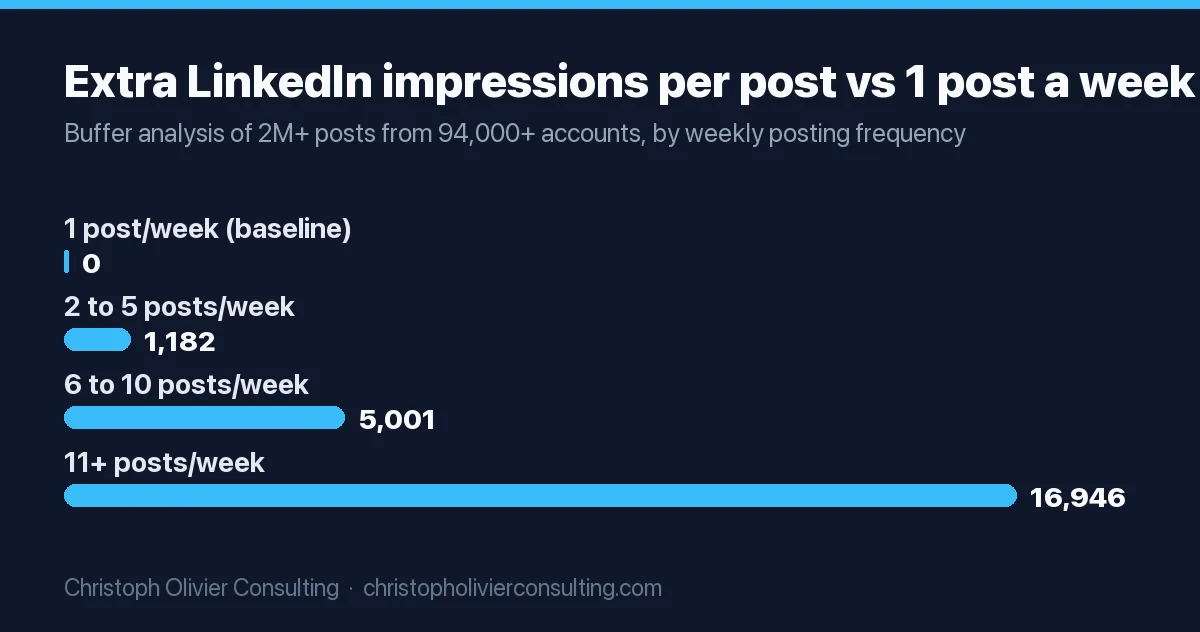
Buffer’s study of more than 2 million posts from 94,000+ LinkedIn accounts (August 2025) compared each account’s busier weeks with its quieter weeks. Moving from 1 post a week to 2 to 5 added 1,182 impressions per post; 6 to 10 posts added 5,001; 11 or more added 16,946. Buffer recommends 2 to 5 posts a week for sustainable growth. Three posts a week sits inside that band and is what one coach can write in one sitting.
| Channel | Normal week | Runway week | Cart week | July and late December |
|---|---|---|---|---|
| Newsletter | 1, Tuesday | 1, Tuesday, on the problem the cohort solves | 4 to 6 launch emails | Every other week, short |
| LinkedIn posts | 3: Tue teardown, Wed framework, Thu story | 3, plus a workshop invite in comments | 5, one per weekday | 2 |
| LinkedIn comments on buyers’ posts | 10 a day, Tue to Thu | 10 a day | 15 a day | Optional |
| Direct conversations | 3 new a week | 5 a week, invite to workshop | Reply to every workshop attendee | Past clients only |
| Live touch | 1 a month (first Tuesday) | The workshop | One live Q&A on day 8 of the cart | None |
For a fill-in grid of post topics by day, use our social media content calendar template for coaches.
Time-blocked weekly marketing schedule (hours per task)
Ian Brodie, who coaches consultants on marketing, suggests about 20% of your working time, roughly one day a week, with more when you are starting out or in a slump and about half a day when new business is flowing steadily. His two rules: one large uninterrupted block when you are freshest, plus some marketing every day. Here is that turned into hours:
| Block | When | Normal week | Cart week | Summer week |
|---|---|---|---|---|
| Deep block: write the newsletter and 3 posts, schedule them | Monday 8:00 to 11:30 | 3.5 h | 3.5 h (launch emails pre-written in runway) | 2 h |
| Daily: publish, 10 comments, 1 conversation | Tue, Wed, Thu, 8:30 to 9:15 | 2.25 h | 3 h (Mon to Fri, 36 min each) | 1 h |
| Relationship slot: podcast guest spot, partner call or monthly live | Wednesday 14:00 to 15:30 | 1.5 h | 2 h (workshop or live Q&A) | 0.5 h |
| Sales follow-up: reply to applicants, book calls | Daily, 16:30 | 0 h | 2.5 h | 0 h |
| Scoreboard and next week’s plan | Friday 15:00 to 15:45 | 0.75 h | 1 h | 0.5 h |
| Total | 8 h | 12 h | 4 h |
Eight hours is Brodie’s one-day baseline; four is his half-day level for a steady pipeline. Discovery calls themselves are not in these totals, because they are selling time, not marketing time.
Put a 45-minute review on the last Friday of each quarter: Mar 26, Jun 25 and Sep 24, with the year-end review on Fri Dec 17 before the holiday quiet. Score three things: did the cart fill, which channel produced the most booked calls per hour spent, and which block you scheduled but skipped. If the same block keeps slipping, cut it. The strategy those numbers feed (offer, price ladder, channel mix) belongs in your marketing plan for business coaches; this calendar is the schedule that executes it.
Frequently asked questions
How do I schedule a marketing consultant?
Choose a format first: a pay-per-minute call on Clarity, a GrowthMentor subscription, a fixed-price strategy hour on Contra, or a matched marketer through MarketerHire. Then send a one-page brief with your last 90 days of numbers and the single decision you need help with, at least 48 hours before the call, and run a 60-minute agenda that ends with a written 30-day action list.
How much does it cost to book a marketing consultant for one call?
On Clarity, named customer-acquisition experts list $3.33 to $16.67 a minute, so a 30-minute call costs about $100 to $500. Margo Upson's one-hour strategy session on Contra starts at $150. GrowthMentor charges $75 a month for unlimited one-to-one calls. MarketerHire's own 2026 guide says paid discovery sessions typically run $200 to $500.
What should I prepare before a call with a marketing consultant?
Bring your last 90 days of numbers (subscribers, discovery calls, clients signed, revenue), where leads came from, what you already tried and what happened, the one decision you need made, your weekly hours and budget, and links to your site, booking page and recent newsletters. GrowthMentor also advises writing down 2 or 3 specific questions before the call.
What should a business coach's marketing calendar include for 2027?
Monthly themes tied to dates your owner clients feel: New Year goal-setting, the March 15 and April 15 tax deadlines, the June mid-year point, the July slowdown, Labor Day and Q4 planning. Add two to four group-program launch windows, a fixed weekly newsletter and LinkedIn cadence, and a time-blocked week with hours per task.
When should a business coach launch a group program?
Start cohorts on the first Monday after a landmark date, when people are more likely to start goals. For 2027 that means carts closing January 22, April 30 and September 17 for cohorts starting February 1, May 3 and October 4, plus an early-bird in November for a January 10, 2028 start. Avoid closing a cart on a federal holiday.
How many hours a week should a coach spend on marketing?
Ian Brodie suggests about 20% of working time, roughly one day a week, more when starting out or in a slump and about half a day when referrals flow steadily. In practice that is about 8 hours in a normal week, 12 hours in a launch week and 4 hours in a summer week, not counting discovery calls.
How often should a business coach post on LinkedIn?
Three posts a week is a workable default. Buffer's 2025 study of over 2 million LinkedIn posts found that moving from one post a week to two to five added 1,182 impressions per post, and Buffer recommends two to five posts weekly for sustainable growth. Raise it to one post per weekday during a launch cart.
More marketing guides for business coaches
- Video Marketing for Business Coaches and Consultants
- Podcast Strategy for Business Coaches and Consultants
- Client Retention as a Growth Channel for Coaches and Consultants
- Client Onboarding for Business Coaches: Turn It Into a Referral Engine
- Marketing Tech Stack for Business Coaches and Consultants
- Strategic Partnerships and Referral Networks for Business Coaches and Consultants
- Marketing for Business Coaches & Consultants