

A marketing plan for a coaching business fits on one page: a revenue target, an offer ladder that reaches it, the number of discovery calls that math requires, and a weekly channel schedule that produces those calls. Most coaching plans skip the calls step, which is why they turn into content lists with no finish line.
Below is a fill-in 12-month plan with the math worked for a hypothetical business coach, plus a channel plan by week, a 4-week content calendar, LinkedIn and podcast-guesting playbooks with exact steps, and the numbers to review every month. Every conversion rate in the example is an assumption and is labeled as one. Replace them with your own numbers after your first 90 days.
The one-page coaching marketing plan (fill in the blanks)
Copy the first two columns into a doc and fill in the third. The worked example belongs to “Dana,” an invented business coach who works with agency owners. Dana is an illustration, not a client.
| Plan line | What you write | Worked example (hypothetical) |
|---|---|---|
| 1. Who you help | One buyer type, with a size or stage filter | Owners of marketing agencies with $1M to $5M in annual revenue |
| 2. Problem they pay to fix | The pain in their words, not yours | “We keep growing revenue and the profit never shows up” |
| 3. 12-month revenue goal | Booked contract value, not cash collected | $180,000 |
| 4. Offer ladder | Free, entry, core, premium rungs with prices | Scorecard ($0), Profit Intensive ($750), 6-month coaching ($12,000), 12-month advisory ($42,000) |
| 5. Discovery calls needed | From the worksheet below | 37 held, 47 booked (about 4 booked per month) |
| 6. Channels | One core, one support, one always-on | LinkedIn (core), podcast guesting (support), referrals (always on) |
| 7. Weekly time budget | Hours you will protect like client sessions | 6 hours, Monday to Friday |
| 8. Proof plan | How often you produce a case study | One written case study per quarter, with client sign-off |
| 9. Review date | A fixed day each month | First Monday of the month, 45 minutes |
Offer ladder for a coaching business, with prices to replace
An offer ladder gives a prospect who is not ready for your core program a smaller first yes. Each rung has one job in the plan, and the job is what matters. The prices below are Dana’s, not a recommendation for yours.
| Rung | Example offer | Price | Job in the plan |
|---|---|---|---|
| Free | Agency Profit Scorecard: 20 yes/no questions, scored, with a 30-minute recorded walkthrough | $0 | Captures the email address and gives you a reason to start a conversation |
| Entry | 90-minute Profit Intensive with a written 90-day action plan | $750 | A low-risk first purchase for people who say “not yet” on a discovery call |
| Core | 6-month 1:1 coaching: two 60-minute sessions a month plus message access | $2,000/month ($12,000) | Most of the revenue |
| Premium | 12-month advisory: monthly sessions plus a quarterly planning day with the leadership team | $3,500/month ($42,000) | Two clients a year carry almost half the goal |
Do a price sanity check before you lock this in. Dana’s core offer works out to $1,000 per session hour ($2,000 divided by two sessions). That is roughly 3.7 times the North American average of $272 per one-hour session in the ICF data below. Outcome-packaged programs for business owners can sit far above hourly averages, but only when positioning and proof support it. If yours do not yet, lower the prices and let the worksheet tell you how many more clients you need.
Coach income and fees: what the ICF Global Coaching Study shows
The International Coaching Federation’s study, run by PwC, is the largest survey of the profession. The latest edition is 2025. ICF’s 2025 study page reports 10,035 responses from 127 countries, a record 122,974 coach practitioners worldwide (up 15% since 2023), and an estimated $5.34 billion in annual revenue. It also reports that 59% of coaches expect to earn more next year, and ICF’s September 16, 2025 release says that growth is expected to come from more clients and sessions rather than higher fees. That is the case for a marketing plan built around call volume.
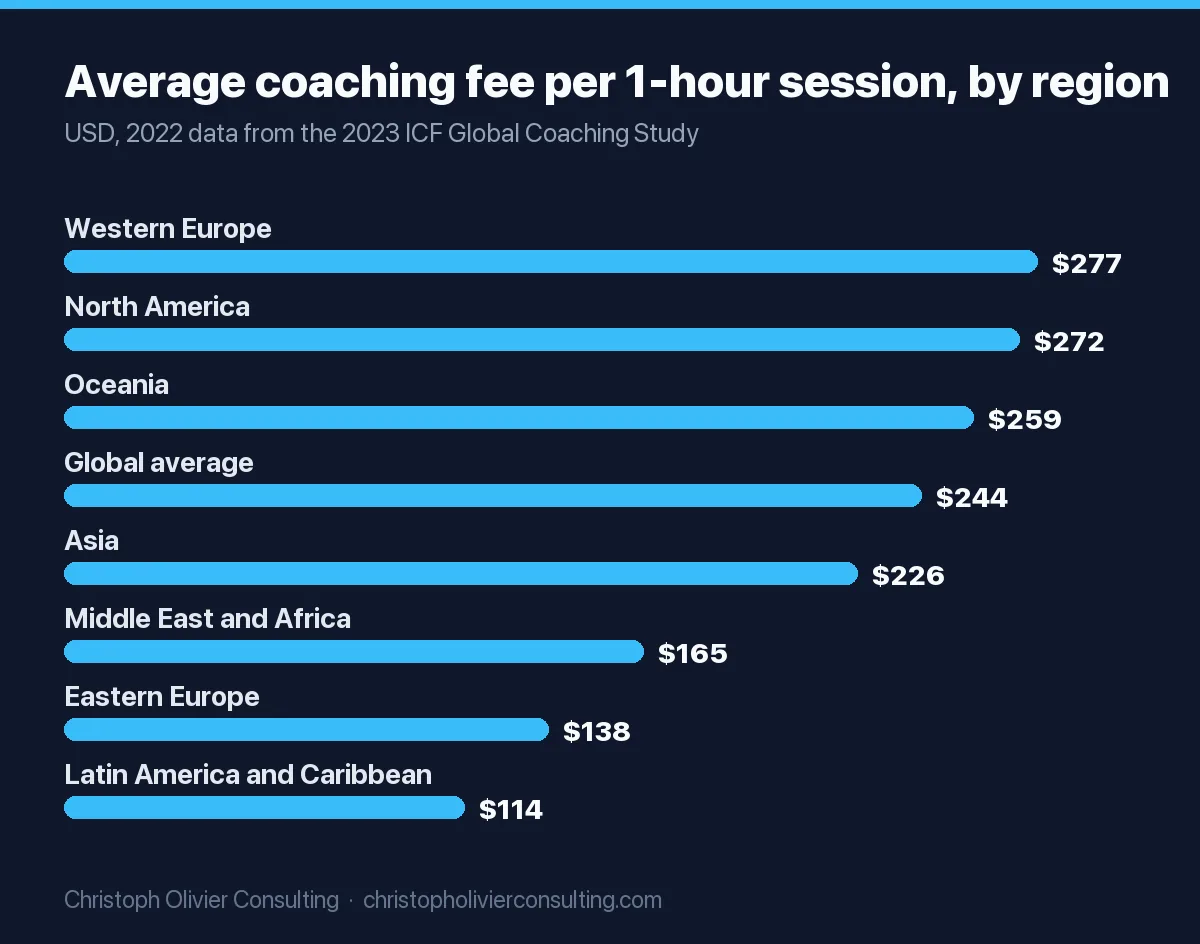
The 2025 income and fee breakdowns sit in the paid full report ($95 for ICF members, $295 for non-members). The most recent free regional figures come from the 2023 ICF Global Coaching Study executive summary, which covers 2022:
| Region (2022 data) | Avg fee per 1-hour session | Avg annual coaching revenue/income | Avg active clients | Avg hours per week coaching |
|---|---|---|---|---|
| North America | $272 | $67,800 | 13.5 | 13.3 |
| Western Europe | $277 | $52,400 | 11.5 | 12 |
| Oceania | $259 | $58,800 | 13.8 | 13.3 |
| Global | $244 | $52,800 | 12.2 | 11.9 |
Two numbers from the same summary belong in your plan. First, 53% of coaches globally reported less than $30,000 in annual coaching revenue, so the average hides a wide spread. Second, the average active coach had 12.2 clients. Dana’s plan needs 10 high-ticket clients across the year, which sits inside a normal coaching caseload, so capacity is not the constraint. Lead flow is.
Revenue target worksheet: how many discovery calls you need
Work backward from the goal to a weekly number. These are the four assumptions in Dana’s math. They are planning assumptions, not benchmarks. Track your real rates from month one and replace them.
- Assumption A: 20% of held discovery calls buy core or premium directly.
- Assumption B: 30% of held calls buy the $750 intensive instead.
- Assumption C: 25% of intensive buyers upgrade to core within 60 days.
- Assumption D: 80% of booked calls actually happen.
- Set the goal. $180,000 in booked contracts.
- Place premium first. 2 premium clients × $42,000 = $84,000. Remaining: $96,000.
- Fill the rest with core. $96,000 ÷ $12,000 = 8 core clients. Total high-ticket clients needed: 10.
- Find clients per held call. 0.20 direct + (0.30 × 0.25 upgrades) = 0.275 high-ticket clients per held call.
- Calls held. 10 ÷ 0.275 = 36.4, round up to 37 held calls.
- Calls booked. 37 ÷ 0.80 = 46.25, round up to 47 booked calls, about 4 a month.
- Count the bonus. 37 × 0.30 = 11 intensives × $750 = $8,250. Projected total: $188,250, a 4.6% buffer over the goal. Keep the buffer. Some months will miss.
The direct close rate moves the plan more than anything else. Here is the same goal at three close rates, holding assumptions B, C and D steady:
| Direct close rate (A) | High-ticket clients per held call | Calls held for 10 clients | Calls booked per year | Calls booked per month |
|---|---|---|---|---|
| 10% | 0.175 | 58 | 73 | 6.1 |
| 20% | 0.275 | 37 | 47 | 3.9 |
| 30% | 0.375 | 27 | 34 | 2.8 |
Moving from a 10% to a 20% close rate cuts the required calls by more than a third. That is why fixing your discovery call often beats adding a channel. If your close rate is the weak line, the structure in discovery calls that convert for business coaches is the place to start. Screening applicants before they reach your calendar also lifts close rate, and these coaching application form questions are ready to paste into a booking form.
Where the 47 calls come from: the channel plan
Split the booked-call target across channels, then turn each share into a weekly activity count. The conversion rates in the last column are assumptions.
| Channel | Calls booked per year | Assumption | Activity needed per year | Weekly activity |
|---|---|---|---|---|
| LinkedIn (core) | 24 | 1 in 5 real DM conversations books a call | 120 conversations | 3 conversations, 3 posts, 25 comments |
| Podcast guesting (support) | 12 | 20% of pitches accepted; 0.5 booked calls per aired episode | 24 episodes from 120 pitches | 3 pitches |
| Referrals and past clients (always on) | 11 | 1 in 10 specific referral asks produces a booked call | 110 asks | 2 asks |
| Total | 47 |
Weekly counts are rounded up from the yearly need (120 ÷ 52 = 2.3, planned as 3) so a slow week does not sink the quarter.
The standard week (about 6 hours)
| Day | Task | Time |
|---|---|---|
| Monday | Draft all three LinkedIn posts for the week | 90 min |
| Tuesday | Publish post 1. Leave 10 comments on buyer posts. Send 3 podcast pitches. | 75 min |
| Wednesday | Publish post 2. Write the newsletter edition (every other week). Leave 8 comments. | 90 min |
| Thursday | Publish post 3. Leave 7 comments. Reply to and open 3 DM conversations. Send 2 referral asks. | 60 min |
| Friday | Update the scoreboard: calls booked, conversations, pitches, asks | 20 min |
That totals 5 hours 35 minutes, leaving room for podcast recordings, which take about an hour each when they land.
12-month plan by week
| Weeks | Focus | Specific deliverables | Booked calls target |
|---|---|---|---|
| 1 to 4 | Set up | Positioning sentence, scorecard built, booking page with application form, LinkedIn headline and Featured section, newsletter created, list of 40 target podcasts | 2 |
| 5 to 13 | Run the standard week | 27 podcast pitches sent; first episodes record around weeks 8 to 10 and air later; 4 newsletter editions | 6 (8 for Q1) |
| 14 to 26 | Add proof | First written case study; scorecard walkthrough run live once; first monthly review that replaces assumptions with real rates | 12 |
| 27 to 39 | Double down | Shift 2 hours a week into whichever channel produced the most held calls per hour; second case study | 13 |
| 40 to 52 | Harvest | Referral asks to every client finishing an engagement; year-end planning offer to intensive buyers who did not upgrade; draft next year’s plan | 14 |
| Year | 47 |
Sample 4-week content calendar for a business coach
Three LinkedIn posts a week, one newsletter every other week, one call to action per week. Each post uses a different format so you learn which one your buyers respond to: a teardown (Tuesday), a framework (Wednesday), a short story or opinion (Thursday). Here is Dana’s first month.
| Week | Tuesday: teardown | Wednesday: framework | Thursday: story or opinion | Newsletter | Call to action |
|---|---|---|---|---|---|
| 1 | “An agency grew 30% and profit stayed flat. Here are the 3 lines I’d check first.” | The 4 margin leaks: scope creep, underpriced retainers, bench time, discounting | Why I stopped recommending hiring ahead of revenue | Edition 1: the margin leak checklist | Take the Agency Profit Scorecard |
| 2 | Rewriting one real public agency pricing page (no names) from hourly to tiered | A 3-tier retainer structure with what goes in each tier | The client who taught me to raise prices mid-contract (anonymized, with permission) | None | Reply “tiers” for the retainer worksheet |
| 3 | A weekly utilization report: what to keep, what to cut | The owner’s 30-minute Monday numbers review | Opinion: most agency owners need fewer clients, not more | Edition 2: the Monday review template | Book a 90-minute Profit Intensive |
| 4 | Case study: before and after margin with the client’s approval and real numbers | How to price a project when you can’t estimate hours | What I ask in the first 10 minutes of a discovery call | None | Apply for a discovery call |
Week 4’s case study carries legal weight. Under the FTC’s Endorsement Guides FAQ, if you cannot show a client’s result is what people generally achieve, your post has to make the generally expected results clear, and any material connection (a discount, free sessions for a review) must be disclosed clearly and conspicuously. The rules for coaches, with examples, are in this guide to using testimonials and case studies without breaking FTC rules.
LinkedIn playbook for business coaches: exact steps
- Rewrite your headline as a buyer filter. Formula: “I help [buyer] [result] | [one proof point].” Dana’s: “I help agency owners at $1M to $5M turn revenue growth into profit | Former agency COO.” Use only proof you can document.
- Pin the lead magnet. Put the scorecard link at the top of your profile’s Featured section so profile visitors from comments have one next step.
- Create the newsletter in week 1. LinkedIn’s help page on newsletters says all members can create one: click Write article at the top of the homepage, open the Manage dropdown in the upper right and select Create newsletter. When you publish, members who follow you are automatically sent a notification inviting them to subscribe, and subscribers get push, in-app and email notifications for each new edition. That email notification is why the newsletter belongs in the plan.
- Build a 30-person comment list. 20 buyers who post (agency owners) and 10 people your buyers follow (agency consultants, software founders, podcast hosts). Save their profiles. Leave 25 comments a week that add a number, a counterpoint or a question. “Great post” counts as zero.
- Start conversations from signals, not cold. A signal is a second comment on your posts, a scorecard download, or a profile view from someone in your buyer filter. Send this, edited to fit:
“Hi [name], saw your comment on the retainer tiers post. Curious: are you pricing retainers by hours right now or by deliverables? Asking because the answer changes which of the margin leaks hits hardest.” - Move to a call only after they describe a problem. Use this when they do:
“That sounds like the [leak] pattern. I do a 30-minute call where we look at your numbers and you leave with the first fix, whether or not we work together. Want the link?” - Route the link through an application. Calendly’s pricing page shows the Free plan includes one event type and one-on-one scheduling. Screening and routing invitees by their answers is a Teams feature at $16 per seat per month billed yearly. A solo coach can stay on Free and put the application form in front of the booking link instead.
- Log every conversation in a spreadsheet with date, source post and outcome. You need this for the monthly review.
Podcast-guesting playbook: from list to booked calls
- Build a list of 40 shows your buyers already listen to. Search Apple Podcasts or Spotify for your buyer’s job and problem (“agency owner,” “agency growth,” “agency profit”). Keep a show only if it published an episode in the last 30 days, has interviewed guests in its last five episodes, and its guests look like your buyers or the people they learn from.
- Write a one-page guest sheet. Headshot, your positioning sentence, three talk titles with a specific promise each (“The 4 margin leaks in agencies past $1M”), and two prior appearances or articles if you have them.
- Listen to one episode before you pitch. Reference something specific in the first line. Hosts get many generic pitches.
- Send 3 pitches a week. Template:
Subject: Guest idea for [show]: [talk title]
Hi [host], your episode with [guest] on [topic] made the point that [specific point]. A related problem your listeners likely have: [problem in one sentence]. I could walk through [talk title] with three examples and a scorecard listeners can use the same day. I coach agency owners at $1M to $5M on margin. Guest sheet attached. Would this fit an upcoming episode?
[Name] - Follow up once after 7 days, then move on. Mark the show as “no reply” and revisit in a quarter.
- Prepare one offer for listeners. Give a short, memorable URL for the scorecard (for example yoursite.com/podcast) so you can count downloads from podcast traffic alone.
- After it airs, post a clip or quote on LinkedIn tagging the host, add the episode to your Featured section and newsletter, and message any new subscriber from that URL within 48 hours.
Guesting comes first for most solo coaches because someone else has already built the audience. When hosting your own show starts to make sense is covered in this podcast strategy for business coaches.
Marketing for coaches and consultants: what changes in the plan
Many practitioners do both. ICF’s 2025 study found 57% of coaches also offer consulting, 60% provide training, 55% offer facilitation and 49% deliver mentoring. The worksheet stays the same. Three lines change.
| Plan line | Coaching practice | Consulting practice |
|---|---|---|
| Core offer | Recurring monthly engagement, priced per month | Fixed-scope project, priced per deliverable |
| Entry offer | Paid intensive or single session | Paid diagnostic or audit that becomes the project scope |
| Calls math | Clients needed = goal ÷ engagement value | Projects needed = goal ÷ average project value, then add a renewal or phase-two rate |
| Proof | Client-reported change over months | Deliverable plus before-and-after metric |
The channel playbook barely changes. Both sell to people who have to trust your judgment before they pay. Channel-by-channel guidance for both models is in this guide to marketing for business coaches and consultants, and if you want more tactics to slot into the weekly plan, here are 12 marketing ideas for business coaches.
The metrics to review on the first Monday of every month
Ten numbers, one sheet, 45 minutes. The targets come from Dana’s assumptions, so replace them with yours. Each red flag points at one fix, not a full plan rewrite.
| Metric | Formula | Monthly target (example) | Red flag | Fix first |
|---|---|---|---|---|
| Booked discovery calls | Count | 4 | Under 3 for two months | Channel activity counts below |
| Show rate | Held ÷ booked | 80% | Under 70% | Reminder emails, application form |
| Direct close rate | High-ticket clients ÷ held calls | 20% | Under 10% over a quarter | Call structure, offer fit |
| Intensive take rate | Intensives ÷ held calls | 30% | Under 15% | Intensive offer and price |
| Intensive upgrade rate | Upgrades within 60 days ÷ intensives | 25% | Under 10% | Action plan quality, follow-up call |
| LinkedIn conversations | Count of real two-way DMs | 10 | Under 6 | Commenting volume, signal follow-up |
| Podcast pitches and acceptances | Accepted ÷ sent | 13 sent, 20% | Under 10% after 30 pitches | Show list fit, talk titles |
| Referral asks | Count | 9 | Under 5 | Ask timing at client milestones |
| Calls by source | Booked calls per channel | 2 LinkedIn, 1 podcast, 1 referral | One channel at zero for a quarter | Cut it or change the activity |
| Booked revenue vs plan | Year to date ÷ (month × $15,000) | 100% | Under 80% at the half-year | Rerun the worksheet with real rates |
The first review that matters is in week 14. By then you have about a dozen calls and can swap real show, close and upgrade rates into the worksheet. If the new numbers say you need twice the calls, you know in April instead of December. More KPI definitions are in this list of marketing KPIs for business coaches. If you want a second opinion on your worksheet before you commit a quarter to it, you can book a consultation.
Frequently asked questions
What should a marketing plan for a coaching business include?
Nine lines: who you help, the problem they pay to fix, a 12-month revenue goal, an offer ladder with prices, the number of discovery calls the goal requires, one core channel plus one support channel and referrals, a weekly time budget, a proof plan such as one case study per quarter, and a fixed monthly review date. The calls line is the one most plans skip.
How many discovery calls does a coach need to get one client?
It depends on your close rate. At a 20% direct close rate, plus intensive buyers who upgrade later, the worked example in this guide needs about 3.6 held calls per high-ticket client. At 10% it needs about 5.7, and at 30% about 2.7. These are planning assumptions. Track your own show, close and upgrade rates for 90 days and recalculate.
What is the best marketing for business coaches?
For coaches selling to business owners, a practical mix is one core channel where buyers already spend time, often LinkedIn, one support channel such as podcast guesting, and a steady habit of referral asks to past clients and partners. The right mix is whichever produces the most held discovery calls per hour, which you only learn by tracking calls by source each month.
How much do coaches charge per hour according to the ICF?
The 2023 ICF Global Coaching Study executive summary, covering 2022, reports an average fee of $244 per one-hour session globally, $272 in North America and $277 in Western Europe. The 2025 edition reports 122,974 coach practitioners and $5.34 billion in revenue, but its fee and income breakdowns are in the paid full report.
How long does a coaching marketing plan take to produce clients?
Expect a lag. In the 12-month example, weeks 1 to 4 are setup, podcast episodes recorded in weeks 8 to 10 air later, and the plan targets only 8 booked calls in the first quarter versus 14 in the last. Judge the plan at the week 14 review, when you have enough calls to replace assumptions with real rates.
Should coaches and consultants use the same marketing plan?
The worksheet and channels can be the same. What changes is the offer: coaches usually sell a recurring monthly engagement, consultants a fixed-scope project, so the math divides the revenue goal by project value and adds a phase-two or renewal rate. ICF's 2025 study found 57% of coaches also offer consulting, so many practitioners plan for both.
More marketing guides for business coaches
- Client Onboarding for Business Coaches: Turn It Into a Referral Engine
- How to Build an Annual Marketing Calendar for Coaches and Consultants
- Marketing Tech Stack for Business Coaches and Consultants
- Strategic Partnerships and Referral Networks for Business Coaches and Consultants
- Discovery Calls That Convert for Business Coaches and Consultants
- Marketing Channels for Business Coaches and Consultants
- Marketing for Business Coaches & Consultants