

Google Ads for Social Security disability lawyers work best on denial and appeal searches, priced against a hard ceiling: under an SSA fee agreement your fee is the lesser of 25% of past-due benefits or $9,200, and only if the claimant wins. Facebook ads for Social Security disability lawyers are cheaper attention, not cheaper cases, so use them to reach claimants and family members before they search. Everything else in Social Security disability law firm marketing follows from that fee math, SSA’s published approval and wait-time data, and a few federal rules that general legal marketing guides skip.
This page gives you the fee-cap math, a cost-per-signed-case calculator, a Google Ads build with a copy-ready negative keyword list, the Meta targeting rules that actually apply, sample ad copy, lead vendor pricing models, the compliance traps specific to SSD, and a 90-day plan.
Want a specialist to build this for your business? See how CO Consulting’s marketing services work, starting with a diagnostic and audit.
The fee cap sets your marketing ceiling
SSA’s fee agreement page says an approved fee cannot exceed “the lesser of 25 percent of the past-due benefits” or the dollar cap, and that the current maximum is $9,200 for favorable decisions issued on or after November 30, 2024. In a May 6, 2025 Federal Register notice, SSA said the $9,200 cap “will remain in effect” and that it will only publish a new notice when it raises the cap. It also dropped the plan, announced in 2024, to review the cap every year starting January 2026.
| Fee agreement cap | In effect |
|---|---|
| $4,000 | July 1, 1991 to January 31, 2002 |
| $5,300 | February 1, 2002 to June 21, 2009 |
| $6,000 | June 22, 2009 to November 29, 2022 |
| $7,200 | November 30, 2022 to November 29, 2024 |
| $9,200 | November 30, 2024 to present |
Source: SSA POMS GN 03920.006. The cap applies based on the date of the favorable decision, not the date the agreement was signed.
Three numbers turn the cap into a budget:
- Back pay needed to reach the cap: $36,800. 25% of $36,800 is $9,200. The average disabled-worker benefit was $1,636.47 a month in September 2026 (SSA Monthly Statistical Snapshot), so an average SSDI claimant needs about 22.5 months of past-due benefits before you hit the cap. SSI pays less: the average SSI payment was $735.86 a month in the same snapshot, so SSI-only cases usually earn well under the cap.
- SSA takes a user fee when it pays you directly. The assessment is the lesser of 6.3% of the fee or a dollar limit, which is $123 from December 2025. A capped $9,200 fee nets $9,077.
- The real average is far below the cap. SSA’s fee payment statistics show 311,047 Title II direct fee payments in 2022 totaling about $924.0 million, an average of roughly $2,971 per payment. That year ran almost entirely under the old $6,000 cap, and SSA’s table stops at February 2023, so treat it as a floor, not your number.
The practical rule: budget on your own average fee per won case, not on $9,200. Pull it from your SSA 1099s or case management system before you set any bid.
What SSA’s own data says about win rates and wait times
Your cost per case depends on how many signed cases you win, and SSA publishes the denominators.
| Level | National rate | Period | Source |
|---|---|---|---|
| Initial claim allowance (SSDI and SSI) | 38.3% | FY2024 | SSA table published by NOSSCR |
| Reconsideration allowance | 15.9% | FY2024 | Same table |
| ALJ hearing awards as a share of decisions | 57.7% (167,024 of 289,447) | Sept 27, 2025 to July 31, 2026 | SSA ALJ Disposition Data, our sum of all judges |
| ALJ awards as a share of all dispositions, dismissals included | 48.1% (167,024 of 347,357) | Same | Same |
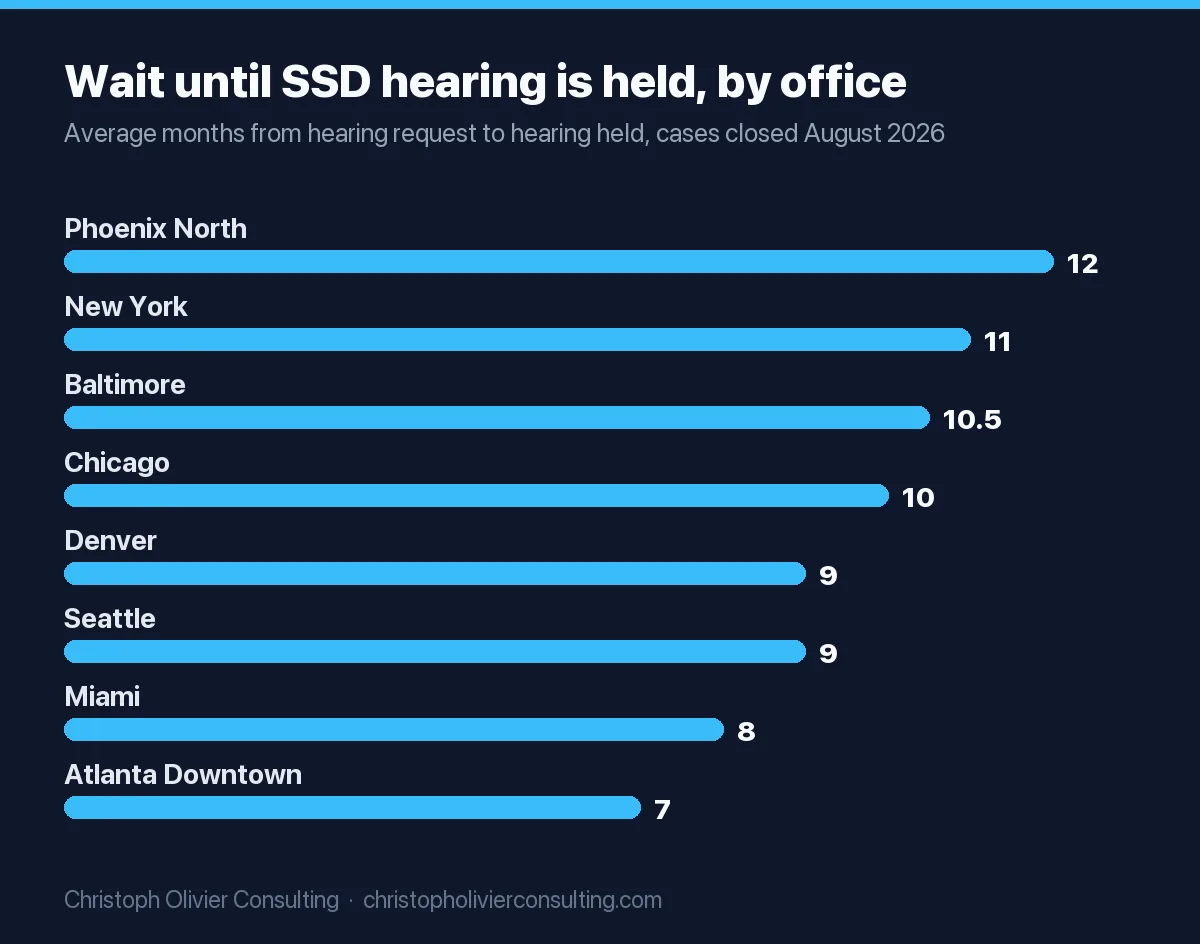
| Average wait from hearing request to hearing held | Median 8 months across 159 offices, most between 7 and 12 | August 2026 | SSA Average Wait Time Until Hearing Held |
State rates vary more than most firms assume. FY2024 initial allowance ran from 32.7% in Kentucky and 33.5% in Arizona to 48.6% in New Hampshire and 49.0% in Alaska, and reconsideration from 10.0% in Kentucky to 22.8% in New Hampshire, per the same SSA table.
What this means for marketing: a claimant denied at reconsideration who is heading to a hearing is your highest-value lead, because the hearing level is where awards are most common. A brand-new applicant is cheaper to reach but has a long, uncertain road, and your fee arrives months later. With a median 8-month wait just to get to the hearing, cash from today’s ad spend lands next year. Plan your budget around that lag.
Cost per signed case: the calculator
Work backward from what a signed case is worth, then find the cost per lead you can afford. The formula:
Maximum cost per lead = average fee per won case x win rate x share of fee you will spend on marketing x lead-to-signed rate
Worked example, with every assumption labeled:
- Average fee per won case: $3,000 (close to SSA’s 2022 average) or $6,000 (a firm that mostly wins larger back-pay hearing cases). Use your own figure.
- Win rate: 48.1%, the hearing-level share of all dispositions above. Your own rate replaces this once you have one.
- Marketing share: 25% of expected fee. This is my working assumption for a firm that also has to pay staff and overhead out of a capped fee, not an industry rule.
- Lead-to-signed rate: the share of form fills and calls that become signed fee agreements.
| Lead-to-signed rate | Max cost per lead at $3,000 avg fee | Max cost per lead at $6,000 avg fee |
|---|---|---|
| 10% | $36 | $72 |
| 15% | $54 | $108 |
| 20% | $72 | $144 |
| 25% | $90 | $180 |
Now compare with paid search reality. LocalIQ’s 2026 benchmarks put Attorneys and Legal Services at a $9.87 average CPC, 5.55% conversion rate and $131.63 cost per lead. At that cost per lead, a $6,000 average-fee firm needs to sign at least about 18% of leads to stay inside a 25% marketing share. A $3,000 average-fee firm cannot get there on generic legal benchmarks at all; it needs cheaper leads (narrower keywords, better landing pages, organic) or a higher sign rate. This is why the SSD firms that make paid search work obsess over intake, not bids.
Google Ads for Social Security disability lawyers: the build
Campaign structure
| Campaign | Keyword themes | Match types | Landing page | Priority |
|---|---|---|---|---|
| Denial and appeal | ssdi denied, appeal disability denial, disability reconsideration lawyer, disability hearing lawyer, denied ssi what now | Phrase and exact | “Denied? Here is what happens next” page with the 60-day deadline and a call button | Highest budget share |
| Core attorney | social security disability lawyer, ssdi attorney, ssi lawyer, disability lawyer near me | Exact, then phrase | Practice page with fee explanation and local hearing office facts | Second |
| Brand | Firm name, lawyer names | Exact | Home page | Always on, small |
| Application help | help applying for disability, how to apply for ssdi | Phrase, low bids | Application checklist page with intake form | Test only after the first two convert |
The 60-day hook is real: 20 CFR 404.909 gives claimants 60 days after they receive the initial determination notice to request reconsideration. Denied claimants search with that clock running, which is why denial terms convert.
Use Google’s general legal account setup from our guide to Google Ads for lawyers for conversion tracking and call reporting, then add the SSD-specific pieces below.
Negative keyword list (copy and paste)
Broad “disability” terms pull in benefits questions, other practice areas and job seekers. Start with this list as phrase match and review the search terms report weekly:
- SSA services, not lawyers: social security office, office hours, phone number, appointment, replacement card, social security card, ssn, my social security, login, payment schedule, payment dates, deposit dates, cola, retirement, retirement calculator, medicare
- Other practice areas: va disability, veterans, workers comp, workers compensation, long term disability, short term disability, disability insurance, ltd claim (remove any you actually handle)
- Not your client: jobs, careers, salary, hiring, paralegal, how to become, cle, course, school, special education, iep, ada accommodation, disability parking, handicap placard
If you also handle workers’ comp, split it into its own campaign instead of negating it, using the approach in our workers’ compensation lawyer marketing guide.
The Google policy most SSD advertisers miss
Google’s Government documents and services policy lists “Health and welfare assistance programs and benefits” as a restricted category, with “disability aid” and “financial assistance” as examples. A law firm is not selling a government service, but SSD ads can still get caught. The policy offers a certification option for advertisers who believe their ads “shouldn’t be in scope” because they do not promote government documents and services. Apply for that before launch if you see disapprovals. Google says certification typically comes through within 10 to 12 business days after advertiser verification. Google may also add an automatic “Not a government website” disclosure to search ads in covered categories.
Local Services Ads
Local Services Ads charge per lead rather than per click; Google’s LSA help page says you “pay only for leads related to your business and the services you offer,” and that LSA is “available only for certain service categories.” Check whether a disability lawyer category is offered for your ZIP codes in the LSA signup before you plan around it. If it is, LSA tends to suit SSD because the per-lead model maps directly to the cost-per-lead ceiling from the calculator, and the Google Verified badge requires passing Google’s screening.
Geo-messaging with hearing wait data
SSA publishes the average wait until a hearing is held for every hearing office, monthly. Use it in ad copy and landing pages for the offices you cover, and update it when SSA updates the file.
Facebook ads for Social Security disability lawyers
Meta’s special ad categories are housing, employment, financial products and services, and social issues, elections or politics, per Meta’s Marketing API documentation. Legal representation for a disability claim is not housing, employment or politics, and Meta describes the financial category as ads from “advertisers promoting financial products and services,” with credit as a subset. On that reading, a law firm’s SSD ad does not belong in a special ad category, and you would pick none. If Meta’s review ever classifies your ad as financial, the US restrictions apply: ages fixed at 18 to 65+, no ZIP code targeting, a 15-mile minimum radius, and no lookalike audiences. Write creative about legal help with an appeal, not about money.
The bigger targeting limit is older. Meta removed detailed targeting options tied to “topics people may perceive as sensitive,” including health causes such as “Chemotherapy” and “Lung cancer awareness,” starting January 19, 2022. You cannot target “people with chronic back pain.” Targeting is geography, age and broad audiences, so the creative has to do the qualifying.
What works in that environment:
- Instant forms with qualifying questions. Lead vendor eGeneration lists the screens it sells to SSD firms on its SSD lead page: does not have an attorney, is not receiving SSD benefits, expects to be out of work 12 months, is being treated by a doctor, age, location. Copy that logic into your own form. Add one earnings question: SSA’s substantial gainful activity limit for non-blind claimants is $1,690 a month in 2026 and $1,770 in 2027, so “Are you earning more than $1,690 a month?” filters out people who cannot qualify while working.
- Family members as the audience. Adult children often research for a parent. Creative that says “Is your mom or dad waiting on a disability appeal?” reaches them without health targeting.
- Short video on one question. “What happens at a disability hearing” or “What to do in the 60 days after a denial.” Retarget video viewers with a lead form.
Treat Meta as the top of the funnel and judge it on cost per signed case, the same as search. For setup basics, see our guide to Facebook ads for lawyers.
Sample ad copy you can adapt
Google responsive search ad headlines (30 characters or fewer):
- Denied Social Security?
- Appeal Your SSDI Denial
- You Have 60 Days to Appeal
- SSI and SSDI Hearing Lawyers
- Free Disability Case Review
- Talk to a Lawyer Today
- Fee Capped at 25% of Back Pay
- Chicago Hearing Wait: 10 Mo. (swap in your office and SSA’s current figure; Chicago was 10 months in August 2026)
Descriptions (90 characters or fewer):
- Denied SSDI or SSI? We file your appeal and prepare you for the hearing. Call for a review.
- Fee only if you win back pay: 25% of past-due benefits, up to $9,200 under SSA rules.
- Private law firm. Not affiliated with or endorsed by the Social Security Administration.
Facebook primary text:
“Got a disability denial letter? You have 60 days from the day you receive it to ask for reconsideration. Our lawyers handle SSDI and SSI appeals and hearings in [state]. You pay no fee unless you are awarded back pay, and federal rules cap that fee. Answer 5 quick questions to see if we can help. [Firm name], [responsible lawyer], [city].”
Before any of this runs, check each line against the compliance list below. “Fee only if you win” needs a note on case costs if you charge for records, and the cap language applies only if you use the fee agreement process.
SSD compliance: a pass/fail checklist for every ad
SSD marketing sits under three rulebooks at once: your state’s version of the ABA Model Rules, SSA’s rules for representatives, and a federal statute on Social Security names and symbols.
| Check | Pass | Fail | Rule |
|---|---|---|---|
| Government look | Your own logo and colors; plain words like “Social Security disability appeals” | SSA seal, eagle, blue SSA-style layouts, “Official Social Security help” | 42 U.S.C. 1320b-10: no false impression of SSA approval; a disclaimer does not cure it; up to $5,000 per violation, $25,000 for broadcasts, each copy or viewing counts |
| Outcome promises | “We prepare you for your hearing” | “Guaranteed approval,” “We win benefits” | 20 CFR 404.1740(c)(3) bars false or misleading statements; your state bar’s advertising rules add their own limits |
| Qualifications | Accurate titles; “attorney” only for attorneys | “Specialist” without state-approved certification, implying a non-attorney is a lawyer | Model Rule 7.2(c); 20 CFR 404.1740(c)(1) on misleading claimants about qualifications |
| Responsible lawyer named | Name and contact of at least one lawyer or firm in the ad | Anonymous “disability help center” ads | Model Rule 7.2(d) |
| Paying for referrals | Paying the reasonable cost of advertising or a qualified lawyer referral service | Paying a clinic, advocate or vendor per recommended claimant | Model Rule 7.2(b) |
| Outbound contact | Calling people who submitted a form or called you | Cold calls or live video to denied claimants from a purchased list | Model Rule 7.3(b) on live person-to-person contact, as in North Carolina’s version; ABA Formal Opinion 501 makes you responsible for agents, including marketing firms (summary) |
| Fee statements | Fee explained as 25% of past-due benefits up to $9,200 under an SSA-approved fee agreement | Quoting a fee SSA has not authorized, or collecting extra | 20 CFR 404.1740(c)(2); SSA fee agreement rules |
Rule 7.3 comment language in North Carolina’s version treats “chat rooms, text messages, or other written communications” as outside live contact, but state versions differ. Check your state bar’s rules, filing requirements and any required labels before you publish, in every state where you take claimants.
Buying SSD leads: pricing models and what to ask
Lead buying is common in SSD because the work is federal and can run by phone across state lines. Vendors rarely publish prices. Here is what is verifiable:
| Model | How you pay | What to check |
|---|---|---|
| Exclusive real-time leads | Per lead. eGeneration says price depends on screening and volume, with “no minimum purchase” and targeting by three-digit ZIP, area code, state or nationwide (source) | Which screens are applied, and the return policy for bad leads |
| Shared leads | Lower price per lead, but several firms call the same claimant | How many buyers receive each lead |
| Filtered packages | eGeneration says the more it filters, the higher the price per lead | Whether you pay for leads that fail your screens |
| Per signed case or retainer | A fee tied to each claimant who signs | Whether your state bar treats this as paying for a recommendation under Rule 7.2(b); get a bar opinion first |
The one cost-per-case figure a vendor publishes is eGeneration’s claim that most of its Social Security clients spend “around $250-350 per desired case” (source). The page is undated, so treat it as a vendor’s claim and run your own numbers through the calculator above. Our guides on whether you should buy leads and on speed to lead cover the rest of the lead vendor checklist and how fast to call back.
Attorneys vs non-attorney representatives: who you are competing with
SSA lets non-attorneys represent claimants. Under 20 CFR 404.1705, an attorney needs the right to practice law before a court and must not be suspended or disqualified, while a non-attorney must be “capable of giving valuable help,” of good character, and not disqualified. Both must register with SSA.
The difference that matters for marketing is direct payment. To have SSA pay fees directly, a non-attorney must qualify as an Eligible for Direct Payment Non-Attorney (EDPNA). Per SSA’s EDPNA page, that takes a $1,000 application fee, a bachelor’s degree or four years of relevant experience plus a high school diploma or GED, a background check, a 50-question exam with a 70% passing score, professional liability insurance and ongoing continuing education.
So in your ad auctions you compete with law firms, national advocacy companies and individual advocates, all bidding on the same “disability help” terms. If you are a lawyer, say so plainly and accurately in ads and on landing pages, because claimants often do not know there is a difference. Do not disparage advocates; just state what you are.
SEO for Social Security disability attorneys
Organic search is the channel most likely to lower your cost per case over time, and SSA’s public data gives you content nobody else in your market publishes. Three page types that answer real claimant questions:
- Hearing office pages. One page per hearing office you cover, with SSA’s current average wait, what to expect at that office, and how to prepare. Update monthly from SSA’s file.
- State approval rate pages. “What are the odds of approval in [state]?” answered with the state’s initial and reconsideration rates from SSA’s table, and what that means for the next step.
- Denial letter explainers. One page per common denial reason, each ending with the 60-day deadline and a call button.
The technical and local groundwork is the same as any firm’s; our guide to SEO for law firms covers it. For a parallel practice area with federal agency data and fixed deadlines, compare how we approach marketing for immigration lawyers.
A 90-day plan for SSD firm marketing
- Days 1 to 10: numbers first. Pull your average fee per won case and win rate from the last 24 months. Fill in the calculator to get your maximum cost per lead. Set up call tracking and a CRM stage for “fee agreement signed.”
- Days 1 to 14: compliance pass. Run every existing ad and landing page through the checklist. Remove any SSA-style imagery. Confirm your state bar’s filing and labeling rules.
- Days 10 to 20: intake. Write a 5-question screening script (attorney already, receiving benefits, out of work 12 months, treating doctor, earnings above $1,690 a month). Set a same-day callback standard and staff for it.
- Days 15 to 30: Google Ads launch. Denial and appeal campaign plus core attorney campaign, phrase and exact only, the negative list above, and a “not in scope” certification request if ads get disapproved under the government services policy. Check LSA availability for your ZIPs.
- Days 30 to 60: first read. Judge on cost per signed fee agreement, not clicks. Cut keywords above your calculator ceiling. Add hearing-wait figures to ads for your main office.
- Days 45 to 75: Meta test. One video, one instant form with qualifying questions, broad audience in your service area, a fixed test budget. Compare cost per signed case with search.
- Days 60 to 90: build the organic base. Publish hearing office and state approval rate pages, then a denial-letter series. Decide whether to keep, scale or cut each channel using the same cost-per-signed-case number.
If you want a second set of eyes on your fee math or a channel plan built around it, you can book a consultation.
Work with CO Consulting
Want this done for your business?
- A diagnostic call and an audit of your current marketing and numbers
- A prioritized 90-day plan built for your market
- Execution across SEO and AI search, paid ads, content, funnels and automation
- Weekly check-ins and monthly reporting, led by a fractional CMO
Frequently asked questions
Do Google Ads work for Social Security disability lawyers?
They can, if you bid on denial and appeal searches and judge results on cost per signed fee agreement. LocalIQ's 2026 benchmarks put legal cost per lead at $131.63. With SSA fees capped at 25% of past-due benefits or $9,200, many firms need to sign roughly one in five leads, or find cheaper leads, for paid search to pay.
Should a disability law firm use Facebook ads?
Yes, as top-of-funnel reach rather than a replacement for search. Meta removed health-condition detailed targeting in January 2022, so you target by location and age and let the creative qualify people. Use instant forms with screening questions, aim some creative at adult children helping a parent, and measure Facebook on the same cost per signed case as Google.
Are SSD lawyer ads a Meta special ad category?
On Meta's published definitions, no. The categories are housing, employment, financial products and services, and social issues, elections or politics, and legal representation for a disability claim fits none of them. If Meta classifies an ad as financial anyway, US limits apply: ages fixed at 18 to 65+, no ZIP targeting, a 15-mile minimum radius and no lookalikes.
What is the maximum fee for a Social Security disability lawyer?
Under the fee agreement process, the fee is the lesser of 25% of past-due benefits or $9,200 for favorable decisions issued on or after November 30, 2024. SSA said in May 2025 that the cap stays in effect until it publishes an increase. When SSA pays you directly, it also deducts a user fee of 6.3% or $123, whichever is less.
What negative keywords should disability attorneys use in Google Ads?
Block SSA service searches (social security office, phone number, replacement card, my social security, payment dates, cola), other practice areas you do not handle (va disability, workers comp, long term disability, disability insurance) and job or school searches (jobs, salary, paralegal, special education, disability parking). Add them as phrase match and review the search terms report weekly.
Can a Social Security disability firm use SSA's name or logo in ads?
Using Social Security words or symbols in a way that suggests SSA approval is prohibited by 42 U.S.C. 1320b-10, and a disclaimer does not fix it. Penalties run up to $5,000 per violation and $25,000 for broadcasts, with each copy or viewing counted separately. Describe your service in plain words and use your own branding.
How much do Social Security disability leads cost?
Few vendors publish prices. eGeneration says its exclusive SSD lead price depends on screening filters and volume, with no minimum purchase, and claims clients spend around $250 to $350 per desired case on an undated page. Compare any quote with your own maximum cost per lead, worked out from your average fee, win rate and sign rate.
More marketing guides for law firms
- Marketing for Workers Compensation Lawyers: Channels, Costs, and Compliance
- Marketing for Bankruptcy Attorneys: Channels, Costs, and Compliance
- Marketing for Construction Law Firms: Channels, Costs, and Compliance
- Marketing for Corporate Law Firms: Channels, Trust, and Compliance
- Marketing for Employment Lawyers: Two Motions, One Firm
- Marketing for Immigration Lawyers: Channels, Costs, and Compliance
- Marketing for Law Firms