

A business-owner workshop for exit planning advisors works best as a 75-minute, 14-slide session: a 5-minute “thank the room” introduction, 40 minutes of teaching (who owns businesses now, what is actually selling, what drives the multiple, a live readiness self-assessment, deal structure and tax basics), 20 minutes of questions, and a close that offers one thing: a 1:1 readiness review. Below is the run of show, the introduction scripts for you and your co-host, talking points and an on-screen number for every slide (each one sourced to a primary report), a scored self-assessment handout, the compliance checks for RIAs, BD reps and CEPA holders, and the invitation and follow-up emails.
The 75-minute run of show
Print this table and tape it to the lectern. The minute marks assume a 60 to 90 minute slot: cut slides 9 and 12 for a 60-minute breakfast, or double the Q&A for a 90-minute evening event.
| Minutes | Slide | What the slide has to do | Number on screen (source) |
|---|---|---|---|
| 0 to 3 | 1. Host introduction | Co-host introduces you and says why they invited you | None |
| 3 to 6 | 2. Thank the room, agenda, disclaimer | Thank attendees and partners, set the 75-minute promise, state it is education | None |
| 6 to 10 | 3. Who owns businesses now | Show the room it is not alone | 51.3% of employer-firm owners are 55 or older (Census ABS, 2023) |
| 10 to 14 | 4. What owners say about their exit | Plans versus preparation | 75% want out within 10 years (EPI, 2023 survey) |
| 14 to 19 | 5. What is selling right now | Real prices, not anecdotes | Median sale price $350,000, Q3 2026 (BizBuySell) |
| 19 to 24 | 6. Why some businesses get a bigger multiple | Size and transferability drive price | 3.73x vs 2.30x cash flow, above vs below $1M (BizBuySell) |
| 24 to 28 | 7. Three kinds of readiness | Business, personal, financial | 9% have no plan at all for life after the sale (EPI, 2023) |
| 28 to 38 | 8. Live self-assessment | Attendees score themselves on paper | The 12-question handout below |
| 38 to 43 | 9. Exit options menu | Internal vs external paths | 70% prefer an internal transition (EPI, 2023) |
| 43 to 48 | 10. Deal structure basics | Cash at close is not the price | 78% of buyers expect to use SBA financing (BizBuySell, Q3 2026) |
| 48 to 52 | 11. Tax in general terms | Why the CPA is in the room early | 20% top federal capital gains rate plus 3.8% NIIT (IRS) |
| 52 to 55 | 12. The team | Who does what | Financial advisors now rank as owners’ most trusted advisor (EPI, 2023) |
| 55 to 72 | 13. Q&A | Answer, never value anyone’s business from the stage | None |
| 72 to 75 | 14. The offer | One next step: a 1:1 readiness review | None |
The “thank the room” introduction: two scripts
The first five minutes decide whether a room of owners leans in or checks email. Two people speak: the co-host who introduces you, and you. Send the host script to your co-host a week ahead so they do not improvise a sales pitch for you.
Script 1: the co-host’s 60-second introduction of you
“Thank you all for coming out this morning. I’m [Name], and I’ve been [the CPA / the banker / the attorney] for many of the businesses in this room. The question I hear most from owners isn’t about taxes. It’s ‘what happens when I want out?’ I don’t have the whole answer to that, so I asked [Advisor Name] to come and walk us through it. [He/She] works with owners of [type of business] in [region] on getting a company ready to sell or hand over, years before the sale. [He/She] holds the [designation, spelled out] and is a [registered investment adviser / registered representative of Firm X / consultant]. This is an education session, not a sales pitch, and there will be time for your questions. Please welcome [Advisor Name].”
Two rules for the host. They state your actual registration status in plain words, and they do not praise your results. If the co-host receives anything of value for promoting you, that introduction is an endorsement under the SEC Marketing Rule (see the compliance table below).
Script 2: your opening, thanking the room
“Thank you, [Host]. And thank you to everyone here. I know what it costs an owner to give up a weekday morning, so I’ll keep my promise: we’ll finish at [time], with at least 15 minutes for your questions. Thank you also to [venue/partner] for hosting us, and to [co-host firm] for the invitation.
Here’s what we’ll cover: who owns businesses today, what businesses like yours are actually selling for this year, what makes a buyer pay more, and a 10-minute self-assessment you’ll fill out yourself and take home. Nobody else sees it.
One thing before we start. This is general education. I won’t put a value on anyone’s business from up here, and nothing today is tax, legal or investment advice for your situation. Your own CPA and attorney need to look at your numbers. With that, let’s start with a question: raise your hand if you’ve been approached by a buyer in the last two years.”
That last line works because it gets hands in the air in the first three minutes and tells you who in the room is already being courted.
Slide-by-slide talking points, with the number for each screen
Put the number on the slide in large type and the source in small type underneath. Owners trust a figure they can look up later more than one you assert.
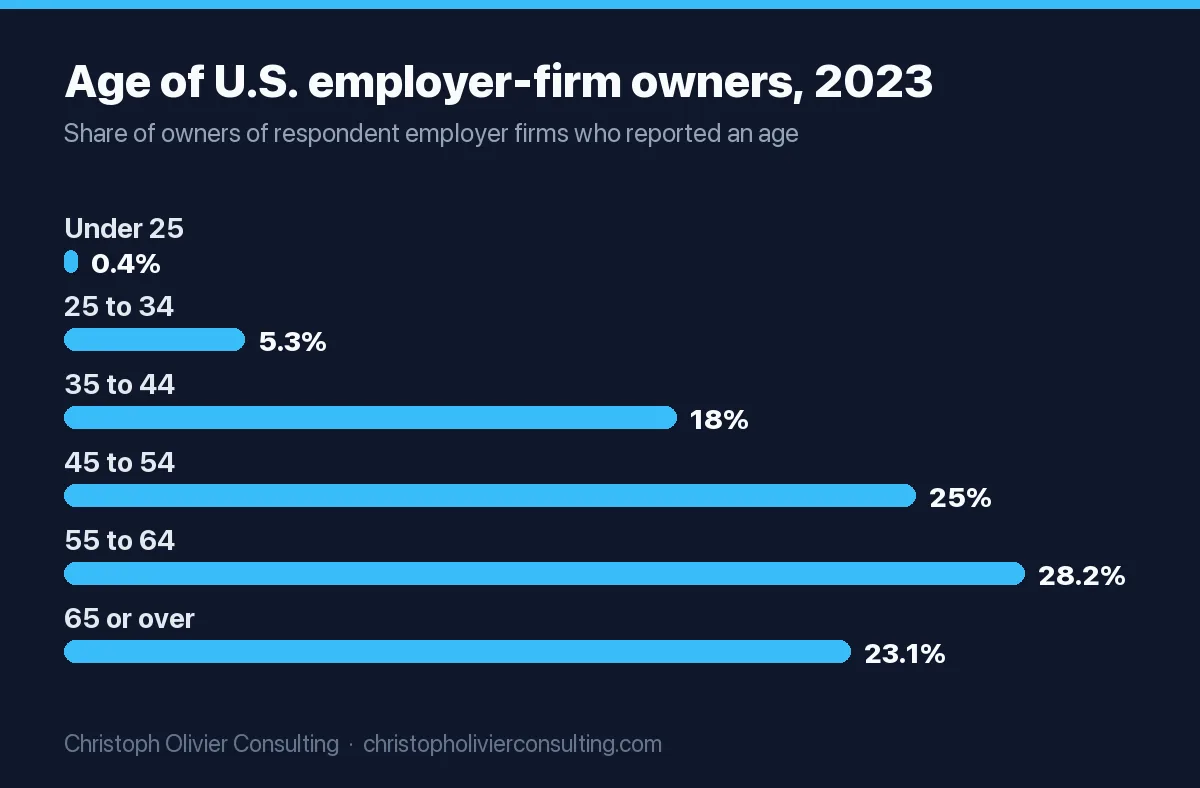
Slide 3: Who owns businesses now
On screen: of the 4,208,231 owners of employer firms who reported their age in the Census Bureau’s Annual Business Survey (data year 2023), 28.2% were 55 to 64 and 23.1% were 65 or over. That is 51.3% aged 55 or older, about 2.16 million owners.
Talking points: more than half of the owners of businesses with employees are 55 or older. Many of them will try to sell in the same decade. Say the implication plainly: when a lot of similar businesses come to market together, buyers get to choose, and the ready ones get chosen.
Slide 4: What owners say about their exit
On screen: in the Exit Planning Institute’s 2023 National State of Owner Readiness Report (1,162 U.S. business owners surveyed in 2023), 49% wanted to exit within five years and 75% within ten. 68% had sought outside advice on their exit, up from 38% in 2013, and 60% had a formal business valuation within the last two years, up from 18% in 2013.
Talking points: intentions are high, and preparation is improving, so the owners in this room are competing with better-prepared sellers than a decade ago. EPI’s 2025 Generational report, which re-cuts the same 2023 data, found 58% of Baby Boomer owners plan to exit within five years, while 78% of them had not completed a pre-transition value enhancement.
Label the source honestly on the slide. EPI issues the CEPA credential, so this is a vendor survey, and its sample skews young: Baby Boomers were only 19% of respondents, while the Census count above puts 51.3% of employer-firm owners at 55 or older. Present EPI’s figures as “what owners who answered EPI’s survey said”, not as a national census.
Slide 5: What is selling right now
On screen, from the BizBuySell Insight Report for Q3 2026: 2,132 businesses changed hands in the quarter, down 7% from a year earlier. Median sale price $350,000, up 17% year over year. Median cash flow $156,000. Median revenue $669,801.
Talking points: BizBuySell says part of the price increase reflects deal mix, because a bigger share of sales were larger businesses. Say that out loud, or someone in the room will hear “prices are up 17%” and add 17% to their own number. Sector lines help if your room is mixed: service businesses posted 992 transactions at a $350,000 median, manufacturing a $807,000 median with the highest average cash flow multiple of the major sectors at 3.02x, and restaurants a $235,000 median.
Slide 6: Why some businesses get a bigger multiple
On screen: businesses that sold for more than $1 million averaged 3.73x cash flow and 0.97x revenue, and sold at 100.8% of asking price. Businesses under $1 million averaged 2.30x cash flow, 0.62x revenue and 93.6% of asking (BizBuySell, Q3 2026). Sales above $1 million were 22% of the quarter’s transactions, the highest share on record.
Talking points: the same report says buyers’ biggest obstacle is finding a quality business (31%), ahead of financing (15%) and asking prices (13%). Buyers are not scarce; transferable businesses are. Then walk the value drivers in the table below and ask the room to circle the one that worries them most.
| Value driver | What a buyer checks | What the owner can start this year |
|---|---|---|
| Owner dependence | Who holds the key customer relationships and approvals | Name a second-in-command for sales and operations; take a two-week absence and log what broke |
| Customer concentration | Revenue share of the top customer and top three | Track it monthly; set a ceiling for any single customer |
| Recurring revenue | Contracted or repeat revenue as a share of the total | Convert repeat work into agreements with renewal terms |
| Clean financials | Whether add-backs are documented and statements are CPA-prepared | Separate personal expenses now; keep a written add-back schedule |
| Documented systems | Whether processes survive staff turnover | Write the ten procedures a new owner would ask for first |
If your room is agency owners, swap in agency multiples instead. FE International’s October 2026 benchmarks put agencies at 3x to 5x adjusted EBITDA between $500,000 and $1 million, 4x to 6.5x at $1 million to $2.5 million, 5.5x to 8.5x at $2.5 million to $5 million and 7x to 12x above $5 million, with owner-run shops priced at 2x to 4x SDE. The other sources and a worked example are in our agency exit planning guide with current multiples.
Slide 7: Three kinds of readiness
On screen: EPI frames readiness as three “legs of the stool”: business, personal and financial. In its 2023 survey, 41% of owners had a formal written plan for what they would do after selling, 50% had an informal plan, and 9% had no plan at all.
Talking points: business readiness asks whether the company runs without you. Financial readiness asks whether the sale funds the life you want. EPI’s report, citing Walking to Destiny, defines the Wealth Gap as your Wealth Goal minus your current net worth. Personal readiness asks what Monday looks like after closing. Most owners only work on the first leg.
Slide 8: The live self-assessment
Hand out the 12-question scorecard from the next section. Give the room eight minutes, then two minutes to total their score. Tell them up front that nobody collects the sheets. Saying so makes honest answers more likely, and the review offer on slide 14 is where an owner chooses to share the score with you.
Slide 9: The exit options menu
On screen: in EPI’s 2023 survey, 70% of owners said they preferred an internal transition, and family transition ranked first among internal options. In 2013, 53% preferred an external sale. 13% were unsure.
Talking points: list the paths without recommending one: sale to a strategic buyer, sale to private equity or a search fund, sale to management, transfer to family, and an employee stock ownership plan. For each, give one sentence on who pays, when the owner gets cash, and how long the owner usually stays. The point: preference for an internal transfer is high, but an internal buyer often cannot pay cash at close, which leads straight into slide 10.
Slide 10: Deal structure basics
On screen: 78% of buyers surveyed by BizBuySell in Q3 2026 said they expect to use SBA financing. BizBuySell also reports that new SBA rules took effect on October 1, requiring an independent valuation on every SBA-financed change of ownership, a quality of earnings report on deals of $3 million or more, and proof that historical earnings cover the debt.
Talking points: the headline price is not the check at closing. Walk through the four pieces: cash at close (often bank or SBA funded), a seller note, an earn-out tied to future results, and rollover equity if a private equity buyer wants you to keep a stake. Then explain asset sale versus stock sale in one line each. In an asset sale, both seller and buyer file IRS Form 8594 to report how the price is allocated across the assets when goodwill could attach, so the allocation is negotiated, not automatic.
Slide 11: Tax considerations, stated generally
On screen: for 2025 tax years, long-term capital gains are taxed at 0%, 15% or 20% depending on taxable income, with the 20% rate starting above $600,050 for married couples filing jointly (IRS Topic 409). The 3.8% Net Investment Income Tax can apply above $250,000 of modified adjusted gross income for joint filers. Under the installment method, gain is spread over the years you receive payments, but depreciation recapture is reported as ordinary income in the year of the sale.
Talking points: three ideas only. The structure of the deal changes the tax, so the CPA has to be involved before the letter of intent, not after. Asset versus stock and the price allocation change what is ordinary income and what is capital gain. A seller note can spread the gain over time, but not all of it. Read the not-advice line out loud: “These are general rules from IRS publications. Your result depends on your entity type, your state and your numbers. Ask your CPA.”
Slide 12: The team an owner needs
On screen: in EPI’s 2023 survey, financial advisors moved from fifth to first as owners’ most trusted advisor, and CPAs moved from first to third.
Talking points: name the roles: exit planning advisor, CPA, transaction attorney, wealth advisor, and the M&A advisor or business broker who runs the sale. Note that someone who facilitates the sale of company stock either is registered as a broker or relies on an exemption: the federal M&A broker exemption covers sales of privately held companies with EBITDA under $25 million or gross revenue under $250 million in the prior fiscal year, with conditions. Owners should ask every advisor which hat they wear. If you have co-hosts, this is the slide where you point to them in the room.
Slide 13: Q&A
Seed the first question so the room does not sit silent. Ask your co-host to raise one of these: “How early is too early to start?” or “What do buyers look at first?” Then expect the one question you must not answer from the stage: “What is my business worth?” Use this line:
“Honest answer: I’d be guessing, and a guess from a stage is worse than no number, because you’d remember it. What I can tell you is the range businesses your size sold for this quarter, which is on slide 6, and what moves you up or down inside it. Your actual number takes your financials. That’s part of what the readiness review covers.”
Slide 14: The offer, a 1:1 readiness review
One offer, no menu. A version that works on a slide: “Want to know where your business stands? Book a 45-minute readiness review. We go through your scorecard together, and you leave with your three biggest gaps and what to do first. No cost, no obligation.” Give every attendee a card with three checkboxes: “Book my readiness review”, “Send me the slides”, and “Not now, keep me on the list”. Collect cards at the door. Owners who book will expect a proposal after the review; our guide to presenting exit planning proposals and pricing covers that meeting.
Do not call the review a “free valuation”. It promises a number you will not deliver in 45 minutes, and a promissory claim is exactly what both the SEC and FINRA rules below prohibit.
The readiness self-assessment handout (copy and print)
Score each line 0, 1 or 2. The thresholds are rules of thumb for a workshop exercise, not a valuation method. Where a threshold comes from a published source, the source is named.
| # | Question | 2 points | 1 point | 0 points |
|---|---|---|---|---|
| 1 | Could the business run for four weeks without you? | Yes, it has | Probably, never tested | No |
| 2 | Share of revenue from your largest customer | Under 15% (FE International’s top-of-band test for agencies) | 15% to 25% | Over 25% |
| 3 | Share of revenue under contract or recurring | Over 60% (FE International’s top-of-band retainer mix for agencies) | 30% to 60% | Under 30% |
| 4 | Financial statements | CPA-reviewed or audited, last 3 years | CPA-compiled | Internal only |
| 5 | Owner add-backs | Written schedule with receipts | Known, not written | Mixed into the books |
| 6 | Formal valuation | Within the last 2 years (EPI’s survey measure) | Older than 2 years | Never |
| 7 | Second-in-command | Named, paid to stay through a sale | Named, no retention plan | None |
| 8 | Key processes documented | Written and used | Partly | In your head |
| 9 | Your Wealth Gap (goal minus net worth) | Calculated with an advisor | Rough idea | Unknown |
| 10 | Plan for life after the sale | Written (41% of EPI respondents) | Informal (50%) | None (9%) |
| 11 | Buy-sell agreement and estate plan | Both current, reviewed in 3 years | One of the two | Neither |
| 12 | Family and partners know your timeline | Discussed and written down | Mentioned | Not discussed |
Scoring bands to print at the bottom: 19 to 24, ready to test the market with advisors in place. 11 to 18, a 2 to 3 year preparation project. 0 to 10, start with lines 1, 4 and 9 this quarter. For the full advisor-side diagnostic, our exit readiness checklist goes deeper than a workshop handout should.
Compliance checks before you present
This is general information, not legal advice. Run the slides, handout, invitation and replay past your compliance officer or counsel. Which column applies depends on how you are registered.
| Item | RIA (SEC Marketing Rule) | BD rep (FINRA Rule 2210) | Any CEPA holder |
|---|---|---|---|
| Live talk | “Extemporaneous, live, oral communications” are excluded from the definition of advertisement in 17 CFR 275.206(4)-1 | An unscripted seminar is a “public appearance” under Rule 2210(f) and must meet the (d)(1) content standards | Say what the credential is, and what it is not |
| Slides, handout, invite, landing page, replay | Not extemporaneous. Treat as advertisements if they offer your advisory services: no untrue or unsubstantiable statements, fair and balanced treatment of risks | Written material reaching more than 25 retail investors within 30 calendar days is a retail communication: principal approval before use, and the member firm’s name shown prominently | Spell out “Certified Exit Planning Advisor (CEPA)” on the bio slide |
| Co-host or partner promoting you | An endorsement: disclose compensation and conflicts; written agreement required unless compensation is $1,000 or less in 12 months | If you write or supply the co-host’s invitation, assume it is your communication and get it approved | Co-host introductions state your real registration status |
| Outcome claims | No implied results; benefits must come with material risks and limitations | No “false, exaggerated, unwarranted, promissory or misleading” claims; no performance predictions | No “free valuation” or “maximize your sale price” promises |
On the credential itself: FINRA’s designation profile for the CEPA lists a five-day virtual program, an online, proctored, closed-book final exam and 40 hours of continuing education every three years, with age 18 as the only prerequisite. FINRA states it does not approve or endorse any designation. So the CEPA on your bio slide is proof of training, not a license to give tax, legal or securities advice. The full testimonial and review rules across the SEC, FINRA and FTC, which matter the moment you quote an attendee’s feedback, are laid out in our guide to reviews and testimonial rules for exit planning advisors.
How to fill the room: co-hosts, invitations and a 6-week timeline
The fastest way to fill a room of owners is to borrow someone else’s list. A CPA, a business attorney or a commercial banker each has owners who trust them and who ask about exits. Offer the co-host something real: a speaking slot on the team slide, their logo on the invitation, and the attendee list for those who check a box agreeing to be contacted by them.
| Co-host | What they bring | Their 3-minute segment |
|---|---|---|
| CPA firm | Owners whose tax returns they prepare | Slide 11: why the tax conversation starts before the letter of intent |
| Business or estate attorney | Clients with stale buy-sell agreements | Slide 12: buy-sell agreements and what a purchase agreement covers |
| Commercial or SBA banker | Business borrowers, plus buyers looking for deals | Slide 10: what lenders need to finance a buyer |
Timeline: six weeks out, confirm the co-host, venue and date, and pick a breakfast or lunch slot so owners lose as little of the working day as possible. Five weeks out, publish the registration page and send invitation 1. Three weeks out, send invitation 2 and submit the event to your local business journal’s calendar, using the press steps in our PR and media guide for exit planning advisors. One week out, send invitation 3 to non-openers and start ads to registration-page visitors, built the way our retargeting guide for exit planners sets up audiences. The day before and two hours before, send reminders with parking details. If you are mailing printed invitations instead, the response math and the follow-up cards are in our estate planning seminar marketing guide, which uses the same mechanics.
Invitation email (send from the co-host’s address)
Subject: What is your business worth to a buyer in 2026? (75 minutes, [date])
Alternate subject: Breakfast for owners thinking about the next 5 to 10 years[First name],
A lot of the owners we work with have asked us the same question this year: “If I wanted to sell in a few years, where would I start?”
So we’ve asked [Advisor Name], [registration status in plain words], to run a 75-minute breakfast workshop for business owners on [date] at [venue]. You’ll see what businesses like yours actually sold for this year, what makes a buyer pay more, and you’ll score your own business on a 12-question readiness sheet you keep.
It’s education, not a sales pitch. Seats are limited to [number] owners.
[Register button]
[Co-host name], [firm]
Have the invitation approved before it goes out if you are FINRA-registered or an RIA; it is written, and it reaches more than 25 people. If you want a second set of eyes on the registration page and follow-up sequence before the first invitation goes out, you can book a consultation.
The follow-up sequence after the workshop
Most of the value of the event comes after it. Sort the cards the same evening into the three checkbox groups, then run this sequence.
| When | Who gets it | Message |
|---|---|---|
| Same day | “Book my review” cards | Personal email with two time slots. Do not send a booking link alone. |
| Day 1 | All attendees | Thank-you email, slides as a PDF, a blank scorecard, and the review offer repeated once |
| Day 2 | Registered no-shows | “Sorry we missed you”: the slides plus the scorecard, with the review offer |
| Day 7 | Attendees who have not booked | One question: “Which line on the scorecard surprised you?” Reply-based, no link |
| Day 14 | Co-host’s attendees | Co-host sends a short note mentioning the review. Same endorsement rules apply. |
| Day 30 | “Not now” group | A three-line note on one scorecard item, for example how to work out your Wealth Gap |
| Day 90 | Everyone not yet a client | Invitation to the next workshop, with a different topic slide (for example, tax or family transfers) |
Update slides 5 and 6 every quarter when BizBuySell publishes, and slide 3 when the Census Bureau releases the next Annual Business Survey owner tables. A workshop that shows this quarter’s numbers is a reason to come back. One that shows last year’s is a reason not to.
Frequently asked questions
How do you thank the room in a workshop introduction?
Thank the attendees first for giving up working time, then the venue and any co-host by name, then restate your promise: when you will finish and how much time is reserved for questions. Follow with a one-line agenda and a plain statement that the session is general education, not tax, legal or investment advice. Close the opening with a show-of-hands question so the room participates in the first three minutes.
What should an exit planning workshop for business owners include?
Cover who owns businesses now, what businesses are actually selling for, what drives a higher multiple, the three kinds of readiness (business, personal, financial), a self-assessment owners complete themselves, the main exit options, deal structure basics, tax rules stated generally, and the team an owner needs. End with Q&A and a single next step, such as a 1:1 readiness review.
How long should an exit planning seminar for owners be?
Plan 60 to 90 minutes. A 75-minute version gives roughly 6 minutes to introductions, 45 minutes to teaching and the self-assessment, 17 minutes to questions and 3 minutes to the offer. For a 60-minute breakfast, cut the exit options and team slides and keep the self-assessment, because it is the part owners take home and act on.
What data should I show in an exit planning presentation?
Use figures owners can look up: the Census Bureau's Annual Business Survey owner age table (51.3% of employer-firm owners were 55 or older in 2023), the latest quarterly BizBuySell Insight Report for sale prices and cash flow multiples, and the Exit Planning Institute's State of Owner Readiness survey, labeled as a vendor survey. Put the source under each number and update the deal data every quarter.
Do FINRA or SEC rules apply to an exit planning workshop?
Often, yes. For RIAs, live extemporaneous speech is excluded from the SEC Marketing Rule's definition of advertisement, but slides, invitations and replays that offer advisory services are not. For broker-dealer reps, an unscripted seminar is a public appearance under FINRA Rule 2210, and written material reaching more than 25 retail investors within 30 days needs principal approval. Confirm with your compliance officer.
Can I use my CEPA designation on workshop slides?
Yes, but spell it out as Certified Exit Planning Advisor and present it as training. FINRA's designation profile lists a five-day program, a proctored closed-book exam and 40 hours of continuing education every three years, and FINRA says it does not endorse any designation. Do not imply the CEPA is a license to give tax, legal or securities advice.
What offer should close an exit planning workshop?
Make one offer, not a menu: a 45-minute 1:1 readiness review where you go through the attendee's scorecard and name their three biggest gaps. Collect a card with three boxes (book my review, send the slides, keep me on the list). Avoid calling it a free valuation, because that promises a number you cannot responsibly give in one meeting.