
An RV park owner’s income runs from close to nothing to well over $250,000 a year, and two things decide where you land: how many sites you rent on how many nights, and what you paid for the land. The typical U.S. RV park or campground company with employees took in between $100,000 and $499,999 in 2022 (Census SUSB). Sole proprietors in the industry reported an average tax profit of just $4,550 on $93,166 of receipts in 2023 (IRS SOI, my calculation). A hired lodging manager at an RV park earned a median of $59,330 in May 2025 (BLS).
Short answer: I built a model from public data. With the park owned free and clear, the owner keeps about $52,000 pre-tax from a 40-site seasonal campground they run themselves, about $282,000 from a 100-site year-round park and about $994,000 from a 250-site resort with a hired manager. Now buy those same parks at a 9.5% cap rate with 25% down and an 8.5% loan. Owner pay falls to about $200, $36,000 and $159,000. No government survey publishes RV park owner income, so treat any single “owner salary” figure online with caution.
Below are the figures that do exist. They come from Census, IRS, BLS, the 2025 10-K filings of Sun Communities and Equity LifeStyle Properties, and SBA lending rules. Then I turn them into a labeled P&L and a pass/fail test you can rerun with your own site count, rates and price.
How much do RV park owners make? What each source actually measures
BLS wage surveys leave out business owners. IRS data comes from tax returns, where depreciation pulls profit down. Census counts revenue, not profit. Each source covers a different slice, so read the “what it measures” column before you quote a number.
| Source and year | What it measures | Figure | How it was calculated |
|---|---|---|---|
| Census SUSB 2022, NAICS 721211 | Revenue per RV park or campground location with employees | $890,146 | $4,425,805,000 receipts ÷ 4,972 establishments (my calculation) |
| Census SUSB 2022, NAICS 721211 | Revenue per firm (one firm can run several parks) | $972,277 | Receipts ÷ 4,552 firms (my calculation) |
| Census Nonemployer Statistics 2022, NAICS 72121 | Revenue per park or camp with no paid employees | $73,011 | $590,733,000 ÷ 8,091 businesses (my calculation) |
| IRS SOI, sole proprietorships, tax year 2023 | Average net income on Schedule C, RV parks and recreational camps | $4,550 (all) / $22,330 (profitable only) | $50.7 million net ÷ 11,144 returns; $176.9 million ÷ 7,922 returns with net income (my calculation) |
| Census Service Annual Survey 2022, NAICS 7212 | Revenue left after total expenses, employer firms | 16.5% | ($7,961M revenue minus $6,649M expenses) ÷ revenue (my calculation) |
| BLS Occupational Outlook Handbook, May 2025 | Median wage of lodging managers employed by RV parks and recreational camps | $59,330 | Published. All lodging managers: $69,250 |
| Sun Communities 10-K, 2025 | RV segment net operating income (NOI) as a share of revenue, before corporate overhead, depreciation and interest | 50.5% | $286.4M NOI ÷ $566.6M revenue across 166 RV properties (my calculation) |
Three things to take from this table:
- The IRS profit figure is not take-home cash. Depreciation ate 17.1% of sole proprietor receipts and interest another 6.5% (my calculation). Add both back and the cash operating margin was about 28.4% for all sole proprietors and 38.2% for the profitable 71.1%. An RV park is a real estate business, so its tax profit sits well below its cash flow.
- The nonemployer average describes small parks. 49.2% of the 8,091 parks and camps without employees took in less than $25,000 in 2022, and 76.1% were sole proprietorships (my calculation). The code also includes recreational camps. Many of these are side businesses, not full-time jobs.
- Sun’s 50.5% is a big-operator number. It comes before head office costs, depreciation and interest. Sun also nets $20.2 million of utility reimbursements against RV expenses, which pushes the margin up. A 40-site park will not get there.
What a typical RV park brings in (the median is far below the average)
The $972,277 average per firm is pulled up by a few large operators. Census also publishes firms by annual revenue band; the shares and per-firm averages below are my calculations.
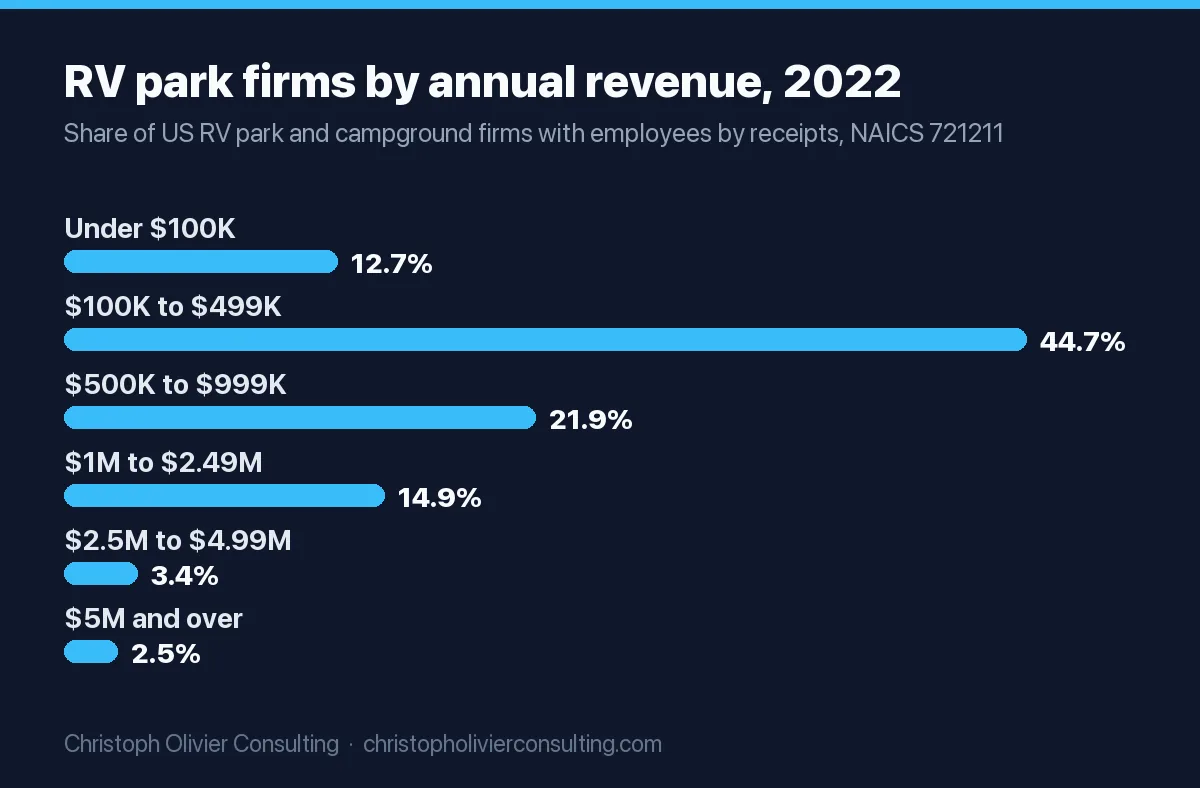
| Annual receipts of the firm | Firms | Share of firms | Cumulative share | Average receipts per firm | Employees per firm | Share of all revenue |
|---|---|---|---|---|---|---|
| Under $100,000 | 578 | 12.7% | 12.7% | $50,687 | 1.0 | 0.7% |
| $100,000 to $499,999 | 2,035 | 44.7% | 57.4% | $281,041 | 1.9 | 12.9% |
| $500,000 to $999,999 | 995 | 21.9% | 79.3% | $709,764 | 4.2 | 16.0% |
| $1 million to $2.49 million | 676 | 14.9% | 94.1% | $1,472,540 | 8.1 | 22.5% |
| $2.5 million to $4.99 million | 156 | 3.4% | 97.5% | $3,142,705 | 18.1 | 11.1% |
| $5 million and over | 112 | 2.5% | 100% | $14,577,455 | 79.2 | 36.9% |
Source: U.S. Census Bureau, SUSB 2022, U.S. 6-digit NAICS by enterprise receipts size, NAICS 721211 (RV parks and campgrounds), released April 10, 2025. Employer firms only. The $5 million and over row combines the published bands above $5 million. Averages and shares are my calculations.
What the table tells you:
- The median RV park company takes in between $100,000 and $499,999 a year. 57.4% of firms are under $500,000, and the average firm in that band collected $281,041 with fewer than two paid employees.
- Revenue is concentrated. The 15 firms with $100 million or more run 229 locations and collect 15.2% of all revenue in the industry.
- Payroll is a smaller cost than in most service businesses. Payroll was 21.3% of receipts in 2022 ($942.1 million of $4.43 billion, my calculation). The bigger costs are land, property tax, utilities and upkeep.
Average RV park revenue in the 8 states with the most parks
| State | Parks with employees | Average receipts per park | Payroll as share of receipts |
|---|---|---|---|
| Texas | 460 | $667,793 | 18.3% |
| California | 359 | $1,399,075 | 24.1% |
| Florida | 265 | $1,546,291 | 22.7% |
| Pennsylvania | 218 | $771,936 | 22.0% |
| New York | 215 | $640,047 | 20.5% |
| Michigan | 212 | $1,099,368 | 20.5% |
| Washington | 194 | $655,521 | 24.5% |
| Wisconsin | 179 | $684,123 | 23.0% |
Source: Census SUSB 2022 state file, NAICS 721211, employer establishments. Averages are receipts ÷ establishments (my calculation). Florida and Arizona averages are lifted by large snowbird resorts; Texas has the most parks but a lower average.
RV park profit margin: what the data says
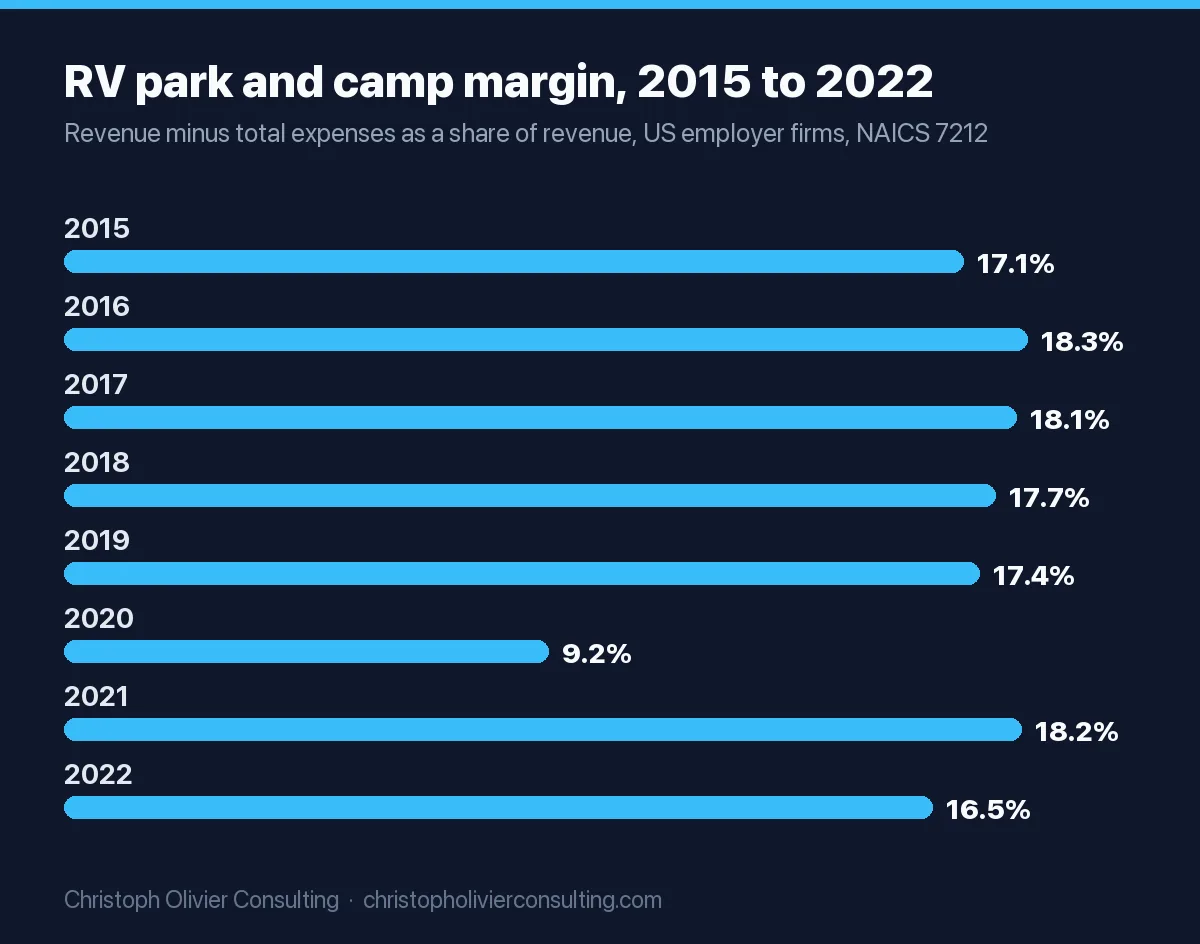
The cleanest industry-wide margin comes from the Census Service Annual Survey. It reports total revenue and total expenses for employer firms in NAICS 7212, which includes RV parks and recreational camps. Revenue minus expenses held between 15.1% and 18.3% in every year from 2013 to 2022 except 2020, when it fell to 9.2% (my calculation).
| Margin measure | Who it covers | Figure | What is already deducted |
|---|---|---|---|
| Revenue minus total expenses, 2022 (Census SAS) | All employer RV parks and camps | 16.5% | Everything the survey counts as an expense, including payroll for any working owner on the payroll |
| Net income, tax year 2023 (IRS SOI) | All sole proprietors | 4.9% | Depreciation and interest, but not the owner’s own labor |
| Net income, tax year 2023 (IRS SOI) | Profitable sole proprietors only | 21.6% | Same as above |
| Cash operating margin, 2023 (IRS SOI, my calculation) | All / profitable sole proprietors | 28.4% / 38.2% | Operating costs only; depreciation and interest added back |
| RV segment NOI margin, 2025 (Sun 10-K) | 166 RV properties | 50.5% | Property operating costs only, utilities partly netted |
| Same Property RV NOI margin, 2025 (Sun 10-K) | 156 RV properties owned since 2024 | 53.2% | Same as above ($276.8M ÷ $520.1M) |
So which number is “the” RV park profit margin? It depends on what you subtract. Before debt and depreciation, a well-run park keeps roughly 30% to 50% of revenue. After depreciation, interest and a paid manager, the industry keeps around 16%. Sun’s expense mix shows where the operating money goes. Across its combined manufactured home and RV Same Property portfolio in 2025, payroll and benefits were 29.1% of operating expenses, real estate taxes 20.6%, supplies and repairs 15.7%, utilities 15.0% and legal, state taxes and insurance 9.1% (my calculation from the 10-K).
Are RV parks profitable? Annual sites pay the bills, transient sites swing
The two public operators answer this question better than any blog, because they break revenue out by guest type. The pattern is the same at both: long-stay sites grew in 2025 and short-stay nightly revenue fell.
| Measure, 2025 | Sun Communities | Equity LifeStyle Properties |
|---|---|---|
| Annual RV sites | 33,330 (includes seasonal rights) | 34,400 |
| Seasonal RV sites | Counted with annual | 11,200 |
| Transient RV sites | 23,550 | 17,500 |
| Average monthly base rent, annual RV site | $682 (Same Property, up 4.6%) | Not disclosed |
| Revenue per annual RV site per year | $10,117 (my calculation: $337.2M ÷ 33,330) | Not broken out from marinas |
| Transient revenue per transient site per year | $9,741, or $26.69 per site per night across 365 nights (my calculation: $229.4M ÷ 23,550) | Not disclosed per site |
| Change in transient revenue | Down 9.0% (Same Property) | Down 8.5% (Core) |
| Change in annual revenue | Up 7.5% (Same Property) | Up 4.1% (Core) |
| Annual share of RV base rent | Not stated | 72.2% of RV and marina base rent (my calculation: $322.3M ÷ $446.3M) |
Sources: Sun Communities 2025 10-K, filed February 25, 2026; Equity LifeStyle Properties 2025 10-K, filed February 18, 2026. Site counts as of December 31, 2025.
Four lessons a private owner can use:
- Transient revenue is seasonal. Sun booked 47.2% of its 2025 transient revenue in July to September and only 10.8% in January to March. Your cash has to last through the slow quarters.
- Transient demand is the volatile line. ELS calls transient revenue “our most volatile” stream. It blamed the 2025 decline on competitor supply coming back after weather damage, softer demand in some markets and fewer returning Canadian guests.
- Converting nightly sites to annual sites is how the big operators protect income. Sun says its RV NOI fell 1.4% mainly because transient revenue dropped $21.1 million, partly offset by converting transient sites to annual contracts.
- Bad parks lose value fast. In the third quarter of 2025, Sun wrote down 6 RV properties by $165.0 million to an estimated fair value of $22.9 million. It cited lower projected cash flows and “deteriorating NOI trends,” and valued them at cap rates of 9.5% to 10.0%.
Is the RV market struggling?
RV sales are down, and that matters for nightly demand. The RV Industry Association counted 342,220 wholesale RV shipments in 2025. Its fall 2026 forecast projects about 290,000 for 2026, a 15.3% drop, and 285,000 for 2027 (RVIA RoadSigns forecast). Shipments through September 2026 were down 13.7% from the year before (RVIA September 2026 report). Shipments count new units sent to dealers, not RVs on the road. The existing fleet still needs places to park. But fewer new buyers usually means fewer first-time campers looking for transient sites.
RV park owner salary: owner pay is a wage plus profit plus a debt bill
An RV park owner can get paid in three ways. Most online answers blend them together.
- A wage for running the park. If you check guests in, mow, fix water lines and answer the phone, you are doing a job a park would otherwise pay $59,330 for at the BLS median for lodging managers in RV parks (May 2025). For maintenance work, the median wage for general maintenance and repair workers was $49,590 (BLS). For grounds maintenance workers it was $40,080 (BLS), both May 2025.
- Profit after operating costs and a capital reserve. Sun spent $69.8 million on recurring capital expenditures in 2025 across 178,650 sites, about $391 per site (my calculation). That covers items like roads, utility lines and amenity repairs. A small park that skips this reserve is borrowing from its future.
- Whatever is left after the mortgage. This is where most first-time buyers get surprised. If you paid full price with borrowed money, debt service can take nearly all of the profit.
So “how much does an RV park owner make” has no single answer. An owner who inherited a paid-off park and runs it with family keeps the wage and the profit. An investor who bought with a loan and hired a manager keeps only what is left after interest.
Worked P&L: what a 40, 100 and 250-site RV park owner makes
This is my own model. The rates and occupancy are assumptions, not published benchmarks. National ARVC benchmarking data on rates and occupancy is limited to members, so these could not be checked against it. Replace every assumption row with your own numbers.
| Line (own calculation) | A: 40-site seasonal campground | B: 100-site year-round park | C: 250-site resort |
|---|---|---|---|
| Site mix | 40 transient, open 180 nights | 40 annual + 60 transient | 100 annual + 150 transient |
| Annual site rent (assumption) | None | $550 a month | $682 a month (Sun 2025 average) |
| Transient revenue (assumption) | 50% occupancy at $50 a night | 45% occupancy at $55 a night, 365 nights | $9,741 per site per year (Sun 2025 average) |
| Total revenue | $180,000 | $806,025 | $2,279,546 |
| Who runs it | Owner and family, unpaid | Owner as manager, plus staff | Hired manager and staff |
| Operating costs (assumption) | 62% = $111,600 (near the 61.8% IRS cost ratio for profitable sole proprietors) | 60% = $483,615 | 52% = $1,185,364 (Sun RV runs 49.5%) |
| Net operating income | $68,400 | $322,410 | $1,094,182 |
| Capital reserve at $400 per site (Sun spends about $391) | $16,000 | $40,000 | $100,000 |
| Owner pay if owned free and clear | $52,400 | $282,410 | $994,182 |
| Price at a 9.5% cap rate (NOI ÷ 0.095) | $720,000 | $3,393,789 | $11,517,709 |
| Conventional loan: 25% down, 8.5%, 25 years, annual payment | $52,179 | $245,949 | $834,693 |
| Owner pay after that loan | $221 | $36,461 | $159,489 |
| Cash return on the down payment | 0.1% on $180,000 | 4.3% on $848,447 | 5.5% on $2,879,427 |
| SBA 7(a) case: 10% down at the 10.00% variable rate cap, 25 years | Owner pay −$18,261 | Owner pay −$50,655 | Not eligible: loan above the $5 million 7(a) limit |
Assumptions: transient rates, occupancy and operating cost ratios are my estimates. The 9.5% cap rate is the low end of the range Sun used to value impaired RV properties in 2025, not a market survey. The 8.5% loan rate is an assumption (the bank prime rate was 7.00% on November 24, 2026 per the Federal Reserve H.15). SBA’s maximum variable rate on 7(a) loans above $350,000 is prime plus 3.0%. Figures are pre-tax, before income tax and before depreciation deductions. Other income such as store sales, propane and laundry is left out.
What the model shows:
- A small seasonal campground is a lifestyle business. Even paid off, park A pays its owner $52,400 for a season of work, below the $59,330 BLS median for a hired RV park manager. Bought with a loan, it pays almost nothing.
- Owner pay comes from what you paid. At a 9.5% cap rate and an 8.5% loan, debt service eats 76% of NOI. With 10% down at SBA’s 10.00% rate cap, it eats 103%, so the owner subsidizes the park.
- Scale buys a real salary only with equity. Park C produces about $1 million a year free and clear. With 75% debt it pays $159,489, a 5.5% cash return on $2.9 million of the owner’s money.
Pass/fail worksheet: will this park pay you a salary?
Run any park you are looking at through these seven tests before you make an offer. Each one uses a number from the seller’s records, your lender or the sources above.
| # | Test | Pass if | Why this threshold |
|---|---|---|---|
| 1 | Debt service coverage: NOI ÷ annual loan payment | 1.40 or higher | At 1.31, the model parks above barely cover the loan plus reserve and pay the owner almost nothing |
| 2 | Owner pay after debt and a $400 per site reserve | At least $59,330 if you work there full time | The BLS median for lodging managers in RV parks, May 2025. Below it, you would earn more managing someone else’s park |
| 3 | Cap rate you are paying (NOI ÷ price) versus your loan rate | Cap rate at least 2 points above the interest rate | In the model, a 9.5% cap against an 8.5% loan leaves little cash; against a 10.00% rate, the cash flow turns negative |
| 4 | Share of revenue from guests staying 30 days or less | More than 50% if you need an SBA loan | SBA treats RV parks as eligible only when more than 50% of prior-year revenue comes from transients staying 30 days or less (SBA SOP 50 10 8) |
| 5 | Share of revenue earned in your single best quarter | Under 40%, or a cash reserve covering the slow months | Sun earned 47.2% of transient revenue in one quarter in 2025 |
| 6 | Transient revenue trend, last 3 years | Flat or up, not just the best year | Transient revenue fell 9.0% at Sun and 8.5% at ELS in 2025 |
| 7 | Capital reserve in the seller’s numbers | Shown, or you deduct about $400 per site yourself | Sun spends about $391 per site per year on recurring capital items |
A simple way to set your top price: start with NOI. Subtract the reserve and the salary you need. Divide what is left by the loan constant (0.0966 for 8.5% over 25 years), then divide by your loan share. For park B, that is ($322,410 minus $40,000 minus $59,330) ÷ 0.0966 = a loan of about $2.31 million. With a 75% loan, that means a price of about $3.08 million, roughly a 10.5% cap rate (my calculation). If the seller wants more, the park cannot pay you a manager’s wage at that rate.
RV park startup costs: what you will need to fund
No government source publishes a per-site cost to build an RV park. Costs depend on land, zoning, whether you can tie into municipal water and sewer, and the electrical service each site needs. Get engineering and utility tap quotes before you trust any per-site figure online. These are the cost lines to price and the sourced anchors that do exist.
| Cost line | What to get | Sourced anchor |
|---|---|---|
| Land or an existing park | Appraisal, plus 3 years of the seller’s P&L and rent roll | Price = NOI ÷ cap rate. Sun valued troubled RV parks at 9.5% to 10.0% in 2025 |
| Zoning and entitlements | Written confirmation from the county or city | ELS says the most significant barrier to new parks is “the difficulty of securing zoning permits from local authorities” |
| Site work, roads, water, sewer, electric | Civil engineer’s estimate and utility tap fee letters | Not published by any government source |
| State campground permit and license | Your state health or environmental agency’s fee schedule | Varies by state |
| Brand or franchise (optional) | The franchisor’s current FDD, Item 7 and Item 19 | KOA’s 2025 FDD lists an initial investment of $109,000 to $16,421,775, a $45,000 fee, an 8% royalty and a 2% brand fund, as reported by PeerSense |
| Your cash in the deal | Lender term sheet | SBA requires at least 10% equity injection for start-ups and complete changes of ownership (SOP 50 10 8) |
| Working capital for the off season | Monthly cash forecast | Sun earned only 10.8% of 2025 transient revenue in January to March |
How to get funding for an RV park
Most small buyers look at SBA loans first. The 7(a) program lends up to $5 million. Real estate loans can run up to 25 years, and variable rates on loans above $350,000 cannot exceed prime plus 3.0%. The 504 program funds land, construction and buildings over 10, 20 or 25 years, but it excludes “speculation or investment in rental real estate.” The key test for either program is the transient rule in test 4 above. A park that earns most of its money from annual or monthly sites can look like passive real estate to SBA. SBA issued an 8.1 update to the SOP for loans numbered from October 1, 2026, so ask your lender to confirm the current wording. Lenders will want proof of transient demand, and that comes from bookings. The tourism SEO approach that wins direct bookings for travel operators works for parks too.
What is the 10 year rule at RV parks?
The “10 year rule” is a park policy, not a law. Parks that use it limit or screen RVs more than 10 years old. Sun Outdoors’ terms for its Cape May, New Jersey resort, for example, say a unit “10 years or older will need to be inspected by a manager prior to entrance,” and admission is “at the discretion of management” (Sun Outdoors Cape May terms). As an owner, you set the rule. A strict age cutoff protects the look of a premium park. It also turns away paying guests, which costs you more at a rural park that needs every transient night.
Is owning an RV park a good business?
It can be, if you buy it right. The data points the same way from every source. Tax returns show thin profits for small owners. Census shows stable 15% to 18% margins for employer parks, apart from 2020. The public operators show that annual sites are steady while nightly revenue swings with weather, gas prices and RV sales. The owners who earn a real salary own the land with modest debt, keep a large share of long-stay sites and treat nightly guests as upside. If you are building the nightly side, pricing and reviews matter most. The guides to setting prices and getting more Google reviews cover both. To compare RV park margins with other industries, see the profit margin by industry tables. If you want a second opinion on the marketing plan for a park you own or are buying, you can book a consultation.
Ready to scale your revenue?
Book a free 30-min consultation. We’ll diagnose your growth bottleneck and map out the 3 highest-leverage moves for your business.
Frequently asked questions
How much does an RV park owner make?
No government survey reports RV park owner income. In a model built from Census, IRS, BLS and 10-K data, a debt-free owner keeps about $52,400 pre-tax from a 40-site seasonal park they run themselves, about $282,000 from a 100-site park and about $994,000 from a 250-site resort. Buy the same parks at a 9.5% cap rate with 75% debt at 8.5%, and owner pay drops to about $200, $36,000 and $159,000.
What is the average RV park owner salary?
There is no published average. IRS data for tax year 2023 shows 11,144 sole proprietors in RV parks and recreational camps averaging $93,166 in receipts and $4,550 in net income, after depreciation and interest. The 71.1% with a profit averaged $22,330. For comparison, BLS puts the median wage of a hired lodging manager at an RV park at $59,330 (May 2025).
What is a typical RV park profit margin?
It depends on what you subtract. Census Service Annual Survey data shows employer RV parks and camps kept 16.5% of revenue after all expenses in 2022, and 15.1% to 18.3% in other years except 2020. Sun Communities' RV segment kept 50.5% as net operating income in 2025, before overhead, depreciation and interest. Small sole proprietors kept about 28% to 38% before depreciation and interest in 2023.
Are RV parks profitable?
Most are, but thinly once debt is counted. 71.1% of sole proprietor RV parks and camps reported a profit for tax year 2023. Profit leans on long-stay sites: in 2025, annual RV revenue rose 7.5% at Sun and 4.1% at Equity LifeStyle, while transient revenue fell 9.0% and 8.5%. Paying too much is the main risk. At a 9.5% cap rate and a 10% interest rate, debt service exceeds net operating income.
How much does it cost to start an RV park?
No government source publishes a per-site build cost, so get engineering and utility tap quotes. Known anchors: SBA requires at least 10% equity for start-ups, 7(a) loans top out at $5 million, and KOA's 2025 franchise disclosure lists an initial investment of $109,000 to $16.4 million, as reported by PeerSense. Budget a capital reserve too: Sun spends about $391 per site a year.
How do you get funding for an RV park?
SBA 7(a) and 504 loans are the usual starting point. Under SBA SOP 50 10 8, an RV park qualifies only if more than 50% of prior-year revenue comes from guests staying 30 days or less. Start-ups must show that in projections and put in at least 10% equity. 7(a) variable rates above $350,000 are capped at prime plus 3.0%, which was 10.00% in November 2026.
What is the 10 year rule at RV parks?
It is a private park policy, not a law. Parks that use it refuse or screen RVs more than 10 years old to protect the park's appearance. Sun Outdoors' Cape May terms, for example, require units 10 years or older to be inspected by a manager before entry, at management's discretion. Owners can choose whether to apply it; a strict cutoff turns away paying guests.
Small business owner income