
A golf course owner who runs the course day to day typically takes home somewhere between nothing and a few hundred thousand dollars a year. Where you land depends on three numbers: how many rounds you sell, what you collect per round, and how much debt sits on the land. No government survey publishes golf course owner income. What does exist is solid. Golf courses and country clubs with employees averaged $3.06 million in revenue per location in 2022 (Census SUSB, my calculation). ClubCorp, which described itself as the largest owner of private golf and country clubs in the U.S. in its last 10-K, kept 29.6% of club revenue before interest, depreciation and head office costs, and 0.3% of revenue as net income after them.
Short answer: In my worked model built from Census, IRS and 10-K data, an owner who also works as general manager earns about $104,000 a year from a $750,000 nine-hole course with no mortgage, and about $135,000 from a $2.4 million 18-hole daily-fee course carrying $180,000 a year of debt service. A $5.5 million semi-private club with a hired GM and a mortgage leaves the owner about $155,000. All figures are pre-tax. Below roughly 35,400 rounds a year, the model’s 18-hole course loses money.
Below are the primary figures, what each one actually measures, and then a P&L at three sizes you can rerun with your own rounds and green fees.
How much does a golf course owner make? What each source measures
Every number online about “golf course owner salary” measures something different. Salary sites report what employed managers earn. Census reports revenue. The IRS reports profit, but lumps golf in with every other recreation business. Read the “what it measures” column before you compare anything.
| Source and year | What it measures | Figure | How it was calculated |
|---|---|---|---|
| Census SUSB 2022, NAICS 713910 | Revenue per golf course or country club location with employees | $3,064,218 | $30,875,060,000 receipts ÷ 10,076 establishments (my calculation) |
| Census Economic Census 2022, NAICS 713910 | Revenue per location, businesses that pay federal income tax (the ones with an owner) | $2,435,456 | $19,111,021,000 ÷ 7,847 establishments (my calculation) |
| Census Economic Census 2022, NAICS 713910 | Revenue per location, tax-exempt clubs (member-owned, no owner profit) | $5,034,494 | $12,203,614,000 ÷ 2,424 establishments (my calculation) |
| IRS SOI Table 1, tax year 2023 | Net profit margin of sole proprietors in amusement, gambling and recreation (golf is not broken out) | 6.2% | $933.3 million net income ÷ $15.12 billion receipts (my calculation) |
| ClubCorp Holdings 10-K, fiscal 2016 | Golf and country club segment Adjusted EBITDA margin, 159 clubs | 29.6% | Published. Consolidated net income was 0.3% of revenue |
| GCSAA 2025 Compensation and Benefits Report | Average base salary of employed golf course superintendents | $121,238 | Published. More than 3,000 superintendents surveyed |
| BLS Occupational Outlook Handbook, May 2025 | Median wage of general and operations managers, all industries | $105,770 | Published. Excludes the self-employed |
Three things this table tells you:
- 39% of the industry’s revenue has no owner at all. Tax-exempt clubs were 23.6% of locations but collected 39.0% of revenue in 2022 (my calculation). Under IRS rules for 501(c)(7) social clubs, the usual status for a member-owned country club, net earnings may not benefit any private person and no more than 35% of gross receipts may come from nonmember sources. If you want owner income, the relevant average is the $2.44 million taxable figure, not the $3.06 million blended one.
- EBITDA is not owner pay. ClubCorp’s 29.6% club margin shrank to 0.3% of revenue after $87.2 million of interest, $107.2 million of depreciation and corporate costs. A private owner with a mortgage faces the same math on a smaller scale.
- There is no solo-owner count. The Census Nonemployer Statistics 2022 file reports golf only inside the broader NAICS 7139 group, so there is no official count of golf courses run with no paid staff.
How much does a golf course make a year?
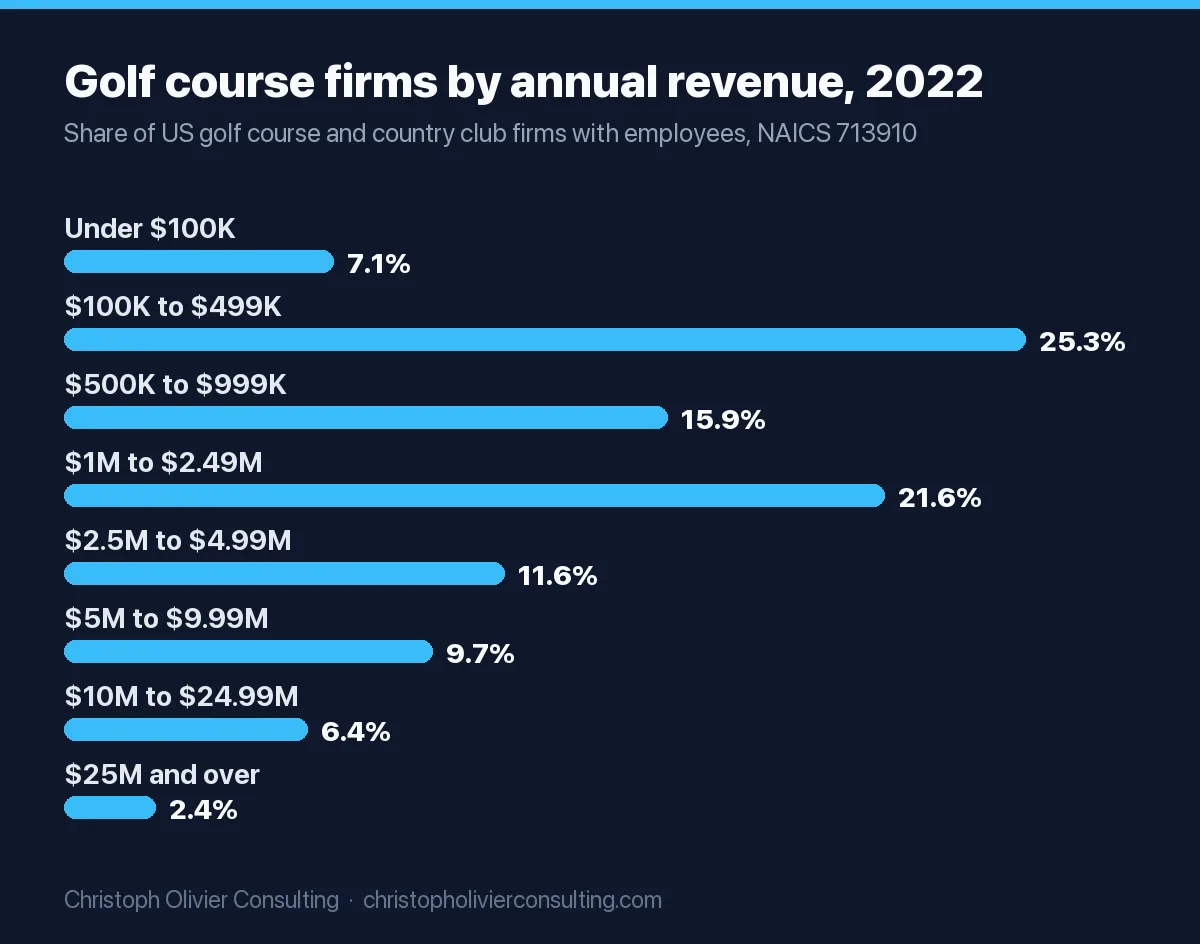
The average is pulled up by large resort and private clubs. Census also publishes firms by annual revenue band, which shows what a typical operator brings in.
| Annual receipts of the firm | Firms | Share of firms | Cumulative share | Average receipts per firm | Employees per firm | Payroll as share of receipts |
|---|---|---|---|---|---|---|
| Under $100,000 | 630 | 7.1% | 7.1% | $53,398 | 1.4 | 78.2% |
| $100,000 to $499,999 | 2,258 | 25.3% | 32.3% | $282,417 | 3.4 | 36.2% |
| $500,000 to $999,999 | 1,422 | 15.9% | 48.2% | $726,274 | 8.6 | 35.3% |
| $1 million to $2.49 million | 1,931 | 21.6% | 69.8% | $1,620,123 | 19.4 | 36.7% |
| $2.5 million to $4.99 million | 1,038 | 11.6% | 81.5% | $3,529,609 | 38.9 | 38.1% |
| $5 million to $9.99 million | 865 | 9.7% | 91.1% | $7,012,599 | 66.8 | 40.8% |
| $10 million to $24.99 million | 576 | 6.4% | 97.6% | $13,523,161 | 116.1 | 40.9% |
| $25 million and over | 216 | 2.4% | 100% | $39,460,782 | 378.4 | 37.3% |
Source: U.S. Census Bureau, SUSB 2022, U.S. 6-digit NAICS by enterprise receipts size, NAICS 713910 (golf courses and country clubs). Employer firms only, taxable and tax-exempt combined. I merged the published bands above $5 million into three rows. Shares, averages and ratios are my calculations.
What the bands mean for a buyer or owner:
- The median golf firm takes in just over $1 million a year. 48.2% of firms are under $1 million, so the midpoint sits at the bottom of the $1 million to $2.49 million band, where firms averaged $1.62 million with 19 employees.
- Payroll eats 35% to 41% of revenue at every size above $100,000. Across the industry, payroll was 38.9% of receipts and averaged $39,363 per employee in 2022 (my calculation). That is wages only, before payroll taxes and benefits.
- Small firms under $500,000 are a third of the industry. At an average of $282,417 with 3.4 employees, these are mostly nine-hole and value courses where the owner mows, runs the counter and does the books.
Golf course revenue by state
Average revenue per location ranged from about $460,000 in North Dakota to $7.7 million in Hawaii in 2022. Short seasons and cheap green fees drag down the northern plains; resort and private clubs lift the Sun Belt and coasts. Figures are receipts divided by establishments from the 2022 Economic Census, NAICS 713910, all tax statuses, states with 30 or more locations (my calculation).
| Highest states | Locations | Average revenue per location | Lowest states | Locations | Average revenue per location |
|---|---|---|---|---|---|
| Hawaii | 41 | $7.71 million | North Dakota | 65 | $0.46 million |
| Florida | 643 | $6.31 million | Iowa | 281 | $0.76 million |
| California | 618 | $6.21 million | West Virginia | 61 | $0.90 million |
| Maryland | 113 | $5.03 million | South Dakota | 76 | $0.90 million |
| Nevada | 69 | $4.99 million | Mississippi | 104 | $1.19 million |
| New Jersey | 204 | $4.87 million | Arkansas | 128 | $1.20 million |
Golf course owner salary = a manager’s wage plus whatever profit is left
Owner pay at a golf course has two parts, and mixing them up is how people end up quoting $60,000 and $600,000 for the same business.
- The job you do. If you run the course yourself, part of what you take out is simply the salary you would otherwise pay a general manager or superintendent. Employed superintendents averaged $121,238 base pay in 2025, assistants $62,184 and equipment managers $68,154 (GCSAA). General and operations managers across all industries had a $105,770 median in May 2025 (BLS).
- The profit on the asset. What is left after every wage, supply, utility, tax, equipment replacement and loan payment. This is the return on the land and the business, and it can be negative.
If your total take is $110,000 and a hired GM would cost you $105,000, the course itself is earning you almost nothing. You have bought a job. That is not a bad outcome if you love the work and the land is appreciating, but it should be a decision you make with the numbers in front of you. In my view this one split, job versus asset, is the single most useful way to judge any golf course listing.
Golf course profit margin: what the audited and tax data show
There is very little public margin data for golf, because almost every operator is private or tax-exempt. These are the figures that come from filings rather than estimates.
| Measure | Figure | Source and what it covers |
|---|---|---|
| Club-level Adjusted EBITDA margin, same-store golf and country clubs | 30.6% | ClubCorp 10-K, fiscal 2016, mostly private clubs, before corporate costs, interest, depreciation and capex |
| Golf segment capital spending as share of segment revenue | 12.0% | Same filing: $105.7 million capex on $879.1 million revenue (my calculation) |
| Corporate overhead as share of total revenue | 5.0% | Same filing: $54.5 million on $1.088 billion (my calculation) |
| Net income as share of revenue | 0.3% | Same filing, after $87.2 million interest and $107.2 million depreciation |
| Operating expenses as share of revenue, tax-exempt clubs | 91.6% | Economic Census 2022: $11.18 billion of $12.20 billion (my calculation). Census does not publish this line for taxable courses |
| Net profit margin, sole proprietors in amusement, gambling and recreation | 6.2% | IRS SOI, tax year 2023. Only 67.2% of the 177,602 returns showed a profit (my calculation). Broader than golf |
So is a golf course profitable? At the operating level, a well-run club can clear 20% to 30% of revenue. After equipment replacement and loan payments, the IRS and Census figures point to single digits for most owners. ClubCorp’s last annual report, filed in February 2017, is old but it is the only audited, club-by-club golf P&L a reader can check. Note that it reflects a 159-club operator with central buying, which a single-course owner does not have. If you want benchmarks from other industries to compare against, our profit margin by industry table uses the same IRS data.
Where a golf club’s revenue comes from
ClubCorp’s same-store golf and country clubs earned $827.9 million in fiscal 2016. Dues were the largest line, which is why private clubs are less exposed to a rainy month than daily-fee courses. Food and beverage cost 33.2% of food and beverage revenue across the company ($100.5 million of $302.5 million, my calculation). If you are planning a clubhouse restaurant, the economics in our restaurant owner salary breakdown apply almost line for line.
| Revenue line, same-store clubs, fiscal 2016 | Amount | Share (my calculation) |
|---|---|---|
| Membership dues | $404.4 million | 48.8% |
| Food and beverage | $188.1 million | 22.7% |
| Golf operations (green fees, carts, pro shop) | $178.0 million | 21.5% |
| Other | $57.4 million | 6.9% |
Source: ClubCorp Holdings 10-K, fiscal year ended December 27, 2016. 135 of its 159 golf and country clubs were private; a daily-fee course will get far more from green fees and far less from dues.
Worked P&L: what a golf course owner makes at three sizes
This is my own model, not survey data. Revenue sizes are anchored to Census: the $750,000 course sits in the $500,000 to $999,999 band (average $726,274), the $2.4 million course matches the taxable average of $2.44 million, and the $5.5 million club matches ClubCorp’s average of $5.53 million per golf club ($879.1 million ÷ 159, my calculation). Every assumption is labeled.
| Line (my calculation) | 9-hole value course, owner is GM | 18-hole daily-fee, owner is GM | Semi-private club, hired GM |
|---|---|---|---|
| Rounds × green and cart fee per round (assumption) | 22,000 × $26 = $572,000 | 38,000 × $45 = $1,710,000 | 20,000 × $70 = $1,400,000 |
| Memberships, season passes or dues (assumption) | $60,000 | $300,000 | $2,200,000 |
| Food and beverage (assumption) | $90,000 | $300,000 | $1,300,000 |
| Pro shop and other (assumption) | $28,000 | $90,000 | $600,000 |
| Total revenue | $750,000 | $2,400,000 | $5,500,000 |
| Cost of food (33% of F&B, ClubCorp ratio) and merchandise (65%, assumption) | −$47,900 | −$157,500 | −$624,000 |
| Staff payroll, excluding owner (34% to 36%, near the 35% to 38% Census band ratios) | −$255,000 | −$864,000 | −$1,980,000 |
| Payroll taxes and benefits (18% of payroll, assumption) | −$45,900 | −$155,520 | −$356,400 |
| Hired general manager (assumption) | $0 | $0 | −$130,000 |
| Course supplies: fertilizer, chemicals, seed, fuel, equipment repair (assumption) | −$95,000 | −$260,000 | −$420,000 |
| Utilities, water, insurance, property tax, marketing, software, admin (17% to 20%, assumption) | −$150,000 | −$456,000 | −$935,000 |
| Operating profit before capex and debt (EBITDA) | $156,200 (20.8%) | $506,980 (21.1%) | $1,054,600 (19.2%) |
| Equipment and course reinvestment reserve (7% to 10%, below ClubCorp’s 12.0%) | −$52,500 | −$192,000 | −$550,000 |
| Annual loan payments (assumption) | $0 (land owned) | −$180,000 | −$350,000 |
| Owner pay, pre-tax | $103,700 | $134,980 | $154,600 |
| Owner pay if there were no loan | $103,700 | $314,980 | $504,600 |
How to read it:
- The small course pays like a job. $103,700 is close to the $105,770 BLS median for general managers, for someone working the season seven days a week. The course itself earns very little on top.
- Debt decides the 18-hole result. The same course pays $134,980 with a loan and $314,980 without one. Most of what makes a course “profitable” is whether the buyer overpaid with borrowed money.
- The big club has the thinnest cushion. It produces the most EBITDA in dollars, but a hired GM, heavy reinvestment and a large loan leave 2.8% of revenue. A 5% drop in revenue would wipe it out.
- The reinvestment line is not optional. Mowers, irrigation, bunkers and cart fleets wear out on a schedule. Owners who skip it show a better year and sell a worse course.
How many rounds does a golf course need?
For the 18-hole daily-fee course above, each extra round brings in about $51.12: the $45 green and cart fee, plus food and beverage of about $7.89 a round at a 67% margin, plus pro shop sales of about $2.37 a round at a 35% margin (my calculation). Treating payroll, supplies and overhead as fixed (my assumption), the costs that do not move with rounds, minus the $300,000 of pass revenue, come to $1,807,520 including the reserve and loan payments. Divide one by the other.
| Goal for the 18-hole model course | Rounds needed per year (my calculation) |
|---|---|
| Break even after reinvestment and loan payments | 35,360 |
| Owner pay of $100,000 | 37,320 |
| Owner pay of $250,000 | 40,250 |
| Owner pay at 30,000 rounds | −$273,967 (a loss) |
| Owner pay at 42,000 rounds | $339,454 |
Every 1,000 rounds moves owner pay by about $51,000 in this model. For context, the National Golf Foundation counts more than 500 million rounds a year at about 14,000 U.S. golf facilities (NGF), which works out to at least 35,700 rounds per facility (my calculation). A state of the industry report presented at the 2026 PGA Merchandise Show put 2025 rounds at 540 million on 12,703 courses (TurfNet), or about 42,500 per course (my calculation). An average course in a record year sits only a few thousand rounds above the model’s break-even line. A wet summer can take that away.
Is golf growing or dying? What it means for owner income
Demand is up and supply is down, which is good for owners who already hold a course. Rounds hit an all-time high in 2025, finishing 1.2% ahead of 2024 (NGF), with as many as 2,000 fewer courses than the early-2000s peak (NGF). 29.1 million Americans played on a course in 2025, and supply has contracted about 13% since 2006, mostly among courses with green fees under $40 (NGF). In 2026, July play fell 3.6% year over year, though the year to date was still 2.5% ahead through July (NGF).
The closure pattern matters most. The courses that disappeared were the cheap ones. In the model above, a $26 fee needs far more rounds per dollar of fixed cost than a $45 fee, which is the same squeeze that closed those courses. Raising price on peak tee times usually does more for owner pay than adding rounds at the margin; our guide to pricing strategy walks through how to test that without losing regulars.
What is the highest paying job at a golf course?
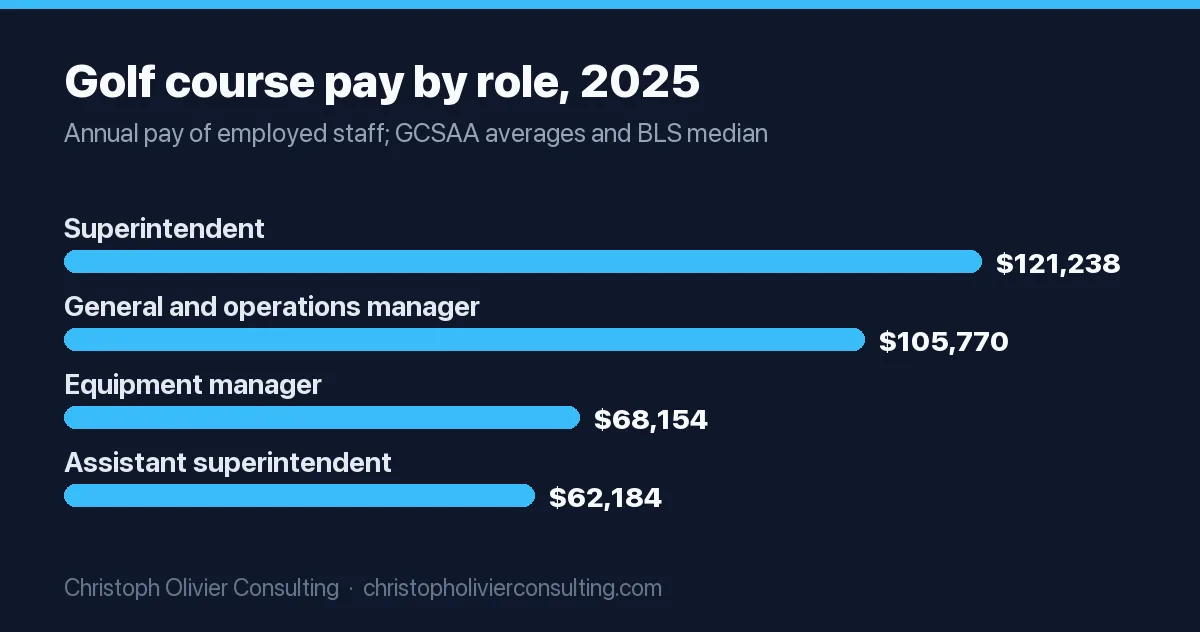
Outside of ownership, the general manager and the superintendent are usually the top-paid roles. Published figures:
| Role | Pay | Source |
|---|---|---|
| Golf course superintendent | $121,238 average base, 2025 | GCSAA |
| General and operations manager (all industries) | $105,770 median, May 2025 | BLS |
| Equipment manager | $68,154 average base, 2025 | GCSAA |
| Assistant superintendent | $62,184 average base, 2025 | GCSAA |
| Grounds maintenance worker in amusement, gambling and recreation | $17.45 median per hour, May 2025 | BLS |
No government series reports golf-specific general manager pay. These figures also set the cost of replacing yourself if you ever want to step back from daily operations.
Owner pay worksheet: pass or fail before you buy
Run any course you own or are considering through these seven tests. The thresholds come from the figures above; where a threshold is my own rule of thumb, it says so.
| # | Test | Pass if | Where the line comes from |
|---|---|---|---|
| 1 | Rounds per year vs. your break-even | Actual rounds at least 10% above break-even (fixed costs ÷ contribution per round) | My rule of thumb; July 2026 play fell 3.6% in one month (NGF) |
| 2 | Staff payroll share | Wages at or below 38% of revenue | Census SUSB 2022: 35.3% to 38.1% for firms from $500,000 to $4.99 million |
| 3 | Food cost | Food and beverage cost at or below 33% of F&B sales | ClubCorp fiscal 2016: 33.2% |
| 4 | Reinvestment | At least 7% of revenue set aside each year for equipment and course work | My floor; ClubCorp spent 12.0% on its golf clubs |
| 5 | Debt load | Annual loan payments under 40% of EBITDA | My rule of thumb; the 18-hole model sits at 35.5% and still pays only $134,980 |
| 6 | Job vs. asset | Owner pay minus a market GM salary is positive | BLS median of $105,770, or the GM you would really hire |
| 7 | Revenue mix | No single line above 75% of revenue | My rule of thumb; dues gave ClubCorp a 48.8% weather-resistant base |
Four or more fails usually means the price is wrong, the debt is too heavy, or both. Fixing tests 1 and 7 is mostly a demand problem: outings, leagues and memberships. Leagues and passes behave like a loyalty program and are worth designing that way. Weddings and corporate outings run on the same calendar math as an event venue, so that breakdown is a useful second check on your clubhouse plan.
If you want an outside read on where your course’s demand is leaking, or how to fill shoulder-season tee times without discounting your best ones, you can book a consultation.
Ready to scale your revenue?
Book a free 30-min consultation. We’ll diagnose your growth bottleneck and map out the 3 highest-leverage moves for your business.
Frequently asked questions
How much does a golf course owner make?
No government survey reports golf course owner income. In a model built from Census, IRS and 10-K data, an owner who works as general manager earns about $104,000 pre-tax from a $750,000 nine-hole course with no loan and about $135,000 from a $2.4 million 18-hole course with $180,000 of annual loan payments. Without that loan, the 18-hole owner would take about $315,000.
What is the average golf course owner salary?
There is no published average. Owner pay is two parts: a market wage for the job you do, plus the course's profit after every cost. For the job part, employed superintendents averaged $121,238 base pay in 2025 (GCSAA) and general and operations managers had a $105,770 median in May 2025 (BLS). If your total take is below that, the course itself is earning you little.
What is a typical golf course profit margin?
Audited figures are scarce. ClubCorp's same-store golf and country clubs had a 30.6% Adjusted EBITDA margin in fiscal 2016, but company net income was 0.3% of revenue after interest and depreciation. Sole proprietors in amusement and recreation, which includes golf, kept 6.2% of receipts as net profit in tax year 2023 (IRS SOI). Tax-exempt clubs spent 91.6% of revenue on operating expenses in 2022.
How much does a golf course make a year?
Golf courses and country clubs with employees averaged $3.06 million in revenue per location in 2022 (Census SUSB). Courses that pay income tax averaged $2.44 million and tax-exempt clubs $5.03 million (Economic Census). The median firm takes in just over $1 million, and about a third of firms take in under $500,000.
How many rounds does a golf course need to be profitable?
It depends on fee per round and fixed costs. In a modeled 18-hole course charging $45 per round with $1.81 million of fixed costs after pass revenue, break-even is about 35,400 rounds a year, and $100,000 of owner pay needs about 37,300. NGF data implies at least 35,700 rounds per U.S. facility, so many courses sit close to that line.
Can a golf course be profitable?
Yes, but most of the margin goes to equipment replacement and loan payments. A well-run course can clear 20% to 30% of revenue before those costs. Whether the owner makes money usually comes down to the purchase price and debt. In the 18-hole model, the same course pays the owner about $135,000 with a loan and about $315,000 without one.
What is the highest paying job at a golf course?
Outside of ownership, the general manager and superintendent are usually the top earners. GCSAA's 2025 report puts average superintendent base pay at $121,238, equipment managers at $68,154 and assistant superintendents at $62,184. BLS reports a $105,770 median for general and operations managers across all industries in May 2025. No government series isolates golf course general manager pay.
Small business owner income