
Most florist owners make between about $25,000 and $130,000 a year before income tax, and where you land depends far more on sales volume and the cost of your flowers than on talent. The typical U.S. flower shop with employees takes in $100,000 to $499,999 a year: 69.1% of florist firms sit below $500,000 in receipts (Census SUSB 2022, my calculation). Employed floral designers earned a median of $37,360 in May 2025 (BLS Occupational Outlook Handbook), and that wage is the floor an owner should measure against.
Short answer: In my worked model built from Census, BLS, IRS and vendor data, an owner who is also the lead designer keeps about $47,000 a year from a $300,000 storefront and about $127,000 from a $700,000 shop, before income tax. A solo event studio with no staff doing $120,000 keeps about $61,000. If flowers and hard goods run 38% of sales instead of 32%, the $300,000 storefront drops to about $29,000.
Below: what each source measures, revenue by size and state, a three-size P&L with labeled assumptions, the wire-order math, a startup budget from current vendor prices, and a pass/fail worksheet.
Florist owner salary: what each source actually measures
No government survey asks flower shop owners what they pay themselves. BLS covers employees, job-site “florist salary” figures come from job ads, and the IRS does not break florists out. What you can measure is revenue, payroll, solo businesses and employee pay. Read the second column before comparing numbers.
| Source and year | What it measures | Figure | How it was calculated |
|---|---|---|---|
| Census SUSB 2022, NAICS 453110 | Revenue per florist location with employees | $531,736 | $6.38 billion receipts ÷ 11,999 locations (my calculation) |
| Census SUSB 2022 | Revenue of the average firm in the most common size band ($100,000 to $499,999) | $271,946 | $1.69 billion ÷ 6,199 firms; 3.1 employees per firm (my calculation) |
| Census SUSB 2022 | Payroll as a share of receipts, all florist firms | 22.2% | $1.42 billion payroll ÷ $6.38 billion receipts (my calculation) |
| Census Nonemployer Statistics 2022, NAICS 45931 | Revenue per florist business with no paid employees | $51,606 | $1.36 billion ÷ 26,365 businesses (my calculation) |
| BLS OOH, May 2025 | Median pay of employed floral designers, all industries | $37,360 | Published. Lowest 10%: under $28,600. Highest 10%: over $51,000 |
| BLS OOH, May 2025 | Median pay of floral designers working in florist shops | $36,870 | Published. Grocery stores paid $38,760 |
| IRS SOI, tax year 2023 | Net profit per sole proprietor in “miscellaneous store retailers,” the category that contains florists | $3,639 | $3.09 billion net income less deficit ÷ 848,568 returns. Broad category: also gift, pet, used goods and other stores (my calculation) |
How to read these together:
- Most florist businesses are one person. Census counted 26,365 florist nonemployers and 11,569 employer firms in 2022, so 69.5% of florist businesses have no payroll. 62.3% of those solo businesses took in under $25,000, and only 14.8% topped $100,000 (my calculation). For most of them floristry is a side income, not a salary.
- The IRS line is a ceiling on optimism, not a florist number. In the broad retail category that includes florists, the 54.5% of sole proprietors who made a profit averaged $15,899 on $66,656 in receipts for 2023 (my calculation from the same IRS table).
- Use the designer wage as your salary floor. If you design every order yourself, $36,870 is what a florist shop pays the median person doing that job. Anything you earn above it is the return on your money and your risk.
Owner pay is a designer’s salary plus the shop’s profit
A flower shop owner gets paid in two layers: pay for the work you do (lead designer, buyer, clerk, often driver), and whatever is left after flowers, staff, rent, the van and fees. Salary sites mix the two, which is why answers online range from $30,000 to six figures.
BLS publishes what the roles you fill would cost to hire:
| Role you may be filling yourself | Median pay, May 2025 | Lowest 10% | Highest 10% |
|---|---|---|---|
| Floral designer (27-1023), all industries | $37,360 ($17.96 an hour) | under $28,600 | over $51,000 |
| Floral designer in florist shops | $36,870 | not published | not published |
| Retail salesperson (41-2031) | $17.03 an hour | under $13.08 | over $23.02 |
| Driver/sales worker (53-3031) | $38,770 | under $22,590 | over $59,980 |
Sources: BLS Occupational Outlook Handbook pages for floral designers, retail sales workers and delivery drivers, May 2025 wage data. Self-employed owners are not included.
Two facts from the same BLS page frame the career question. Floral designer jobs are projected to fall 6% from 45,200 in 2025 to 42,700 in 2035, and 14% of floral designers are already self-employed. BLS links the decline to fewer florist shops, with each remaining shop serving a wider area through online orders.
How much does a flower shop make? Census revenue by size
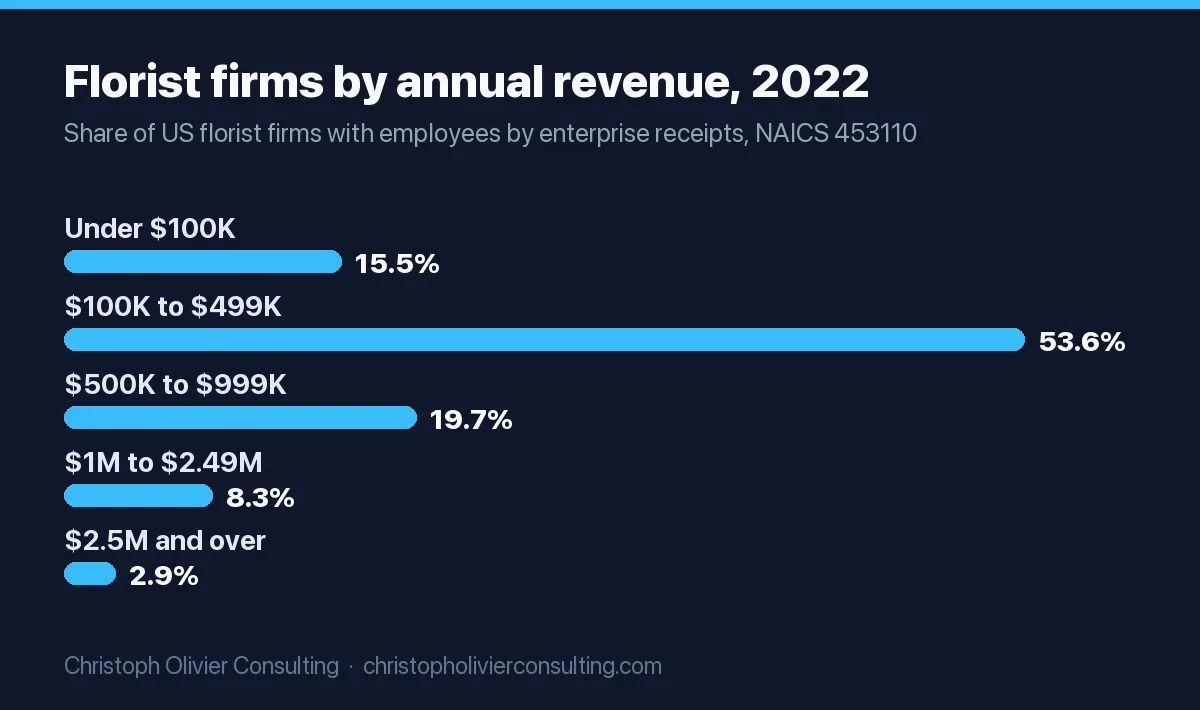
The $531,736 average per location is pulled up by a small number of large operators. Census also counts florist firms by revenue band, which shows where a typical shop sits.
| Annual receipts of the firm | Florist firms | Share | Cumulative | Avg receipts per firm | Employees per firm | Payroll as % of receipts |
|---|---|---|---|---|---|---|
| Under $100,000 | 1,797 | 15.5% | 15.5% | $50,248 | 1.2 | 27.5% |
| $100,000 to $499,999 | 6,199 | 53.6% | 69.1% | $271,946 | 3.1 | 21.4% |
| $500,000 to $999,999 | 2,276 | 19.7% | 88.8% | $686,751 | 6.4 | 22.4% |
| $1 million to $2.49 million | 957 | 8.3% | 97.1% | $1,418,356 | 11.5 | 23.9% |
| $2.5 million and over | 338 | 2.9% | 100% | not shown (mixed bands) |
Source: U.S. Census Bureau, SUSB 2022 by enterprise receipts size, NAICS 453110 (renumbered 459310 in NAICS 2022), released April 10, 2025. Employer firms only. Shares, averages and ratios are my calculations. Payroll is wages before payroll taxes and benefits.
What the table tells you:
- The median florist with employees takes in $100,000 to $499,999. That band holds 53.6% of firms, and its average shop runs on 3.1 employees, many of them part time: florist payroll averaged $24,783 per employee in 2022 (my calculation).
- Payroll share barely moves with size. It sits between 21.4% and 23.9% of sales from $100,000 to $2.5 million. Bigger shops do not get cheaper labor; they spread the same rent, van and owner over more orders.
- Fewer shops, more sales each. Florist locations fell 5.2% from 12,661 in 2017 to 11,999 in 2022, while revenue per location rose 40.6%, from $378,284 to $531,736 in current dollars (my calculation from SUSB 2017 and SUSB 2022).
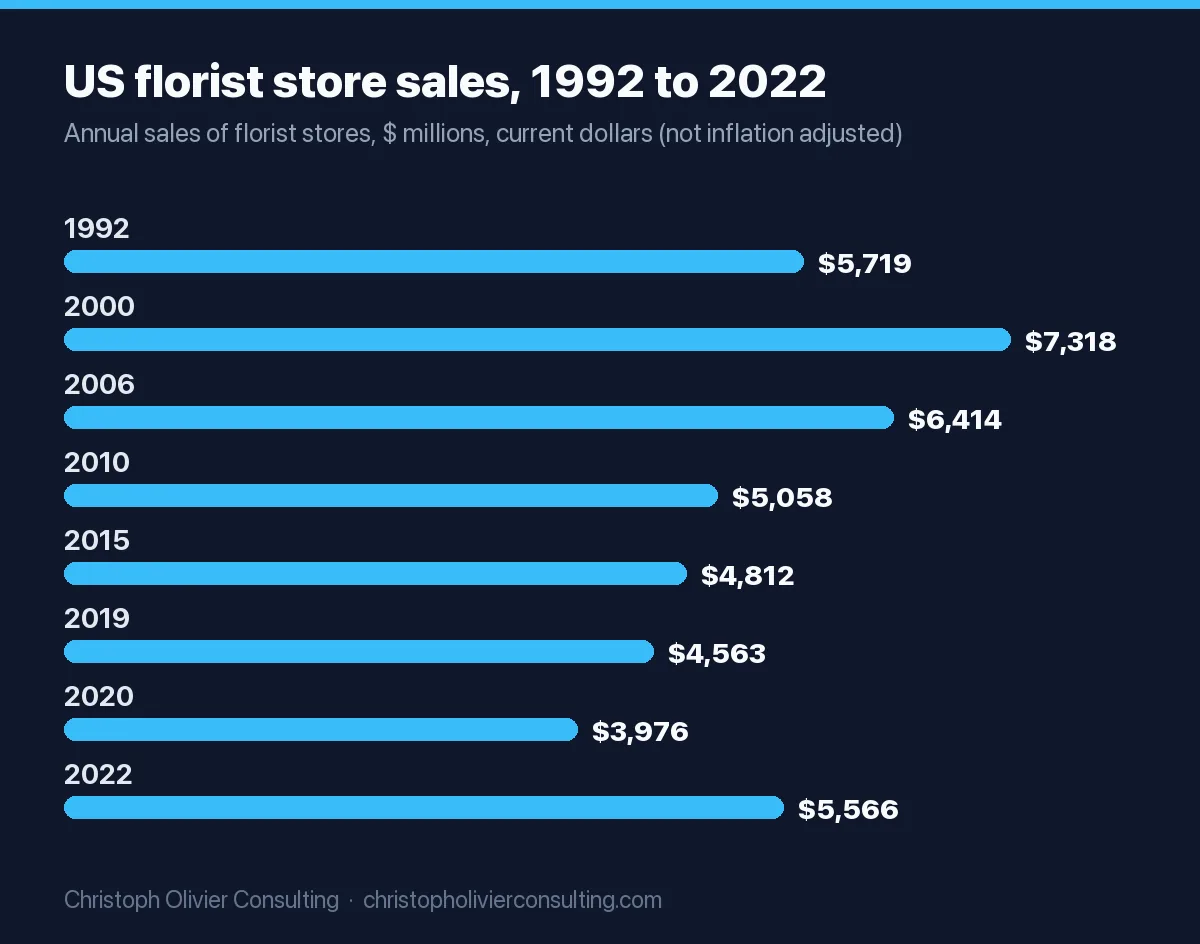
The longer view comes from the Census Annual Retail Trade Survey, which tracks sales at florist stores. They peaked at $7.32 billion in 2000, fell to $3.98 billion in the 2020 shutdown year and recovered to $5.57 billion in 2022, all in current dollars that are not adjusted for inflation.
Where do florists make the most money? Revenue by state
Average receipts per florist location in 2022, from the SUSB 2022 state file (receipts ÷ locations, my calculation). Hawaii tops the list at $955,604, but across only 48 locations; I left out the District of Columbia and New Mexico because Census flags their figures as less reliable.
| Highest | Avg receipts per location | Lowest | Avg receipts per location |
|---|---|---|---|
| Arizona | $712,978 | West Virginia | $302,495 |
| Colorado | $674,143 | Wyoming | $314,378 |
| New York | $666,696 | Maine | $321,922 |
| Florida | $625,759 | Vermont | $328,056 |
| California | $625,490 | Iowa | $331,050 |
| Massachusetts | $618,713 | Nebraska | $336,938 |
Higher sales do not guarantee higher owner pay. Payroll ran 26.2% of receipts in Maryland versus 19.2% in New Jersey, and rent is not in this file at all. Use the state figure to sanity-check a sales forecast, not as an income promise.
Worked P&L: what a florist owner keeps at three sizes
This is my own model, not survey data. Each line is either a published figure (linked) or an assumption I state. The owner works full time as lead designer and takes no wage, so the bottom line is the owner’s pay before income tax.
| Line (own calculation) | Solo event studio, no staff | Small storefront | Established shop | Basis |
|---|---|---|---|---|
| Annual sales | $120,000 | $300,000 | $700,000 | Top 15% of nonemployers; SUSB $100K to $499K band; SUSB $500K to $999K band |
| Flowers, greens, vases and hard goods (32%) | $38,400 | $96,000 | $224,000 | Assumption, including shrink; a 3x markup on product equals a 33% cost |
| Staff wages | $0 | $64,200 | $156,800 | Census payroll share for the band: 21.4% and 22.4% |
| Payroll taxes and benefits (10% of wages) | $0 | $6,420 | $15,680 | Assumption |
| Rent and occupancy | $0 (home studio) | $24,000 | $42,000 | Assumption: $2,000 and $3,500 a month |
| Delivery vehicle | $4,350 | $10,875 | $21,750 | 6,000 / 15,000 / 30,000 miles at the 2026 IRS rate of 72.5 cents, which covers fuel, upkeep, insurance and depreciation |
| Business insurance | $500 | $3,388 | $5,444 | Insureon: general liability $500 a year; owner’s policy $1,332 plus workers’ comp $2,056; larger shop assumes two workers’ comp units |
| Card processing (2.9%) | $3,480 | $8,700 | $20,300 | Assumed blend of Square in-person 2.6% + 15¢ and online 3.3% + 30¢ |
| Wire network and order platform costs (3%) | $0 | $9,000 | $21,000 | Assumption; see the wire math below |
| Website, POS and software | $1,800 | $3,600 | $4,800 | Assumption |
| Marketing (3%) | $3,600 | $9,000 | $21,000 | Assumption |
| Utilities, cooler power, supplies, accounting, repairs (5%) | $6,000 | $15,000 | $35,000 | Assumption |
| Cooler and equipment payments | $709 | $3,000 | $5,000 | A $3,545 reach-in over 5 years; larger shops assumed |
| Owner pay before income tax | $61,161 | $46,817 | $127,226 | Sales minus all lines |
| As % of sales | 51.0% | 15.6% | 18.2% | |
| Versus floral designer median ($36,870) | +$24,291 | +$9,947 | +$90,356 | BLS, florist shops |
Three things stand out. The small storefront pays its owner only about $10,000 more than a designer job, for far more risk and hours. The solo studio looks rich in margin but caps out at what one person can design and deliver, and only about 1 in 7 solo florists reach $100,000 in sales. The established shop is where ownership pays, because the same owner salary sits on top of more than twice the volume.
How sensitive is the owner’s pay? Flower cost and labor
Flower cost and staff hours are the two lines you control week to week. Same model, changing only those two:
| Product cost (own calculation) | $300K shop: wages 3 pts lower | $300K shop: Census wages | $300K shop: wages 3 pts higher | $700K shop: Census wages |
|---|---|---|---|---|
| 28% of sales | $68,717 | $58,817 | $48,917 | $155,226 |
| 32% of sales | $56,717 | $46,817 | $36,917 | $127,226 |
| 38% of sales | $38,717 | $28,817 | $18,917 | $85,226 |
At $300,000 in sales, every point of flower cost is worth $3,000 of your pay. Wilted stems you throw out after a slow week count in that line, which is why buying discipline after Valentine’s Day and Mother’s Day matters as much as pricing.
Florist profit margin: the wire-order math
Most florist profit margin articles quote a single net figure without a source. The more useful question is margin per order type, because a shop’s mix of walk-in, website, event and wire orders sets its margin. The wire split is published. Under the FTD Standards dated July 2026, the amount of an order sent through the Mercury Network is split 20% to the sending florist, 9% to the FTD Clearinghouse and 71% to the filling florist, with a minimum $10.00 delivery charge to the filling florist. FTD’s Local Order Program pays 80% of order value with a $3.99 processing fee per order.
Here is one $79.99 order ($69.99 arrangement plus $10.00 delivery) handled three ways. Costs are the same in each: product at 32% of the $69.99 retail price ($22.40), 20 minutes of design at the BLS designer median of $17.96 an hour ($5.99), a 12-mile round trip at 72.5 cents ($8.70) and 30 minutes of driver time at the $38,770 driver/sales median ($9.32).
| Same $79.99 order (own calculation) | Shop receives | Cost to make and deliver | Left toward rent and owner pay |
|---|---|---|---|
| Your own customer, paid by card at 2.9% | $77.67 | $46.41 | $31.26 |
| FTD Local Order Program (80% less $3.99, fee assumed deducted) | $60.00 | $46.41 | $13.59 |
| Incoming Mercury wire order (71%) | $56.79 | $46.41 | $10.38 |
| Outgoing wire order you send to another florist (20%) | $16.00 | Order taking only | about $16.00 before card fees |
A direct order leaves three times what an incoming wire order leaves. Wire orders still help a shop with idle designers and a van already on the road, but a shop where they are a large share of sales is working for the network. The public numbers confirm the network is shrinking: 1-800-Flowers reported its BloomNet florist network segment at $96.8 million in revenue for fiscal 2026, down 1.9%, with earlier gross profit helped by “lower florist rebates related to lower florist-to-florist volume” (1-800-Flowers 10-K, fiscal year ended June 28, 2026). BloomNet kept a 27.8% segment contribution margin on that revenue (my calculation: $26.9 million ÷ $96.8 million).
Is owning a florist profitable? What the public company shows
The one audited set of floral margins comes from that same 10-K, and it is sobering. The Consumer Floral & Gifts segment sold $638.9 million in fiscal 2026, down 17.7%, at a 39.4% gross margin, and the company as a whole lost $134.8 million on $1.50 billion in revenue. It is not a local shop, but it shows that order-gathering on national advertising is a thin business. A local florist earns its margin through design, local delivery and repeat customers, not volume alone.
Holidays and weddings: where florist revenue comes from
Florist sales cluster around a few dates, so a weak holiday can wipe out a year’s profit.
- Valentine’s Day 2026: 41% of consumers planned to buy flowers, for projected flower spending of $3.1 billion (National Retail Federation, Jan. 27, 2026, survey of 7,791 adults).
- Mother’s Day 2026: 75% of shoppers planned to buy flowers, for projected flower spending of $3.2 billion (NRF, April 21, 2026, survey of 7,877 adults).
- Weddings: couples married in 2025 spent an average of $2,800 on flowers, within a $34,200 average wedding (The Knot 2026 Real Weddings Study, 10,474 couples). There were 2,041,926 U.S. marriages in 2023 (CDC, provisional).
Put those side by side and you see the competition. The two holidays’ projected flower budgets add up to $6.3 billion, more than the $5.57 billion all U.S. florist stores sold in a full year in 2022. The surveys and the Census series measure different things and different years, but the gap shows how much holiday flower money goes to grocery stores and online sellers instead of florists. BLS finds grocery stores already employ 19% of floral designers, against 55% in florist shops.
Events change the owner math. Ten weddings at the $2,800 average add $28,000 in sales booked months ahead, on dates you choose. If you are building that side, the wedding planner income and event venue owner models use the same method and show the other vendors’ economics, and the holiday retail marketing statistics page covers how shoppers plan seasonal purchases.
Florist startup costs: a budget from current vendor prices
Startup cost lists online often stop at a single total with no source. This one prices what can be priced from vendor pages and labels the rest as my assumptions, so you can swap in your own quotes.
| Item (own budget) | Home event studio | Small storefront | Established-size shop | Source or assumption |
|---|---|---|---|---|
| Flower cooler | $3,545 | $6,645 | $19,910 | WebstaurantStore True floral cases: 24-inch $3,544.81, 54-inch $6,645.08, 78-inch $8,580.97; plus an 8 x 8 ft walk-in at $11,329 for the largest shop |
| Electrical and cooler installation | $0 | $1,500 | $3,000 | Assumption; the walk-in listing says it must be hardwired by a professional |
| Buildout, workbench, displays, lighting | $2,000 | $20,000 | $45,000 | Assumption; get local quotes |
| Lease deposit and first month | $0 | $4,000 | $7,000 | Two months of the model rent |
| First-year insurance | $500 | $3,388 | $5,444 | Insureon florist medians and averages, updated Nov. 5, 2026 |
| Opening flowers, vases and hard goods | $3,000 | $8,700 | $18,600 | Assumption: about two weeks of flower spend plus a starting stock of containers |
| Website, POS, software for year one | $1,800 | $3,600 | $4,800 | Same as the P&L assumption |
| Delivery van | Own car at 72.5¢ a mile | $20,000 | $40,000 | Assumption: one and two used cargo vans |
| Working capital (3 months of fixed costs) | $4,240 | $34,871 | $76,869 | A quarter of the model’s fixed costs |
| Total | about $15,100 | about $102,700 | about $220,600 | Own calculation |
Two financing and licensing details. An SBA microloan tops out at $50,000, averages about $13,000 and runs up to seven years at rates generally between 8% and 13% (SBA), so it covers a studio or part of a storefront but not a full shop. Louisiana is the state with florist-specific permits: a Cut Flower Dealer Permit costs $120 per location a year, or $100 for a Floral Dealer Permit that also covers potted plants (Louisiana Department of Agriculture and Forestry). Elsewhere you need the usual sales tax registration and local business license.
Most shops at the established size are bought, not started. In my view working capital is the last line to cut, because a weak February arrives before the shop has built up cash.
Break-even: how much does a flower shop need to sell?
In the $300,000 storefront model, the costs that move with each sale (product at 32%, card fees at 2.9% and network costs at 3%) take 37.9 cents of each dollar. Everything else is $139,483 a year of fixed cost.
- Break-even with the owner unpaid: $139,483 ÷ 0.621 = $224,610 a year (my calculation).
- Sales needed to also pay the owner the $37,360 designer median: $284,771 a year.
- For the $700,000 shop, the same math gives a break-even of $495,127 and $555,288 to pay the owner a designer wage.
Divide by your average ticket to get orders. For scale, 1-800-Flowers reported an average e-commerce order of $89.23 across all its brands in fiscal 2026. At an $80 average, $284,771 is about 3,560 orders a year, or 11 to 12 a day over a six-day, 312-day year (own calculation). If the gap is orders, local search is usually where they come from; the local SEO statistics page has the data on how people find local shops, and the retail marketing plan for independent stores covers the channels.
Florist owner pay worksheet: pass/fail benchmarks
Run last year’s numbers through these lines. Two or more fails usually means you are paying yourself less than a designer job would.
| Check | Pass | Fail | Where the line comes from |
|---|---|---|---|
| Flowers and hard goods as % of sales | 32% or less | Above 38% | Own model: 38% cuts $300K owner pay to $28,817 |
| Staff wages as % of sales (owner excluded) | At or below your Census band (21.4% under $500K, 22.4% at $500K to $999K) | 3+ points above your band | Census SUSB 2022, NAICS 453110 |
| Rent and occupancy as % of sales | 8% or less | Above 12% | Own rule: model runs 8.0% and 6.0% |
| Incoming wire orders as % of sales | Under 15% | Over 30% | Own rule: a wire order leaves $10.38 vs $31.26 direct on $79.99 |
| Sales versus break-even | At least 15% above | Within 5% | Own break-even formula above |
| Best quarter as % of annual sales | 35% or less | Over 45% | Own rule; 1-800-Flowers drew 47% of fiscal 2026 revenue in one quarter |
| Owner pay versus a designer job | Above $51,000 | Below $36,870 | BLS: top 10% of floral designers and the florist-shop median |
Do flower shop owners make good money?
A minority do. The data shows a business with low barriers and thin results at the small end: most florist businesses are solo operations with under $25,000 in sales, and the median employer shop sits in a revenue band where my model leaves the owner about $10,000 above a designer’s wage. Owners who earn well usually have three things the numbers reward: sales above $500,000, product cost held near 30%, and a mix tilted toward their own customers and events rather than incoming wire orders.
Is owning a flower shop hard?
The work is physical and the calendar is unforgiving. Unsold flowers turn straight into cost, the busiest days fall on holidays, and BLS notes self-employed florists also handle advertising, pricing, inventory and taxes.
Are flower shops doing well in 2026?
Demand is steady but shifting away from the traditional shop. NRF projected Mother’s Day flower spending of $3.2 billion in 2026, the same figure it projected for 2025 (NRF, April 28, 2025), while BLS projects fewer florist jobs through 2035 and Census counted 5.2% fewer florist locations in 2022 than in 2017. The largest public floral seller reported a 17.7% drop in its consumer floral segment for the year ended June 2026. Shops that grow tend to take share from closing competitors rather than ride a rising market.
Is it worth starting a florist business?
Start small enough to survive being wrong. A home event studio needs about $15,000 in my budget and can test demand before you sign a lease. A storefront needs about $100,000 and roughly $285,000 a year in sales before it pays you a designer’s wage. If you want a second opinion on whether the local market and your marketing plan can reach that number, you can book a consultation. Outside the U.S., none of the figures here apply; wages, taxes and wire networks differ by country.
How the numbers on this page were built
- Census. SUSB 2022 and 2017 for florist employer firms (NAICS 453110, which is 459310 in NAICS 2022), Nonemployer Statistics 2022 (NAICS 45931) and the Annual Retail Trade Survey 2022 benchmark release. All averages, shares and ratios are my calculations. SUSB payroll can include officers’ wages at incorporated shops, so payroll ratios may slightly overstate staff-only payroll. SUSB receipts and ARTS sales use different definitions and do not match exactly.
- BLS. Occupational Outlook Handbook pages with May 2025 wages and 2025 to 2035 projections. Owners and the self-employed are not in the wage data.
- IRS. Sole Proprietorship Table 1, tax year 2023. Florists are not broken out; the miscellaneous store retailers line is shown only as broad context.
- Model assumptions. Product cost, payroll load, rent, mileage, software, marketing, other costs, equipment payments, buildout, opening stock and vans are my assumptions, labeled in each table. Replace them with your own numbers.
Ready to scale your revenue?
Book a free 30-min consultation. We’ll diagnose your growth bottleneck and map out the 3 highest-leverage moves for your business.
Frequently asked questions
How much does a florist owner make a year?
No government survey reports florist owner pay. In a worked model built from Census, BLS and vendor data, an owner who is also the lead designer keeps about $47,000 a year before income tax from a $300,000 storefront and about $127,000 from a $700,000 shop. A solo event studio with no staff doing $120,000 keeps about $61,000. Employed floral designers earned a median of $37,360 in May 2025.
How much does a flower shop make in revenue?
Florist locations with employees averaged $531,736 in receipts in 2022, according to Census SUSB data (my calculation). The typical firm is smaller: 69.1% of florist firms took in under $500,000, and the average firm in the $100,000 to $499,999 band collected $271,946 with 3.1 employees. Florist businesses with no employees averaged $51,606.
What is a typical florist profit margin?
There is no audited margin for independent florists. In my model, owner pay plus profit runs about 15.6% of sales at a $300,000 storefront and 18.2% at a $700,000 shop when flowers and hard goods cost 32% of sales. Margin depends on order type: on a $79.99 order, a direct sale leaves about $31.26 after product, design and delivery, an incoming FTD wire order about $10.38.
How much does it cost to start a flower shop?
In a budget built from current vendor prices plus labeled assumptions, a home event studio costs about $15,100 to open, a small storefront about $102,700 and an established-size shop about $220,600, including three months of working capital. Floral coolers on WebstaurantStore run $3,544.81 to $8,580.97, and an 8 by 8 foot walk-in cooler lists at $11,329. SBA microloans top out at $50,000.
How much does a florist make per wire order?
Under FTD Standards dated July 2026, an order sent through the Mercury Network is split 20% to the sending florist, 9% to the FTD Clearinghouse and 71% to the filling florist, with a minimum $10.00 delivery charge. On a $79.99 order, the filling florist receives $56.79. After product, design time and delivery, about $10.38 is left, versus about $31.26 on the same order sold directly.
How much does an average florist make a year?
Employed floral designers earned a median of $37,360 in May 2025, or $17.96 an hour, according to BLS. The lowest 10% earned under $28,600 and the highest 10% over $51,000. Designers in florist shops had a median of $36,870, slightly below the $38,760 paid in grocery stores. BLS projects floral designer jobs to decline 6% from 2025 to 2035.
Where do florists make the most money?
By revenue per location, Arizona ($712,978), Colorado ($674,143), New York ($666,696), Florida ($625,759) and California ($625,490) led in 2022, from Census SUSB data (my calculation). Hawaii was higher on only 48 locations. West Virginia ($302,495) and Wyoming ($314,378) were lowest. Higher sales do not guarantee higher owner pay, because payroll share and rent vary by state.
Small business owner income