
A dance studio owner usually takes home somewhere between part-time teacher pay and about $200,000 a year. Where you land depends on how many students you enroll, what you charge, and how much of the teaching you still do yourself. No government survey reports owner income for dance studios. Salary sites say about $39,000, but Payscale’s $38,975 average rests on just 20 salary profiles and was last updated in September 2023. The numbers that are reliable come from elsewhere: Census revenue counts for fine arts schools, BLS wages for dance teachers, and the audited franchise disclosures of two dance brands.
Short answer: In my worked model built from public data, a dance studio owner earns about $57,000 pre-tax with 100 students while teaching 12 hours a week, about $115,000 with 250 students, and about $191,000 with 500 students and no teaching load. Those figures come before loan payments and income tax. With 30% fewer students and $80 monthly tuition, the same three studios pay their owners only about $5,200 to $22,400. Half of all fine arts school firms with employees took in between $100,000 and $499,999 in 2022.
How much does a dance studio owner make? What each source measures
Every figure you will find online counts something different. Read the “what it measures” column before you compare any two numbers.
| Source and year | What it measures | Figure | How it was calculated |
|---|---|---|---|
| Census SUSB 2022, NAICS 611610 | Revenue per fine arts school firm with employees (dance, music, art and drama schools combined) | $456,645 | $7,105,390,000 receipts ÷ 15,560 firms (my calculation) |
| Census SUSB 2022, NAICS 611610 | Share of revenue paid out as payroll | 32.7% | $2,323,136,000 payroll ÷ receipts (my calculation). Wages only, before payroll taxes |
| Census Nonemployer Statistics 2022, NAICS 611 | Revenue per education business with no employees (all kinds, including tutors and solo teachers) | $17,749 | $15,263,190,000 ÷ 859,958 businesses (my calculation). Census does not break this out for dance |
| IRS SOI sole proprietorships, tax year 2023 | Net profit of educational services sole proprietors (Schedule C) | $5,731 average; $11,126 for those with a profit | $4.94 billion net income less deficit ÷ 862,502 returns; $7.30 billion ÷ 656,164 profitable returns (my calculation) |
| BLS Occupational Outlook Handbook, May 2025 | Median hourly wage of employed dancers in educational services | $27.00 an hour | Published. Choreographers in educational services: $23.37 |
| Tutu School FDD Item 19, 2025 results | Gross revenue of franchised children’s ballet schools open 3+ years | $283,159 average; $267,542 median | Published, 52 schools. Revenue, not profit |
| Fred Astaire Dance Studios FDD Item 19, 2023 results | Gross revenue of mature franchised ballroom studios | $724,005 average; $587,714 median | Published, 210 studios. Revenue, not profit |
| Payscale, updated September 2023 | Self-reported base salary of people titled “dance studio owner” | $38,975; $20K to $71K range | 20 salary profiles. Leaves out profit drawn by the owner |
Three things to take from this:
- The Census code is broader than dance. NAICS 611610 counts all fine arts schools, so music and art schools sit in the same numbers. It is still the closest government revenue count for dance studios with staff.
- The IRS and nonemployer averages are dominated by side income from solo and part-time teachers, so they understate what a studio owner earns.
- Franchise revenue is not owner pay. Neither franchisor discloses franchisee profit, so the P&L below subtracts costs.
Dance studio owner salary is salary plus profit
An owner who teaches gets paid twice from the same revenue. Part of it is a wage for the classes you teach, which you would otherwise pay someone else. The rest is profit, the return for owning the lease, the risk and the brand. To read any owner’s income, split it:
- Market wage for your teaching. Your weekly class hours × teaching weeks × what you would pay a hired teacher. In my model that is $35 per class hour plus 15% for rehearsals and recital prep. That works out to $19,320 a year for 12 class hours a week over 40 weeks.
- Profit. Whatever remains after every cost, including step 1.
The test is simple. If your owner pay minus your teaching wage is near zero, you own a job, not a business. That is the trap for many small studios. In the 100-student model below, $19,320 of the owner’s $57,440 is simply teaching pay.
What a typical dance studio brings in
The $456,645 average per firm is pulled up by a small number of large schools. Census also groups firms by annual revenue. I added the shares and per-firm averages.
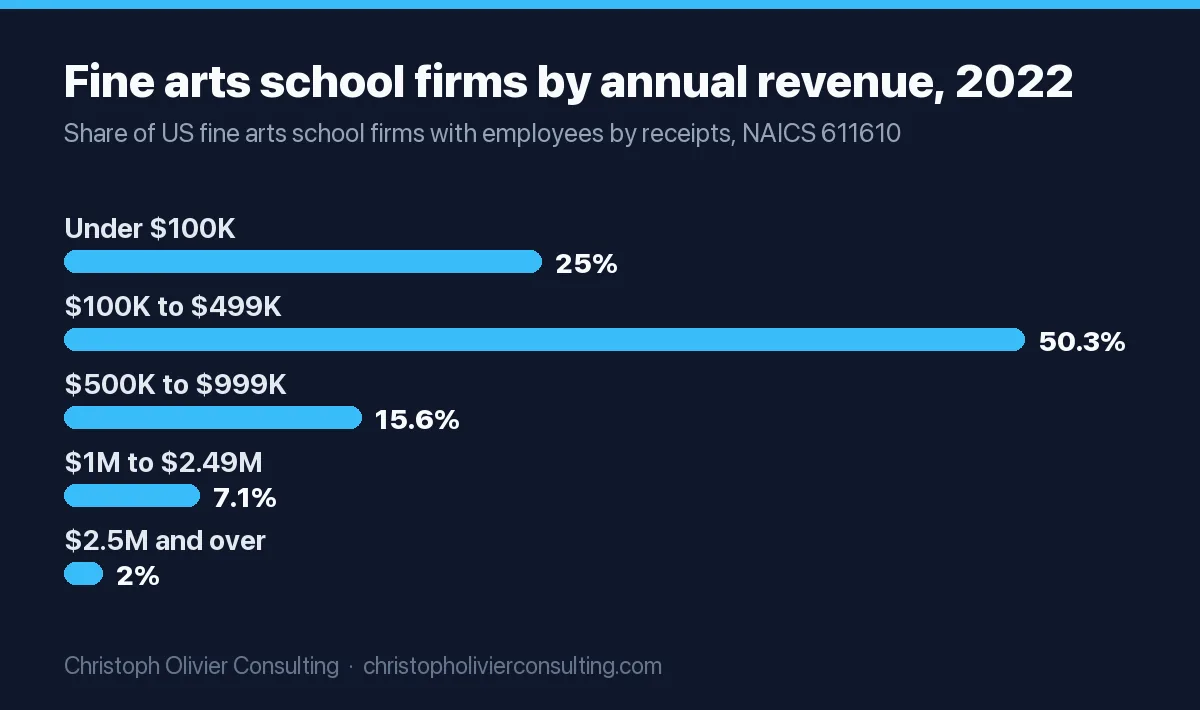
| Annual receipts of the firm | Firms | Share of firms | Cumulative share | Average receipts per firm | Employees per firm | Share of all revenue |
|---|---|---|---|---|---|---|
| Under $100,000 | 3,895 | 25.0% | 25.0% | $49,705 | 2.0 | 2.7% |
| $100,000 to $499,999 | 7,826 | 50.3% | 75.3% | $254,048 | 5.6 | 28.0% |
| $500,000 to $999,999 | 2,427 | 15.6% | 90.9% | $685,831 | 11.3 | 23.4% |
| $1 million to $2.49 million | 1,100 | 7.1% | 98.0% | $1,429,161 | 18.9 | 22.1% |
| $2.5 million and over | 312 | 2.0% | 100% | $5,407,119 | 62.4 | 23.7% |
Source: U.S. Census Bureau, SUSB 2022, U.S. 6-digit NAICS by enterprise receipts size, NAICS 611610 Fine Arts Schools, released April 10, 2025. Employer firms only. The last row is the U.S. total minus the four bands above it. Employment is the mid-March count and includes part-time staff. Averages and shares are my calculations.
The median firm falls in the $100,000 to $499,999 band, where firms averaged $254,048 with 5.6 people on payroll. A quarter take in less than $100,000.
Revenue and payroll by number of employees
Census also sorts firms by headcount. Payroll grows as a share of revenue once the owner stops teaching most classes.
| Employees at the firm | Firms | Share of firms | Average receipts per firm | Payroll as share of receipts |
|---|---|---|---|---|
| Fewer than 5 | 8,132 | 52.3% | $205,413 | 21.9% |
| 5 to 9 | 3,587 | 23.1% | $406,115 | 29.1% |
| 10 to 19 | 2,697 | 17.3% | $614,490 | 34.1% |
| 20 to 99 | 1,070 | 6.9% | $1,585,764 | 40.7% |
Source: U.S. Census Bureau, SUSB 2022, U.S. and states by employment size, NAICS 611610. Payroll excludes the owner’s profit draw in sole proprietorships and partnerships. Averages and shares are my calculations.
Payroll in my three-size model below lands at 21%, 27% and 33% of revenue, close to these Census bands.
How much do dance studios make? Two franchise systems, line by line
Franchise disclosure documents are the only published revenue data for named dance concepts. Item 19 is optional; both brands below publish one, revenue only.
| Measure | Tutu School (children’s ballet), 2025 | Fred Astaire Dance Studios (ballroom), 2023 |
|---|---|---|
| Units in the sample | 52 franchised schools open 3+ years | 210 mature U.S. studios |
| Average gross revenue | $283,159 | $724,005 |
| Median gross revenue | $267,542 | $587,714 |
| Range | $60,574 to $738,497 | $75,928 to $3,455,947 |
| Top third average | $456,944 | Not reported by thirds |
| Bottom third average | $129,904 | Not reported by thirds |
| Early years | Schools opened in 2024: $147,932 average in year 1 | Year 2 studios: $375,783 average |
| Ongoing fees to franchisor | 5% royalty plus 1% brand fund (as reported by PeerSense from the 2025 FDD) | 7% royalty on weekly gross, $150 a month advertising, $50 to $100 a week technology fee |
| Owner profit | Not disclosed | Not disclosed |
Sources: Tutu School FDD Item 19, 2025 results (107 franchised and 4 corporate schools at December 31, 2025); FADS USA, Inc. FDD issued April 22, 2024, Items 6, 7 and 19 (246 studios at December 31, 2023).
The two brands show the two business models. A children’s program like Tutu School sells monthly tuition to toddlers and young kids in small rooms. A ballroom studio sells private lessons to adults. Fred Astaire studios sold an average of 4,495 lessons in 2023, which works out to about $161 of revenue per lesson sold (my calculation). That is why the ballroom average is more than twice as high.
How much does a ballet studio owner typically earn?
Ballet-only schools are smaller businesses. In the Tutu School sample, the middle third averaged $275,721 in 2025 and the bottom third $129,904. Tutu does not disclose what owners keep. If you apply the mid-size model’s cost ratio below (60.2% of revenue) plus a 5% royalty and a 1% brand fund, a school at the $267,542 median would leave its owner about $90,000 before debt. That is my estimate, not a reported figure. Ballet-only studios also pay the lowest ASCAP rate tier, $92.16 to $368.59 a year.
Dance studio profit margin: what is disclosed and what is not
No public company runs dance studios, so there is no 10-K margin to quote, and neither franchise above publishes franchisee profit. Two numbers frame the range:
- IRS, 2023: educational services sole proprietors with a profit kept 49.7% of receipts as net income ($7.30 billion of $14.70 billion, my calculation). That share includes the owner’s own labor, because a Schedule C owner pays themselves out of net profit.
- IRS, 2023: 76.1% of all educational services sole proprietors reported a profit (656,164 of 862,502 returns, my calculation). This covers all teaching businesses, not dance studios alone.
In my model, owner pay is 50%, 40% and 33% of revenue at the three sizes. After paying the owner a market wage for their teaching, the true profit margin is about 33% at every size. Claims online of a “40% to 60% profit margin” for dance studios mix owner wages into profit. They also cite trade groups without a link or a year.
Worked P&L: what a dance studio owner makes at three sizes
This is my own calculation, not a survey result. Every input is sourced or labeled as an assumption, so you can swap in your own numbers.
| Line (own calculation) | Small: 1 room, 100 students, owner teaches 12 hrs/week | Mid: 2 rooms, 250 students, owner teaches 12 hrs/week | Large: 4 rooms, 500 students, owner manages only |
|---|---|---|---|
| Weekly class hours (1.5 classes per student, 10 per class) | 15 | 37.5 | 75 |
| Tuition ($100/month × 10.6 billed months) | $106,000 | $265,000 | $530,000 |
| Registration fees ($40 per student) | $4,000 | $10,000 | $20,000 |
| Recital and costume net ($60 per student) | $6,000 | $15,000 | $30,000 |
| Revenue | $116,000 | $290,000 | $580,000 |
| Hired teachers ($35/class hour, +15% rehearsals, +10% payroll tax, 40 weeks) | $5,313 | $45,161 | $132,825 |
| Front desk ($18.27/hr + 10% payroll tax) | $0 | $12,661 (15 hrs, 42 weeks) | $57,879 (60 hrs, 48 weeks) |
| Rent | $30,000 ($2,500/month) | $66,000 ($5,500/month) | $108,000 ($9,000/month) |
| Utilities, cleaning, repairs | $6,000 | $12,000 | $19,200 |
| Insurance | $2,500 | $4,000 | $6,000 |
| Music licenses (ASCAP + BMI, 2026 rates) | $719 | $1,297 | $1,733 |
| Studio software and website | $588 | $2,400 | $2,940 |
| Accounting, legal, other | $3,000 | $5,000 | $8,000 |
| Card processing (3%), marketing (4%), supplies (2%) | $10,440 | $26,100 | $52,200 |
| Owner pay (salary + profit, pre-tax) | $57,440 | $115,382 | $191,223 |
| Owner pay as share of revenue | 49.5% | 39.8% | 33.0% |
| Of which: market wage for owner’s teaching | $19,320 | $19,320 | $0 |
| Of which: true profit | $38,120 (32.9%) | $96,062 (33.1%) | $191,223 (33.0%) |
| Payroll incl. owner teaching wage, share of revenue | 21.2% | 26.6% | 32.9% |
| Census revenue band | $100K to $499K (median band) | $100K to $499K | $500K to $999K |
Assumptions and where each comes from:
- Tuition $100 a month per student, billed 10.6 months. These are assumptions. The 10.6 months means 10 school-year months plus a summer at 30% of normal. A year-round program bills more: Tutu School’s 2025 annual revenue equals 11.6 times its average school-year month (my calculation from its monthly table).
- Registration $40 and recital/costume net $60 per student (fees and tickets minus venue and costume cost) are assumptions.
- Class load: 1.5 one-hour classes per student and 10 students per class are assumptions. Teaching runs 40 full-schedule weeks.
- Teacher pay $35 per class hour is an assumption, set above the BLS May 2025 median of $27.00 an hour for dancers in educational services to cover prep. The extra 15% covers recital rehearsals.
- Front desk $18.27 an hour: the BLS May 2025 median for receptionists.
- 10% payroll tax load, no benefits for part-time teachers. With benefits, private employers paid $46.89 in total compensation for every $32.82 in wages in June 2026 (BLS Employer Costs for Employee Compensation), a 1.43 multiplier.
- Music licenses: the 2026 ASCAP “Combination” dance school rate plus the BMI instructional-use rate for each enrollment band (table below).
- Software: Jackrabbit Dance starts at $49 a month, priced by student count, and its Enterprise plan is $245 a month. The mid-size line is a budget assumption.
- Rent, utilities, insurance, accounting and the 3%, 4% and 2% ratios are assumptions. For comparison, Fred Astaire’s FDD budgets $25,500 to $76,500 for three months of rent on 2,000 to 4,500 square feet, or $8,500 to $25,500 a month.
- Not included: loan payments on the build-out, depreciation, the owner’s health insurance, SESAC or GMR licenses if you play their catalogs, and income tax. In year one, revenue will be lower while enrollment builds.
Sensitivity: owner pay by enrollment and tuition
This is the same model with only enrollment and average monthly tuition changed. Rent, front desk and overhead stay fixed. Each cell shows small / mid / large studio owner pay.
| Enrollment vs. plan | $80 per month | $100 per month | $120 per month |
|---|---|---|---|
| 30% fewer students (70 / 175 / 350) | $17,580 / $22,374 / $5,208 | $31,085 / $56,135 / $72,730 | $44,589 / $89,896 / $140,252 |
| Plan (100 / 250 / 500) | $38,148 / $67,152 / $94,763 | $57,440 / $115,382 / $191,223 | $76,732 / $163,612 / $287,683 |
| 30% more students (130 / 325 / 650) | $56,058 / $111,929 / $184,317 | $81,138 / $174,628 / $309,715 | $106,218 / $237,327 / $435,113 |
Look at the top left corner. A large studio that is 30% under-enrolled at $80 tuition pays its owner $5,208, less than the small studio does. Fixed rent and desk staff punish an empty building. In my view, this is why a studio’s marketing should be judged by filled class spots per room, not by trial sign-ups. The lead math for small businesses works backward from that number.
Break-even enrollment
Break-even students = fixed costs ÷ (annual revenue per student × 0.91 minus teacher cost per student). In this model each student brings in $1,160 a year. Hired teaching for that student costs $265.65 (0.15 class hours a week × 40 weeks × $35 × 1.265). Using those figures:
- Small: $42,807 fixed costs. The owner teaches the first 80 students’ classes, so break-even comes at about 41 students (my calculation).
- Mid: $103,358 fixed costs including front desk. Break-even is about 131 students if teachers taught every class.
- Large: $203,752 fixed costs. Break-even is about 258 students.
Seasonality: the recital year in monthly revenue
Dance revenue follows the school year. Tutu School is the only dance brand I found that publishes monthly revenue. Its 52 mature franchised schools peaked in March 2025 at $28,105 average and bottomed in July at $19,276, 31% lower.
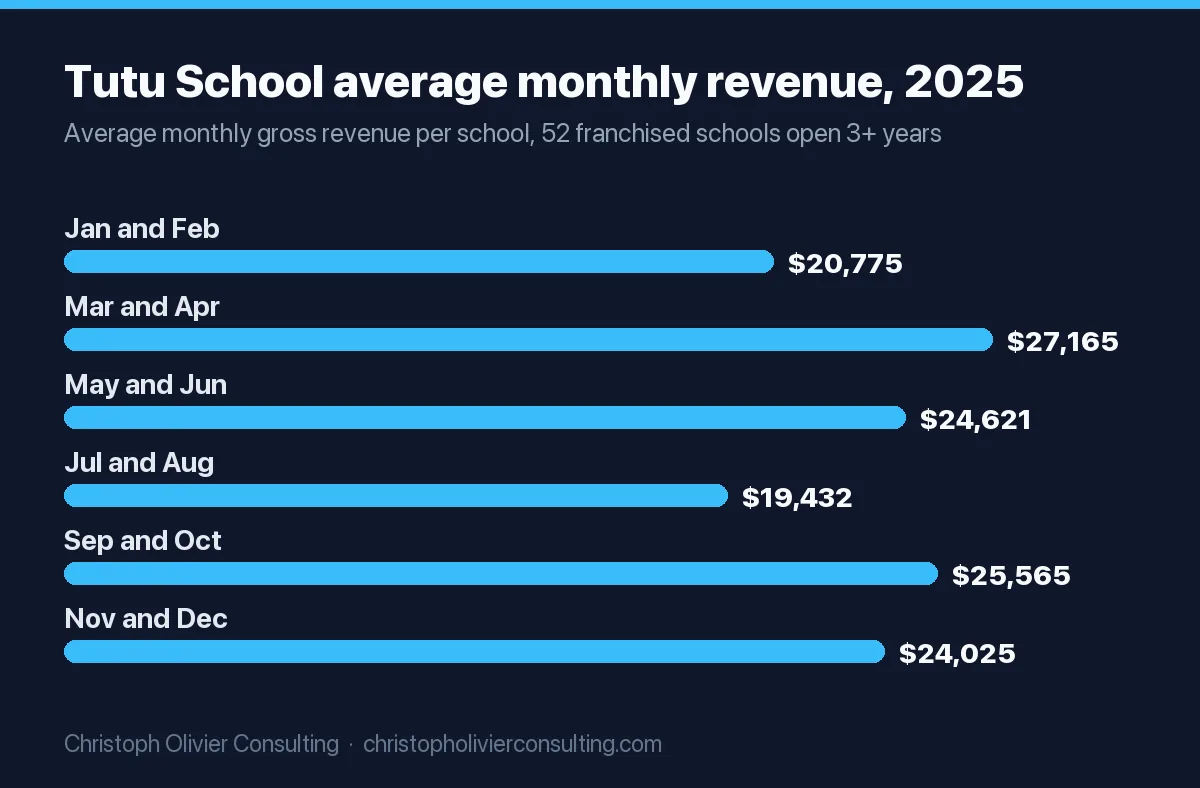
July and August together averaged 79.5% of a school-year month (my calculation). Tutu runs year-round classes for young children. A competition or recital studio on a September to June season usually has a deeper summer dip, but no dance brand publishes that data. Plan cash for it: rent is due in July whether or not classes run.
Is owning a dance studio profitable?
It can be, but the evidence says most of the profit sits in a minority of studios. In the Tutu School sample, 25 of 52 mature schools (48%) reached the $283,159 average, and the bottom third averaged $129,904. Among Fred Astaire studios, 82 of 210 (39%) met or beat the average. Profit grows with enrollment only when rooms are full.
Do dance studio owners make good money?
Owners of full mid-size and large studios can, if you compare them with dance employees. The BLS median for dancers was $24.80 an hour in May 2025, part-time work is common, and 41% of dancers are self-employed. A 250-student studio in my model pays its owner $115,382 before debt and tax. The small owner-teacher studio pays $57,440. That is only about $5,900 more than full-time work at the dancer median ($24.80 × 2,080 hours = $51,584, my calculation), and the owner carries the lease.
Dance studio setup cost: what it takes to open
The most detailed public budget for opening a dance studio is Item 7 of the Fred Astaire FDD. It covers a 2,000 to 4,500 square foot ballroom studio with full leasehold build-out.
| Item 7 line (Fred Astaire, April 2024) | Low | High | Needed by an independent studio? |
|---|---|---|---|
| Net leasehold improvements (dance floor, walls, HVAC, electrical) | $100,000 | $250,000 | Yes, scaled to your space |
| Rent for 3 months | $25,500 | $76,500 | Yes |
| Security deposits | $8,500 | $25,500 | Yes |
| Design, architecture, engineering; permits; due diligence | $9,000 | $40,000 | Yes |
| Furniture, fixtures, equipment (audio, lighting, lockers) | $10,000 | $30,000 | Yes |
| Signage; supplies; business licenses; professional fees; insurance | $20,000 | $47,000 | Yes |
| Grand opening marketing | $5,000 | $5,000 | Yes |
| Working capital for 3 months | $50,000 | $70,000 | Yes |
| Franchise fee, training, travel, construction management, tech system, captive insurance, tech fee, franchisor materials | $73,200 | $125,700 | No |
| Total | $301,200 | $669,700 | |
| Total without franchise-only lines (my calculation) | $228,000 | $544,000 |
Source: FADS USA, Inc. Franchise Disclosure Document, Item 7, issued April 22, 2024. I grouped several lines; the groups add up to the published totals.
That is the high end. A children’s ballet franchise in a smaller space costs much less: Tutu School’s investment range was $97,150 to $178,300 in its 2024 FDD and $115,000 to $216,000 in its 2025 FDD, as reported by PeerSense. An independent studio that leases a space already finished with sprung floors can open for far less than either franchise, but no public source tracks those costs. Build your own budget from the Item 7 lines above.
Music licensing fees every studio pays
Teaching to recorded music is a public performance, so you need a license from each performing rights organization whose catalog you use. ASCAP and BMI list dance-specific rates in their 2026 filings with the Colorado Secretary of State.
| Average students per week | ASCAP: ballet only | ASCAP: combination (jazz, tap, ballet, hip-hop) | ASCAP: ballroom | BMI: instructional use only |
|---|---|---|---|---|
| Up to 75 (BMI: under 60) | $92.16 | $138.22 | $184.31 | $224.00 |
| Up to 150 (BMI: 60 to 124) | $184.31 | $276.43 | $368.59 | $443.00 |
| Up to 300 (BMI: 125 to 249 / 250 to 374) | $276.43 | $414.68 | $552.90 | $665.00 / $882.00 |
| 301 and over (BMI: 375 and over) | $368.59 | $552.90 | $737.17 | $1,180.00 |
Sources: ASCAP 2026 licensing book, Rate Schedule for Dance Schools; BMI 2026 Music License for Dance Classes. ASCAP counts a student taking 5+ hours a week as two students. BMI charges more ($352 to $2,361) if music also plays outside the studio rooms. SESAC and GMR are separate.
What is the highest paying dance job?
By BLS data, it is choreography. The top 10% of choreographers earned more than $66.65 an hour in May 2025, against $52.30 for the top 10% of dancers. Choreographers at performing arts companies had the highest median by industry at $30.74 an hour. For comparison, a studio owner in my 500-student model earns $191,223, roughly $92 an hour at 40 hours a week.
If you also run adult fitness classes, the economics resemble the Pilates studio owner model and the yoga studio owner model more than a kids’ program. Those businesses sell memberships instead of seasonal tuition. A side note on a common search: “1MILLION Dance Studio” is a choreography studio in Seoul, not a U.S. business, and its fees are not covered here.
Dance studio owner pay worksheet: pass/fail before you sign a lease
Copy this into a spreadsheet. Each check comes from the benchmarks above.
| Step | Formula | Pass if |
|---|---|---|
| 1. Annual revenue per student | (Monthly tuition × billed months) + registration + recital net | $1,160 or more (model at $100 tuition) |
| 2. Students per class | Enrolled class spots ÷ weekly classes | 10 or more; at 7, teacher cost per student rises 43% |
| 3. Break-even enrollment | Fixed costs ÷ (step 1 × 0.91 minus teacher cost per student) | Your realistic year-2 enrollment is at least 1.5× break-even |
| 4. Rent share | Annual rent ÷ revenue | 20% or less; the 100-student model runs 26% and pays its owner least |
| 5. Payroll share (including your teaching wage) | All teaching and desk pay ÷ revenue | At or below the Census band for your size: 21.9% (under 5 staff) to 34.1% (10 to 19) |
| 6. Summer revenue | Average July and August revenue ÷ average school-year month | 70% or more (Tutu School 2025: 79.5%); otherwise reserve summer rent in cash |
| 7. Market wage for your own teaching | Your class hours × 40 weeks × $35 × 1.15 | Booked as a cost before profit |
| 8. True profit | Owner pay minus step 7 | Positive and large enough to repay your build-out within five years |
| 9. Licenses | ASCAP + BMI (plus SESAC/GMR if used) | In place before the first class |
If steps 1 or 2 fail, a bigger space multiplies the problem. Fill the rooms you have first. Owners who want an outside read on their enrollment funnel can compare notes with the martial arts school marketing playbook, which deals with the same monthly-tuition economics. If you want help working out where your own numbers break, you can book a consultation.
Ready to scale your revenue?
Book a free 30-min consultation. We’ll diagnose your growth bottleneck and map out the 3 highest-leverage moves for your business.
Frequently asked questions
How much does a dance studio owner make?
No government survey reports it directly. In a model built from Census, BLS and franchise disclosure data, an owner earns about $57,000 pre-tax with 100 students while teaching 12 hours a week, about $115,000 with 250 students and about $191,000 with 500 students. Those figures come before loan payments and income tax. With 30% fewer students and $80 monthly tuition, owner pay falls to roughly $5,000 to $22,000.
What is the average dance studio owner salary?
Payscale lists a $38,975 average base salary, but it rests on only 20 self-reported profiles last updated in September 2023, and it leaves out profit. A better way to read owner pay is in two parts: a market wage for the classes you teach, about $19,320 a year for 12 class hours a week at $35 an hour, plus whatever profit the studio earns after every cost.
What is a typical dance studio profit margin?
No dance studio chain publishes audited margins, and neither Tutu School nor Fred Astaire discloses franchisee profit. In a sourced model, owner pay is 33% to 50% of revenue, and true profit after paying the owner a teaching wage is about 33%. IRS data for 2023 show profitable educational services sole proprietors kept 49.7% of receipts, a figure that includes the owner's own labor.
How much does it cost to open a dance studio?
Fred Astaire's 2024 franchise disclosure budgets $301,200 to $669,700 for a 2,000 to 4,500 square foot ballroom studio, or $228,000 to $544,000 without franchise-only fees. A children's ballet franchise like Tutu School was reported at $97,150 to $178,300 (2024) and $115,000 to $216,000 (2025). An independent studio in a space that is already finished can open for less.
How much revenue does a dance studio make?
Fine arts school firms with employees averaged $456,645 in 2022 receipts, but the median firm took in between $100,000 and $499,999, according to Census SUSB data for NAICS 611610. Tutu School's mature franchised ballet schools averaged $283,159 in 2025, and mature Fred Astaire ballroom studios averaged $724,005 in 2023.
Is owning a dance studio profitable?
It can be once classes are full, but results are skewed. Only 48% of mature Tutu School franchises reached their system's average revenue in 2025, and the bottom third averaged $129,904. In a sourced model, a 100-student studio needs about 41 students to break even, and a 500-student studio with hired teachers needs about 258. Rent and empty class spots are what sink owner pay.
What is the highest paying dance job?
Among employed dance roles, choreography pays most. The top 10% of choreographers earned more than $66.65 an hour in May 2025 according to BLS, against $52.30 for the top 10% of dancers. Owning a full studio can pay more: a 500-student studio in a sourced model pays its owner about $191,000 before debt and tax.
Small business owner income