
A yoga studio owner makes the studio’s profit plus whatever wage they pay themself, so income tracks one number above all: how many paying members the studio keeps each month. No government survey reports yoga studio owner pay. The best public studio data is the YogaSix franchise disclosure document: its 162 US studios open all of 2024 averaged $488,615 in gross revenue (median $468,417) with an average of 264 monthly active members, per Item 19 of the YogaSix FDD (February 2026 amendment). Employed fitness instructors, the job most owners leave, earned a median $47,160 in May 2025 (BLS).
Short answer: In my worked model built from public data, a yoga studio owner earns about $92,000 a year pre-tax with 137 members (owner teaching 15 classes a week), about $144,000 with 264 members and about $274,000 with 420 members, after loan payments. Below roughly 175 members, a studio with a hired teaching staff and a $150,000 build-out loan loses money. A YogaSix franchisee at the system average keeps about $55,000 in my model, because royalties and a larger loan eat most of the margin.
Below: what each primary source actually measures, YogaSix revenue and members by quartile, Census and IRS numbers for every fitness and recreation business, a labeled P&L at three sizes plus a franchise column, startup costs line by line from the FDD, and a pass/fail worksheet to run before you sign a lease.
How much does a yoga studio owner make? What each source measures
The salary sites that rank for this question publish job-ad or self-reported averages for “yoga studio owner,” which mixes owners, managers and teachers. Primary sources do not report owner pay at all. They report revenue, wages and profit for groups that include yoga studios, and each one measures a different slice.
| Source and period | What it measures | Figure | Notes |
|---|---|---|---|
| YogaSix FDD Item 19, calendar 2024 | Average gross revenue per franchised yoga studio open all year | $488,615 (median $468,417) | 162 qualified studios; range $75,890 to $1,223,369. Revenue only, no costs or profit |
| YogaSix FDD Item 19, 2024 | Average monthly active members per studio | 264 (median 244) | Range 74 to 626 members |
| Xponential Fitness 10-K, 2025 | YogaSix studios operating and licenses sold, worldwide | 194 operating; 637 licenses sold | Xponential calls YogaSix the largest franchised yoga brand by studio count |
| Census SUSB, 2022, NAICS 713940 | Revenue per location, all fitness and recreational sports centers with employees | $928,640 | $37.88 billion ÷ 40,786 locations (my calculation). Yoga studios are not counted separately |
| Census Nonemployer Statistics, 2022, NAICS 7139 | Revenue per business with no employees, other amusement and recreation (includes solo yoga teachers and instruction businesses) | $45,661 | $6.41 billion ÷ 140,432 businesses (my calculation). Sole proprietors alone: $30,369 |
| IRS SOI Table 1, tax year 2023 | Net profit of sole proprietors with a profit, amusement, gambling and recreation industries | $19,986 average; 23.7% margin | $2.38 billion ÷ 119,272 returns (my calculation). Broad group, many part-time businesses |
| BLS Occupational Outlook Handbook, May 2025 | Median wage, employed fitness trainers and instructors (yoga teachers are included) | $47,160 ($22.67 an hour) | $48,140 in fitness and recreational sports centers. Excludes the self-employed |
Read the table this way. A franchised yoga studio grosses about half a million dollars. Most one-person yoga and fitness businesses gross far less: 67.3% of the 140,432 nonemployer businesses in NAICS 7139 took in under $25,000 in 2022, and only 11.0% took in $100,000 or more (my calculation from the Census file). That is teaching income, not studio ownership. Revenue is not salary either: a studio grossing $488,615 can still pay its owner less than an instructor’s wage if membership is thin and the loan is large.
Yoga studio owner salary is salary plus profit
If your studio is an LLC taxed as a sole proprietorship, you do not get a salary. You take draws, and your pay is the studio’s net profit. If you elected S corporation status, you pay yourself a wage through payroll and take the rest as distributions. Either way, the number to compare with a teaching job is owner earnings: profit before any owner pay, after loan payments. That is the figure in my P&L below. It includes the value of the classes you teach yourself, so an owner who teaches 15 classes a week is partly being paid as an instructor.
How much do yoga studios make? YogaSix revenue and members by quartile
YogaSix is the only yoga brand whose studio-level revenue I could verify in a disclosure document. Item 19 ranks the 162 qualified studios by 2024 gross revenue and, separately, by average monthly active members.
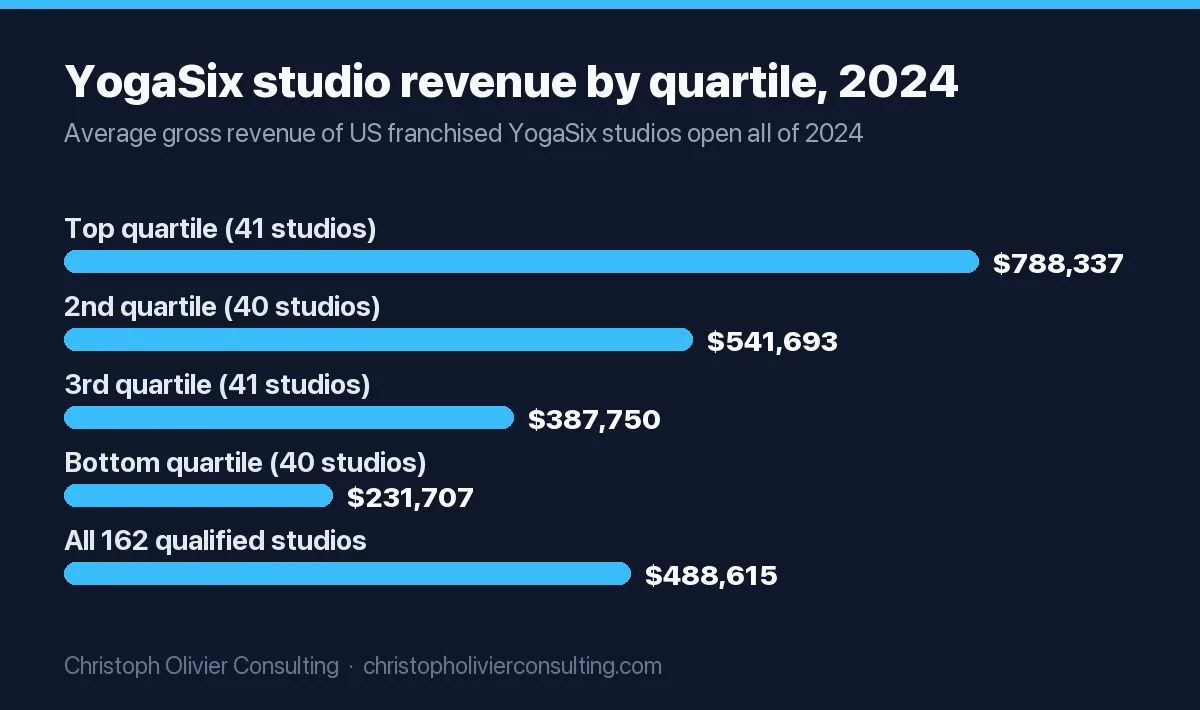
| Quartile (2024) | Studios | Average gross revenue | Revenue range | Average monthly active members | Average new memberships per month |
|---|---|---|---|---|---|
| Top quartile | 41 | $788,337 | $628,541 to $1,223,369 | 420 | 40 |
| 2nd quartile | 40 | $541,693 | $468,560 to $628,054 | 284 | 27 |
| 3rd quartile | 41 | $387,750 | $314,060 to $467,735 | 214 | 19 |
| Bottom quartile | 40 | $231,707 | $75,890 to $312,060 | 137 | 12 |
| All qualified studios | 162 | $488,615 | $75,890 to $1,223,369 | 264 | 24 |
Source: YogaSix FDD (February 2026 amendment), Item 19, Parts A-1, A-2 and A-3, measurement period January 1 to December 31, 2024. Revenue, member and new-membership quartiles are ranked separately, so a studio in the top revenue quartile is not necessarily in the top member quartile.
What the filing tells you about owner income:
- Revenue per member is about $154 a month. $488,615 ÷ 264 members ÷ 12 months (my calculation). That all-in figure includes drop-ins, class packs and retail, not just dues. Memberships were 73% of average revenue, services such as class packs and privates 22%, products 4% and fees 1% (Part C).
- The bottom quartile is a small business. 40 studios averaged $231,707 with 137 members. At that size, a studio carrying hired teachers, a desk and a loan struggles to pay anyone, as the sensitivity table below shows.
- New studios plateau around $40,000 a month. Studios that soft-opened in 2024 averaged $8,268 in month one (excluding pre-sales), $31,200 in month two, $37,538 in month three and between $39,000 and $40,500 a month in months six through ten (Part B). Annualized, that plateau is roughly $475,000 (my calculation). Average active members peaked at 308 in month three and slid to 266 by month nine, so pre-sale members churn out after the launch.
What pays more, yoga or Pilates?
At the studio level, Pilates. The same franchisor’s 2024 disclosures show Club Pilates studios averaged $984,270 in gross revenue across 849 qualified studios (Club Pilates FDD Item 19), about twice the YogaSix average of $488,615. Club Pilates studios also averaged more members (440 vs 264) and more revenue per member (about $186 a month vs $154, my calculation from both filings). My Pilates studio owner salary breakdown runs the same P&L method on reformer studios. For instructors, BLS does not split yoga from Pilates; both fall under the $47,160 median for fitness trainers and instructors.
What a typical small fitness studio brings in
Census counts yoga studios with employees together with gyms and other fitness centers under NAICS 713940. The distribution still tells you where an independent studio sits. I calculated the shares, averages and payroll ratios from the SUSB 2022 file (released April 10, 2025).
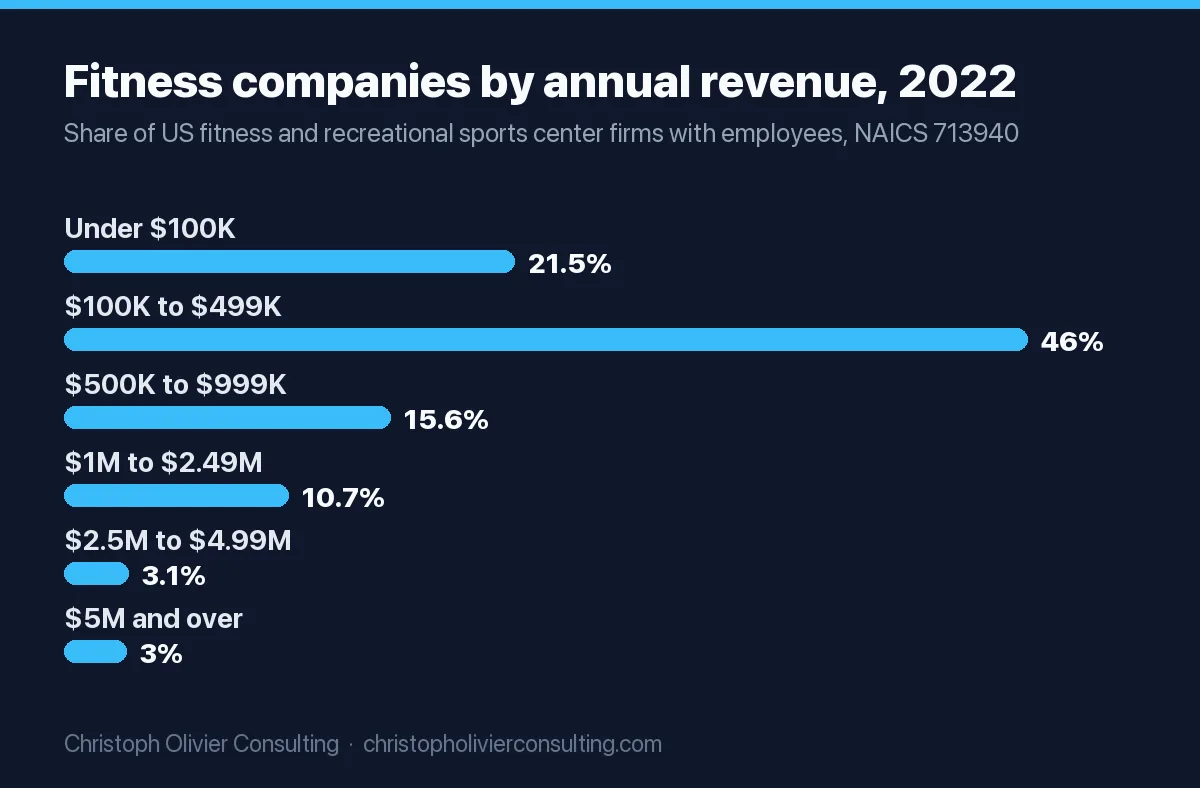
| Company annual revenue | Companies | Share | Cumulative | Average revenue | Payroll as % of revenue |
|---|---|---|---|---|---|
| Under $100,000 | 7,160 | 21.5% | 21.5% | $46,890 | 35.9% |
| $100,000 to $499,999 | 15,292 | 46.0% | 67.6% | $258,248 | 31.9% |
| $500,000 to $999,999 | 5,198 | 15.6% | 83.2% | $691,542 | 33.0% |
| $1M to $2.49M | 3,557 | 10.7% | 93.9% | $1,507,794 | 31.0% |
| $2.5M to $4.99M | 1,036 | 3.1% | 97.0% | $3,236,946 | 34.4% |
| $5M and over | 989 | 3.0% | 100% | n/a (large chains) | n/a |
Source: U.S. Census Bureau, Statistics of U.S. Businesses 2022, NAICS 713940, employer firms only (33,232 firms). The $5 million and over row combines the published bands above $5 million. Shares, averages and ratios are my calculations.
The median fitness company with a payroll takes in between $100,000 and $499,999 a year, and payroll takes about 31% to 33% of revenue in every band where a yoga studio is likely to sit. An average YogaSix studio ($488,615) would sit at the top of the band that holds 46% of all fitness companies. I use the 31.9% payroll ratio for the hired-staff studios in the P&L below. For comparison with bigger-box fitness, see my gym owner salary breakdown, which covers the same Census code.
Yoga studio profit margin: what is disclosed and what is not
Margins get quoted loosely online, usually without a source. Here is what the primary data does and does not say:
- YogaSix does not disclose studio costs or profit. Item 19 covers revenue, members and revenue mix only. Any YogaSix “profit margin” you see is an estimate.
- IRS: sole proprietors in amusement, gambling and recreation (a broad group that includes fitness and yoga instruction) kept 6.2% of receipts as net profit across all 177,602 returns, and 23.7% among the 119,272 returns that made a profit, in tax year 2023, per IRS Statistics of Income (my calculation). For sole proprietors, that net profit is the owner’s pay.
- IRS cost ratios for the same group: rent on business property was 7.0% of receipts and payroll 11.5% across all returns (my calculation). The low payroll share reflects owners doing the work themselves.
So the honest answer to “what is a yoga studio’s profit margin” is: no audited figure exists for yoga studios, the broad IRS group shows 6.2% overall and 23.7% for profitable operators, and in my model below, owner earnings before debt run from a loss to more than 40% of revenue depending almost entirely on member count. If you want the cross-industry context, my profit margin by industry breakdown shows where recreation sits against other service businesses.
Worked P&L: what a yoga studio owner makes at three sizes
This is my own calculation, not reported data. Every input is labeled so you can swap in your lease, your prices and your schedule.
Assumptions (mine):
- Member counts match YogaSix’s 2024 bottom quartile (137), average (264) and top quartile (420).
- Revenue per member is $154 a month all in, the YogaSix 2024 average calculated above.
- Small studio: 30 classes a week, the owner teaches 15 and works the desk. The other 15 classes cost $45 each, about two paid hours at the BLS median instructor wage of $22.67, plus 10% for payroll taxes.
- Medium and large studios: the owner manages but payroll for teachers, desk and a manager runs at 31.9% of revenue (the Census ratio above) plus 8% for payroll taxes.
- Rent at $32 per square foot per year all in. Sizes of 1,500, 1,800 and 2,000 square feet bracket the YogaSix typical studio of 1,500 to 1,800 square feet built for up to 40 people (Xponential 10-K).
- Marketing 5%, card processing 3%, retail cost of goods 2% and other costs (repairs, props, laundry, accounting) 3% of revenue. Software $3,000 a year. Insurance $5,000 to $8,000, the range implied by YogaSix’s Item 7 insurance line of $4,681 to $9,683.
- Build-out loan of $100,000, $150,000 or $200,000 at 10% over seven years.
- Franchise column: YogaSix average revenue, 7% royalty and 2% brand fund (per the FDD as reported by 1851 Franchise), 2% local marketing, and 70% of the Item 7 midpoint ($677,749) financed. Technology fees are not included because I could not confirm the amount.
| Annual line (my model) | Small: 137 members | Medium: 264 members | Large: 420 members | YogaSix franchise: average |
|---|---|---|---|---|
| Revenue | $253,562 | $488,615 | $777,342 | $488,615 |
| Payroll (non-owner) | $38,610 | $168,074 | $267,390 | $168,074 |
| Rent | $48,000 | $57,600 | $64,000 | $52,800 |
| Utilities and cleaning | $14,400 | $16,800 | $20,400 | $16,800 |
| Software and insurance | $8,000 | $9,000 | $11,000 | $9,000 |
| Marketing | $12,678 | $24,431 | $38,867 | $9,772 |
| Card fees, retail cost, other | $20,285 | $39,088 | $62,187 | $39,088 |
| Royalty and brand fund (9%) | n/a | n/a | n/a | $43,975 |
| Earnings before debt and owner pay | $111,589 (44.0%) | $173,621 (35.5%) | $313,497 (40.3%) | $149,104 (30.5%) |
| Loan payments | $19,921 | $29,882 | $39,843 | $94,512 |
| Owner earnings, pre-tax | $91,667 | $143,739 | $273,654 | $54,592 |
My calculation. Inputs from YogaSix FDD Item 19 (members, revenue per member), Census SUSB 2022 (payroll ratio), BLS May 2025 (instructor wage) and YogaSix Item 7 (insurance, investment); every other input is my labeled assumption. Owner earnings are before income tax and before any owner health insurance or retirement contributions.
Three things this model shows:
- The small studio’s 44% margin is the owner’s labor. $91,667 for teaching 15 classes a week plus running the desk is about $44,500 more than the BLS median instructor wage, for far more hours and personal risk.
- The franchise owner earns least at the same revenue. Royalty and brand fund take $43,975, and financing a $474,424 investment costs $94,512 a year. Once the loan is paid off, owner earnings would rise to about $149,000.
- Debt and members decide everything. Rent and software barely move the result. A studio that adds 50 members adds about $80,000 in pre-debt earnings in this model.
Sensitivity: owner earnings by member count
Same medium-studio cost base (payroll fixed at $168,074, 1,800 square feet, $150,000 loan). Only the member count changes.
| Average monthly members | Matches YogaSix 2024 | Revenue | Owner earnings, pre-tax |
|---|---|---|---|
| 137 | Bottom quartile average | $253,562 | Loss of $60,758 |
| 180 | $333,147 | $8,481 | |
| 214 | 3rd quartile average | $396,074 | $63,229 |
| 264 | All-studio average | $488,615 | $143,739 |
| 284 | 2nd quartile average | $525,631 | $175,943 |
| 330 | $610,769 | $250,013 | |
| 420 | Top quartile average | $777,342 | $394,932 |
My calculation, holding payroll and other fixed costs at the medium-studio level. A real studio would cut classes as members fall, so the bottom rows overstate the loss and the top rows overstate the gain.
Is opening a yoga studio profitable?
It can be, but the break-even point is higher than most owners expect. In my medium-studio model, fixed costs (payroll, rent, utilities, software, insurance and loan) total $281,356 a year. Each member contributes about $1,610 a year after variable costs ($154 × 12 × 87%). That puts break-even at about 175 members, and paying the owner the $47,160 instructor median takes about 204 members (my calculation). The YogaSix bottom quartile averaged 137 members, below that line.
The small owner-teacher studio breaks even at about 80 members and reaches the instructor median at about 109, because the owner’s own teaching replaces payroll. That is why many profitable independent studios are small and owner-taught.
Churn is the hidden cost. The average YogaSix studio signed 24 new memberships a month in 2024 just to hold its member base at 264 (Item 19, Part A-3). If your marketing cannot replace members at that pace, the member count drifts down. My gym marketing guide works through retention economics for membership businesses, and the tiered package logic in good better best pricing applies directly to 4-class, 8-class and unlimited memberships, the three packages YogaSix sells.
Why are so many yoga studios closing?
No government source tracks yoga studio closures. The public filings show the pressure points. Across all Xponential brands in North America, 92 franchised studios stopped operating in 2025 against 2,446 open at the start of the year (3.8%, my calculation), and run-rate average unit volume fell 2% in the fourth quarter of 2025 versus a year earlier (10-K). YogaSix’s own US net studio growth slowed from +35 in 2022 to +26 in 2023 and +7 in 2024 (Item 20). The model above shows the mechanism: a studio with hired staff and a loan needs about 175 members to break even, and a quarter of YogaSix studios averaged 137.
Yoga studio startup costs: the FDD line by line
The only itemized, legally disclosed yoga studio budget is YogaSix’s Item 7. These figures are from the 2025 FDD as reported by 1851 Franchise; I did not read Item 7 in the filing itself. The last column is my note on what an independent studio can skip or shrink.
| Item 7 line | Low | High | Independent studio (my note) |
|---|---|---|---|
| Initial franchise fee | $60,000 | $60,000 | Skip |
| Sourcing fee | $0 | $28,000 | Skip |
| Training travel and living | $0 | $3,000 | Skip or replace with your own teacher training |
| Real estate, lease and professional fees | $23,000 | $51,000 | Still needed: deposit, broker, lawyer |
| Net leasehold improvements | $285,500 | $416,000 | Biggest variable. A second-generation fitness space cuts this sharply; a heated room raises it |
| Signage | $9,500 | $25,000 | Shrink |
| Insurance | $4,681 | $9,683 | Still needed |
| Fitness equipment and furniture package | $36,600 | $60,000 | Mats, blocks, straps, bolsters, lockers; shrink |
| Pre-sale and opening retail inventory | $13,000 | $18,000 | Optional |
| Audio/visual and computer system | $29,500 | $29,500 | Shrink |
| Initial marketing and advertising | $35,370 | $51,500 | Still needed: pre-sales drive the first months |
| Instructor training | $3,000 | $4,500 | Still needed |
| Technology and software | $4,082 | $4,082 | Still needed, smaller |
| Additional funds (3 months) | $25,000 | $66,000 | Hold at least this much |
| Total | $529,233 | $826,265 | Varies with build-out |
Across all its brands, Xponential reports a weighted average initial franchisee investment of about $554,000 in 2025 (10-K). There is no disclosed equivalent for independent studios. If you remove the franchise and sourcing fees and shrink signage, AV and inventory, the FDD lines that remain still show why build-out and three months of operating cash are where an independent budget is won or lost.
How large should a yoga studio be?
YogaSix’s typical studio is 1,500 to 1,800 square feet and is designed for up to 40 people in class (Xponential 10-K, 2025). That is one main room plus lobby, changing areas and storage. In my model, a single room running 42 classes a week at 264 members fills only about a quarter of its 40 spots on average (422 visits a week across 1,680 spots, assuming 1.6 visits per member a week), so most studios do not need a second room until classes at peak times sell out.
How much to charge for a 1 hour yoga class
YogaSix sells monthly packages of four, eight or unlimited classes plus single classes, but the 10-K does not publish prices. What the data does show: average revenue per member of about $154 a month. Xponential reported 59.2 million visits in 2025 and about 704,000 actively paying members, roughly 84 visits per member a year or 1.6 a week (my calculation; includes livestream visits and all brands). At that rate, $154 a month works out to about $22 per visit (my calculation). Set your drop-in price above your per-visit membership price so the membership is the obvious deal; my pricing strategy guide covers anchoring a single-class price against packages.
Yoga studio owner pay worksheet: pass/fail before you sign a lease
Run your own numbers through these checks. Each threshold comes from the sources and model above. Fail two or more and the plan needs changing before you commit.
| Check | How to calculate | Pass | Fail | Where the threshold comes from |
|---|---|---|---|---|
| 1. Members to break even | Annual fixed costs (payroll, rent, utilities, software, insurance, loan) ÷ (monthly revenue per member × 12 × 0.87) | Break-even at or below 140 members | Above 175 members | YogaSix bottom quartile averaged 137 members; my medium model breaks even at 175 |
| 2. Owner pay vs teaching job | Projected owner earnings at your realistic member count | Above $47,160 by month 12 | Below $47,160 | BLS median instructor wage, May 2025 |
| 3. Payroll share | Non-owner payroll ÷ revenue | At or below 33% | Above 36% | Census SUSB 2022: 31.9% to 33.0% in the $100K to $999K bands; 35.9% under $100K |
| 4. Rent share | Annual rent ÷ projected revenue | At or below 12% | Above 15% | My model: 11.8% at 264 members; IRS recreation sole proprietors averaged 7.0% |
| 5. Member replacement | New members you can sign per month with your marketing budget | At least 9% of your target member base | Under 5% | YogaSix average: 24 new a month on 264 members (9.1%) |
| 6. Cash cushion | Cash held after opening ÷ monthly fixed costs | 3 months or more | Under 2 months | YogaSix Item 7 sets aside 3 months of additional funds ($25,000 to $66,000) |
| 7. Debt service | Annual loan payments ÷ earnings before debt | Under 25% | Over 50% | My model: 17% medium independent vs 63% franchise column |
A worked example for check 1. Say your fixed costs are $200,000 a year and you expect $140 per member per month. Contribution per member is $140 × 12 × 0.87 = $1,462. Break-even is $200,000 ÷ $1,462 = 137 members. That passes, but only just: you would sit at the YogaSix bottom-quartile average before paying yourself anything.
If you are deciding between opening, buying an existing studio or franchising, and want someone to pressure-test the member and marketing math with you, you can book a consultation.
Ready to scale your revenue?
Book a free 30-min consultation. We’ll diagnose your growth bottleneck and map out the 3 highest-leverage moves for your business.
Frequently asked questions
How much does a yoga studio owner make?
No government survey reports it. In my model built from the YogaSix FDD, Census and BLS data, an owner earns about $92,000 pre-tax with 137 members while teaching 15 classes a week, about $144,000 with 264 members and about $274,000 with 420 members, after loan payments. Below about 175 members, a studio with hired teachers and a $150,000 loan loses money.
Do yoga studio owners make good money?
Some do, many do not. IRS data for tax year 2023 shows sole proprietors in amusement and recreation, which includes yoga instruction, kept 6.2% of receipts overall and averaged $19,986 in profit among those that made money. A studio at the YogaSix average of 264 members can pay its owner well; one at the bottom-quartile average of 137 members struggles unless the owner teaches most classes.
What is a typical yoga studio profit margin?
No audited yoga studio margin exists, and YogaSix does not disclose costs. The closest primary figure is IRS tax year 2023 data for amusement and recreation sole proprietors: a 6.2% net margin across all returns and 23.7% among profitable ones. In my model, earnings before debt and owner pay range from a loss to more than 40% of revenue, driven mostly by member count.
How much does a yoga studio make a year?
YogaSix franchised studios open all of 2024 averaged $488,615 in gross revenue, with a median of $468,417 and a range of $75,890 to $1,223,369 across 162 studios, per Item 19 of its FDD. The bottom quartile averaged $231,707 and the top quartile $788,337. Revenue per member worked out to about $154 a month.
How much money is needed to open a yoga studio?
YogaSix's Item 7 puts a franchised studio at $529,233 to $826,265, as reported from its 2025 FDD, including a $60,000 franchise fee and $285,500 to $416,000 in leasehold improvements. No disclosed figure exists for independent studios. An independent skips the franchise and sourcing fees, but build-out, marketing and three months of operating cash still dominate the budget.
Is opening a yoga studio profitable?
It can be if you reach enough members. In my medium-studio model with hired staff, 1,800 square feet and a $150,000 loan, break-even is about 175 members and paying the owner the $47,160 BLS instructor median takes about 204. An owner-taught small studio breaks even at about 80 members. Replacing churn matters: YogaSix studios averaged 24 new memberships a month.
What pays more, yoga or Pilates?
At the studio level, Pilates. Club Pilates studios averaged $984,270 in 2024 revenue versus $488,615 for YogaSix, both from the same franchisor's FDDs, with more members (440 vs 264) and more revenue per member. For instructors, BLS does not separate yoga from Pilates; both fall under the $47,160 median for fitness trainers and instructors in May 2025.
Small business owner income