
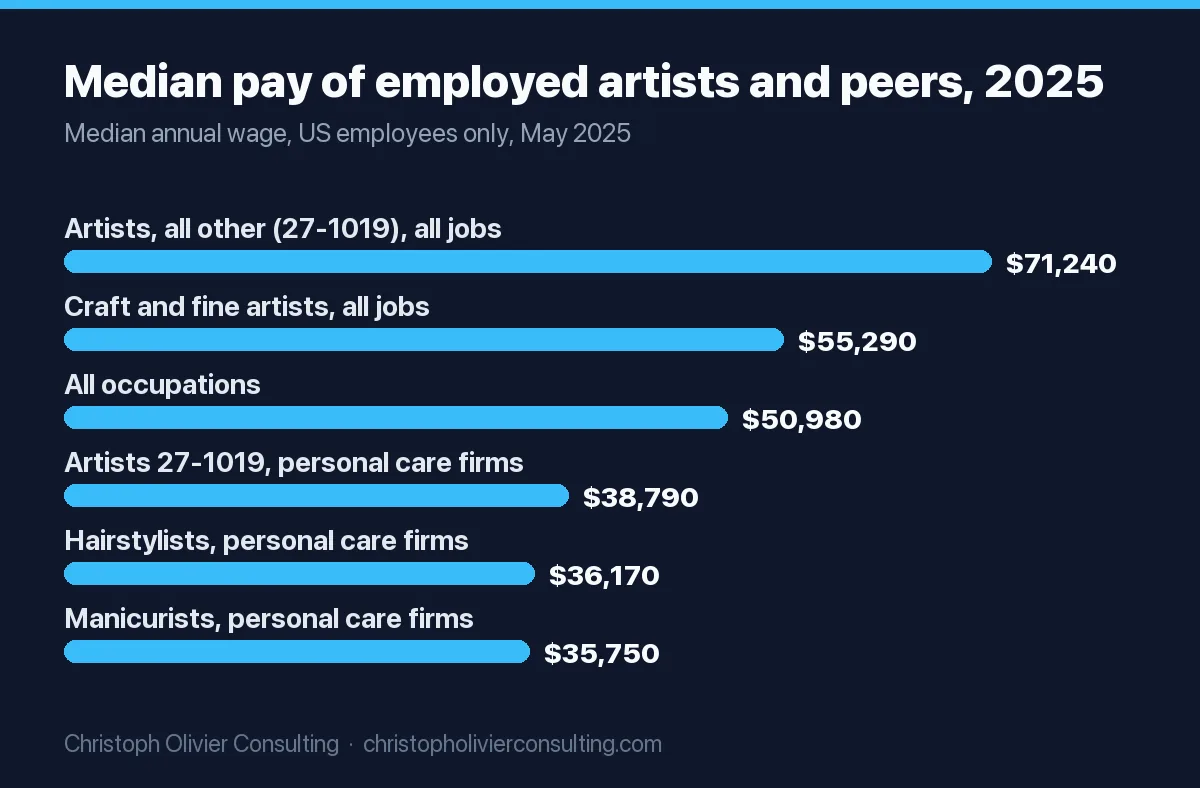
A tattoo shop owner’s income depends on two things: how many hours the chairs are booked and how the shop splits each artist’s billings. No government survey reports tattoo shop owner pay. The closest Census count of tattoo parlors, a broader personal care category, shows a typical shop with employees taking in $100,000 to $499,999 a year in 2022 (Census SUSB). Artists (BLS code 27-1019) employed by personal care businesses earned a median of $38,790 in May 2025 (BLS OEWS).
Short answer: In my worked model, a solo owner who tattoos 25 booked hours a week at $150 an hour clears about $130,000 a year before income tax. A 4-chair shop where the owner still tattoos pays the owner about $187,000. An 8-chair shop where the owner only manages pays about $185,000. At 15 booked hours a week and $100 an hour, the solo figure drops to about $35,000. Booked hours move owner pay more than any other input.
Below are the public numbers that do exist: Census revenue for the industry that includes tattoo parlors, IRS sole proprietor results, BLS artist wages and state license fees. Then I turn them into a labeled P&L at three shop sizes, a rate and hours grid, a commission versus booth rent comparison and a worksheet you can fill in with your own numbers.
How much does a tattoo shop owner make? What each public source measures
Tattoo parlors have no government dataset of their own. Census files them under NAICS 812199, “Other Personal Care Services,” together with day spas, tanning salons, hair removal, ear piercing and permanent makeup (2022 NAICS index). BLS has no tattoo artist occupation code either. Its Occupational Outlook Handbook lists tattoo artists as a type of craft and fine artist, and an O*NET keyword search for “tattoo” returns several codes, led by fine artists (27-1013) and artists and related workers, all other (27-1019). Read the “what it measures” column before you compare any of these numbers.
| Source and year | What it measures | Figure | How it was calculated |
|---|---|---|---|
| Census SUSB 2022, NAICS 812199 | Average revenue per firm with employees (tattoo parlors, day spas, tanning, hair removal and similar) | $519,052 | $13,943,289,000 receipts ÷ 26,863 firms (my calculation) |
| Census SUSB 2022, NAICS 812199 | Revenue band that holds the middle firm | $100,000 to $499,999 | 35.1% of firms are under $100,000 and 76.8% are under $500,000 (my calculation) |
| Census Nonemployer Statistics 2022, NAICS 81219 | Average revenue of a business with no paid employees (mostly solo operators; also includes diet centers) | $32,346 | $6,101,057,000 ÷ 188,618 businesses (my calculation) |
| IRS SOI, tax year 2023, personal and laundry services | Net profit of the average profitable sole proprietorship (includes salons, dry cleaners and pet care) | $16,758 | $35,285,835,000 net income ÷ 2,105,585 profitable returns (my calculation) |
| BLS OEWS, May 2025, SOC 27-1019 in personal care services | Median wage of employed (W-2) artists working in personal care businesses | $38,790 | Published. 1,460 jobs; mean $46,850 |
| BLS Occupational Outlook Handbook, May 2025 | Median wage of employed craft and fine artists in all industries | $55,290 | Published. 58% of craft and fine artists are self-employed, and their pay is not in this figure |
Three things to take from this table:
- The Census average is pulled up by a few large firms. 232 firms with $5 million or more in revenue collect 25.3% of all revenue in NAICS 812199. A single-location tattoo shop sits in the lower bands.
- The small nonemployer and IRS averages are not full-time owner incomes. 64.8% of the 188,618 nonemployer businesses in NAICS 81219 took in less than $25,000 in 2022 (my calculation). That pattern fits side work, guest spots and part-time studios.
- BLS wages leave out most tattoo artists. OEWS counts only employees. Commission artists paid on a 1099 and booth renters are self-employed, so they are not in the $38,790 figure.
What a typical tattoo shop brings in: revenue by size
Census publishes NAICS 812199 firms by annual revenue band. I calculated the shares, the average revenue per firm in each band and payroll as a share of revenue. The industry includes non-tattoo businesses, so use the bands as a range, not a tattoo-only benchmark.
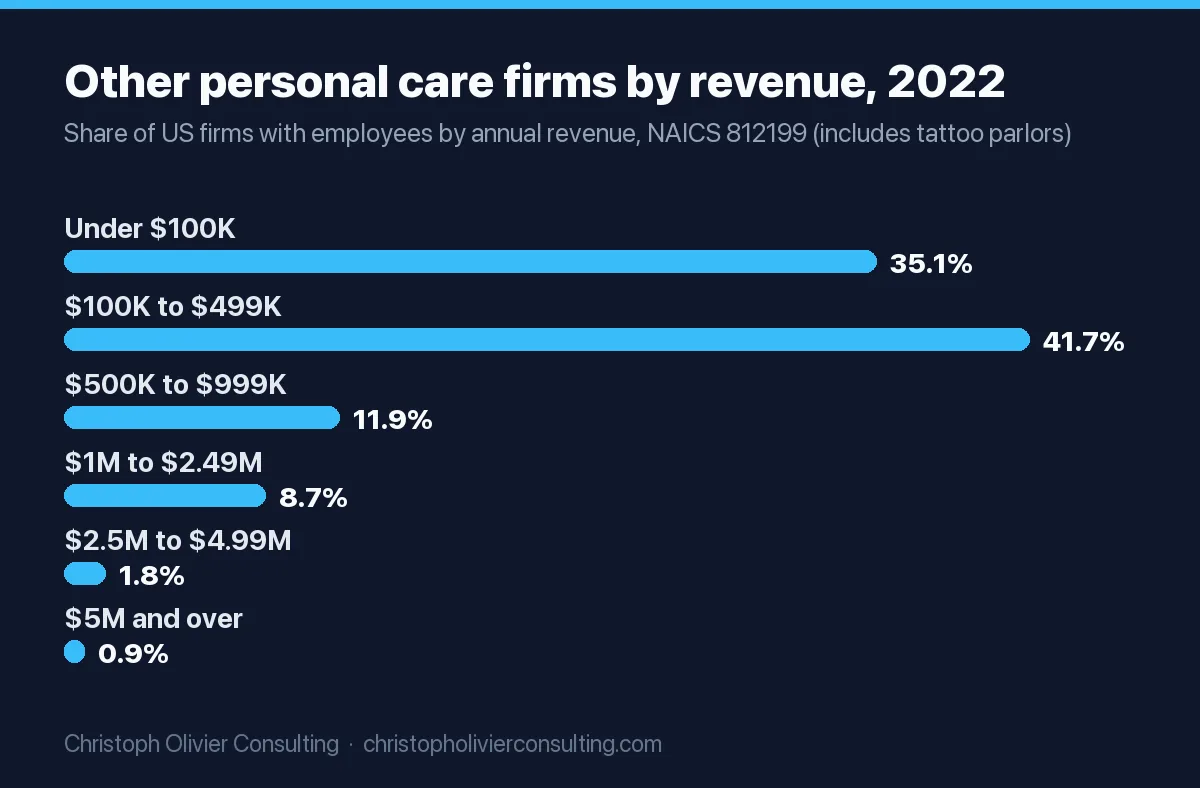
| Annual revenue of the firm | Firms | Share of firms | Cumulative share | Average revenue per firm | Employees per firm | Payroll as % of revenue |
|---|---|---|---|---|---|---|
| Under $100,000 | 9,428 | 35.1% | 35.1% | $47,818 | 1.2 | 37.7% |
| $100,000 to $499,999 | 11,191 | 41.7% | 76.8% | $238,188 | 3.5 | 33.5% |
| $500,000 to $999,999 | 3,184 | 11.9% | 88.6% | $707,049 | 9.9 | 38.5% |
| $1 million to $2.49 million | 2,341 | 8.7% | 97.3% | $1,465,761 | 18.4 | 39.9% |
| $2.5 million to $4.99 million | 487 | 1.8% | 99.1% | $3,329,119 | 31.6 | 34.5% |
| $5 million and over | 232 | 0.9% | 100% | $15,185,379 | 127.7 | 32.8% |
| All firms | 26,863 | 100% | $519,052 | 6.3 | 35.9% |
Source: Census SUSB 2022, NAICS 812199. The $5 million and over row is the total minus the published bands. Shares, averages and ratios are my calculations.
For context, the same Census file puts average revenue per firm at $281,882 for barber shops, $362,886 for beauty salons and $346,111 for nail salons in 2022 (my calculations). If you are weighing a tattoo shop against a chair-based business, the barbershop owner salary and hair salon owner salary breakdowns use the same Census tables.
Tattoo shop owner pay is two numbers: your chair plus the shop’s profit
Most tattoo shop owners also tattoo. That makes “owner salary” a blend of two very different things:
- Pay for your own chair. This is what you would earn as an artist at another shop on the same billings. In my model I value it at the same split the shop pays its own artists, so at a 50/50 split you “pay yourself” half of what you bill.
- Shop profit. What is left after every artist, rent, supply, card fee and front desk wage, including the market value of your own chair. This is the part that grows with each added chair and the part a buyer would pay for.
If you only track the combined number, a busy owner-artist can look like a great business owner when the shop itself barely breaks even. Splitting the two shows whether adding chairs is worth it.
Taxes come out of both parts. A sole proprietor or single-member LLC owner pays self-employment tax of 15.3% (12.4% Social Security, 2.9% Medicare) on net earnings, with Social Security applying to the first $184,500 in 2026 (IRS). Every figure in the model below is before income and self-employment tax.
Worked P&L: what a solo, 4-chair and 8-chair tattoo shop owner makes
This is my own calculation, not survey data. The assumptions are listed under the table so you can swap in your own.
| Line (per year) | Solo private studio | 4 chairs, owner tattoos | 8 chairs, owner manages |
|---|---|---|---|
| Owner’s own billings | $180,000 | $144,000 | $0 |
| Other artists’ billings | $0 | $475,200 (3 artists) | $1,108,800 (7 artists) |
| Gross billings | $180,000 | $619,200 | $1,108,800 |
| Artist commissions (50%) | $0 | $237,600 | $554,400 |
| Employer payroll tax on commissions (7.65%) | $0 | $18,176 | $42,412 |
| Card processing (2.6%) | $4,680 | $16,099 | $28,829 |
| Needles, cartridges, ink, barrier film, gloves (7%) | $12,600 | $43,344 | $77,616 |
| Rent | $21,600 | $48,000 | $90,000 |
| Front desk (wage plus 7.65% payroll tax) | $0 | $37,107 (1) | $74,214 (2) |
| Insurance | $2,000 | $4,000 | $7,000 |
| Booking software, phone, utilities | $3,600 | $9,000 | $15,000 |
| State licenses (Florida rates) | $260 | $440 | $620 |
| Marketing (3%) | $5,400 | $18,576 | $33,264 |
| Value of owner’s own chair (50% of own billings) | $90,000 | $72,000 | $0 |
| Shop profit after paying the owner’s chair | $39,860 (22.1%) | $114,857 (18.5%) | $185,446 (16.7%) |
| Total owner pay, pre-tax | $129,860 | $186,857 | $185,446 |
Assumptions (mine, not sourced benchmarks): $150 per booked hour; 48 working weeks; the owner bills 25 hours a week solo and 20 hours in the 4-chair shop; each other artist bills 22 hours a week; artists are W-2 employees on a 50% commission, so the shop owes 6.2% Social Security plus 1.45% Medicare on their pay (IRS Topic 751); rent of $1,800, $4,000 and $7,500 a month; supplies at 7% and marketing at 3% of billings. Card fees use Square’s 2.6% in-person rate and ignore the 15 cent per-transaction fee, which is under 0.1% on a typical tattoo ticket (Square pricing). The front desk wage is $34,470, the May 2025 BLS median for receptionists in personal care services (BLS OEWS). License costs use the Florida fee schedule covered below.
What the model shows:
- The 8-chair owner earns about the same as the 4-chair owner. Doubling the chairs replaced the owner’s own $144,000 in billings with management work. Unless the larger shop raises rates or fills more hours, growth buys you time out of the chair, not more money.
- Shop margin falls as the shop grows. 22.1% solo, 18.5% with 4 chairs and 16.7% with 8 chairs, because front desk pay and payroll tax scale up while the owner’s own high-margin chair disappears.
- A solo owner’s 72% “margin” is mostly wages. Of the $129,860, $90,000 is pay for the owner’s own tattooing. The shop itself earns $39,860.
Is $100 an hour good for a tattoo artist? Rate and hours grid
The rate question only makes sense next to booked hours. Below is total pre-tax pay for the solo owner in the model above, with every cost held the same and only the rate and weekly booked hours changed (my calculation).
| Booked hours per week | $100 an hour | $150 an hour | $200 an hour |
|---|---|---|---|
| 15 | $35,468 | $66,932 | $98,396 |
| 20 | $56,444 | $98,396 | $140,348 |
| 25 | $77,420 | $129,860 | $182,300 |
| 30 | $98,396 | $161,324 | $224,252 |
For an artist on commission at someone else’s shop, the math is simpler: rate × booked hours × 48 weeks × your split. At $100 an hour, 25 booked hours a week and a 50% split, that is $60,000 a year, above the $55,290 BLS median for employed craft and fine artists (BLS). At $200 an hour on the same terms, it is $120,000. So $100 an hour is a workable rate if the book stays full. At $200 an hour, the question is whether clients keep booking at that price, not whether the rate is fair. If you want to know how many clients a full book takes, see how many clients tattoo artists have.
Commission split or booth rent: which pays the owner more?
No government agency or trade body publishes tattoo commission splits or booth rent rates, so the figures below are scenarios, not market data. Take the 4-chair shop above and compare two ways of filling the three other chairs:
| Setup (3 other chairs) | Shop income from those chairs | Total owner pay, pre-tax | Who carries the slow weeks |
|---|---|---|---|
| Commission, shop keeps 50%, artists bill 22 hours a week | $237,600 minus supplies, card fees, marketing and payroll tax on their work | $186,857 | The shop |
| Commission, shop keeps 50%, artists bill 14 hours a week | $151,200 before those costs | $128,840 | The shop |
| Booth rent, $200 a week per chair | $31,200 | $58,509 | The renter |
| Booth rent, $300 a week per chair | $46,800 | $74,109 | The renter |
| Booth rent, $400 a week per chair | $62,400 | $89,709 | The renter |
Booth rent rows assume renters buy their own supplies, take their own payments and do their own marketing, so the shop drops those costs on their chairs and owes no payroll tax on them (my calculation). At these inputs, commission beats $300 a week booth rent once each artist bills more than about $894 a week, or 6 hours at $150. Below that, booth rent wins, and it also moves the risk of an empty book onto the artist.
Choose the model you can defend to the IRS. The agency looks at behavioral control, financial control and the type of relationship to decide whether a worker is an employee or a contractor (IRS). A shop that sets artists’ schedules, prices and supplies while paying them on a 1099 is taking a classification risk. Either business or worker can ask the IRS for a ruling on Form SS-8.
Tattoo shop profit margin: what the public data supports
No public company runs tattoo shops, so there is no audited tattoo margin in a 10-K. The pieces that exist:
- Payroll share. NAICS 812199 firms with employees spent 35.9% of revenue on payroll in 2022 (Census SUSB, my calculation). In the model, commissions plus front desk wages come to 44% of billings in the 4-chair shop, so a tattoo shop that pays 50% commissions runs heavier on labor than the category average.
- Sole proprietor margin. Personal and laundry services sole proprietors reported net income less deficit equal to 24.4% of receipts in tax year 2023, and 42.7% for those that made a profit (IRS SOI, my calculations). Those margins include the owner’s own labor, because a sole proprietor does not pay themselves a wage.
- Rent load. The same IRS group paid rent on business property equal to 8.9% of receipts. The model’s rent runs 7.8% to 12.0% of billings.
Put together: a tattoo shop that pays its owner a market rate for their own chair keeps roughly 15% to 22% of gross billings in the model. Margins of 30% or more usually mean the owner’s own tattooing is being counted as profit. For how this compares with other service businesses, see profit margin by industry.
How much would it cost to start a tattoo shop?
There is no public, tattoo-specific startup cost survey, and I could not retrieve a tattoo franchise disclosure document to cite Item 7 figures from. What can be pinned down are the regulatory costs and the cash you need before the book fills.
| Cost line | Verified figure or rule | Source |
|---|---|---|
| Florida tattoo establishment license | $200 (initial or renewal); temporary establishment $200 | Fla. Admin. Code 64E-28.011 |
| Florida tattoo artist license | $60 (initial or renewal); guest artist registration $35 | Fla. Admin. Code 64E-28.011 |
| Texas tattoo-only studio license | $900 for two years per location; $450 for a temporary location of up to 7 days; $100 late renewal fee | 25 Tex. Admin. Code 229.403; licensing applies to the business (Texas DSHS) |
| Hepatitis B vaccination for employees | Must be offered at no cost to employees with occupational exposure within 10 working days of assignment; exposure control plan reviewed at least annually | OSHA 29 CFR 1910.1030 |
| Card processing | 2.6% + 15 cents in person; 3.3% + 30 cents online (Free plan) | Square pricing |
Licensing varies by state and often by county, so check your state health department before you sign a lease. For the 4-chair shop in the model, the cash needed beyond build-out and equipment works out to about $43,000 (my calculation): a two-month rent deposit ($8,000), first-year licenses ($440), a year of insurance paid up front ($4,000), two months of supplies at full volume ($7,224) and three months of fixed costs as working capital ($23,527 for rent, front desk, software, phone and utilities). Build-out, stations, chairs, sterilization and plumbing come on top of that; get local contractor quotes, because no public benchmark exists for them.
Do tattoo shop owners make good money?
Some do, and many tattoo part-time for very little. The data points both ways:
- Demand is broad. 32% of U.S. adults had a tattoo in July 2023, and 22% had more than one, in a Pew survey of 8,480 adults. Among adults aged 30 to 49 the share was 46% (Pew Research Center).
- Most small operators earn little. 83.4% of nonemployer businesses in NAICS 81219 took in less than $50,000 in 2022 (my calculation from Census). Revenue, not profit.
- A full book changes the outcome. In the model, a solo owner at 25 booked hours and $150 an hour earns about 2.3 times the $55,290 BLS craft and fine artist median. At 15 hours and $100, the same owner earns less than that median.
Booked hours depend on reviews, a portfolio people can find and repeat clients. Local search and Instagram do most of that work for tattoo studios; if your chairs sit empty, start with getting more Google reviews and an Instagram plan built around Reels.
Tattoo shop owner pay worksheet with pass/fail checks
Copy this into a spreadsheet. Each check uses a benchmark from this page.
| Step | Formula | Pass if |
|---|---|---|
| 1. Booked hours per chair per week | Billed hours ÷ weeks worked ÷ chairs | 20 or more (at 14, the 4-chair owner made $58,000 less than at 22) |
| 2. Effective hourly rate | Collected revenue ÷ billed hours (count deposits lost to no-shows as revenue only if kept) | Equal to the rate you quote; a lower figure means sessions run longer than quoted |
| 3. Supplies share | Needles, cartridges, ink, barrier and PPE ÷ gross billings | At or below 7% (model assumption; replace with your 3-month average) |
| 4. Rent share | Annual rent ÷ gross billings | Under 12% (model range 7.8% to 12.0%; IRS personal services sole proprietors: 8.9%) |
| 5. Labor share | (Commissions + wages + payroll tax) ÷ gross billings | At or below the model: 47.3% with 4 chairs where the owner tattoos, 60.5% with 8 chairs where the owner does not |
| 6. Your chair’s market value | Your billings × the split you pay other artists | Booked as a cost before profit |
| 7. True shop profit | Billings minus all costs including step 6 | 15% or more of billings (model range 16.7% to 22.1%) |
| 8. Total owner pay | Step 6 + step 7 | Above what you would earn as a commission artist elsewhere by enough to cover your risk and capital |
If step 1 fails, adding chairs multiplies the problem: fill the chairs you have first. If you want an outside view of where your shop’s booking math breaks, you can book a consultation.
Ready to scale your revenue?
Book a free 30-min consultation. We’ll diagnose your growth bottleneck and map out the 3 highest-leverage moves for your business.
Frequently asked questions
How much does a tattoo shop owner make?
No government survey reports it. In a worked model built from Census, BLS, IRS and state fee data, a solo owner who tattoos 25 booked hours a week at $150 an hour clears about $130,000 a year before income tax. A 4-chair shop where the owner still tattoos pays about $187,000, and an 8-chair shop where the owner only manages pays about $185,000. At 15 hours and $100 an hour, a solo owner makes about $35,000.
What is a typical tattoo shop profit margin?
No public company runs tattoo shops, so there is no audited benchmark. In my model, a shop that pays the owner a market rate for their own chair keeps about 15% to 22% of gross billings: 22.1% solo, 18.5% with 4 chairs and 16.7% with 8 chairs. Margins above 30% usually count the owner's own tattooing as profit. Census shows similar businesses spend 35.9% of revenue on payroll.
How much do tattoo artists make?
BLS has no tattoo artist code. Artists classified as 27-1019 who work for personal care businesses earned a median of $38,790 in May 2025, and craft and fine artists overall earned $55,290. Those figures cover employees only. A commission artist earns rate times booked hours times the split: $100 an hour, 25 hours a week, 48 weeks and a 50% split comes to $60,000 a year.
How much does it cost to start a tattoo shop?
Regulatory costs are small: Florida charges $200 for an establishment license and $60 per artist, and Texas charges $900 for a two-year tattoo-only studio license. The bigger number is cash. For a 4-chair shop, deposit, licenses, insurance, two months of supplies and three months of fixed costs come to about $43,000 in my model, before build-out and equipment, which need local quotes.
Is $100 an hour good for a tattoo artist?
It depends on booked hours. A solo owner at $100 an hour earns about $35,000 pre-tax at 15 booked hours a week and about $98,000 at 30 hours in my model. A commission artist on a 50% split at 25 hours a week earns $60,000, above the $55,290 BLS median for employed craft and fine artists. Raising the rate matters less than keeping the book full.
Is commission or booth rent better for a tattoo shop owner?
In my 4-chair model, three busy commission artists on a 50% split pay the owner about $187,000 in total, versus $58,509 to $89,709 with booth rent of $200 to $400 a week per chair. Commission beats $300 weekly booth rent once an artist bills more than about $894 a week. Booth rent moves slow-week risk to the artist. Worker classification must follow IRS control rules.
Small business owner income