
A barbershop owner who cuts hair full time and runs a small shop typically clears somewhere between about $50,000 and $130,000 a year before income tax, and most people who call themselves barbershop owners make far less than that because they are one-person businesses. The average barber shop with paid employees took in $252,672 per location in 2022 (Census SUSB 2022, my calculation). The 137,372 barber businesses with no employees averaged $30,504 in gross receipts (Census Nonemployer Statistics 2022, my calculation). Employed barbers earned a median of $38,210 in May 2025, tips included (BLS).
Short answer: In my worked model built from Census, BLS and franchise disclosure data, a solo owner-barber grossing $75,000 keeps about $52,000 before tax, an owner who cuts in a four-chair commission shop keeps about $101,000, and an owner who manages an eight-chair shop without cutting keeps about $127,000. Store-level operating margins in published franchise data run from 6% to 30% depending on sales volume (Sport Clips company stores, 2024). No government survey publishes barbershop owner income directly.
Below are the numbers that do exist, what each one actually measures, a revenue-by-size breakdown for barber shops specifically (NAICS 812111, not salons), real store-level expense ratios from the Sport Clips franchise disclosure document, and a three-size P&L you can rerun with your own chair count. A pass/fail worksheet closes the page.
How much does a barbershop owner make? What each source measures
No federal dataset asks barbershop owners what they take home. BLS wage data leaves out the self-employed, which matters more for barbers than almost any other trade: BLS says 80% of the roughly 75,800 barber jobs in 2025 were held by self-employed workers (BLS Occupational Outlook Handbook). The IRS does not break out barber shops either. So you have to read several sources side by side.
| Source and year | What it measures | Figure | How it was calculated |
|---|---|---|---|
| Census SUSB 2022, NAICS 812111 | Revenue per barber shop location with at least one paid employee | $252,672 | $1,860,418,000 receipts ÷ 7,363 establishments (my calculation) |
| Census SUSB 2022, NAICS 812111 | Revenue per barber shop firm (some own several locations) | $281,882 | $1,860,418,000 ÷ 6,600 firms (my calculation) |
| Census SUSB 2022, NAICS 812111 | Payroll as a share of revenue, employer barber shops | 48.3% | $897,934,000 payroll ÷ receipts (my calculation); wages only, before payroll taxes |
| Census Nonemployer Statistics 2022, NAICS 812111 | Revenue per barber business with no employees (solo barbers, booth and suite renters) | $30,504 | $4,190,345,000 ÷ 137,372 businesses (my calculation) |
| BLS OEWS, May 2025, SOC 39-5011 | Employed barbers only (15,000 wage and salary jobs), tips included | $38,210 median; $47,070 mean | Published; annual figures from the OEWS series for SOC 39-5011 |
| IRS SOI Table 2, tax year 2023 | Sole proprietors in “personal and laundry services” (barbers plus salons, dry cleaners, pet care and others) | 24.4% net income less deficit on receipts | $23.44 billion ÷ $95.93 billion (my calculation); $7,923 per return on average |
| Sport Clips FDD 2025, Item 19 | Company-owned Sport Clips stores, operating profit before royalties | 23% average (6% to 30% by sales band) | Published for 73 company stores, 2024 (unaudited) |
How to read the gaps:
- Most barbershop “owners” are one person. The 137,372 no-employee barber businesses are 95.4% of all barber businesses counted by Census in 2022, and they collected 69.3% of barber shop revenue (my calculation across both Census files). 95.8% of them were sole proprietorships.
- The $30,504 average is gross receipts, not profit. It also includes part-timers. 58.0% of no-employee barber businesses took in under $25,000 in 2022, which points to side income, not a full-time chair.
- The employer shop is a different business. Once a shop has staff, almost half its revenue goes to payroll, and the owner’s income is whatever is left after rent and supplies.
Barber shop revenue by size: where the typical shop sits
The $281,882 average per firm is pulled up by a few large chains. Census also publishes barber shop firms by annual revenue band. I added the shares, averages and payroll ratios.
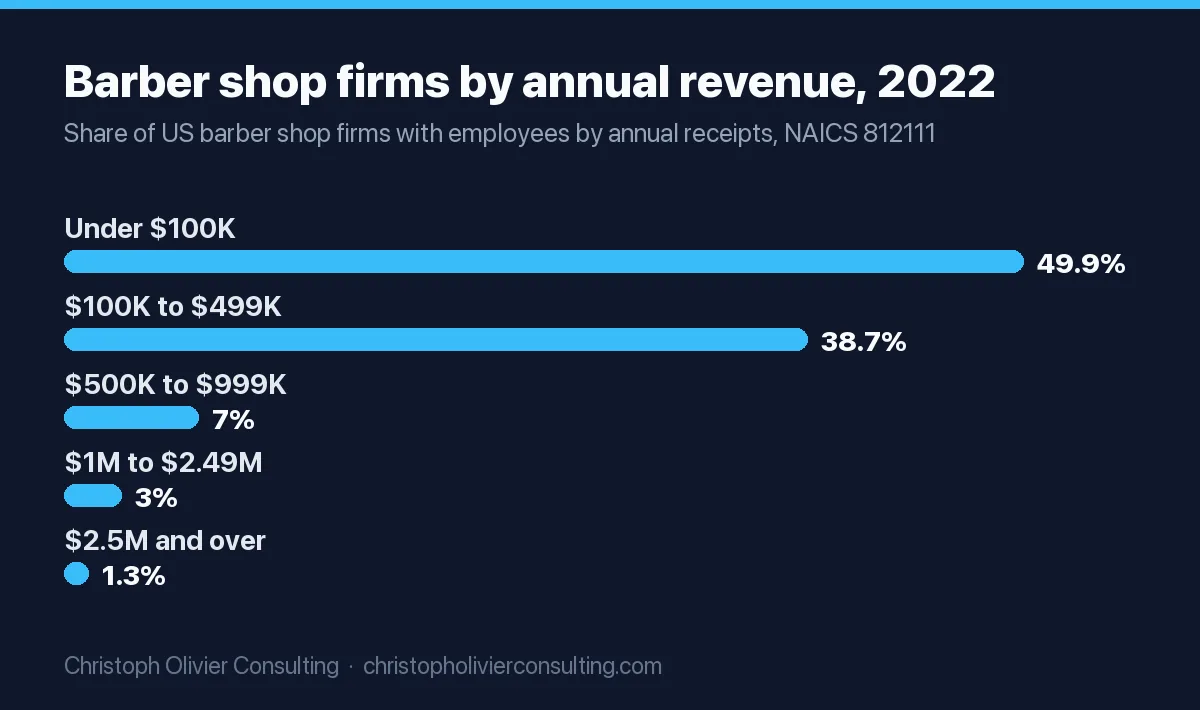
| Annual receipts of the firm | Firms | Share of firms | Cumulative share | Average receipts per firm | Employees per firm | Payroll as share of receipts |
|---|---|---|---|---|---|---|
| Under $100,000 | 3,294 | 49.9% | 49.9% | $45,432 | 1.1 | 41.2% |
| $100,000 to $499,999 | 2,556 | 38.7% | 88.6% | $220,751 | 3.2 | 44.1% |
| $500,000 to $999,999 | 464 | 7.0% | 95.7% | $673,435 | 9.4 | 50.4% |
| $1 million to $2.49 million | 200 | 3.0% | 98.7% | $1,414,415 | 20.4 | 52.4% |
| $2.5 million and over | 86 | 1.3% | 100% | $6,408,919 | 100.0 | 51.1% |
Source: U.S. Census Bureau, SUSB 2022, U.S. 6-digit NAICS by enterprise receipts size, NAICS 812111 Barber Shops, released April 10, 2025. Employer firms only. The $2.5 million and over row is the national total minus the published lower bands. Averages and shares are my calculations.
What this tells you:
- Half of employer barber shops take in less than $100,000 a year. They average 1.1 employees, so many are an owner-barber with one part-time hire. That revenue cannot support a six-figure owner income.
- The typical shop that runs like a real business sits in the $100,000 to $499,999 band, averaging $220,751 with 3.2 employees.
- Payroll share rises with size, from 41.2% to over 50%. Bigger shops pay for front desk staff and managers, and the owner stops cutting.
- Small headcount, small revenue. Census also sorts by employees: the 5,296 barber firms with fewer than 5 employees (80.2% of employer firms) averaged $118,005 in receipts, and the 729 firms with 5 to 9 employees averaged $380,811 (SUSB 2022 state and size file, my calculation).
Barber shop revenue by state
Average receipts per employer barber shop vary more than two to one between large states. These are the ten states with the most employer barber shops in 2022 (receipts ÷ establishments, my calculation from the SUSB 2022 state file):
| State | Employer barber shops | Employees | Average receipts per shop | Payroll as share of receipts |
|---|---|---|---|---|
| New York | 996 | 2,097 | $168,634 | 34.1% |
| Florida | 759 | 1,677 | $178,033 | 35.6% |
| California | 587 | 2,520 | $271,363 | 49.4% |
| New Jersey | 552 | 1,604 | $176,022 | 44.2% |
| Texas | 525 | 4,070 | $434,775 | 59.5% |
| Pennsylvania | 284 | 948 | $194,218 | 54.8% |
| Illinois | 267 | 1,032 | $238,622 | 47.0% |
| Virginia | 248 | 939 | $275,960 | 43.6% |
| Georgia | 218 | 787 | $231,472 | 53.4% |
| Colorado | 193 | 1,230 | $438,528 | 53.2% |
Higher state averages do not mean higher owner pay. Texas and Colorado shops average more employees per shop (7.8 and 6.4), which points to chain stores staffed by employees, not owner-barbers. New York and Florida shops average about two employees each, with low payroll ratios, which fits the booth-rent model where barbers pay the owner instead of drawing a wage.
Barbershop profit margin: real store-level expense ratios
Private barbershops do not publish their books. The most detailed public expense data comes from the Item 19 section of the Sport Clips 2025 franchise disclosure document, which reports 2024 results for 73 mature company-owned stores in Texas, Nevada, Oklahoma, Arkansas and New York. Sport Clips is a national haircut chain, and its store-level ratios are the closest public match to a barbershop P&L. The figures are unaudited and exclude royalties, which a company store does not pay.
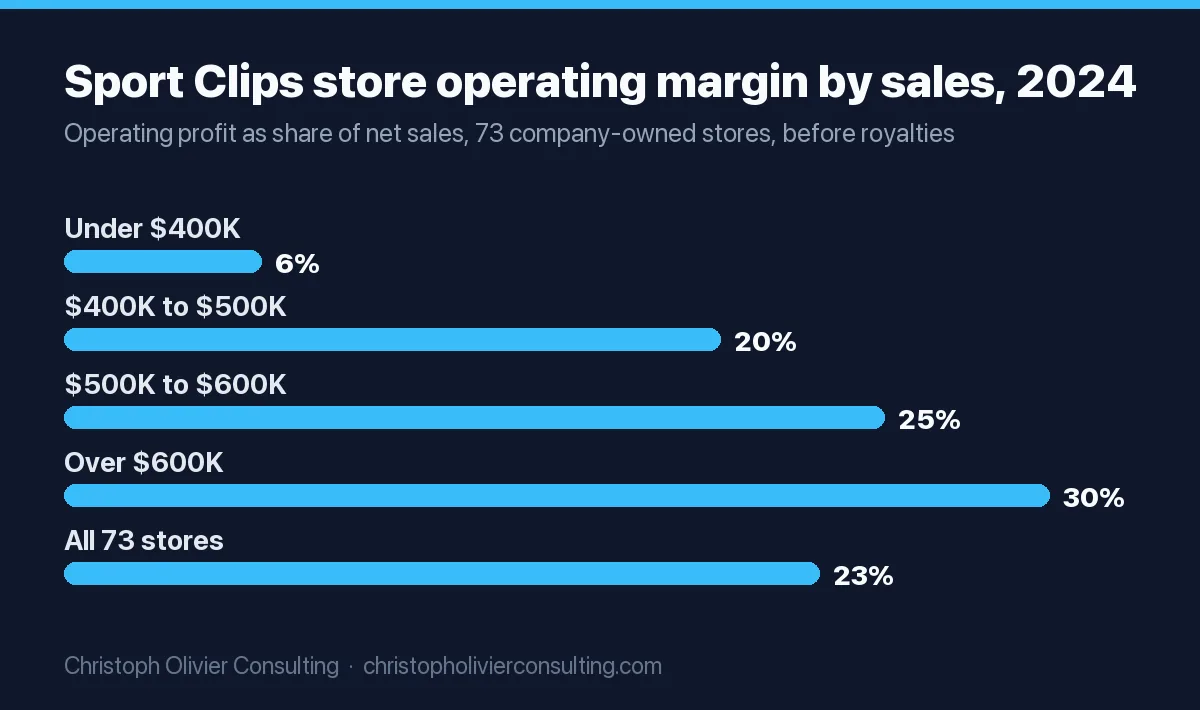
| 2024 sales band (company stores) | Under $400,000 | $400,001 to $500,000 | $500,001 to $600,000 | Over $600,000 | All 73 stores |
|---|---|---|---|---|---|
| Stores | 19 | 16 | 16 | 22 | 73 |
| Average net sales | $329,623 | $444,101 | $544,869 | $766,141 | $533,445 |
| Variable costs (supplies, goods, card fees) | 7% | 7% | 6% | 6% | 7% |
| Payroll (incl. full-time manager, taxes) | 55% | 49% | 48% | 47% | 49% |
| Occupancy (rent, utilities, repairs) | 23% | 17% | 13% | 10% | 14% |
| Advertising (incl. ad fund) | 5% | 5% | 5% | 4% | 5% |
| Miscellaneous (insurance, funds) | 4% | 3% | 2% | 2% | 2% |
| Operating profit | $19,617 (6%) | $86,628 (20%) | $134,863 (25%) | $233,411 (30%) | $123,995 (23%) |
Source: Sport Clips, Inc., Franchise Disclosure Document 2025, Item 19, “Expense Reports for Company-Owned Stores During 2024,” average by sales band (pages 45 to 46; read from a copy of the Item 19 section, see notes). Percentages are as published.
The lesson in that table is fixed costs. Rent barely changes between a slow store and a busy one ($76,724 versus $78,379), so occupancy eats 23% of a store doing $330,000 and only 10% of a store doing $766,000. That single line explains most of the gap between a 6% and a 30% margin. For an owner, the practical question is not “what margin do barbershops make” but “how many paid haircuts per chair per week does my rent require.” For context, the IRS shows sole proprietors across all personal and laundry services kept 24.4% of receipts as net income in tax year 2023, with rent on property and equipment at 10.3% of receipts and supplies at 8.6% (IRS SOI Table 2, my calculation). Compare those ratios with other sectors in our profit margin by industry table.
What a franchise barbershop owner makes
Sport Clips reported that its 1,669 mature franchised stores averaged $419,485 in 2024 gross sales, with a median of $409,206; 52% of stores sold more than $400,000 and 10% sold less than $250,000 (Sport Clips FDD 2025, Item 19). The 2025 FDD sets a royalty of 6% of net sales and an advertising fee of $300 a week or 5% of net sales, whichever is more, with an estimated initial investment of $288,500 to $475,000, as summarized by Franchise Chatter from the FDD.
My calculation: a franchise store at the $409,206 median, with the 20% operating margin of company stores in the $400,001 to $500,000 band, earns about $81,800 before royalties. Subtract the 6% royalty ($24,550) and about $57,300 is left before loan payments, the weekly training fee (the FDD excerpt does not state its amount) and income tax. That store already pays a full-time manager, so the owner does not need to cut hair to earn it, but the owner also does not earn a barber’s wage on top.
Owner pay is two paychecks: your chair plus the shop’s profit
Every owner figure online mixes two things. If you cut hair in your own shop, your income is:
- The wage your chair earns. The market value of that is the employed-barber wage: $38,210 at the BLS median, $58,960 at the 75th percentile and $76,460 at the 90th percentile in May 2025.
- The profit from other barbers’ chairs, after their pay, rent, supplies and marketing.
This is why a solo owner’s “margin” looks huge (most of it is their own labor) and why a manager-run shop’s 20% to 30% margin is real profit. When you compare yourself to another owner, split the two.
Commission vs booth rent vs suite: how each model pays the owner
| Model | Who keeps the service revenue | Owner’s income comes from | Owner’s main risk |
|---|---|---|---|
| Commission (barbers are employees) | The shop; barbers get a percentage plus tips | Revenue minus commissions, payroll taxes, rent, supplies | Slow weeks still cost payroll taxes and rent; employer obligations |
| Booth rent (barbers are independent) | Each barber keeps their own | Weekly chair rents, minus rent and shared costs | Empty chairs earn nothing; no control over pricing or service |
| Suite or solo chair | The barber-owner keeps it all | Own services minus suite rent and supplies | Income stops when you stop cutting |
No government source publishes typical chair rents or commission splits, so treat any figure you see online as anecdotal and price from your own local rent. The Census payroll ratios above are the best public check: if your payroll is far above 50% of revenue, your commission rate or staffing is out of line with employer barber shops nationally.
Worked P&L: what an owner makes at three shop sizes
This is my own calculation, not survey data. Every assumption is labeled so you can swap in your numbers.
Assumptions: each full-time chair produces $75,000 in service revenue a year (the midpoint of the $50,000 to $99,999 band where 18,377 no-employee barber businesses sat in 2022, Census). Employed barbers earn a 50% commission (assumption; tips pass through and are excluded). Employer payroll taxes are 7.65%. Variable costs are 7% of revenue and advertising 4%, from the Sport Clips company-store ratios. Miscellaneous (insurance, software, licenses) is 3%. Rent is an assumption for a small-city storefront and is the number you most need to replace.
| Line | A: Solo owner-barber, 1 chair | B: Owner cuts + 3 commission barbers | C: 8 commission barbers, owner manages |
|---|---|---|---|
| Service revenue | $75,000 | $300,000 | $600,000 |
| Barber commissions + 7.65% payroll tax | $0 | $121,106 | $322,950 |
| Variable costs (7%) | $5,250 | $21,000 | $42,000 |
| Rent and utilities (assumed) | $14,400 ($1,200/month) | $36,000 ($3,000/month) | $66,000 ($5,500/month) |
| Advertising (4%) | $3,000 combined | $12,000 | $24,000 |
| Insurance, software, licenses (3%) | $9,000 | $18,000 | |
| Owner pre-tax income | $52,350 | $100,894 | $127,050 |
| As share of revenue | 69.8% | 33.6% | 21.2% |
| Of which: value of owner’s own chair | All of it | $38,210 (BLS median wage) | $0 |
| Of which: profit on other chairs | $0 | $62,684 | $127,050 |
| Self-employment tax (15.3% on 92.35%) | $7,397 | $14,256 | $17,952 |
Checks against public data: model B’s payroll is 40.4% of revenue and model C’s is 53.8%, against Census payroll shares of 44.1% and 50.4% for barber firms in the matching revenue bands. Model C’s 21.2% margin sits between the 20% and 25% Sport Clips bands. Self-employment tax uses the 15.3% IRS rate on the 92.35% of net earnings that is generally subject to it; an S corporation election changes this, so ask your tax preparer.
Two sensitivities matter most. Drop every chair in model B, including yours, to $55,000 a year and owner income falls to about $64,000. Raise rent in model C to $8,000 a month and it falls to about $97,000. A shop that cannot fill its chairs is the most common reason an owner ends up earning less than the barbers they employ. Filling chairs is a marketing job, and our barbershop marketing playbook covers the channels that drive bookings.
How much does a barber shop make a day?
Census reports annual receipts only, so daily figures are my division. I assume 306 open days a year (six days a week, minus a week of holidays). Weekly figures need no assumption beyond 52 weeks.
| Shop type and source | Annual revenue | Per week | Per open day (306 days) |
|---|---|---|---|
| Average no-employee barber business (Census 2022) | $30,504 | $587 | $100 |
| Average employer barber firm with under 5 employees (Census 2022) | $118,005 | $2,269 | $386 |
| Average employer barber shop location (Census 2022) | $252,672 | $4,859 | $826 |
| Median mature Sport Clips franchise store (FDD, 2024) | $409,206 | $7,869 | $1,337 |
| Model B above, 4 chairs | $300,000 | $5,769 | $980 |
To turn a daily target into haircuts, divide by your average ticket. At a $40 ticket (an example, not a benchmark), $980 a day is 24.5 paid services across four chairs, about six per chair. If you want to see how client counts translate into a full book, our page on how many clients a hair stylist or barber has breaks it down.
Can a barber make $100,000 a year?
As an employee, rarely. The top 10% of employed barbers earned more than $76,460 in May 2025 (BLS OEWS), so $100,000 is above the 90th percentile of wages, tips included. As an owner, yes, but usually by owning other chairs. Only 4,820 of the 137,372 no-employee barber businesses, 3.5%, had $100,000 or more in gross receipts in 2022 (Census, my calculation), and that is revenue before rent and supplies. In the model above, crossing $100,000 takes about three productive chairs besides your own. Hair salons follow the same pattern; see our hair salon owner salary breakdown for the salon numbers.
Are barbers struggling in 2026?
The public data is mixed rather than alarming. BLS projects employment of barbers, hairstylists and cosmetologists to grow 7% from 2025 to 2035, “much faster than the average,” with about 80,300 openings a year. The largest barbershop chain is flat: Sport Clips franchised stores fell from 1,785 to 1,754 in 2024 while company-owned stores rose from 75 to 83, a net change of minus 23 (Sport Clips FDD 2025, Item 20). The squeeze shows up at the low end: company stores under $400,000 in sales kept only 6% because occupancy took 23% of revenue.
Pass/fail worksheet: is your barbershop paying you enough?
Fill in your last 12 months. Each threshold comes from the data on this page.
| Check | Your number | Pass if | Where the threshold comes from |
|---|---|---|---|
| 1. Revenue per full-time chair per year | ______ | $75,000 or more | Model assumption; midpoint of the Census $50,000 to $99,999 solo band |
| 2. Rent and utilities as share of revenue | ______ | 17% or less | Sport Clips stores at 17% or less earned 20% to 30% margins (2024) |
| 3. Payroll and commissions as share of revenue | ______ | 55% or less | Census 2022 barber payroll 41% to 52% by band; Sport Clips 47% to 55% |
| 4. Operating profit after a market wage for your own chair | ______ | 20% or more | Sport Clips stores above $400,000 in sales: 20% to 30% |
| 5. Your total pre-tax income | ______ | Above $38,210 | BLS median for employed barbers, May 2025; below this, a job pays more |
If checks 1 and 2 fail together, you have a demand problem, not a cost problem: the rent is fine for a busy shop and wrong for a half-empty one. Fixing that usually means more first visits and better rebooking, not a cheaper lease. If you want an outside view of where your bookings come from, you can book a consultation.
Ready to scale your revenue?
Book a free 30-min consultation. We’ll diagnose your growth bottleneck and map out the 3 highest-leverage moves for your business.
Frequently asked questions
How much does a barbershop owner make a year?
No government survey reports it. In a model built from Census, BLS and Sport Clips franchise data, a solo owner-barber grossing $75,000 keeps about $52,000 before tax, an owner who cuts plus three commission barbers keeps about $101,000, and an owner managing eight chairs keeps about $127,000. Most barber businesses are solo: the 137,372 with no employees averaged $30,504 in 2022 receipts.
What is a typical barbershop profit margin?
Sport Clips company-owned stores, the most detailed public data, earned a 23% average operating profit in 2024, ranging from 6% for stores under $400,000 in sales to 30% for stores over $600,000. The difference is mostly rent: occupancy took 23% of revenue at slow stores and 10% at busy ones. A solo owner's margin looks higher because it includes the owner's own labor.
How much does a barber shop make a day?
The average U.S. employer barber shop took in $252,672 in 2022, about $826 per day if open 306 days a year (my calculation from Census SUSB). Small shops with under five employees averaged $118,005, about $386 a day. The median mature Sport Clips franchise store sold $409,206 in 2024, about $7,869 a week.
Can a barber make $100,000 a year?
As an employee it is rare: the top 10% of employed barbers earned more than $76,460 in May 2025, tips included (BLS). As an owner it is possible, usually by owning other chairs. Only 3.5% of no-employee barber businesses grossed $100,000 or more in 2022, and that is revenue before rent and supplies.
Is owning a barbershop profitable?
It can be, if chairs stay full. Census shows half of employer barber shops took in under $100,000 in 2022, which cannot support a six-figure owner income. Sport Clips stores above $400,000 in sales earned 20% to 30% operating profit before royalties, while stores under $400,000 earned 6%. Revenue per chair against fixed rent decides which side you land on.
How much does a Sport Clips franchise owner make?
Sport Clips does not publish franchisee profit. Its 2025 FDD reports 2024 median gross sales of $409,206 for 1,669 mature franchised stores. Applying the 20% operating margin of company stores in the $400,001 to $500,000 band and subtracting the 6% royalty leaves about $57,300 before debt payments, training fees and income tax (my calculation).
Small business owner income