
A photography business usually makes between a few thousand dollars and about $225,000 a year in revenue. What the owner keeps depends on bookings, price per booking and whether there is a studio lease and staff. The typical one-person photography business took in only $10,000 to $24,999 in 2022. The typical photography studio with employees took in $100,000 to $499,999 (Census Nonemployer Statistics 2022 and Census SUSB 2022, my calculation). Employed photographers earned a median of $44,660 in May 2025 (BLS).
Short answer: In my worked model, a solo wedding photographer shooting 30 weddings at The Knot’s $3,000 average keeps about $55,000 before income and self-employment tax. A portrait studio at the Census average for its size band ($219,000 revenue, 1.6 employees) also leaves its owner about $55,000. An established studio at $673,000 revenue leaves about $197,000. At 15 weddings a year, owner pay falls to about $19,000. No government survey publishes photography owner income directly, so these figures are modeled from public data.
Below are the numbers that exist: Census revenue by business size for NAICS 54192 (portrait and commercial photography), BLS wages for photographers, The Knot’s 2025 wedding photographer prices, and real vendor prices for software, insurance and card processing. Then I turn them into a labeled P&L you can rerun with your own booking count and price.
How much do photography business owners make? What each source measures
Every number you find online for “photographer income” measures something different. Salary sites survey job ads. BLS counts employees only. Census counts revenue, not profit. Read the “what it measures” column before you compare anything.
| Source and year | What it measures | Figure | How it was calculated |
|---|---|---|---|
| BLS Occupational Outlook Handbook, May 2025 | Median annual wage of employed photographers (excludes the self-employed) | $44,660 | Published. $21.47 per hour |
| BLS OEWS, May 2025, occupation 27-4021 | Wage spread of employed photographers, 10th to 90th percentile | $30,820 to $91,810 | Published via the BLS data API. Mean $55,410; 51,760 wage jobs |
| BLS Occupational Outlook Handbook, May 2025 | Median hourly wage of photographers employed by photographic services firms | $18.84 | Published. About $39,187 at 2,080 hours (my calculation) |
| Census SUSB 2022, NAICS 54192 | Average revenue per photography firm with employees | $474,230 | $6,913,792,000 receipts ÷ 14,579 firms (my calculation) |
| Census Nonemployer Statistics 2022, NAICS 54192 | Average revenue per photography business with no paid employees | $29,359 | $6,807,370,000 ÷ 231,865 businesses (my calculation) |
| The Knot Real Weddings Study, 2025 weddings | What couples paid a professional wedding photographer | $3,000 average | Published. Quartiles $1,500 / $2,800 / $4,700; 10,474 couples |
| IRS SOI sole proprietorships, tax year 2023 | Net profit of sole proprietors by industry | Not broken out | Photography is folded into “other miscellaneous services,” so no photography profit figure exists |
Three things to take from this table:
- The BLS median is not owner income. BLS says 67% of the 145,000 photographer jobs in 2025 were self-employed, and its wage data leave all of them out.
- The $29,359 nonemployer average is revenue, before costs. A business owner’s profit is lower, often much lower, once gear, software, insurance and travel come out.
- No public benchmark for photography profit margins exists. There are no listed photography studio chains filing 10-Ks, and the IRS does not break the industry out. Any margin you see quoted is a model or a small survey, including mine below.
How much does a photography business make? Revenue by size
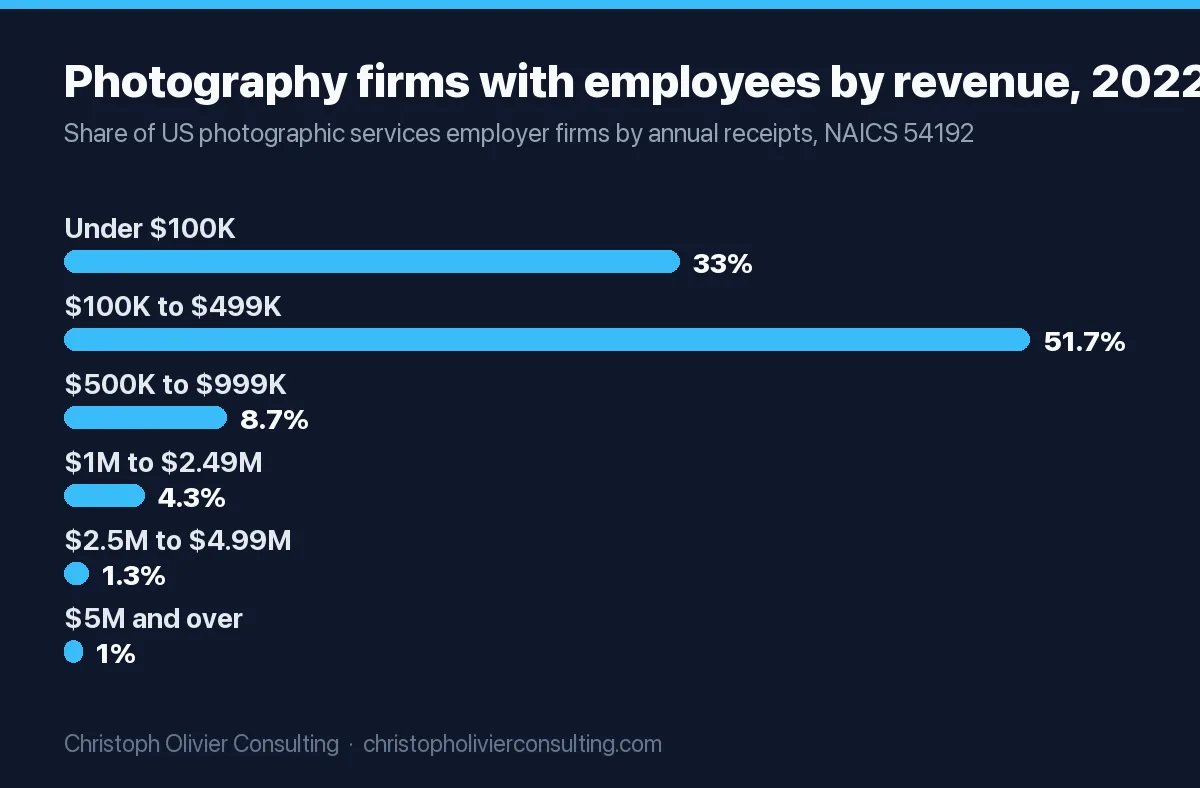
The $474,230 average per employer firm is pulled up by a handful of large companies, such as school and portrait chains. Census also reports firms by annual revenue band. I added the shares and per-firm averages for all photographic services (NAICS 54192).
| Annual receipts of the firm | Firms | Share of firms | Cumulative share | Average receipts per firm | Employees per firm | Payroll as share of receipts |
|---|---|---|---|---|---|---|
| Under $100,000 | 4,816 | 33.0% | 33.0% | $49,936 | 0.9 | 30.3% |
| $100,000 to $499,999 | 7,541 | 51.7% | 84.8% | $223,466 | 1.6 | 26.4% |
| $500,000 to $999,999 | 1,264 | 8.7% | 93.4% | $678,380 | 4.1 | 27.7% |
| $1 million to $2.49 million | 629 | 4.3% | 97.7% | $1,478,132 | 7.9 | 27.0% |
| $2.5 million to $4.99 million | 186 | 1.3% | 99.0% | $3,402,290 | 20.5 | 27.4% |
| $5 million and over | 140 | 1.0% | 100% | $17,715,564 | 136.2 | 28.0% |
Source: U.S. Census Bureau, SUSB 2022, U.S. 6-digit NAICS by enterprise receipts size, NAICS 54192, released April 10, 2025. Employer firms only. The $5 million and over row combines the published bands above $5 million. Shares, averages and ratios are my calculations.
What the table tells you:
- The median photography firm with employees takes in $100,000 to $499,999. 84.8% of employer firms are under $500,000. The average firm in that band collected $223,466 with 1.6 employees.
- Payroll eats about 27.5% of revenue across the industry ($1,904,138,000 of $6,913,792,000 in 2022, my calculation). That share barely changes with size: 26.4% to 30.3% in every band.
- Only 955 photography firms with employees (6.6%) took in $1 million or more. The 140 firms above $5 million collected 35.9% of all employer revenue.
Portrait studio vs commercial photography revenue
Census splits the industry into portrait studios (NAICS 541921, which lists wedding, school, home and passport photography) and commercial photography (541922, product, advertising and corporate work). Commercial firms are slightly larger per firm with fewer, better-paid staff.
| 2022, employer firms | Portrait studios (541921) | Commercial photography (541922) |
|---|---|---|
| Firms | 9,682 | 4,902 |
| Average receipts per firm | $457,762 | $506,271 |
| Average receipts, $100K to $499K band | $218,978 | $232,515 |
| Average receipts, $500K to $999K band | $673,033 | $685,689 |
| Employees per firm | 3.77 | 2.56 |
| Annual payroll per employee | $33,982 | $52,810 |
| Payroll as share of receipts | 28.0% | 26.7% |
Source: Census SUSB 2022. Averages and ratios are my calculations. Payroll per employee includes part-time staff.
Most photographers run one-person businesses
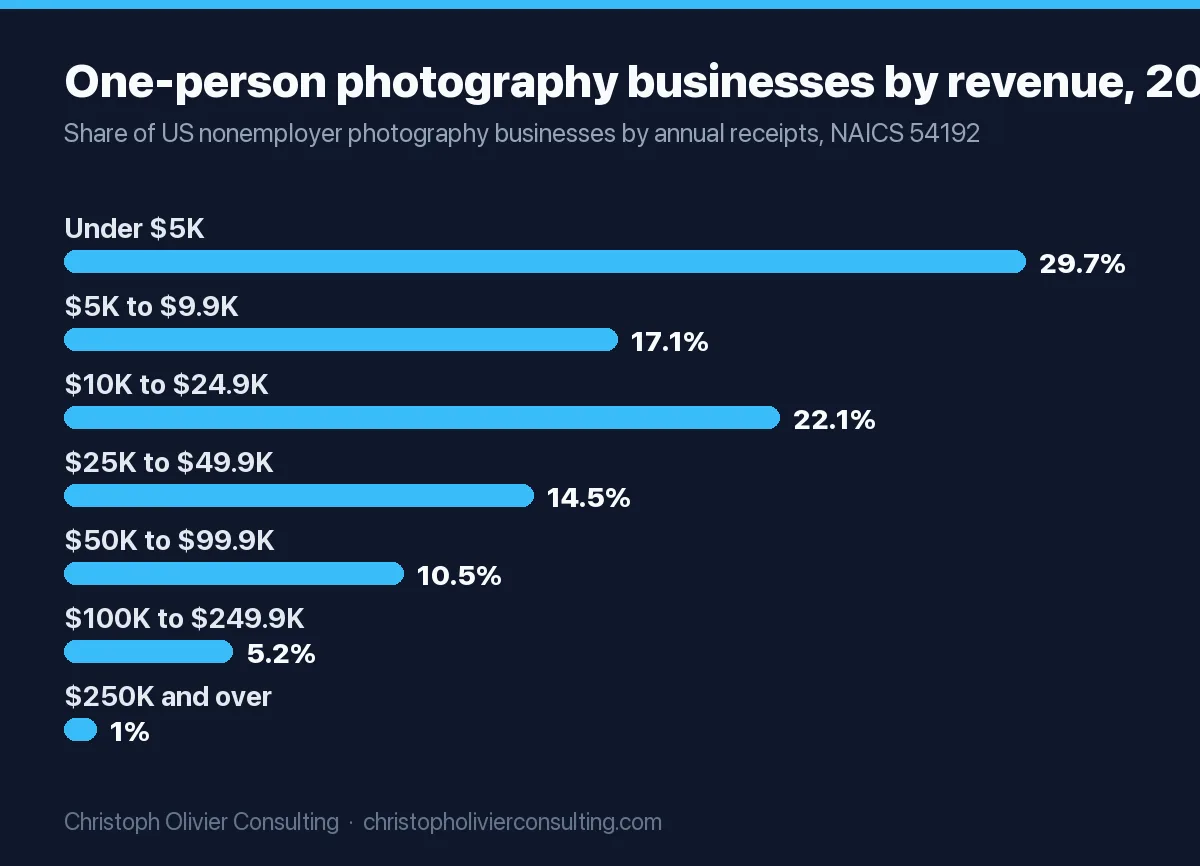
For every photography firm with employees there are about 16 without any. In 2022 there were 231,865 nonemployer photography businesses, so 94.1% of all photography businesses had no payroll (my calculation). Together they took in $6.81 billion, nearly as much as the $6.91 billion of the 14,579 employer firms. 95.3% of them were sole proprietorships.
| Annual receipts, nonemployer photography businesses | Businesses | Share | Cumulative share |
|---|---|---|---|
| Under $5,000 | 68,844 | 29.7% | 29.7% |
| $5,000 to $9,999 | 39,603 | 17.1% | 46.8% |
| $10,000 to $24,999 | 51,156 | 22.1% | 68.8% |
| $25,000 to $49,999 | 33,505 | 14.5% | 83.3% |
| $50,000 to $99,999 | 24,383 | 10.5% | 93.8% |
| $100,000 to $249,999 | 12,137 | 5.2% | 99.0% |
| $250,000 and over | 2,237 | 1.0% | 100% |
Source: Census Nonemployer Statistics 2022, U.S. file, NAICS 54192, size classes per the Census record layout. The last row combines the $250,000 to $499,999, $500,000 to $999,999 and $1 million to $2.49 million classes. Shares are my calculations.
The median nonemployer photography business took in $10,000 to $24,999. 46.8% took in under $10,000, which is side income, not a living. Legal form tells the same story: the 6,107 nonemployers set up as S corporations averaged $84,210 in receipts, against $26,710 for sole proprietors (my calculation). Owners who earn enough to justify an S corporation run very different businesses from the hobby end of the market.
Owner pay is salary plus profit
“Photography business owner salary” is a slightly misleading phrase. A self-employed photographer does not draw a salary in the payroll sense. What you take home is two things combined:
- A market wage for the shooting and editing you do. The BLS benchmark is $44,660 a year for employed photographers, or $18.84 an hour inside photographic services firms.
- The profit left after every cost, including any staff. That is the return for owning the risk, the client list and the brand.
If your pre-tax profit is below the employee benchmark, the business is paying you less than a job would. It is also not quite a like-for-like comparison. An employee’s employer pays half of Social Security and Medicare. A sole proprietor pays the full 15.3% self-employment tax (12.4% Social Security, 2.9% Medicare) on 92.35% of net earnings. To match a $44,660 W-2 job before benefits, a sole proprietor needs roughly $48,077 of profit (my calculation: $44,660 × 1.0765). That number is the line the worksheet at the end of this page uses.
Worked P&L: what a photography business owner keeps at three sizes
This is my own calculation, not a survey. Revenue, payroll ratios and prices come from the linked sources; the rest are assumptions marked in the last column. Replace them with your own numbers.
| Line (annual) | Solo wedding photographer | Small portrait studio | Established studio | Basis |
|---|---|---|---|---|
| Revenue | $90,000 | $218,978 | $673,033 | Solo: 30 weddings × $3,000 (The Knot, 2025). Studios: Census SUSB 2022 band averages, NAICS 541921 |
| Staff payroll | $0 | $56,934 | $187,776 | Census band payroll ratio: 26.0% and 27.9% |
| Employer payroll taxes and required benefits | $0 | $5,807 | $19,153 | 10.2% of wages (BLS ECEC June 2026, full-time private workers: $3.76 ÷ $36.97, my calculation) |
| Second shooters (contract) | $6,000 | Included in payroll | Included in payroll | Assumption: second shooter on 15 of 30 weddings at $400 |
| Prints, albums, products | $4,500 | $32,847 | $100,955 | Assumption: 5% of revenue solo, 15% for studios selling prints |
| Studio rent | $0 | $24,000 | $48,000 | Assumption: home office solo; $2,000 and $4,000 a month |
| Card processing | $2,637 | $6,569 | $20,191 | Stripe 2.9% + 30¢ (3 payments per wedding solo; about 3% for studios) |
| Editing and gallery software | $528 | $960 | $2,400 | Adobe Photography plan US$19.99/mo + Pixieset Client Gallery Pro $24/mo annual; studios assume more seats and the $40/mo Ultimate plan |
| Insurance | $1,369 | $2,259 | $4,518 | Insureon medians: general liability $350, equipment $519, professional $500; studios use BOP $570 and workers’ comp $670; established studio assumed at 2× |
| Gear replacement reserve | $6,000 | $8,000 | $15,000 | Assumption: bodies, lenses and lighting replaced on a 3 to 4 year cycle |
| Travel | $2,736 | In admin | In admin | Assumption: 120 miles per wedding at the IRS rate of 76¢ (July to December 2026) |
| Marketing | $7,200 | $17,518 | $53,843 | Assumption: 8% of revenue |
| Admin, accounting, utilities, website | $3,600 | $9,000 | $24,000 | Assumption |
| Total costs | $34,570 | $163,895 | $475,836 | Sum |
| Owner pay before income tax | $55,430 | $55,083 | $197,197 | Revenue minus costs |
| Owner pay as share of revenue | 61.6% | 25.2% | 29.3% | My calculation |
| Self-employment tax if a sole proprietor | $7,832 | $7,783 | $27,863 | 15.3% on 92.35% of profit; Social Security part capped at $184,500 of earnings |
Two things stand out in this model:
- The small studio earns its owner about the same as the solo wedding photographer, on more than twice the revenue. Rent, staff and print costs absorb the difference. Growing revenue from $90,000 to $219,000 does not raise owner pay unless the extra revenue carries its own margin.
- Owner pay only clearly beats a photographer’s wage at the $500,000+ band. In Census terms that is the top 15% of employer firms and about 1% of all photography businesses, counting nonemployers.
One caveat on the studio columns: Census payroll includes salaries of corporate officers, so an incorporated owner who pays themselves through payroll is partly inside the payroll line already. For a sole proprietor it is not.
Wedding photography profit margin: bookings times price
For a solo wedding photographer, the margin question is really two numbers: how many weddings you shoot and what you charge. The Knot’s 2025 data put the lower quartile at $1,500, the median at $2,800, the average at $3,000 and the upper quartile at $4,700. Regional averages ran from $2,600 in the Southwest to $3,800 in the Mid-Atlantic. The table holds every other cost at the solo assumptions above.
| Owner pay before tax (my calculation) | $1,500 per wedding | $2,800 per wedding | $3,000 per wedding | $4,700 per wedding |
|---|---|---|---|---|
| 15 weddings a year | $3,044 | $19,444 | $21,966 | $43,412 |
| 25 weddings a year | $12,738 | $40,070 | $44,276 | $80,018 |
| 35 weddings a year | $22,432 | $60,698 | $66,584 | $116,624 |
Model: per wedding, 2.9% + three 30¢ card fees, 5% albums, 8% marketing, $200 average second-shooter cost and 120 miles at 76¢; fixed costs $11,497 a year (software, insurance, gear reserve, admin). Prices from The Knot Real Weddings Study, couples married in 2025.
Each wedding at $3,000 contributes about $2,231 after its direct costs. That means about 5 weddings just to cover the fixed costs, and about 27 weddings to reach the $48,077 W-2 equivalent (my calculation). A photographer charging the lower-quartile $1,500 never gets there at 35 weddings.
The hours behind a wedding fee
The Knot itself assumes an eight-hour wedding day, which turns the $3,000 average into about $375 per hour of coverage. Coverage is not the whole job. My model assumes 30 hours per wedding (8 shooting, 2 travel, 4 client meetings and email, 16 culling and editing) plus 400 hours a year of marketing and admin. Those are assumptions, not survey data. On them, 30 weddings take 1,300 hours, and $55,430 of profit works out to about $42.64 per hour before tax. That is roughly double the BLS median of $21.47 for employed photographers, but on part-time annual hours. Most wedding photographers fill the rest of the year with portraits, engagements or commercial work.
Photography business profit margin
There is no audited profit margin for photography businesses. The IRS does not publish one for the industry, no public studio chain files with the SEC, and the Census counts revenue and payroll only. What can be said from primary data:
- Payroll is about 27.5% of revenue for photography firms with employees (Census SUSB 2022). That is the biggest cost you can check against a benchmark.
- A solo photographer’s “margin” includes their own wage. In my model the solo wedding business keeps 61.6% of revenue, but all of that is the owner’s pay for 1,300 hours of work. It is not comparable to a corporate net margin.
- Studios with rent and staff keep far less. My two studio columns leave 25% to 29% for the owner, before the owner’s own labor is valued separately.
For context on how photography compares with other sectors, our profit margin by industry breakdown uses the same rule: say where a margin comes from, or do not quote it.
Can photographers make 100k a year?
Yes, but few do as employees. The BLS 90th percentile for employed photographers was $91,810 in May 2025, so fewer than 10% of wage-earning photographers cleared about $92,000. As an owner, the sensitivity table shows the path: about 35 weddings at the $4,700 upper-quartile price gets a solo photographer to about $117,000 before tax. Alternatively, a studio has to reach the $500,000 to $999,999 revenue band, where my model leaves about $197,000. Only 1,264 photography firms with employees were in that band in 2022.
The lever that moves you fastest is price, not volume. Going from $2,800 to $4,700 per wedding at 25 weddings nearly doubles owner pay in the model, from $40,070 to $80,018, without adding a single wedding day. Packaging matters here; a good, better, best package structure is the usual way photographers lift the average booking.
How many photographers are making over $300,000 a year?
No source counts photographers by income at that level. The closest proxy is revenue: 955 photography firms with employees took in $1 million or more in 2022, and 2,237 nonemployer photography businesses took in $250,000 or more (Census, my calculation). Revenue is not take-home pay, so the number of owners personally earning over $300,000 is smaller than either count, and unknown.
Is photography still a good career in 2026?
BLS projects photographer employment to fall 1% from 2025 to 2035, a loss of about 1,000 jobs, with about 10,700 openings a year from people leaving the field. As a business, demand in the wedding segment is steady: the CDC counted 2,041,926 marriages in 2023 (provisional). The career is viable as a business, much less so as a job.
What is the 80/20 rule in photography?
On the business side it is the Pareto principle: a minority of clients or services tends to produce most of the profit. There is no published photography statistic behind it. The useful test is to sort last year’s bookings by profit after direct costs and see which type (weddings, family sessions, headshots, product work) carries the business. Then price and market toward that type. A focused photography marketing plan starts from that list.
Owner pay worksheet: pass or fail
Run your last 12 months through these checks. Each threshold comes from the sources above.
| Check | Pass if | Where the line comes from |
|---|---|---|
| 1. Profit vs a photography job | Pre-tax profit ≥ $48,077 | BLS median $44,660 × 1.0765 for the employer half of FICA |
| 2. Profit per hour | Profit ÷ all hours worked ≥ $21.47 | BLS median hourly wage, May 2025 |
| 3. Wedding price | Average booking ≥ $2,800 | The Knot median, 2025 weddings (adjust for your region: $2,600 to $3,800) |
| 4. Break-even bookings | Fixed costs covered by your first 6 bookings or fewer | Model: $11,497 fixed ÷ $2,231 contribution ≈ 5.2 |
| 5. Payroll | Staff payroll ≤ 28% of revenue | Census SUSB 2022 industry ratio 27.5% |
| 6. Card fees | Processing ≤ 3.2% of revenue | Stripe 2.9% + 30¢ on typical invoice sizes |
| 7. Insurance | General liability and equipment cover in force | Insureon medians $29 and $43 a month |
| 8. Gear reserve | A replacement fund exists and is topped up monthly | Model assumption $6,000 a year solo |
| 9. Self-employment tax | Quarterly estimates set aside at 14.1% of profit | 15.3% × 92.35%, IRS |
Failing check 1 or 2 is the one that matters most. It means the business pays you less than a job would. The fix is usually price or the booking mix, not more hours. Fixing price usually starts with how you set it; the pricing strategy guide covers value-based and tiered methods. On the demand side, size your spend with a marketing budget tied to bookings, not a flat monthly figure. Wedding pros in adjacent trades face the same math; the wedding planner income breakdown runs it for planners. If you want a second pair of eyes on your numbers and your booking funnel, you can book a consultation.
Ready to scale your revenue?
Book a free 30-min consultation. We’ll diagnose your growth bottleneck and map out the 3 highest-leverage moves for your business.
Frequently asked questions
How much does a photography business make?
Most make little. In 2022 the median one-person photography business took in $10,000 to $24,999, and 94.1% of photography businesses had no employees. The median photography firm with employees took in $100,000 to $499,999, with an average of $474,230 per employer firm pulled up by large chains (Census Nonemployer Statistics and SUSB 2022, my calculation).
How much do photography business owners make?
No government survey reports it. In a model built from Census, BLS, The Knot and vendor prices, a solo wedding photographer shooting 30 weddings at $3,000 keeps about $55,000 before income tax, a $219,000 portrait studio also leaves about $55,000, and a $673,000 studio about $197,000. Employed photographers earned a $44,660 median wage in May 2025.
What is a typical photography business profit margin?
There is no audited benchmark: the IRS does not break photography out and no public studio chain files a 10-K. Census shows payroll takes about 27.5% of revenue for firms with employees. In my model a solo wedding business keeps about 62% of revenue, all of it the owner's pay for their own labor, while studios with rent and staff keep 25% to 29%.
What is the profit margin for wedding photography?
It depends on price and bookings. At The Knot's $3,000 average for 2025 weddings, each wedding contributes about $2,231 after card fees, albums, marketing, travel and a second shooter in my model. About 5 weddings cover fixed costs and about 27 match a $44,660 photography job after self-employment tax. At 25 weddings, pay ranges from $12,738 at $1,500 to $80,018 at $4,700.
Can photographers make 100k a year?
Some can, mostly as owners. Fewer than 10% of employed photographers earned more than $91,810 in May 2025 (BLS 90th percentile). In my model a solo wedding photographer needs about 35 weddings at the $4,700 upper-quartile price to reach roughly $117,000 before tax, or a studio needs revenue in the $500,000 to $999,999 band, where owner pay is about $197,000.
Is a photography business profitable?
It can be, but the typical one is small. 46.8% of nonemployer photography businesses took in under $10,000 in 2022, which is side income. The test is whether pre-tax profit beats about $48,077, the BLS median photographer wage plus the employer half of payroll tax a sole proprietor pays, and whether profit per hour beats the $21.47 median hourly wage.
Small business owner income