
A single coffee shop owner in the US typically earns about $40,000 to $50,000 a year in salary and profit combined. The only published survey of US coffee business owners, run by Fresh Cup magazine in 2023, found coffee shop owners averaged $48,234 in 2022 pay, with a median of $40,000 for owners of a single type of coffee business. Owners of busy, million-dollar shops earn several times that, and owners of small shops often earn less than their baristas per hour worked.
Short answer: Coffee shop owners average about $48,000 a year in salary plus profit distributions (Fresh Cup owner survey, 2022 pay). Revenue decides the rest: the typical US coffee and snack bar firm takes in $100,000 to $499,999 a year (Census, 2022), and my worked P&L shows an owner keeping roughly $41,000 at $300,000 in sales, $92,000 at $600,000 and $197,000 at $1 million, before income tax.
Below are the primary numbers behind that answer: Census revenue for every US coffee and snack bar, IRS tax returns, BLS wages, the cost lines Starbucks and Dutch Bros report in their 10-K filings, and a franchise disclosure. Where you see an average or share the source does not print, I calculated it from the published totals and labeled it. The worked P&L and an owner pay worksheet are in the second half.
How much does a coffee shop owner make a year? Six sources compared
No government agency publishes “coffee shop owner salary.” Each source below measures a different slice, so read the second column before you compare yourself to any one number.
| Source and year | What it measures | Figure |
|---|---|---|
| Fresh Cup Coffee Business Owner Salary Report, published 2023 | Salary or wages plus profit distributions paid to coffee shop owners in 2022, self-reported by 155 US coffee business owners | $48,234 average for shop owners; $40,000 median (single business type) |
| Same survey | Owners who run a shop and a roastery | $61,635 average |
| IRS Statistics of Income, Table 1, tax year 2023 | Net profit per unincorporated owner (Schedule C) of restaurants and drinking places, returns that reported a profit. Coffee shops are not broken out. | $21,282 (my calculation: $8.01 billion ÷ 376,535 returns) |
| Scooter’s Coffee Item 19, calendar 2025 | Average EBITDA of 621 franchised drive-thru kiosks open all year, as defined in the franchisor’s disclosure | $134,457; top quartile $273,683 |
| BLS OEWS, May 2025 | Median pay of employed food service managers across all industries. This is what you would pay someone to run the shop for you. | $69,390 median annual |
| BLS OEWS, May 2025 | Median pay of fast food and counter workers, the federal job category that includes baristas | $15.00 an hour, $31,200 a year |
Three things stand out. First, the survey average ($48,234) sits below the median wage of a hired food service manager ($69,390), which means many owners are paid less than the person they would hire to replace themselves. Second, the IRS figure is lower still because it includes part-time and first-year operators across all restaurant types, and 42% of those sole proprietors did not report a net profit (276,837 of 653,372 returns, my calculation). Third, the franchise kiosk figure shows what a high-volume drive-thru can earn, but it is EBITDA before debt payments and the owner’s own pay is not separated out.
Owner pay is salary plus profit, not a salary
When people ask what a coffee shop owner makes, they usually mean owner earnings: what the owner pays themselves plus whatever profit is left. How that splits depends on the legal structure:
- Sole proprietor or single-member LLC: there is no salary. The owner keeps the Schedule C net profit and pays self-employment tax on it.
- S corporation: the owner takes a W-2 salary that runs through payroll, and the remaining profit passes through to the owner’s personal return.
- Either way, loan principal on the build-out comes out of profit, so cash in the owner’s pocket can be lower than the profit on paper.
Fresh Cup counted both salary and profit distributions, which is why it is the closest match to what owners actually take home. It did not measure taxes or benefits.
How much do coffee shops make? Revenue by size from Census data
The Census Bureau classifies coffee shops under NAICS 722515, Snack and Nonalcoholic Beverage Bars. The code also includes donut shops, juice and smoothie bars, ice cream and bagel shops, so treat these numbers as the closest available proxy, not a coffee-only figure. In 2022, the latest year published, 78,856 of these locations with paid employees reported $63.97 billion in receipts, according to Statistics of U.S. Businesses (SUSB) 2022. That is $811,182 per location on average (my calculation).
That average is pulled up by chains. The same file splits results by the size of the company that owns the shop:
| Company size (employees) | Locations | Average revenue per location | Payroll as % of revenue | Employees per location |
|---|---|---|---|---|
| Under 5 | 25,879 | $209,587 | 22.8% | 1.4 |
| 5 to 9 | 13,499 | $433,028 | 27.7% | 6.5 |
| 10 to 19 | 13,433 | $722,378 | 30.9% | 12.6 |
| All companies under 500 | 66,718 | $571,791 | 29.9% | 8.8 |
| 500 or more (chains) | 12,138 | $2,127,025 | 25.0% | 23.9 |
| All | 78,856 | $811,182 | 27.9% | 11.1 |
Source: U.S. Census Bureau, SUSB 2022, NAICS 722515, by enterprise employment size. Averages, percentages and ratios are my calculations from published totals. Employee counts exclude unincorporated owners, who are not on payroll.
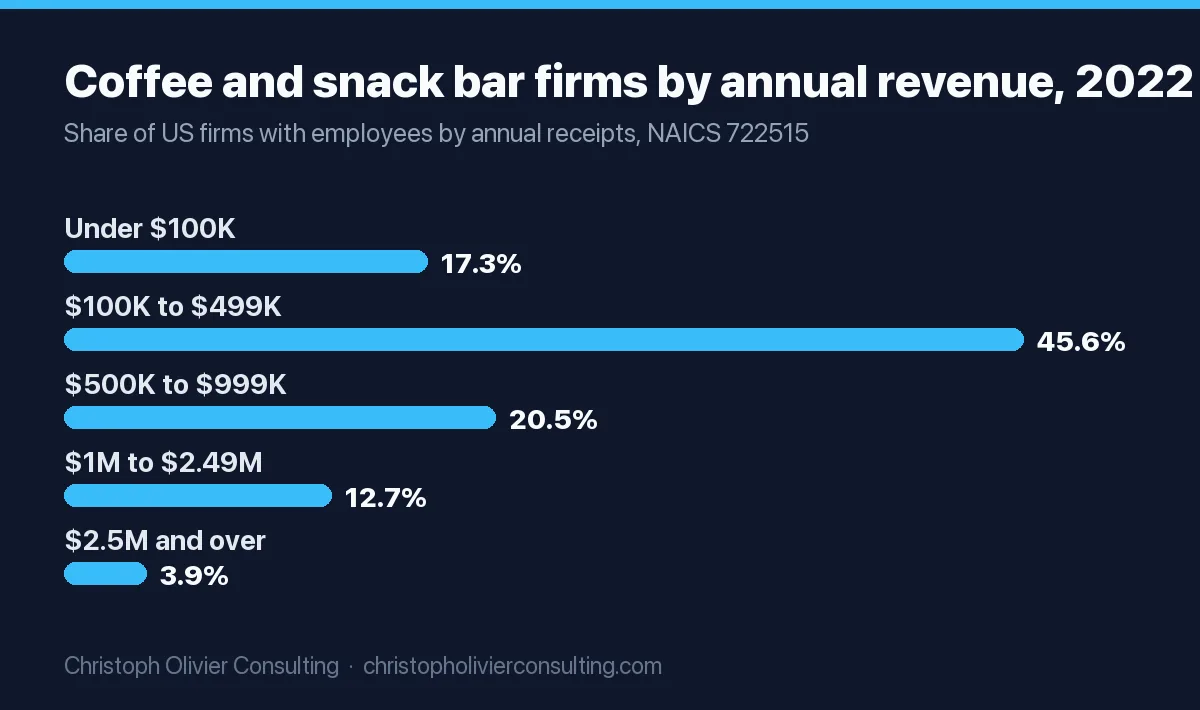
The typical independent is the small one. Census also groups the 59,857 firms in this industry by annual receipts: 17.3% took in under $100,000 and 45.6% took in $100,000 to $499,999, so the median firm sits in the $100,000 to $499,999 band. Only 3.9% of firms (2,326) reached $2.5 million or more. Firms in the $100,000 to $499,999 band averaged $265,557 in receipts, and those in the $500,000 to $999,999 band averaged $682,087 (my calculations).
Shops with no employees at all are a separate group. Census Nonemployer Statistics for 2022 counted 18,452 snack and beverage bar businesses with no payroll, with $829.6 million in combined receipts, or $44,960 each. Their median falls between $10,000 and $24,999 a year, and 63% took in less than $25,000. These are mostly carts, pop-ups and side businesses, not full shops.
Coffee shop revenue by state
Average revenue per location varies by more than 3 to 1 across states. Chain density, prices and wages all feed into these averages, so use them to judge your market, not as a forecast for one shop.
| State | Locations (2022) | Average revenue per location | Payroll as % of revenue |
|---|---|---|---|
| District of Columbia | 242 | $1,211,116 | 29.5% |
| California | 12,600 | $1,027,020 | 27.8% |
| Massachusetts | 2,495 | $1,020,467 | 29.3% |
| Illinois | 2,398 | $928,054 | 27.9% |
| Washington | 2,956 | $884,377 | 29.2% |
| Colorado | 1,631 | $855,689 | 30.7% |
| Florida | 4,262 | $843,478 | 24.7% |
| Oregon | 1,619 | $842,695 | 30.9% |
| New York | 6,741 | $826,947 | 27.1% |
| Georgia | 1,899 | $771,928 | 26.0% |
| Texas | 6,800 | $695,720 | 26.6% |
| Pennsylvania | 2,804 | $693,245 | 26.9% |
| Ohio | 2,187 | $660,092 | 28.9% |
| Mississippi (lowest) | 563 | $365,547 | 26.5% |
Source: Census SUSB 2022 state file, NAICS 722515, all enterprise sizes. Averages and payroll shares are my calculations.
Coffee shop profit margin: what the public chains disclose
Margin claims online range from 2.5% to 25% because writers mix gross, operating and net margin. The only audited coffee shop cost structures in the US come from public company filings and franchise disclosures. Here is how they line up, each as a share of shop revenue.
| Cost line | Dutch Bros 10-K, company-operated shops, 2025 | Starbucks 10-K, North America, fiscal 2026 |
|---|---|---|
| Beverage, food and packaging (Starbucks: product and distribution costs) | 25.9% | 28.7% of segment revenue |
| Labor | 26.9% | 56.4% combined (“coffeehouse operating expenses” as a % of company-operated coffeehouse revenue) |
| Occupancy and other shop costs | 16.6% | |
| Depreciation and amortization | 7.0% | 4.1% |
| Margin reported | 21.9% shop gross profit; 28.9% shop contribution (non-GAAP, before depreciation and pre-opening costs) | 12.0% segment operating margin |
| Revenue per shop | $2,061,000 average unit volume, company-operated shops open 15+ months | Not disclosed per store in the segment table |
Two more reference points:
- Franchised kiosks: Scooter’s Coffee reports in its Item 19 that 621 franchised drive-thru kiosks open all of 2025 averaged $998,869 in gross sales and a 14.6% average net profit margin, as Scooter’s defines it in that disclosure. Its franchise cost page lists a 6% royalty and a 2% advertising fee on net sales. The top quartile averaged $1,433,875 in sales and a 20.7% margin.
- Small unincorporated restaurants and drinking places kept 3.4% of receipts as net profit in tax year 2023 across all returns, and 13.6% among returns with a profit (IRS SOI, my calculation). For a sole proprietor that net profit is also the owner’s pay.
So a realistic reading: a well-run shop keeps roughly 12% to 21% of sales before owner pay and income tax, which is the band between Starbucks’ North America operating margin and the Scooter’s top quartile. Many small shops keep far less, as the IRS loss rate shows. “Gross margin of 70% on a latte” only tells you ingredient cost, not what is left after labor and rent.
Coffee costs went up sharply in 2024 and 2025
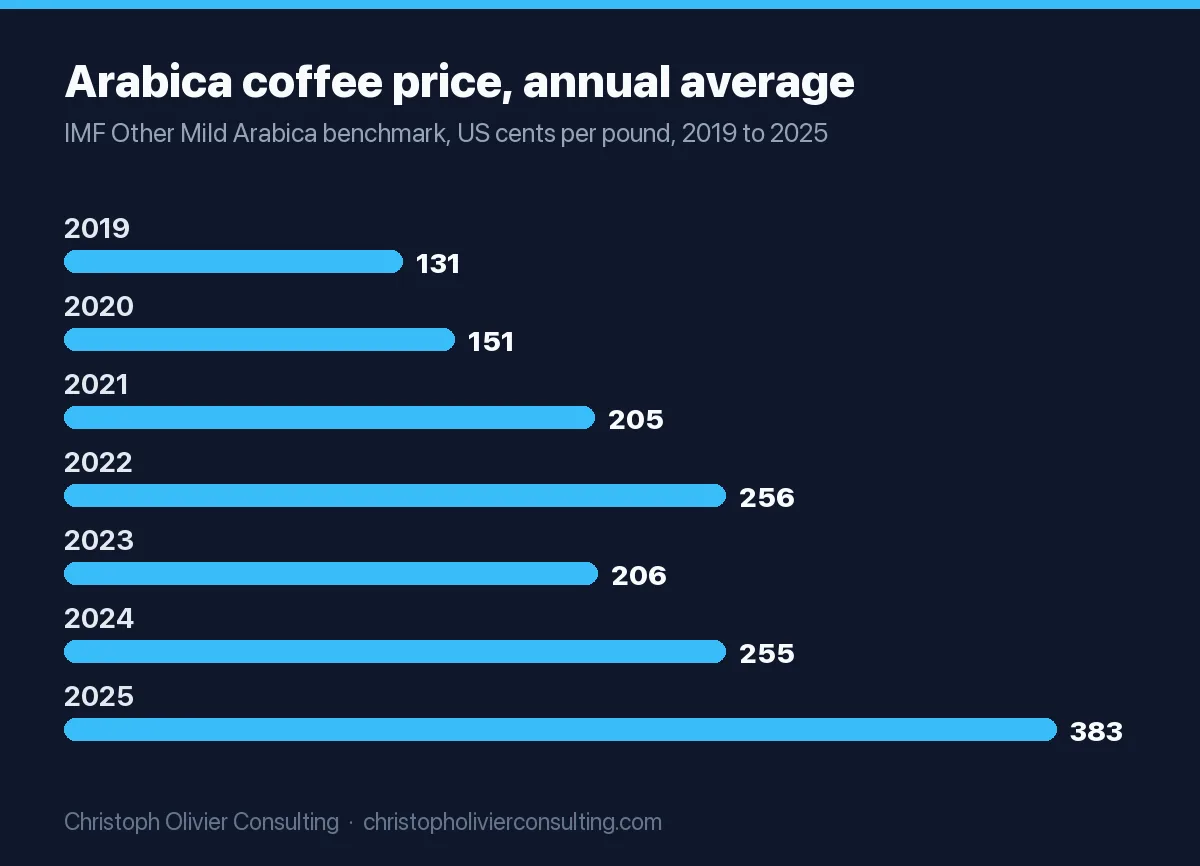
The IMF benchmark price for Other Mild Arabica, published on FRED, averaged 130.6 cents a pound in 2019 and 383.1 cents in 2025, nearly triple. It peaked at 409.7 cents in November 2025 and was 330.1 cents in September 2026. Dutch Bros said in its 2025 10-K that beverage, food and packaging costs rose 40 basis points as a share of shop revenue, driven by a 90 basis point increase in coffee costs.
Retail shelf prices followed. The BLS average price for 100% ground roast coffee, tracked on FRED, rose from $4.174 a pound in October 2019 to $9.249 in October 2026. As a rough reference point (my calculation, using the retail price, not your roaster’s wholesale price), an 18 gram double shot at $9.249 a pound costs about 37 cents in coffee. Milk, cups, lids and syrups usually cost more than the coffee in a flavored latte, so price your menu on the full recipe cost.
Worked P&L: what the owner keeps at $300K, $600K and $1M in sales
This is my own model, not reported data. Each assumption is tied to a source above so you can swap in your own numbers. It shows owner earnings before income tax: what is left for the owner’s salary and profit combined.
| Line (assumption) | Small shop, $300,000 | Busy shop, $600,000 | High-volume, $1,000,000 |
|---|---|---|---|
| Cost of goods: coffee, milk, food, cups (28%, between Dutch Bros 25.9% and Starbucks 28.7%) | $84,000 | $168,000 | $280,000 |
| Staff payroll, owner excluded (22% / 28% / 27%, from Census payroll shares for under-5 and under-20 employee firms and Dutch Bros labor; the $1M shop includes a manager) | $66,000 | $168,000 | $270,000 |
| Payroll taxes and workers’ comp (8% of payroll; 7.65% is the employer FICA rate, the rest is an assumption) | $5,280 | $13,440 | $21,600 |
| Rent (assumed $4,000 / $5,000 / $6,500 a month) | $48,000 | $60,000 | $78,000 |
| Card processing (assumed 2.5% of sales) | $7,500 | $15,000 | $25,000 |
| Utilities, insurance, repairs, supplies, software, marketing, accounting (assumed 8% of sales) | $24,000 | $48,000 | $80,000 |
| Equipment and build-out loan payments (assumed $2,000 / $3,000 / $4,000 a month) | $24,000 | $36,000 | $48,000 |
| Total costs | $258,780 | $508,440 | $802,600 |
| Owner earnings before income tax | $41,220 (13.7%) | $91,560 (15.3%) | $197,400 (19.7%) |
Own calculation, November 2026. Percentages in the first column are assumptions; benchmark sources are linked in the sections above. Excludes income tax and self-employment tax.
What the model shows:
- The $300,000 shop only works if the owner is on bar. Payroll at 22% of sales buys roughly one full-time employee plus part-timers. If the owner works 55 hours a week for 50 weeks (2,750 hours), $41,220 is about $15 an hour, the same as the BLS median for fast food and counter workers ($15.00). Fresh Cup found 34% of owners work more than 50 hours a week.
- The model at $300,000 lands close to the survey. $41,220 sits near Fresh Cup’s $40,000 median and $48,234 average, which suggests most surveyed owners run shops in this revenue range.
- Fixed costs are why volume matters. Rent and loan payments are 24% of sales at $300,000 but 12.6% at $1 million. In this model, each extra $100,000 in sales adds about $17,000 (between $300,000 and $600,000) to $26,000 (between $600,000 and $1 million) to owner earnings.
- One point of cost of goods is real money. A 1 percentage point change in cost of goods moves owner earnings by $3,000 at $300,000 in sales and $10,000 at $1 million.
To turn your sales target into a daily number: divide annual sales by days open. A $600,000 shop open 360 days needs $1,667 a day. At an assumed $7 average ticket, that is about 238 transactions a day. Plug in your own ticket from your point-of-sale reports.
Coffee shop owner pay worksheet: pass/fail benchmarks
Fill in the “Your shop” column from your last 12 months of books, as a share of sales. Any line that fails is where your owner pay is going. The pass thresholds come from the disclosed cost structures above, so they are aggressive for a small independent; treat a narrow fail as a warning, not a crisis.
| Line, % of sales | Your shop | Pass | Fail | Benchmark source |
|---|---|---|---|---|
| Cost of goods (beverage, food, packaging) | ____% | 29% or less | Over 32% | Dutch Bros 25.9% (2025); Starbucks North America 28.7% (FY2026) |
| Staff payroll, owner excluded | ____% | 28% or less | Over 31% | Census 27.9% for firms under 20 employees (2022); Dutch Bros 26.9% |
| Rent and occupancy | ____% | 12% or less | Over 17% | Dutch Bros occupancy and other costs 16.6% (includes more than rent) |
| Revenue per location vs. peers your size | $______ | At or above the Census average for your employee size | Below it | Census SUSB 2022 table above ($209,587 under 5 employees; $433,028 at 5 to 9) |
| Owner earnings (salary plus profit) | ____% | 12% or more | Under 5% | Starbucks North America operating margin 12.0%; Scooter’s kiosks 14.6% (2025 Item 19) |
| Owner earnings per owner hour worked | $____/hr | Above $33/hr | Below $15/hr | $69,390 BLS food service manager median ÷ 2,080 hours; $15.00 BLS counter worker median |
The last line is the one most owners skip. If your earnings per hour are below what you would pay a manager, the shop is buying you a job, not an investment. That can still be a good choice, but make it knowingly.
Coffee shop startup costs: what is actually disclosed
There is no government survey of what it costs to open an independent coffee shop. The most detailed public figures are franchise disclosure documents, which must list the estimated initial investment in Item 7:
| Format | Estimated initial investment | Ongoing fees | Source |
|---|---|---|---|
| Scooter’s Coffee drive-thru kiosk | $1,163,650 to $1,345,750 | 6% royalty, 2% advertising fee | Scooter’s Coffee franchise cost page (includes the $40,000 franchise fee; $20,000 opening support fee listed separately) |
| Scooter’s Coffee endcap | $658,898 to $1,068,525 | Same |
Scooter’s also asks franchisees for $250,000 in liquid capital and $500,000 in net worth. An independent storefront can open for much less because it skips the franchise fee, builds in an existing space and buys used equipment, but no primary source publishes a reliable average for that, and any single number you read online is an estimate. Dutch Bros, for scale, builds 800 to 1,000 square foot drive-thru shops on lots of at least 25,000 square feet, according to its 10-K.
The cost drivers to price for your own plan: lease deposit and build-out (plumbing, electrical, ventilation and permits are where budgets break), espresso machine and grinders, refrigeration, furniture, point of sale, opening inventory, and at least three to six months of operating cash, since revenue takes time to build. Get written quotes for each line before you sign a lease.
Can I open a coffee shop with $20,000 or $50,000?
Not a staffed storefront, based on the disclosed figures above. A budget of $20,000 to $50,000 fits the businesses Census counts as nonemployers: carts, kiosks at events, pop-ups and stalls inside another business. There were 18,452 of them in this industry in 2022, and the median took in $10,000 to $24,999 a year. That is a way to test demand and build a following before you take on a lease, not a full-time income on its own.
Is owning a coffee shop worth it? Do coffee shop owners make good money?
On the numbers, a single small shop is a modest living with long hours. The owners who earn six figures share a few traits in the data:
- Volume above $600,000 a year. In the model above, owner earnings roughly double between $300,000 and $600,000 in sales because rent and loan payments stay flat.
- More than one location or revenue stream. Fresh Cup reported that owners who also roast averaged $61,635, and that owners earning $100,000 or more tended to have more locations and older businesses.
- Drive-thru or high-traffic formats. Dutch Bros company-operated shops average $2,061,000 in annual sales; the typical independent firm takes in under $500,000.
- Time. 43% of Fresh Cup respondents had been in business under five years, and the survey found $0 incomes were concentrated among businesses under two years old.
Before you commit, run the worksheet on your own plan with real rent and staffing quotes, and test whether you can hit the daily transaction count your sales target needs. Repeat customers matter more than one-time promotions in this business; the frequency math is in our guide to coffee shop marketing, and the channel costs are in restaurant marketing strategies ranked by what you keep. To compare coffee margins with other industries, see profit margin by industry, or compare owner pay in another membership-style local business in how much a gym owner makes.
In my view, the most useful number on this page is owner earnings per hour. If the plan only pays you barista wages, fix the plan (location, format, ticket size) before you sign the lease. If you want a second set of eyes on the revenue side of that plan, you can book a consultation.
How the numbers on this page were built
- Census figures cover NAICS 722515, which also includes donut, juice, smoothie, ice cream and bagel shops; there is no coffee-only Census category. 2022 is the latest Economic Census year.
- BLS has no separate barista wage series: the 2018 occupation classification lists barista as an example title under fast food and counter workers (35-3023).
- IRS data cover unincorporated restaurants and drinking places only; coffee shops are not reported separately, and S corporations and partnerships are excluded.
- Company figures come from each company’s latest 10-K or franchise disclosure, as stated in each table. Fresh Cup data are self-reported by a voluntary sample.
Ready to scale your revenue?
Book a free 30-min consultation. We’ll diagnose your growth bottleneck and map out the 3 highest-leverage moves for your business.
Frequently asked questions
How much does a coffee shop owner make a year?
About $40,000 to $50,000 for a typical single shop. Fresh Cup's 2023 survey of 155 US coffee business owners found shop owners averaged $48,234 in 2022 salary plus profit distributions, with a $40,000 median for single-type businesses. Owners of high-volume shops earn more: Scooter's franchised kiosks averaged $134,457 in EBITDA in 2025 on about $1 million in sales.
What is the average coffee shop profit margin?
Public filings put a well-run shop at roughly 12% to 21% of sales before owner pay and income tax. Starbucks reported a 12.0% North America operating margin in fiscal 2026, and Scooter's franchised kiosks averaged a 14.6% net profit margin in 2025 (20.7% in the top quartile). Unincorporated restaurants and drinking places kept just 3.4% of receipts overall in tax year 2023 (IRS data).
How much revenue does a coffee shop make?
Census data for 2022 show US snack and nonalcoholic beverage bars, the category that includes coffee shops, averaged $811,182 per location. That average includes chains. Locations owned by companies with under 5 employees averaged $209,587, and the median firm took in between $100,000 and $499,999. Dutch Bros company-operated shops averaged $2,061,000 in 2025.
How much does it cost to start a coffee shop?
There is no government survey of independent coffee shop startup costs. The clearest public figures are franchise disclosures: Scooter's Coffee lists an estimated initial investment of $1,163,650 to $1,345,750 for a drive-thru kiosk and $658,898 to $1,068,525 for an endcap, including a $40,000 franchise fee. Independents can spend less, but get written quotes for build-out, equipment and opening cash.
Can I open a coffee shop with $20,000 or $50,000?
Not a staffed storefront, judging by disclosed build-out costs. That budget fits a cart, event kiosk or pop-up. Census counted 18,452 coffee and snack bar businesses with no employees in 2022, and their median receipts were $10,000 to $24,999 a year, so treat it as a way to test demand rather than a full-time income.
Is owning a coffee shop worth it?
It depends on volume and your hours. In a worked model, a $300,000 shop leaves the owner about $41,220 before income tax, roughly $15 an hour at 55 hours a week, close to the BLS median for counter workers. At $600,000 the owner keeps about $91,560 and at $1 million about $197,400. Compare your plan with the $69,390 median pay of a food service manager.
Practice economics benchmarks