
The restaurant marketing strategies that pay back fastest for an independent restaurant in 2026 are the ones that move guests toward channels where you keep most of the check: your Google listing, your own ordering link, and a guest list you can reach without paying a platform on every order. Delivery apps, discounts and social posts still matter, but they work best as feeders for those three.
The reason is margin, not fashion. The National Restaurant Association’s 2026 State of the Restaurant Industry report projects $1.55 trillion in sales this year, up 4.8%, but says most of that growth comes from menu prices rather than more guests, with real (inflation-adjusted) growth of about 1.3%. The same report found that 42% of operators were not profitable in 2025. When traffic is flat, the useful question shifts from “how do we get more people?” to “how much of each order do we keep, and how do we get the same guest back?” This guide is built around that question. If you want the wider data set behind it, our roundup of restaurant marketing statistics pulls it together.
Want a specialist to build this for your business? See how CO Consulting’s marketing services work, starting with a diagnostic and audit.
Restaurant marketing strategies ranked by what a $40 order leaves you
Start with the math most marketing lists skip. The table below shows what the platform or card processor takes from a $40 food subtotal on each channel, using published US standard rates. These figures come before food cost, labor, packaging, promotions and any ads you buy inside the apps, so treat them as the ceiling on what each channel can return.
| Channel | Published rate | Taken from a $40 order | Left before food and labor |
|---|---|---|---|
| Your own online ordering, guest picks up (card paid online) | Up to 3.3% + 30¢ | $1.62 | $38.38 |
| DoorDash pickup, any plan | 6% | $2.40 | $37.60 |
| Uber Eats pickup, in-store prices validated | 7% | $2.80 | $37.20 |
| DoorDash Basic, delivery | 15% | $6.00 | $34.00 |
| Uber Eats Lite, delivery | 20% | $8.00 | $32.00 |
| DoorDash Plus, delivery | 25% | $10.00 | $30.00 |
| Uber Eats Plus, delivery | 25% (30% on Uber One member orders) | $10.00 to $12.00 | $28.00 to $30.00 |
| DoorDash Premier or Uber Eats Premium, delivery | 30% | $12.00 | $28.00 |
Where the rates come from: DoorDash’s 15%, 25% and 30% delivery tiers and 6% pickup rate are as listed on its US merchant pricing page and compiled by Duck Hub (rates verified July 2026). Uber Eats figures come from Restaurant Dive’s March 10, 2026 report that Uber raised its Lite tier from 15% to 20% and validated pickup from 6% to 7%, with pickup at 10% when in-store pricing is not validated. The direct-ordering row uses Square’s published fees, where online card payments run 2.9% + 30¢ to 3.3% + 30¢ depending on plan; your processor may differ.
Three things stand out:
- A $40 order is worth $4.38 to $10.38 more to you as direct pickup than as app delivery. Your food and labor cost are identical either way, so that gap is pure margin.
- App pickup is cheap; app delivery is expensive. When a regular uses the app to order pickup, you are paying a small fee for convenience. When they order delivery on a top tier, you are paying close to a third of the ticket.
- Direct delivery is not free. If you deliver your own orders, you pay a driver or a delivery service, so the cleanest win is usually direct pickup. Price your own delivery honestly before you push it.
One caveat keeps this from becoming “quit the apps.” Some app customers would never have found you otherwise. In the NRA report, 69% of operators who offer delivery say it creates more opportunities than challenges, and the ones who like it point to reaching new customers, filling slow periods and offsetting fixed costs. My view: treat the apps as a paid acquisition channel. Paying 25% to meet a new guest can be fine. Paying 25% on the same regular’s twelfth order is the leak to fix.
Your diners already want to order direct, so make it the easy path
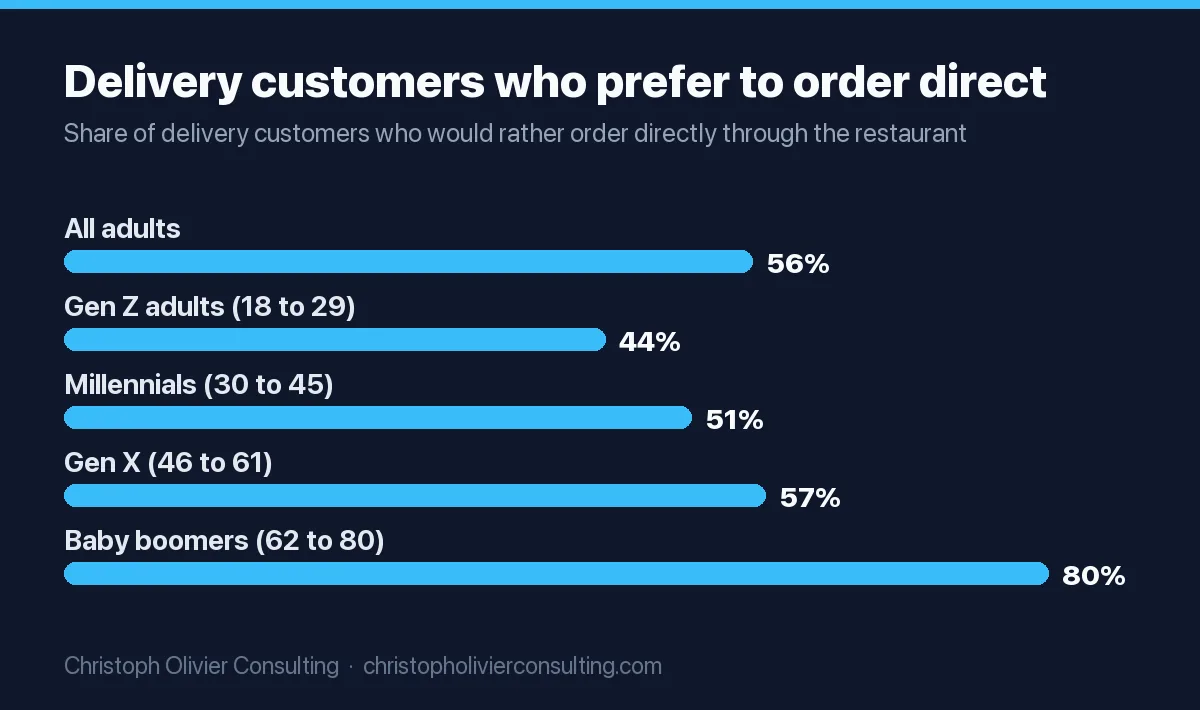
This is the finding that surprises most owners. In the NRA’s 2026 consumer survey, 75% of delivery customers had ordered through a third-party service in the past six months, yet 56% said they would rather order directly through the restaurant. That preference climbs with age, from 44% of Gen Z adults to 80% of baby boomers. Asked who they want carrying the bag, 44% picked a restaurant employee and 26% a third-party driver; the rest had no preference.
So the job is less about persuasion and more about removing friction. Guests use the app because the app is where the button is. Put your own button where they look first, then give app customers one good reason to try it.
Digital marketing for restaurants starts on your Google Business Profile
For many guests, your Google Business Profile is the first version of your restaurant they see, before your website or your Instagram. Google’s own help documentation spells out the controls that matter for ordering:
- You can add one menu link and up to 10 links per action type, including food ordering and reservations.
- When there is more than one ordering link, you can mark one as Business preferred, which puts it at the top. Some third-party links appear automatically from partners, so this setting is how your own link wins the top spot.
- Turning off “Accept orders on your profile” hides every ordering link, yours included. Do not switch it off to hide the apps; set your own link as preferred instead.
- These links cannot be managed through the Business Profile API or a spreadsheet upload. Someone has to add them by hand through Edit profile, which is why they are often left wrong.
While you are in there, add menu items with prices, upload recent photos of the dishes that actually sell, set holiday hours before each holiday, and reply to reviews. None of it costs money, and it is the profile guests see when they search “tacos near me” at 6:40 p.m.
Turn every app order into an invitation to order direct
The bag is the one marketing channel the apps deliver for you. A simple printed card in each app order, written for the guest who already likes your food, might read:
Thanks for ordering from Rosa’s Kitchen. Next time, order pickup straight from us at rosaskitchen.com/order and take $5 off your first direct order with code DIRECT5. Same kitchen, same food, and more of what you spend stays with the people who cooked it.
Swap in your own name, link and offer. Read your platform agreement before you start, since marketplace terms differ and change.
Here is the worked example, using the table above with hypothetical guest behavior. A regular who orders a $40 delivery on a 25% plan costs you $10.00 in commission each time. If that guest switches to direct pickup at $1.62 in card fees, you keep $8.38 more per order. Give $5 off the first direct order and that first one still nets $3.38 more than the app would have. At two orders a month, one converted regular is worth roughly $200 a year in kept margin (24 orders at $8.38). Not every guest will switch, and a guest who wants delivery may not want pickup. The point is that a modest first-order offer can pay for itself quickly when it moves a repeat customer.
Pick your app plan on purpose, then recheck it
Higher app tiers generally buy more exposure inside the app; lower tiers cost less per order. If most of your app orders come from people who already know you, the cheaper tier is a sensible test. If the app is genuinely bringing new guests, a higher tier may earn its fee. Either way, revisit the decision every quarter. Uber Eats moved its Lite tier from 15% to 20% in March 2026, so an owner who chose Lite on price two years ago is now paying a third more per delivery order without changing anything.
Restaurant email marketing and SMS: build the list the apps don’t give you
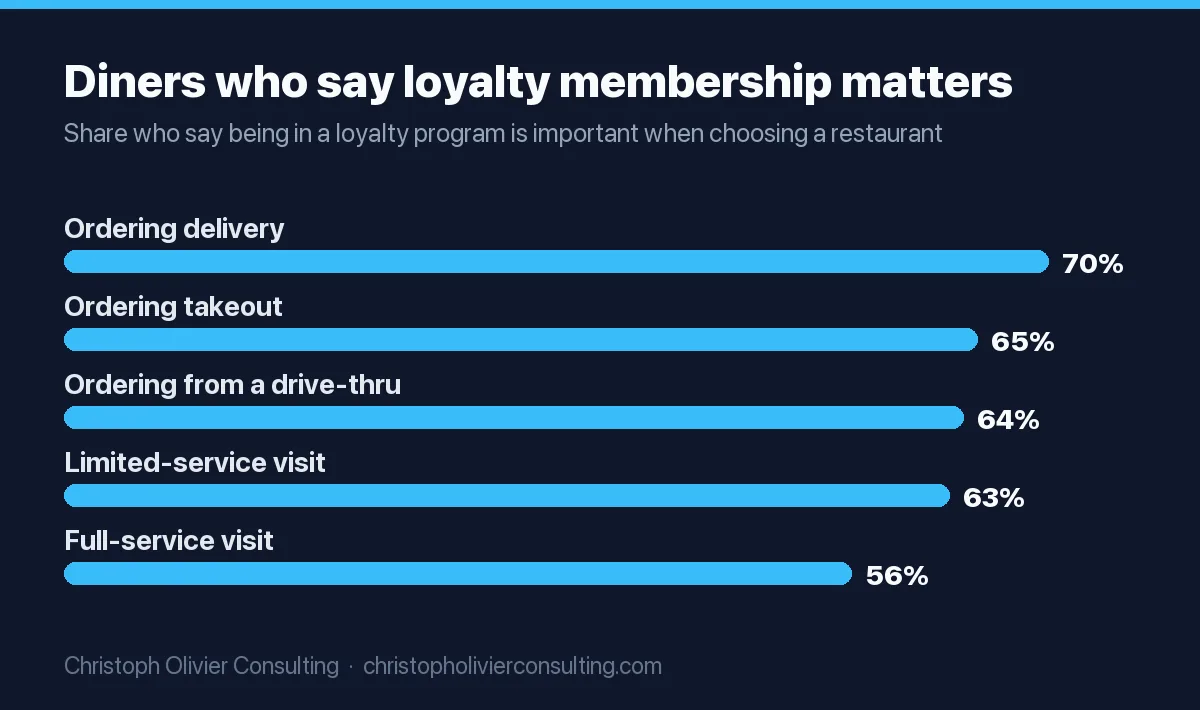
On a marketplace order, the platform owns the relationship by default. Your own guest list is how you take it back. The NRA’s 2026 survey found that a majority of diners say loyalty program membership matters when choosing where to eat, from 70% for delivery orders down to 56% for full-service visits. Its 2025 Off-Premises Restaurant Trends report found that over 60% of takeout and delivery users say loyalty membership affects where they order, and nearly 9 in 10 respondents said they would use limited-time, app-only offers.
Give loyalty one specific job
A loyalty program that rewards everything equally teaches guests nothing. Point it at the behavior you want more of. Toast’s loyalty best-practice guide describes two levers worth copying on almost any platform: a dining-option bonus that awards extra points for ordering directly rather than through third-party platforms, and a day-and-time bonus, such as double points on Tuesday nights, to fill slow shifts. It also recommends QR codes on table tents, menus and the host stand, and a staff contest for sign-ups, because enrollment rarely happens unless the team asks.
Be deliberate with discounts, too. In the NRA’s 2026 survey, 81% of delivery customers and 70% of full-service diners said a discount or value promotion matters when they choose a restaurant. Diners respond to value, so spend it where it changes behavior: the first direct order, the slow night, the lapsed guest. A blanket 20% off on a Friday mostly discounts guests who were coming anyway.
The three emails worth writing first
You do not need a weekly newsletter to start restaurant email marketing. You need three automated messages that run on their own:
- Welcome, sent the day someone joins. Subject: “You’re in. Here’s your first-order perk.” Include the direct ordering link and the reward they just earned.
- The “your usual” nudge, about three weeks after a first visit. Subject: “The green chile burrito misses you.” Name the dish they ordered if your system records it.
- The win-back, around 60 days without a visit. Subject: “It’s been a while. Dessert’s on us this week.” Make it time-limited and easy to redeem.
Once those run, add event and seasonal sends. Our list of email marketing ideas by goal has more campaign formats to borrow.
SMS works, and it is regulated
Text messages reach a phone in a pocket, which is why they suit last-minute tables and same-day specials. They also carry real legal exposure. Under the FCC’s TCPA rule at 47 CFR 64.1200, advertising calls to mobile numbers made with an autodialer or prerecorded voice require the recipient’s prior express written consent, and the FCC applies its consent rules to marketing texts as well. That consent must be a written agreement bearing the person’s signature (electronic signatures count) that clearly authorizes you to send, and it must make clear that agreeing is not a condition of buying anything. The same rule bars telephone solicitations to residential subscribers before 8 a.m. or after 9 p.m. local time. Because restaurant texting tools send in bulk, the safe baseline is written consent for every marketing text. This is not legal advice; have counsel review your opt-in flow.
A sign-up line next to the checkbox or keyword might read:
Get up to 4 texts a month with specials and open tables from Rosa’s Kitchen. By checking this box you agree to receive recurring automated marketing texts from Rosa’s Kitchen at the number provided. Consent is not a condition of purchase. Message and data rates may apply. Reply STOP to cancel or HELP for help.
Choosing a tool is its own decision; our comparison of SMS marketing platforms with 2026 prices covers the options.
Social media marketing for restaurants: show the plate, then answer the room
Social is how a lot of people find you in the first place. In the NRA’s 2026 survey, 78% of adults said social media is a good way to learn about restaurants in their area, including 75% of baby boomers. 73% said it helps them learn about foods they haven’t tried, and 66% said the same about drinks.
That points to a content plan built around the food in motion, not the logo:
- Short vertical video for Instagram Reels and TikTok. The sauce going on, the cheese pull, the pour, the special coming off the line. Fifteen seconds shot on a phone at the pass beats a polished flat-lay of the menu.
- The people. The cook who has been on the grill for nine years, the server who knows everyone’s order. Guests come back for people as much as plates.
- A reason to come this week. A limited special, a collaboration, a slow-night event. Every post should answer “why now?”
- Local creators, chosen for audience over follower count. A food account whose followers live within a short drive is worth more than a big one followed from three states away. Ask anyone you comp or pay to label the post clearly.
Reviews are the other half of social. A claimed Yelp business page is free and lets you respond to reviews, upload unlimited captioned photos and keep your hours, phone number and website current. Yelp notes that claiming a page does not make you a paid advertiser. Reply to Google and Yelp reviews every week, thank people specifically, and answer complaints with a fix rather than an argument. Future guests read the replies as much as the reviews.
Full-service or counter-service? Your plan splits here
The same playbook does not fit a 90-seat dinner house and a fast-casual counter. The NRA’s 2026 report shows how differently the two formats are running:
- 93% of full-service operators said on-premises was the more successful side of their business in 2025, compared with 73% of limited-service operators.
- For 2026, 85% of full-service and 65% of limited-service operators say building on-premises business matters more for their success.
- 40% of full-service restaurants offer delivery, against 62% of limited-service. Among those that do, 37% of full-service operators say delivery brings more challenges than opportunities, compared with 26% of limited-service operators.
Here is how I would weight the strategies in this guide for each format, based on those numbers:
| Decision | Full-service | Counter-service and fast casual |
|---|---|---|
| Main growth lever | Filling seats on slow nights, reservations, private events | Order frequency and direct online ordering |
| Role of delivery apps | Optional; test pickup first and watch the commission line | Discovery channel; convert repeat app guests to direct pickup |
| Loyalty design | Visit-based rewards, birthdays, slow-night bonus points | Points per order plus a bonus for ordering direct |
| Best list channel | Email for events and reservations; SMS for same-day open tables | SMS for limited drops and specials; email for the weekly menu |
| Content focus | The room, the chef, the occasion | The dish, the speed, the value |
| Google profile priority | Reservation link set as preferred, current photos of the dining room | Own ordering link set as preferred, menu items with prices |
Counter-service concepts live on frequency, which is the same economics coffee shops run on; our guide to coffee shop marketing works through why a visit-frequency reward usually beats a one-time discount. Full-service rooms tend to win with local events: a chef’s table night, a brewery or winery pairing, trivia on the slowest weeknight, a sponsored youth sports team that eats with you after games. For more formats, borrow from these small business marketing campaign ideas and adapt them to your shifts.
Where to put your next five hours a week
If you are an owner-operator who also works the line, you will not do all of this at once. This is the order I would work in, because each step makes the next one pay more:
- Fix the Google Business Profile. Add your own ordering link, mark it Business preferred, add menu items and recent dish photos, check hours.
- Make direct pickup the easiest way to order. One short URL, a QR code at the register and on the menu, and the same link in your Instagram bio.
- Start capturing guests on every channel. Loyalty sign-up at the register and on receipts, a QR code on table tents, and an SMS opt-in that meets the written-consent rule.
- Put an insert in every app bag. One offer, one link, one code you can track.
- Turn on the three automated emails. Welcome, “your usual,” and win-back.
- Post two short videos a week. Shoot them during prep, not service.
- Reply to every review once a week. Set a recurring 20-minute block.
- Recheck your app plans each quarter. Compare commission paid against new guests the app actually brought.
The four numbers to check every Monday
Marketing for a restaurant is easy to measure badly and hard to measure well. Skip follower counts and track these four from your POS and app statements:
- Direct share of off-premises orders. Direct pickup and delivery orders divided by all off-premises orders. This is the single best read on whether your Google, insert and loyalty work is paying off.
- Effective app commission rate. Total app fees, promotions and in-app ad spend divided by app sales. If it creeps up while order counts stay flat, you are paying more for the same guests.
- Repeat rate. The share of guests on your list who order or visit again within 30 or 60 days. In the NRA’s 2026 report, 39% of full-service and 51% of limited-service operators called bringing back repeat customers a significant challenge in 2025, and 72% and 78% said the same about attracting new ones.
- List growth. New loyalty, email and SMS sign-ups per week. If it stalls, the problem is usually that staff stopped asking.
Write the four numbers on the same sheet each week and watch the trend, not any single day. If you want a second set of eyes on your channel mix before you change app plans or launch a loyalty program, you can book a consultation and bring last quarter’s statements.
Work with CO Consulting
Want this done for your business?
- A diagnostic call and an audit of your current marketing and numbers
- A prioritized 90-day plan built for your market
- Execution across SEO and AI search, paid ads, content, funnels and automation
- Weekly check-ins and monthly reporting, led by a fractional CMO
Frequently asked questions
What is the best marketing strategy for a small restaurant?
For most independents, the best first move is free: fix your Google Business Profile, add your own ordering link and mark it Business preferred, then capture every guest into a loyalty, email or SMS list. Those steps move orders toward channels where you keep most of the check, and they make every later tactic, from social video to local events, pay back more.
How much do DoorDash and Uber Eats charge restaurants in 2026?
DoorDash lists US delivery commissions of 15% on Basic, 25% on Plus and 30% on Premier, with 6% on pickup. Uber Eats raised its Lite tier from 15% to 20% in March 2026; Plus is 25%, or 30% on Uber One member orders, and Premium is 30%. Validated pickup went from 6% to 7%. Large chains often negotiate custom terms.
Should my restaurant stop using delivery apps?
Usually not. Apps can bring guests who would never have found you, and 69% of operators offering delivery told the National Restaurant Association it creates more opportunities than challenges. The better move is to treat apps as paid acquisition: keep them for discovery, then use bag inserts, loyalty bonuses and a clear direct ordering link to move repeat guests to direct pickup.
How do I get customers to order directly instead of through apps?
Make the direct path the easiest one. Set your own ordering link as Business preferred on Google, put a short URL and QR code at the register and in your Instagram bio, add a card with a first-order code to every app bag, and award bonus loyalty points for ordering direct. The NRA found 56% of delivery customers already prefer ordering directly.
Do I need permission to text my restaurant's customers?
Yes. Under the FCC's TCPA rule, marketing calls to mobile numbers sent with automated tools require prior express written consent, and the FCC applies its consent rules to texts. Consent must be a signed agreement, electronic signatures count, and it cannot be a condition of purchase. Include clear opt-out instructions and have counsel review your sign-up flow.
Which social media platform is best for restaurant marketing?
The best platform is the one your local guests scroll, and for most restaurants that means short vertical video on Instagram Reels and TikTok. The NRA found 78% of adults say social media is a good way to learn about restaurants nearby. Film the food in motion and the people behind it, and give every post a reason to visit this week.
How do I measure whether my restaurant marketing is working?
Track four numbers weekly from your POS and app statements: direct share of off-premises orders, effective app commission rate including promotions and in-app ads, repeat rate within 30 or 60 days, and new list sign-ups. Watch the trend over several weeks rather than single days, and ignore follower counts unless they move one of those four.
More Growth Consulting guides
- Coffee Shop Marketing: The Frequency Economics That Beat One-Time Discounts
- Inbound vs Outbound Marketing: When Each Wins
- Marketing Operations: Skip at Your Peril
- Daycare Marketing: A Funnel That Fills Your Enrollment
- Fintech Marketing: A Compliance-Safe Playbook for Regulated Growth
- 12 Marketing Strategy Frameworks Compared
- All Growth Consulting guides →